
Discrete Sensors Market Insights
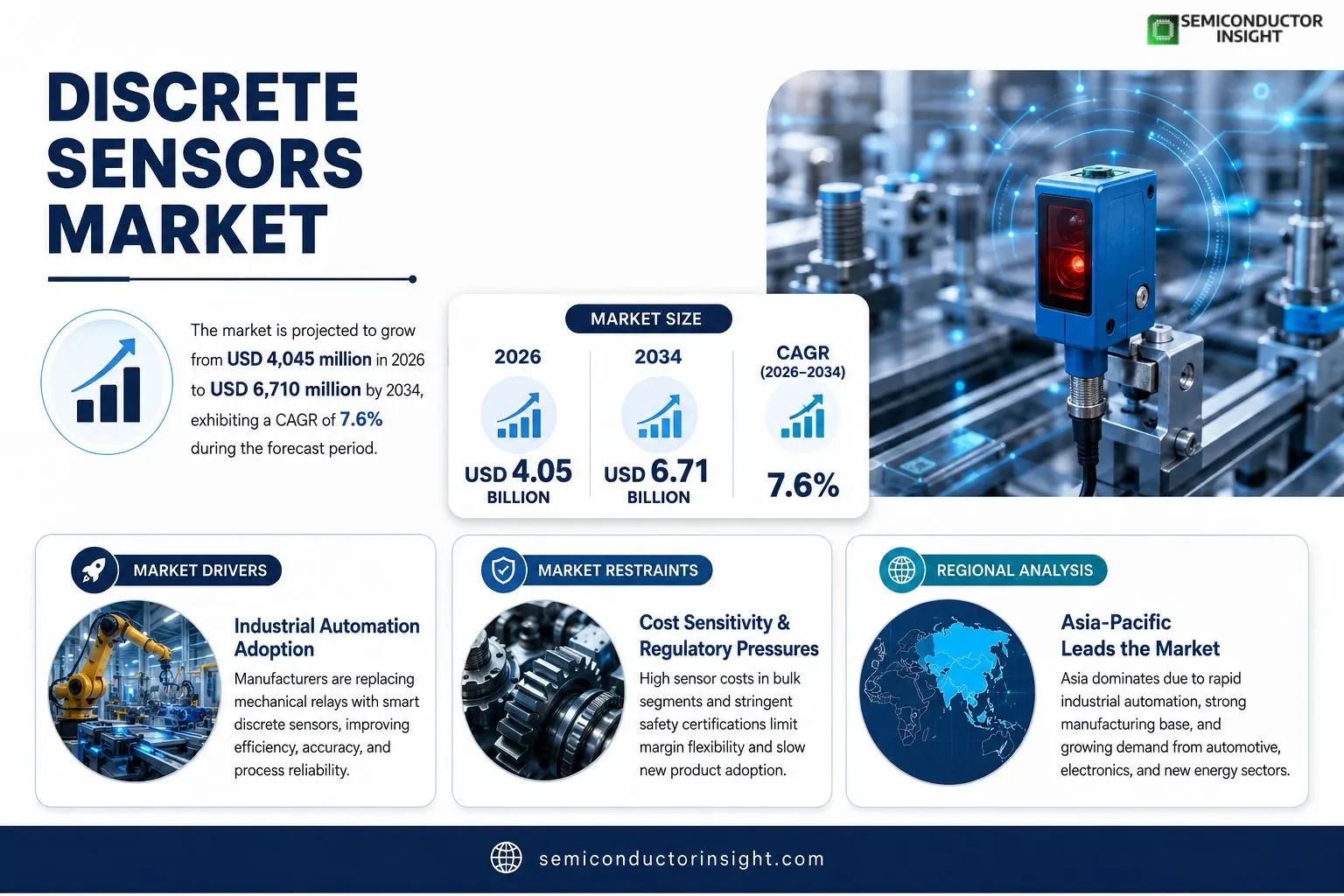
Discrete Sensors Market was valued at USD 4,045 million in 2025 and is projected to reach USD 6,710 million by 2034, exhibiting a CAGR of 7.6% during the forecast period.
Discrete sensors are standardized devices in industrial automation that serve as the front‑end sensing and switching layer. Their core role is to convert discrete states such as object presence, arrival, passage, position, distance, color, transparent‑object recognition, level, and single‑sheet or double‑sheet conditions into stable electrical signals that can be read by PLCs, controllers, or upper‑level systems.The market is experiencing growth because manufacturers are expanding sensor portfolios beyond basic photoelectric or inductive switches into ultrasonic, fiber‑optic, color detection and background‑suppression technologies. End‑users in automotive, electronics, food & beverage, pharmaceuticals and logistics demand higher accuracy, interference resistance and miniaturization, prompting vendors to integrate IO‑Link and teach‑in capabilities. Recent product launches from leading players such as Turck and SICK illustrate the shift toward highly reliable detection nodes for smart factories.
MARKET DRIVERS
Industrial Automation Adoption
Discrete Sensors Market is gaining traction as manufacturers replace mechanical relays with solid‑state sensing solutions. The shift reduces downtime and improves process repeatability, prompting plant managers to prioritize sensor upgrades. Recent plant surveys indicate that over 60 % of new automation projects now specify discrete sensors as a baseline component.
IoT Integration and Data Granularity
Enterprise‑wide IoT rollouts demand high‑resolution point‑of‑presence data, a niche where discrete sensors excel. Their compact footprint and digital output simplify network integration, allowing real‑time condition monitoring across distributed assets. Consequently, system integrators are bundling discrete sensor modules with edge‑computing platforms to meet client expectations for actionable insights.
➤ “Clients increasingly view discrete sensors as the connective tissue between legacy equipment and modern analytics platforms.”
These dynamics encourage OEMs to diversify product portfolios, embedding smarter diagnostics into next‑generation hardware. For vendors, the ripple effect translates into expanded service contracts and higher margin accessories tied to sensor performance.
MARKET CHALLENGES
Cost Sensitivity in High‑Volume Segments
Although performance advantages are clear, the price premium of discrete sensors over traditional switches remains a hurdle for low‑margin industries. Buyers often negotiate bulk discounts, compressing manufacturer margins and prompting a reassessment of bill‑of‑materials strategies.
Other Challenges
Supply Chain Bottlenecks
\Component shortagesparticularly for semiconductor substrateshave strained production schedules. Manufacture rs are forced to allocate capacity, which elongates lead times and can erode confidence among end‑users seeking quick deployment.
MARKET RESTRAINTS
Regulatory Compliance Pressures
Stringent safety certifications in automotive and aerospace sectors impose additional testing cycles for discrete sensor assemblies. Certification costs, coupled with periodic audit requirements, raise the entry barrier for new players and limit the speed at which novel designs can reach market.
MARKET OPPORTUNITIES
Emerging Applications in Healthcare
Medical device manufacturers are exploring discrete sensors for patient‑monitoring wearables and implantable diagnostics. The ability to deliver precise binary signals with low power consumption aligns with the industry’s push toward minimally invasive solutions. Early adopters report a 15 % reduction in device size when swapping conventional switches for discrete sensor modules, opening avenues for new product categories.
Discrete Sensors Market Trends
Integration of Smart Communication Protocols
Discrete Sensors Market is increasingly shaped by the adoption of industrial communication standards such as IO‑Link, EtherCAT, and PROFINET. Manufacturers embed these interfaces directly into sensor units, turning a simple switch into a configurable node that can report diagnostics, self‑check status, and real‑time set‑point changes. This shift matters because production lines now demand instantaneous feedback to reduce downtime and to synchronize multiple stations without resorting to separate PLC logic. As factories transition to model‑based design, the ability of a sensor to speak the same language as higher‑level controllers shortens integration cycles and lowers engineering overhead. Companies that embed such protocols gain a foothold in high‑value projects where flexibility outweighs pure component cost.
Other Trends
Diversification of Sensing Technologies
Beyond traditional photoelectric and inductive switches, Discrete Sensors Market is witnessing a broadened portfolio that includes ultrasonic, fiber‑optic, and selective laser solutions. This diversification responds to niche requirements: ultrasonic units excel in detecting transparent packaging, fiber‑optic devices maintain performance in electrically noisy environments, and laser‑based sensors provide sub‑millimeter accuracy for semiconductor equipment. The breadth of options enables system integrators to match sensor physics with specific material and speed constraints, reducing false triggers and maintenance cycles. Consequently, OEMs are able to offer modular kits that swap technology types without redesigning mechanical mounts, a capability that supports rapid product‑line variations in automotive and consumer electronics manufacturing.
Regional Competitive Shifts
Geographically, the competitive landscape of Discrete Sensors Market reflects distinct strengths. European firms continue to prioritize reliability and compliance for harsh‑environment applications, while Japanese players focus on miniaturization and tight tolerance performance. Korean manufacturers maintain a reputation for cost‑effective solutions that appeal to midsize factories in Southeast Asia. Meanwhile, Chinese and Taiwanese suppliers have accelerated localized engineering services, allowing them to respond to custom specifications within weeks. This regional balance suggests that buyers will increasingly adopt a hybrid sourcing strategyselecting high‑precision devices from Japan for critical nodes, while leveraging Asian volume producers for bulk deployments. Such a multi‑source approach furthers resilience against supply-chain disruptions and aligns with the broader trend of distributed manufacturing across the globe.
COMPETITIVE LANDSCAPE
Key Industry Players
Competitive Dynamics and Regional Strengths in Discrete Sensors Market
The discrete‑sensor arena is anchored by a small cohort of multinationals that have transformed traditional proximity switches into full‑fledged detection platforms. Turck, SICK and Keyence dominate the high‑value segment, leveraging extensive R&D pipelines that span photoelectric, ultrasonic and fiber‑optic families while embedding IO‑Link or Ethernet/IP for seamless plant integration. Their product portfolios display a clear hierarchy: entry‑level inductive units for cost‑sensitive OEMs, mid‑tier color‑recognition sensors for packaging lines, and premium laser‑based distance modules for semiconductor equipment. Geographic concentration mirrors this tiering; European firms excel in rugged, safety‑critical installations, whereas Japanese and Korean counterparts command the miniaturized, high‑speed niche required by automotive electronics. The resulting market structure resembles a tiered ecosystem where scale, technology breadth, and regional service networks create defensible moats around the leaders.Beyond the tier‑one giants, a vibrant cohort of specialist manufacturers injects resilience and differentiation into the market. Banner, Omron, Pepperl+Fuchs, Baumer and ifm electronic supply highly engineered solutions for confined‑space, wet‑environment or reflective‑surface applications, often bundling custom reflectors or adaptive background‑suppression algorithms. Rockwell Automation and Emerson have entered the space through system‑level integration, pairing discrete sensors with advanced analytics platforms to deliver predictive maintenance insights. Asian innovators such as Panasonic Industry, Delta Electronics, Inc., and Shanghai Lanbao Sensing Technology focus on rapid customization and aggressive price‑performance ratios, capturing the fast‑growing Southeast Asian automation wave. These niche players sustain competitive pressure by targeting verticalspharmaceutical hygiene, food‑grade wet cleaning, and new‑energy equipmentwhere reliability nuances outweigh pure cost considerations.
List of Key Discrete Sensors Companies Profiled
- Turck
- SICK
- Keyence
- Banner
- Omron
- Pepperl+Fuchs
- Baumer
- ifm electronic
- Rockwell Automation
- Emerson
- Panasonic Industry
- Delta Electronics, Inc.
- Shanghai Lanbao Sensing Technology Co., Ltd.
Segment Analysis:
| Segment Category | Sub-Segments | Key Insights |
| By Type |
|
Leading Segment
|
| By Application |
|
Leading Segment
|
| By End User |
|
Leading Segment
|
| By Technology |
|
Leading Segment
|
| By Operating Environment |
|
Leading Segment
|
Regional Analysis: Discrete Sensors Market
North America
Manufacturers are licensing sensor designs to OEMs, securing volume commitments and aligning product roadmaps with downstream requirements.
Tightening safety standards in the chemical and aerospace sectors are forcing end‑users to upgrade to higher‑integrity discrete sensors.
Larger component distributors are acquiring niche sensor firms, streamlining procurement for integrators and reducing lead times.
Real‑time sensor data is feeding digital twin models, allowing operators to simulate equipment behavior before physical changes are made.
Europe
European industrial players are leveraging Discrete Sensors Market to comply with the EU’s green‑transition agenda. Manufacturers are embedding sensors that monitor emissions and energy consumption, enabling tighter process control without compromising productivity. The region’s strong standards framework encourages early adoption of safety‑critical sensors, particularly in the automotive and heavy‑machinery sectors, where failure modes are heavily scrutinized. Collaborative research programs funded by Horizon Europe are generating cross‑border knowledge on low‑power sensor architectures, positioning Europe as a hub for sustainable sensor design. Companies that can certify compliance with both CE marking and emerging sustainability labels are likely to capture premium contracts in regulated markets.
Asia‑Pacific
Asia‑Pacific’s growth in Discrete Sensors Market is driven by rapid modernization of manufacturing plants across China, India, and Southeast Asia. The push toward smart factories has created demand for rugged sensors capable of handling high humidity and temperature fluctuations typical of the region’s climate. Local OEMs are increasingly sourcing sensors from domestic suppliers to avoid tariff exposure, fostering a competitive ecosystem that pushes cost efficiency while maintaining performance. At the same time, governments are launching incentives for Industry 4.0 adoption, prompting mid‑size enterprises to retrofit legacy lines with discrete sensing modules, a shift that expands the addressable market beyond large corporates.
South America
In South America, Discrete Sensors Market is influenced by expanding mining and agribusiness operations that require precise monitoring of equipment health. Companies are turning to sensors that can survive dust‑laden environments and provide predictive alerts to reduce unplanned downtime. Regional trade agreements are encouraging cross‑border component sharing, allowing firms in Brazil and Argentina to source sensors from neighboring economies with comparable specifications. The growing emphasis on export‑quality standards is compelling local manufacturers to adopt internationally recognized sensor solutions, thereby raising the overall technology baseline across the continent.
Middle East & Africa
Middle East & Africa’s industrial landscape is characterized by large‑scale petrochemical projects and emerging renewable‑energy installations. The harsh desert climate drives demand for sensors that retain accuracy under extreme heat and sand ingress. Energy companies are integrating discrete sensors into pipeline monitoring networks to detect leaks early, a practice that aligns with increasing environmental oversight. Meanwhile, African economies are investing in modular processing facilities where sensor flexibility is critical for quick reconfiguration. Partnerships between multinational sensor firms and regional distributors are facilitating technology transfer, helping local players upgrade their maintenance capabilities.
Report Scope
This market research report provides a comprehensive analysis of the Discrete Sensors Market , covering the forecast period 2026–2034. It offers detailed insights into market dynamics, technological advancements, competitive landscape, and key trends shaping the industry.
Key focus areas of the report include:
- Market Overview: The report begins with an overview outlining its current market scenario, key growth indicators, and industry transformation drivers. It discusses macroeconomic factors, demand–supply balance, regulatory landscape, and the strategic role of semiconductors in powering advancements across industries such as automotive, telecommunications, consumer electronics, and industrial automation.
- Market Size & Forecast: Historical data and future projections for revenue, unit shipments, and market value across major regions and segments.
- Segmentation Analysis: Detailed breakdown by product type, technology, application, and end-user industry to identify high-growth segments and investment opportunities.
- Regional Insights: Insights into market performance across North America, Europe, Asia-Pacific, Latin America, and the Middle East & Africa, including country-level analysis where relevant.
- Competitive Landscape: Profiles of leading market participants, including their product offerings, R&D focus, manufacturing capacity, pricing strategies, and recent developments such as mergers, acquisitions, and partnerships.
- Technology Trends & Innovation: Assessment of emerging technologies, integration of AI/IoT, semiconductor design trends, fabrication techniques, and evolving industry standards.
- Market Drivers & Restraints: Evaluation of factors driving market growth along with challenges, supply chain constraints, regulatory issues, and market-entry barriers.
- Stakeholder Insights: Insights for component suppliers, OEMs, system integrators, investors, and policymakers regarding the evolving ecosystem and strategic opportunities.
Primary and secondary research methods are employed, including interviews with industry experts, data from verified sources, and real-time market intelligence to ensure the accuracy and reliability of the insights presented.
FREQUENTLY ASKED QUESTIONS:
What is the current market size of Discrete Sensors Market?
-> Discrete Sensors Market was valued at USD 4045 million in 2025 and is expected to reach USD 6710 million by 2034, at a CAGR of 7.6% during the forecast period.
Which key companies operate in Discrete Sensors Market?
-> Key players include Turck, SICK, BANNER, Keyence, Autonics, ifm electronic, Omron, Emerson, Rockwell Automation, Balluff, Pepperl+Fuchs, Leuze, Baumer, wenglor, Panasonic Industry, Azbil, OPTEX FA, IDEC, HANYOUNG NUX, Delta Electronics, Shanghai Lanbao Sensing Technology, F&C Sensing Technology (Hunan), DADISICK TECHNOLOGY.
What are the key growth drivers?
-> Drivers include rapid automation across automotive, electronics, food & beverage, and new energy sectors; increasing adoption of AI‑enabled manufacturing and Industry 5.0 initiatives; expanding robotics and smart factory deployments; and strong demand for high‑reliability, oil‑ and water‑resistant sensing solutions.
Which region dominates the market?
-> Asia remains the dominant region, driven by intensive automation investments in China, Japan, South Korea and Southeast Asia, while also showing the fastest growth rates.
What are the emerging trends?
-> Emerging trends include multi‑technology sensor platforms combining photoelectric, ultrasonic and fiber‑optic detection; integration of IO‑Link and other smart communication interfaces; background‑suppression and distance‑setting capabilities; and increasing functional density to support smart manufacturing and Industry 5.0.
Get Sample Report PDF for Exclusive Insights
Report Sample Includes
- Table of Contents
- List of Tables & Figures
- Charts, Research Methodology, and more...





