Discrete Semiconductor Device for Solid State Relays Market Insights
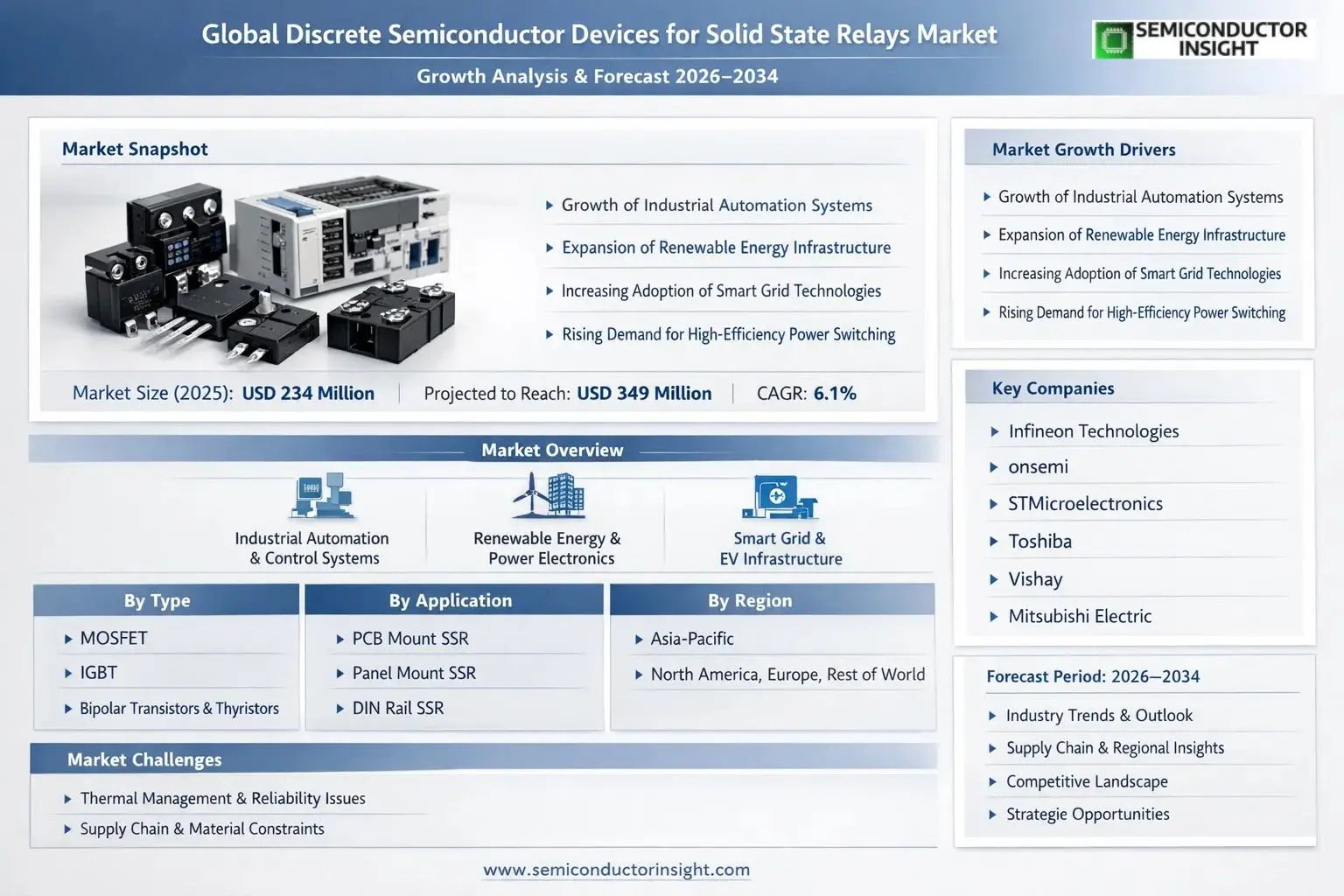
Global Discrete Semiconductor Device for Solid State Relays market size was valued at USD 234 million in 2025. The market is projected to grow from USD 248.3 million in 2026 to USD 349 million by 2034, exhibiting a CAGR of 6.1% during the forecast period. In 2024, Global production of power semiconductor devices for solid-state relays reached 936 million units, with an average ex-factory price of USD 0.26 per unit.
A Discrete Semiconductor Device for Solid State Relays (SSRs) refers to the individual semiconductor components used to construct solid state relays. These devices are essential in the functioning of SSRs, which are electronic switching devices designed to control electrical loads without the mechanical contacts found in traditional electromechanical relays. The product category encompasses a broad range of power switching components, including MOSFETs, IGBTs, Bipolar Power Transistors, and Thyristors (SCRs), each serving distinct performance tiers and application requirements across industrial and commercial end-use segments.
The market is gaining significant momentum because the industry of power semiconductor devices used in SSRs is undergoing a critical phase of transformation , migrating from conventional electromechanical switching toward high-performance electronic switching solutions. Furthermore, with the acceleration of industrial automation, renewable energy integration, electric transportation, and smart grid deployment, demand for SSRs offering high current-carrying capability, elevated voltage tolerance, rapid switching response, and wide operating temperature ranges is rising sharply. Key market participants, including Infineon, onsemi, STMicroelectronics, Toshiba, Vishay, Fuji Electric, Renesas Electronics, Rohm, Nexperia, and Mitsubishi Electric, continue to drive competitive innovation across device design, thermal management, and wide-bandgap material adoption such as SiC and GaN, reinforcing the market’s long-term growth trajectory.
MARKET DRIVERS
Rising Adoption of Industrial Automation and Power Control Systems
Global demand for discrete semiconductor devices used in solid state relays is being significantly propelled by the accelerating shift toward industrial automation across manufacturing, energy, and process industries. Unlike traditional electromechanical relays, solid state relays (SSRs) built on discrete semiconductor components such as thyristors, TRIACs, MOSFETs, and IGBTs offer superior switching speed, longer operational lifespan, and silent operation. As industries increasingly prioritize operational efficiency and reduced downtime, Discrete Semiconductor Device for Solid State Relays Market is witnessing robust demand from sectors including automotive manufacturing, food processing, and semiconductor fabrication facilities where precise load switching is critical.
Growth in Renewable Energy Infrastructure and Smart Grid Deployment
Global transition toward renewable energy sources such as solar photovoltaic and wind power systems has created substantial demand for reliable, high-frequency switching components. Discrete semiconductor devices integrated within solid state relays play a pivotal role in inverter circuits, power conditioning units, and grid-tied systems by enabling seamless energy conversion and load management. Governments across North America, Europe, and Asia-Pacific have committed to substantial investments in smart grid modernization, further expanding the application scope for solid state relay semiconductor components. The increasing deployment of distributed energy resources (DERs) is reinforcing the need for compact, thermally efficient discrete switching devices capable of handling variable load conditions without mechanical wear.
➤ The proliferation of electric vehicles (EVs) and EV charging infrastructure is emerging as a high-growth application segment for discrete semiconductor devices used in solid state relays, particularly those based on wide-bandgap materials such as silicon carbide (SiC) and gallium nitride (GaN), which offer superior thermal performance and higher switching efficiency compared to conventional silicon-based alternatives.
Furthermore, the miniaturization trend in electronics and the growing adoption of Industry 4.0 frameworks are compelling manufacturers to integrate more capable and thermally robust discrete semiconductor devices into next-generation SSR designs. The convergence of IoT-enabled control systems with industrial relay applications is creating a sustained demand pipeline, positioning Discrete Semiconductor Device for Solid State Relays Market for long-term structural growth supported by both end-use diversification and technological advancement in device architecture.
MARKET CHALLENGES
Thermal Management Complexity and Device Reliability Under High Load Conditions
One of the primary challenges confronting Discrete Semiconductor Device for Solid State Relays Market is the inherent thermal management complexity associated with high-power switching applications. Unlike electromechanical relays, discrete semiconductor-based SSRs generate considerable heat during continuous operation at elevated current loads, necessitating sophisticated heat sink designs, thermal interface materials, and active cooling mechanisms. This adds to system-level cost and engineering complexity, particularly in industrial environments where ambient temperatures are already elevated. Device degradation caused by thermal cycling remains a persistent reliability concern that manufacturers must address through stringent qualification and testing protocols to maintain field performance standards.
Other Challenges
Supply Chain Vulnerability and Raw Material Dependencies
The discrete semiconductor supply chain for solid state relay applications remains susceptible to disruptions stemming from raw material shortages, geopolitical tensions affecting key producing regions, and the concentration of advanced wafer fabrication capacity in a limited number of geographic markets. Specialty substrates such as silicon carbide wafers, which are increasingly critical for high-performance SSR applications, face periodic supply constraints that can delay product development timelines and increase component costs for relay manufacturers.
Competition from Alternative Switching Technologies
Discrete Semiconductor Device for Solid State Relays Market faces competitive pressure from alternative switching solutions, including hybrid relays and intelligent power modules (IPMs), which integrate multiple control and protection functions within a single package. In cost-sensitive applications, electromechanical relays continue to hold market share due to their lower upfront cost and zero on-state voltage drop, creating ongoing substitution risk for discrete semiconductor-based SSR solutions, particularly in low-frequency switching or low-budget industrial deployments.
MARKET RESTRAINTS
High Initial Component Cost and Design Integration Barriers
A significant restraint on the expansion of Discrete Semiconductor Device for Solid State Relays Market is the comparatively higher initial cost of discrete semiconductor components relative to conventional relay technologies. The fabrication of high-voltage thyristors, power MOSFETs, and wide-bandgap devices involves capital-intensive processes and specialized manufacturing infrastructure, resulting in elevated per-unit costs that can limit adoption in price-sensitive end markets. For small and medium-sized enterprises (SMEs) operating in emerging economies, budget constraints often necessitate continued reliance on electromechanical alternatives, slowing the pace of technology transition within these customer segments.
Regulatory Compliance and Electromagnetic Compatibility Requirements
Solid state relays incorporating discrete semiconductor devices must conform to increasingly stringent regulatory standards governing electromagnetic interference (EMI), electromagnetic compatibility (EMC), and safety certifications across different geographic markets. Meeting these requirements demands additional design iterations, component shielding, filtering circuits, and third-party certification processes, all of which extend product development cycles and increase the cost of market entry for new participants. Variations in regional compliance standards , particularly between North American, European, and Asian regulatory frameworks , further complicate global product commercialization strategies for manufacturers operating in Discrete Semiconductor Device for Solid State Relays Market, creating a structural barrier that disproportionately affects smaller, resource-constrained suppliers.
MARKET OPPORTUNITIES
Expansion of Wide-Bandgap Semiconductor Adoption in Next-Generation SSR Designs
The accelerating commercial adoption of silicon carbide (SiC) and gallium nitride (GaN) based discrete devices presents a transformative opportunity for Discrete Semiconductor Device for Solid State Relays Market. Wide-bandgap semiconductors enable solid state relays to operate at higher voltages, elevated temperatures, and greater switching frequencies than conventional silicon devices, unlocking new application possibilities in electric vehicle infrastructure, aerospace power systems, and advanced industrial drives. As production volumes increase and wafer costs continue to decline, wide-bandgap discrete devices are expected to achieve broader cost parity with silicon alternatives, substantially expanding the addressable market for high-performance SSR solutions across both established and emerging application segments.
Growing Demand from HVAC, Medical Equipment, and Building Automation Sectors
Discrete Semiconductor Device for Solid State Relays Market stands to benefit meaningfully from rising adoption in HVAC control systems, medical diagnostic equipment, and intelligent building automation platforms. In HVAC applications, SSRs based on discrete semiconductor switching elements offer precise temperature control, reduced contact wear, and lower maintenance requirements compared to electromechanical alternatives , attributes highly valued in commercial and residential energy management systems. The medical equipment sector, characterized by stringent reliability and contamination-avoidance requirements, increasingly favors solid state switching solutions for patient-critical applications. Similarly, Global proliferation of smart buildings equipped with automated lighting, HVAC, and access control systems is generating a sustained and diversified demand base that reinforces the long-term growth outlook for discrete semiconductor devices deployed within solid state relay architectures.
Trends
Shift Toward Wide-Bandgap Materials Redefining Performance Benchmarks
One of the most consequential trends shaping Discrete Semiconductor Device for Solid State Relays Market is the accelerating transition from conventional silicon-based switching devices to wide-bandgap (WBG) semiconductor materials, particularly silicon carbide (SiC) and gallium nitride (GaN). These materials offer superior thermal conductivity, higher breakdown voltage thresholds, and faster switching frequencies compared to traditional silicon counterparts. As industrial automation, renewable energy integration, and electric mobility applications demand SSRs capable of operating under elevated voltages exceeding 1,000 V and currents above 100 A, WBG-based discrete devices are increasingly becoming the preferred solution in high-end SSR module design. Manufacturers including Infineon, STMicroelectronics, and Rohm have accelerated their SiC and GaN device portfolios, reflecting a broader industry-level commitment to next-generation power switching performance.
Other Trends
Voltage-Driven Devices Gaining Dominance Over Current-Driven Architectures
Within Discrete Semiconductor Device for Solid State Relays Market, voltage-driven devices such as MOSFETs and IGBTs are steadily displacing current-driven alternatives like SCRs and thyristors across a growing range of SSR applications. Voltage-driven architectures offer simpler gate-drive circuitry, lower conduction losses, and more precise switching control, attributes that align well with the requirements of modern industrial and energy management systems. This structural shift is particularly evident in PCB-mount and panel-mount SSR segments, where compact form factors and energy efficiency are prioritized. Leading suppliers such as onsemi, Vishay, and Nexperia are expanding their MOSFET and IGBT discrete device lines tailored specifically for SSR integration, reinforcing the voltage-driven paradigm as the default design preference.
Thermal Management and Advanced Packaging Innovations
As SSR operating environments become increasingly demanding, thermal management has emerged as a critical differentiator in Discrete Semiconductor Device for Solid State Relays Market. Discrete power devices now feature heatsink-integrated packaging, direct-bonded copper substrates, and thermally optimized module architectures designed to minimize junction-to-case thermal resistance. These packaging advancements directly extend device reliability and allow higher power densities within compact SSR enclosures. Companies such as Fuji Electric, Mitsubishi Electric, and Toshiba are investing in advanced packaging platforms that combine superior thermal performance with streamlined assembly processes, enabling SSR manufacturers to achieve gross margins consistently above 50% on premium device categories.
Digitalization and Smart Monitoring Driving Next-Generation SSR Integration
A forward-looking trend in Discrete Semiconductor Device for Solid State Relays Market is the convergence of discrete power switching components with embedded digital intelligence. Modern SSR designs increasingly incorporate discrete devices that support real-time status monitoring, fault detection, and adaptive drive-circuit control. This integration supports predictive maintenance frameworks within industrial automation and smart grid infrastructure. Renesas Electronics and Rohm are among the firms developing discrete semiconductor solutions with built-in diagnostic capabilities, positioning Discrete Semiconductor Device for Solid State Relays Market for a transition from passive switching components toward intelligent, system-aware power control elements that meet the operational demands of Industry 4.0 environments.
COMPETITIVE LANDSCAPE
Key Industry Players
Discrete Semiconductor Device for Solid State Relays Market , Global Competitive Intelligence & Strategic Benchmarking Analysis
Global Discrete Semiconductor Device for Solid State Relays market, valued at approximately USD 234 million in 2025 and projected to reach USD 349 million by 2034 at a CAGR of 6.1%, is characterized by a moderately consolidated competitive landscape dominated by a handful of established power semiconductor giants. Infineon Technologies holds a leading position in the market, leveraging its deep expertise in MOSFET and IGBT technologies, wide-bandgap (SiC and GaN) device portfolios, and highly optimized packaging platforms that directly address the thermal management and high-frequency switching demands of next-generation solid state relay applications. STMicroelectronics and onsemi follow closely, each deploying comprehensive product lines spanning silicon-based MOSFETs, IGBTs, and bipolar power transistors, while actively investing in SiC-based discrete solutions suited for high-voltage, high-current SSR modules targeting industrial automation, renewable energy integration, and electric transportation systems. These top-tier players benefit from vertically integrated manufacturing capabilities, global wafer foundry infrastructure, and well-established relationships with SSR module integrators and OEM partners across North America, Europe, and Asia-Pacific.
Beyond the market leaders, several strategically significant niche players exert considerable influence across specific product segments and regional markets. Toshiba and Mitsubishi Electric maintain strong footholds in the Japanese and broader Asia-Pacific market, particularly in thyristor and IGBT-based discrete devices serving panel mount and DIN rail SSR applications in heavy industrial and smart grid environments. Vishay Intertechnology commands a competitive position in low-to-medium power discrete semiconductors, with a broad catalog of MOSFETs, bipolar transistors, and SCR/thyristors optimized for PCB mount SSR designs. Fuji Electric and Renesas Electronics contribute advanced power module integration and drive-circuit embedded solutions, increasingly aligning product development with the industry’s shift toward platform-based modular SSR architectures. Rohm Semiconductor is gaining traction through its SiC MOSFET and SiC Schottky barrier diode offerings, targeting high-performance SSR applications demanding superior switching efficiency and wide temperature range operation. Nexperia differentiates itself through high-volume, cost-competitive discrete MOSFET and bipolar transistor production optimized for automated SSR assembly lines. Collectively, these companies compete on device performance, packaging innovation, thermal management integration, drive compatibility, and increasingly, digital monitoring features that support smart industrial relay systems.
List of Key Discrete Semiconductor Device for Solid State Relays Companies Profiled
- Infineon Technologies
- onsemi (ON Semiconductor)
- STMicroelectronics
- Toshiba Electronic Devices & Storage Corporation
- Vishay Intertechnology
- Fuji Electric Co., Ltd.
- Renesas Electronics Corporation
- Rohm Semiconductor
- Nexperia B.V.
- Mitsubishi Electric Corporation
- Littelfuse, Inc.
- Microsemi (Microchip Technology)
- IXYS Corporation (Littelfuse)
- Semikron Danfoss
- Diodes Incorporated
Segment Analysis:
| Segment Category | Sub-Segments | Key Insights |
| By Type |
|
MOSFET leads this segment owing to its voltage-driven nature, enabling highly efficient, low-loss switching operations within solid state relays. Key qualitative drivers include:
|
| By Application |
|
Panel Mount Solid State Relay emerges as the leading application segment, driven by widespread adoption in industrial control panels and power distribution environments demanding high reliability and thermal resilience. Key qualitative observations include:
|
| By End User |
|
Industrial Automation & Manufacturing remains the dominant end-user segment, underpinned by Global shift from electromechanical switching to high-performance electronic switching in factory environments. Critical qualitative factors include:
|
| By Material Technology |
|
Silicon-based Devices currently hold the leading position in this segment due to their mature manufacturing ecosystem, established supply chains, and cost-competitive production infrastructure that supports broad-based SSR manufacturing at scale. Key qualitative insights include:
|
| By Control Method |
|
Voltage-driven Devices represent the leading and fastest-growing control method segment, reflecting the broader industry transition toward more energy-efficient, digitally compatible switching architectures in modern SSR designs. Key qualitative considerations include:
|
Regional Analysis: Discrete Semiconductor Device for Solid State Relays Market
Asia-Pacific
Government-backed industrial modernization initiatives, including China’s strategic push toward domestic semiconductor self-sufficiency and Japan’s continued investment in precision electronics, have created a fertile environment for market growth. The proliferation of renewable energy installations across Southeast Asian economies further amplifies demand, as solid state relays are critical switching elements in photovoltaic inverters and energy management systems. Additionally, the region’s thriving consumer electronics and automotive electronics sectors provide strong ancillary demand for discrete semiconductor devices used in relay applications. Asia-Pacific is expected to sustain its leading position throughout the forecast period, underpinned by continuous capacity expansions and innovation investments across the semiconductor value chain.
Asia-Pacific hosts some of the world’s most sophisticated semiconductor fabrication facilities, enabling vertically integrated production of discrete devices used in solid state relay assemblies. The region’s supply chain resilience, supported by upstream wafer production and downstream component packaging capabilities, gives manufacturers a significant competitive edge in terms of lead times, scalability, and cost efficiency compared to other global counterparts.
Rapid deployment of automated production lines across manufacturing hubs in China, South Korea, and Japan is a key demand catalyst. Discrete semiconductor devices for solid state relays are indispensable in programmable logic controllers, robotic systems, and precision motor drives , all of which are experiencing accelerated uptake as regional manufacturers pursue productivity gains and operational efficiency improvements at scale.
Southeast Asia and China are aggressively expanding solar and wind energy infrastructure, creating substantial demand for solid state relay components in power conditioning and grid interface equipment. Discrete semiconductor devices play a pivotal role in ensuring reliable, fast-switching performance within inverter systems, making the region’s clean energy transition a powerful long-term growth driver for this market segment.
Japan, South Korea, and Taiwan continue to lead in semiconductor research and development, driving advancements in wide bandgap materials such as silicon carbide and gallium nitride. These innovations directly enhance the thermal performance, switching efficiency, and miniaturization potential of discrete semiconductor devices intended for next-generation solid state relay applications, reinforcing the region’s long-term technological leadership in this space.
North America
North America represents a mature yet highly dynamic market for discrete semiconductor devices used in solid state relays, characterized by strong demand from advanced industrial automation, aerospace and defense, and medical equipment sectors. The United States serves as the primary growth engine, where stringent safety standards and the increasing complexity of industrial control systems drive preference for high-reliability solid state relay solutions over conventional electromechanical counterparts. The region benefits from a well-established semiconductor design ecosystem, with leading fabless companies and integrated device manufacturers continuously advancing discrete component performance. Additionally, ongoing federal investments in semiconductor manufacturing reshoring , exemplified by domestic chip production incentives , are expected to strengthen local supply capabilities over the forecast period. Growing adoption of electric vehicles and charging infrastructure also presents incremental demand opportunities for solid state relay components across North American automotive and energy markets.
Europe
Europe occupies a significant position in Global discrete semiconductor device for solid state relays market, with demand anchored in the region’s advanced industrial base, stringent energy efficiency mandates, and accelerating electrification of transportation. Germany, France, and the United Kingdom are key contributors, where established automotive manufacturing, precision engineering, and process automation industries generate consistent requirements for reliable solid state switching solutions. European regulatory frameworks emphasizing energy conservation and reduced electromagnetic interference have accelerated the transition from traditional relay technologies to solid state alternatives, benefiting the broader market. The region’s strong commitment to smart grid modernization and renewable energy integration , particularly offshore wind and distributed solar , further supports demand. European semiconductor manufacturers and research institutions are also actively collaborating on next-generation compound semiconductor materials, positioning the region as a meaningful contributor to future product innovation within this market.
South America
South America presents a developing but progressively promising landscape for Discrete Semiconductor Device for Solid State Relays Market. Brazil serves as the regional anchor, with growing industrial activity, expanding power generation infrastructure, and increasing penetration of automation technologies in manufacturing sectors driving gradual demand growth. While the region currently lags behind Asia-Pacific, North America, and Europe in terms of market maturity, improving economic conditions and infrastructure modernization programs are steadily creating new application opportunities. The agricultural sector’s increasing reliance on automated irrigation and processing systems also contributes to solid state relay component demand. Challenges related to import dependency, currency volatility, and inconsistent regulatory environments temper near-term growth prospects; however, the long-term outlook remains constructive as regional governments prioritize industrial development and energy sector upgrades throughout the forecast period.
Middle East & Africa
The Middle East and Africa region represents an emerging frontier for Discrete Semiconductor Device for Solid State Relays Market, with growth primarily driven by large-scale energy infrastructure projects, industrial diversification initiatives, and expanding telecommunications networks. Gulf Cooperation Council nations, particularly Saudi Arabia and the United Arab Emirates, are investing heavily in smart city development, renewable energy megaprojects, and industrial automation as part of broader economic transformation agendas, all of which require reliable solid state relay solutions. Africa’s gradually improving power infrastructure and the deployment of off-grid solar energy systems in underserved markets present incremental demand opportunities. While the region currently accounts for a modest share of Global market, ongoing urbanization, rising foreign direct investment in manufacturing, and growing awareness of energy-efficient switching technologies are expected to support above-average growth rates relative to more saturated regional markets over the coming years.
Report Scope
This market research report provides a comprehensive analysis of Discrete Semiconductor Device for Solid State Relays Market, covering the forecast period 2026–2034. It offers detailed insights into market dynamics, technological advancements, competitive landscape, and key trends shaping the industry.
Key focus areas of the report include:
- Market Overview: The report begins with an overview outlining its current market scenario, key growth indicators, and industry transformation drivers. It discusses macroeconomic factors, demand–supply balance, regulatory landscape, and the strategic role of semiconductors in powering advancements across industries such as automotive, telecommunications, consumer electronics, and industrial automation.
- Market Size & Forecast: Historical data and future projections for revenue, unit shipments, and market value across major regions and segments.
- Segmentation Analysis: Detailed breakdown by product type, technology, application, and end-user industry to identify high-growth segments and investment opportunities.
- Regional Insights: Insights into market performance across North America, Europe, Asia-Pacific, Latin America, and the Middle East & Africa, including country-level analysis where relevant.
- Competitive Landscape: Profiles of leading market participants, including their product offerings, R&D focus, manufacturing capacity, pricing strategies, and recent developments such as mergers, acquisitions, and partnerships.
- Technology Trends & Innovation: Assessment of emerging technologies, integration of AI/IoT, semiconductor design trends, fabrication techniques, and evolving industry standards.
- Market Drivers & Restraints: Evaluation of factors driving market growth along with challenges, supply chain constraints, regulatory issues, and market-entry barriers.
- Stakeholder Insights: Insights for component suppliers, OEMs, system integrators, investors, and policymakers regarding the evolving ecosystem and strategic opportunities.
Primary and secondary research methods are employed, including interviews with industry experts, data from verified sources, and real-time market intelligence to ensure the accuracy and reliability of the insights presented.
FREQUENTLY ASKED QUESTIONS:
What is the current market size of Discrete Semiconductor Device for Solid State Relays Market?
-> Global Discrete Semiconductor Device for Solid State Relays Market was valued at USD 234 million in 2025 and is expected to reach USD 349 million by 2034, growing at a CAGR of 6.1% during the forecast period.
Which key companies operate in Discrete Semiconductor Device for Solid State Relays Market?
-> Key players include Infineon, onsemi, STMicroelectronics, Toshiba, Vishay, Fuji Electric, Renesas Electronics, Rohm, Nexperia, and Mitsubishi Electric, among others.
What are the key growth drivers?
-> Key growth drivers include accelerating industrial automation, expansion of renewable energy systems, growth in electric transportation, and rising demand for smart grid applications. Increasing need for SSRs with high current carrying capability, elevated voltage tolerance, rapid switching response, and wide operating temperature range is further fueling market growth.
Which region dominates the market?
-> Asia is a dominant and fast-growing region in the market, driven by strong manufacturing ecosystems in China, Japan, South Korea, and Southeast Asia, while North America and Europe also maintain significant market presence supported by advanced industrial automation and renewable energy investments.
What are the emerging trends?
-> Emerging trends include adoption of wide-bandgap materials such as SiC and GaN for high-end SSR applications, transition from silicon-based to non-silicon-based devices, modular and platform-based design approaches, integration of digital drive and status-monitoring functions for smart operation, and development of devices supporting higher current (>100 A) and higher voltage ratings (>1000 V) with faster switching frequencies and more compact packaging.

Get Sample Report PDF for Exclusive Insights
Report Sample Includes
- Table of Contents
- List of Tables & Figures
- Charts, Research Methodology, and more...
 Download Sample Report PDF