MARKET INSIGHTS
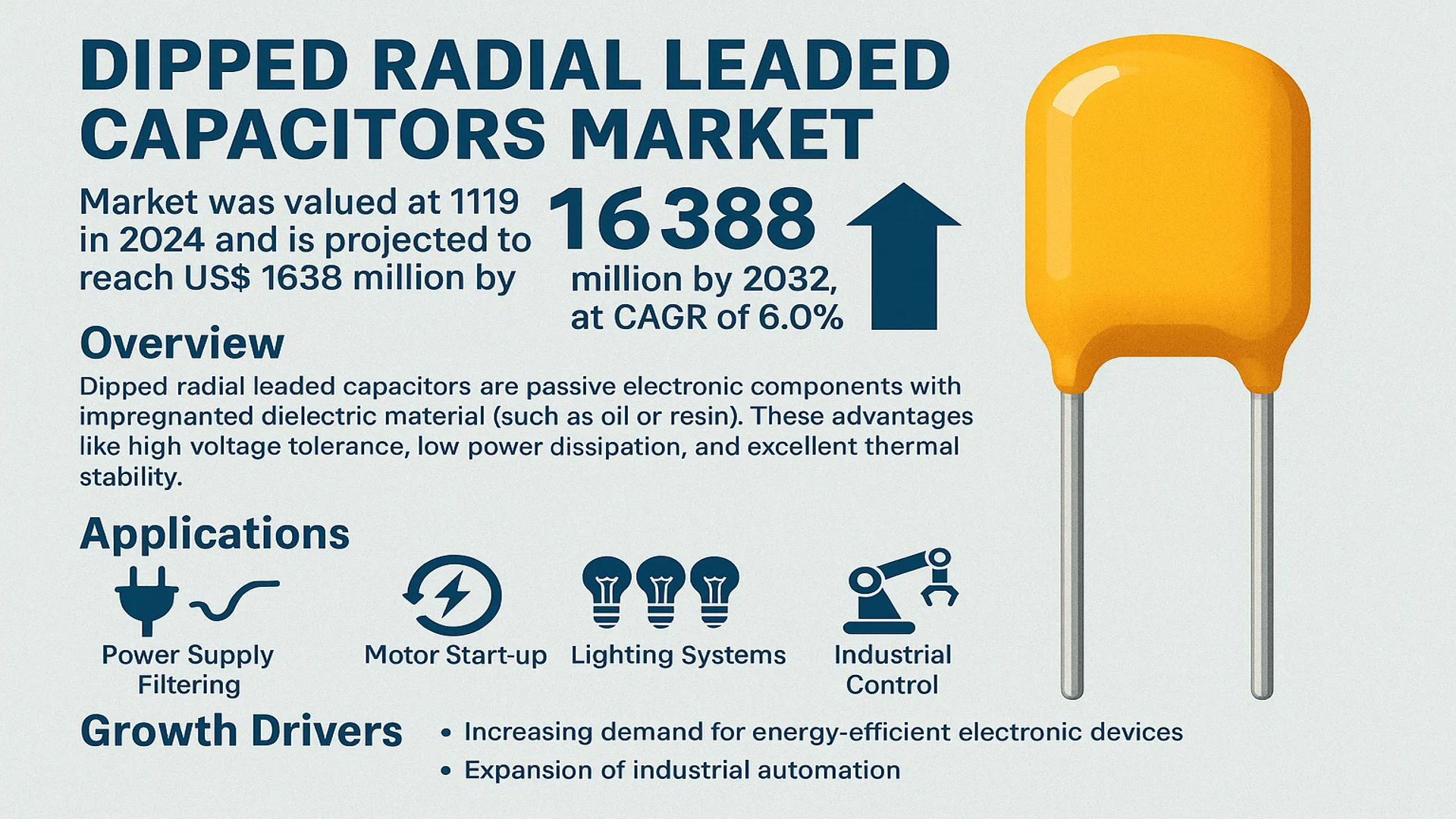
The global Dipped Radial Leaded Capacitors Market was valued at 1119 million in 2024 and is projected to reach US$ 1638 million by 2032, at a CAGR of 6.0% during the forecast period.
Dipped radial leaded capacitors are passive electronic components designed with an impregnated dielectric material (such as oil or resin) to enhance insulation properties and stability. These capacitors feature leads extending radially from one end for easy mounting and soldering, offering advantages like high voltage tolerance, low power dissipation, and excellent thermal stability. They are widely used in power supply filtering, motor start-ups, lighting systems, and industrial control applications due to their reliability and extended operational lifespan.
The market growth is driven by increasing demand for energy-efficient electronic devices and the expansion of industrial automation. However, competition from surface-mount capacitors poses a challenge. Key players like TDK Electronics, KYOCERA AVX Components Corporation, and KEMET dominate the market with advanced product offerings and strategic collaborations to enhance their market presence.
MARKET DYNAMICS
MARKET DRIVERS
Growing Demand for High-Performance Electronic Components to Fuel Market Expansion
The global dipped radial leaded capacitors market is experiencing robust growth driven by the increasing demand for reliable and high-performance electronic components across various industries. These capacitors play a critical role in power supply filtering, motor starting circuits, and industrial control systems due to their superior voltage rating, temperature stability, and long operational life. The power electronics sector alone is projected to grow at over 8% annually, creating significant demand for robust passive components. The automotive industry’s rapid electrification and increasing adoption of advanced driver-assistance systems (ADAS) are further accelerating market growth as these systems require stable power conditioning.
Expansion of Renewable Energy Infrastructure Creating New Demand
The global push toward renewable energy is creating substantial opportunities for dipped radial leaded capacitors, particularly in solar inverters and wind turbine control systems. With solar PV installations expected to exceed 350 GW annually by 2030, the need for reliable capacitors that can withstand harsh environmental conditions while maintaining performance is paramount. These capacitors are preferred in renewable energy applications because their impregnated dielectric design provides excellent resistance to moisture and temperature fluctuations, significantly reducing failure rates in field applications compared to standard capacitors.
Industrial Automation Boom Driving Adoption
The fourth industrial revolution is accelerating the adoption of automation across manufacturing sectors, with the industrial automation market projected to surpass $300 billion by 2026. Dipped radial leaded capacitors are integral components in industrial control systems, motor drives, and power conditioning units. Their radial lead design simplifies PCB assembly in automated production lines while providing reliable performance in electrically noisy industrial environments. The growing emphasis on predictive maintenance in Industry 4.0 applications further increases the demand for durable components with predictable aging characteristics like impregnated capacitors.
MARKET RESTRAINTS
Transition to Surface Mount Technology Hindering Leaded Component Demand
While dipped radial leaded capacitors maintain strong demand in specific applications, the broader electronics industry’s shift toward surface mount technology (SMT) presents a significant challenge. Modern PCB designs increasingly favor SMT components due to their space efficiency and compatibility with automated assembly processes. This transition is particularly evident in consumer electronics and telecommunications equipment, where space constraints drive component miniaturization. Although leaded capacitors still dominate certain high-power and high-voltage applications, this technological shift may gradually erode their market share in some segments.
Supply Chain Disruptions Impacting Material Availability
The manufacturing of dipped radial leaded capacitors relies on specialized materials including high-quality dielectric films, impregnation compounds, and metal foils. Recent global supply chain disruptions have caused volatility in the availability and pricing of these raw materials. The capacitor industry has faced particularly acute challenges in sourcing polypropylene films, which are essential for high-performance film capacitors. These material constraints, combined with rising energy costs in manufacturing, have pressured profit margins and occasionally led to extended lead times for customers.
MARKET CHALLENGES
Technical Limitations in High-Frequency Applications
While dipped radial leaded capacitors excel in power applications, they face growing challenges in meeting the needs of high-frequency electronic systems. Modern communication equipment and high-speed digital circuits increasingly require capacitors with ultra-low equivalent series resistance (ESR) and inductance (ESL). The inherent design of radial leaded capacitors, particularly their lead frame construction, introduces parasitic effects that can degrade performance at frequencies above several hundred kilohertz. This limitation is pushing some designers toward alternative solutions like multilayer ceramic capacitors in high-frequency applications.
Environmental Regulations Impacting Material Choices
The capacitor industry faces increasing regulatory pressure regarding material composition, particularly concerning restricted substances like certain impregnation oils and lead-based termination materials. Compliance with regulations such as REACH and RoHS requires continuous reformulation of capacitor designs, which can impact performance characteristics and require costly requalification processes. These regulatory challenges are particularly acute for manufacturers serving global markets, as regional requirements continue to evolve and sometimes conflict.
MARKET OPPORTUNITIES
Expansion in Medical Electronics Creates New Growth Potential
The medical electronics sector presents significant growth opportunities for high-reliability dipped radial leaded capacitors. Medical equipment manufacturers increasingly demand components that combine long-term reliability with predictable aging characteristics, particularly in critical applications like imaging systems and patient monitoring equipment. The global medical electronics market is projected to grow at nearly 7% CAGR, with particular strength in diagnostic imaging equipment where high-voltage capacitors are essential components. Capacitor manufacturers that can meet stringent medical certifications while maintaining competitive pricing are well-positioned to capitalize on this growth.
Emerging Markets Offer Untapped Potential
Rapid industrialization in developing economies is creating new demand for industrial-grade electronic components. Regions including Southeast Asia, Latin America, and parts of Africa are experiencing accelerated growth in manufacturing infrastructure, driving demand for reliable power electronics components. Localized production of consumer appliances, industrial equipment, and renewable energy systems in these markets presents opportunities for capacitor manufacturers to expand their geographic footprint. Many emerging markets still rely heavily on leaded components due to the prevalence of through-hole PCB assembly in local manufacturing.
Innovation in Materials and Designs Opens New Applications
Advances in dielectric materials and capacitor construction techniques are creating opportunities to extend dipped radial leaded capacitors into new application areas. Recent developments in high-temperature impregnation materials have enabled capacitor operation in environments exceeding 125°C, making them suitable for automotive under-hood applications and industrial equipment subject to extreme conditions. Similarly, improvements in self-healing film technologies are enhancing reliability in power electronics applications where capacitor failures can have severe consequences.
DIPPED RADIAL LEADED CAPACITORS MARKET TRENDS
Increasing Demand for Energy-Efficient Electronics Drives Market Growth
The global dipped radial leaded capacitors market is witnessing significant growth due to the rising demand for energy-efficient electronic components across industries such as power, communication, and medical fields. These capacitors, known for their high withstand voltage, low loss, and excellent temperature stability, are crucial in applications like power supply filtering and motor starting. With the market valued at $1,119 million in 2024 and projected to reach $1,638 million by 2032, growing at a CAGR of 6.0%, manufacturers are focusing on enhancing dielectric materials such as paper, film, and ceramics to improve performance and durability. Companies like TDK Electronics and KYOCERA AVX dominate the market, collectively holding a significant revenue share.
Other Trends
Expansion of Renewable Energy Infrastructure
The shift toward renewable energy sources has amplified the demand for reliable capacitive components in solar inverters and wind turbine systems. Dipped radial leaded capacitors play a critical role in stabilizing voltage fluctuations and ensuring efficient power conversion. Countries like China and the U.S. are heavily investing in renewable energy projects, which is expected to further fuel market expansion. Additionally, technological advancements in capacitor designs, such as self-healing films and improved impregnation techniques, are enhancing their applicability in harsh environmental conditions.
Growth in Automotive Electrification
The increasing electrification of automobiles, including hybrid and electric vehicles (EVs), has significantly boosted the adoption of dipped radial leaded capacitors in onboard charging systems and infotainment modules. With the automotive industry transitioning toward sustainability, capacitors with high reliability and long operational life are in high demand. Leading manufacturers are expanding their product portfolios to include capacitors tailored for high-temperature automotive applications, ensuring compliance with stringent industry standards. The rise of 5G technology is also accelerating growth, particularly in the communication sector, where capacitors are essential for signal integrity and noise suppression.
COMPETITIVE LANDSCAPE
Key Industry Players
Market Leaders Focus on Technological Innovation and Strategic Expansion
The global dipped radial leaded capacitors market features a competitive mix of established manufacturers and emerging regional players. TDK Electronics leads the market with its extensive product portfolio and strong technological expertise in ceramic and film capacitors, holding approximately 15% of global revenue share in 2024. The company’s dominance stems from its vertically integrated manufacturing capabilities and strategic partnerships with automotive and industrial clients.
KYOCERA AVX Components Corporation and Knowles Precision Devices represent the second tier of market leaders, collectively accounting for 22% of 2024 sales. These companies differentiate through specialized product lines—KYOCERA AVX excels in high-reliability capacitors for aerospace applications, while Knowles focuses on precision components for medical devices. Both have significantly expanded production capacity in Asia-Pacific regions to capitalize on growing regional demand.
Mid-sized competitors like Suntan Technology and Kingtronics are making notable strides by offering cost-effective alternatives, particularly in the paper capacitors segment which is projected to grow at 5.8% CAGR through 2032. Their strength lies in streamlined production processes and competitive pricing strategies targeting price-sensitive markets in Southeast Asia and South America.
Strategic maneuvers are reshaping the competitive dynamics—KEMET (a YAGEO company) recently acquired Presidio Components to strengthen its position in military-grade capacitors, while Cornell Dubilier invested $50 million in new automated production lines to meet rising demand from renewable energy applications. Such developments indicate intensifying competition in high-margin application segments.
List of Key Dipped Radial Leaded Capacitor Manufacturers
- TDK Electronics (Japan)
- KYOCERA AVX Components Corporation (U.S.)
- Knowles Precision Devices (U.S.)
- Suntan Technology (China)
- Kingtronics International (Hong Kong)
- Presidio Components, Inc. (U.S.)
- UF Capacitors (India)
- WEISHI Electronics (China)
- Charcroft Electronics (UK)
- Cornell Dubilier (U.S.)
- KEMET (U.S.)
Segment Analysis:
By Type
Paper Capacitors Segment Leads Due to High Reliability and Cost-Effectiveness
The market is segmented based on type into:
- Paper Capacitors
- Subtypes: Oil-impregnated, Resin-dipped, and others
- Film Capacitors
- Subtypes: Polypropylene, Polyester, and others
- Ceramic Capacitors
- Subtypes: Class 1, Class 2, and others
- Others
By Application
Power Field Segment Dominates Due to Widespread Use in Power Electronics
The market is segmented based on application into:
- Power Field
- Sub-applications: Motor drives, Power supplies, and others
- Communication Field
- Medical Field
- Industrial Control
- Others
Regional Analysis: Dipped Radial Leaded Capacitors Market
Asia-Pacific
The Asia-Pacific region dominates the global Dipped Radial Leaded Capacitors market, accounting for over 40% of global demand, driven by robust electronics manufacturing in China, Japan, and South Korea. China’s position as the world’s largest electronics producer fuels consistent demand for passive components like dipped capacitors, particularly for power supply filtering in consumer electronics and industrial automation. While Japan remains a technology leader with companies like TDK Electronics and KYOCERA AVX driving innovation, Southeast Asian nations are emerging as competitive manufacturing hubs. The region benefits from established supply chains and cost advantages, though increasing environmental regulations are pushing manufacturers toward more sustainable production methods.
North America
North America maintains strong demand for high-performance dipped radial leaded capacitors, particularly in aerospace, defense, and medical applications where reliability is critical. The U.S. market benefits from technological leadership in sectors like 5G infrastructure and electric vehicles, with manufacturers focusing on precision components that meet stringent military specifications (MIL-SPEC). Recent reshoring initiatives in semiconductor and electronics manufacturing are creating new opportunities for capacitor suppliers. However, the region faces challenges from semiconductor shortages and supply chain disruptions that impact capacitor availability for key industries.
Europe
Europe’s dipped radial leaded capacitor market is characterized by demand for specialized industrial and automotive-grade components, with Germany and the UK leading in high-end manufacturing applications. The region’s focus on renewable energy systems and electric mobility drives need for capacitors in power conversion and energy storage. European manufacturers emphasize environmentally compliant products, responding to EU RoHS and REACH regulations. While facing competition from Asian suppliers, regional players differentiate through precision engineering and customization capabilities for mission-critical applications in medical devices and industrial automation.
South America
The South American market shows moderate growth potential, primarily serving local electronics assembly and industrial maintenance sectors. Brazil represents the largest regional market, though economic volatility and import dependency constrain faster adoption. Most capacitor demand comes from replacement markets and basic industrial applications rather than cutting-edge electronics. Local manufacturing remains limited, with the majority of components imported from Asia and North America. However, growing investments in infrastructure and energy projects create opportunities for power-grade capacitor applications.
Middle East & Africa
This emerging market shows gradual growth, primarily driven by infrastructure development and increasing electronics consumption in Gulf Cooperation Council (GCC) countries. The region lacks significant capacitor manufacturing capabilities, relying heavily on imports from Europe and Asia. Industrial and energy applications dominate demand, particularly for motor run capacitors in oil/gas operations and power distribution systems. While the market remains price-sensitive, there’s growing recognition of quality components for critical infrastructure, creating opportunities for suppliers of reliable dipped radial leaded capacitors.
Report Scope
This market research report provides a comprehensive analysis of the Global Dipped Radial Leaded Capacitors market, covering the forecast period 2024–2032. It offers detailed insights into market dynamics, technological advancements, competitive landscape, and key trends shaping the industry.
Key focus areas of the report include:
- Market Size & Forecast: Historical data and future projections for revenue, unit shipments, and market value across major regions and segments. The market was valued at USD 1,119 million in 2024 and is projected to reach USD 1,638 million by 2032, growing at a CAGR of 6.0%.
- Segmentation Analysis: Detailed breakdown by product type (Paper, Film, Ceramic Capacitors), application (Power, Communication, Medical, Others), and end-user industry to identify high-growth segments and investment opportunities.
- Regional Outlook: Insights into market performance across North America, Europe, Asia-Pacific, Latin America, and the Middle East & Africa, including country-level analysis where relevant. The U.S. and China are key markets, with Asia-Pacific showing the highest growth potential.
- Competitive Landscape: Profiles of leading market participants, including TDK Electronics, KYOCERA AVX Components Corporation, KEMET, Knowles Precision Devices, and Syfer Technology, among others, covering their product offerings, R&D focus, and recent developments.
- Technology Trends & Innovation: Assessment of emerging capacitor technologies, material advancements, and evolving industry standards to enhance performance and reliability.
- Market Drivers & Restraints: Evaluation of factors driving market growth, such as rising demand for energy-efficient electronics, alongside challenges like supply chain constraints and raw material price volatility.
- Stakeholder Analysis: Insights for component suppliers, OEMs, system integrators, investors, and policymakers regarding the evolving ecosystem and strategic opportunities.
Primary and secondary research methods are employed, including interviews with industry experts, data from verified sources, and real-time market intelligence to ensure the accuracy and reliability of the insights presented.
FREQUENTLY ASKED QUESTIONS:
What is the current market size of the Global Dipped Radial Leaded Capacitors Market?
-> Dipped Radial Leaded Capacitors Market was valued at 1119 million in 2024 and is projected to reach US$ 1638 million by 2032, at a CAGR of 6.0% during the forecast period.
Which key companies operate in the Global Dipped Radial Leaded Capacitors Market?
-> Key players include TDK Electronics, KYOCERA AVX Components Corporation, KEMET, Knowles Precision Devices, and Syfer Technology, among others.
What are the key growth drivers?
-> Key growth drivers include rising demand for consumer electronics, industrial automation, and renewable energy applications.
Which region dominates the market?
-> Asia-Pacific leads the market due to strong manufacturing hubs in China, Japan, and South Korea, while North America remains a significant player.
What are the emerging trends?
-> Emerging trends include miniaturization, high-temperature stability, and the integration of advanced dielectric materials to meet evolving industry demands.

Get Sample Report PDF for Exclusive Insights
Report Sample Includes
- Table of Contents
- List of Tables & Figures
- Charts, Research Methodology, and more...
 Download Sample Report PDF