
MARKET INSIGHTS
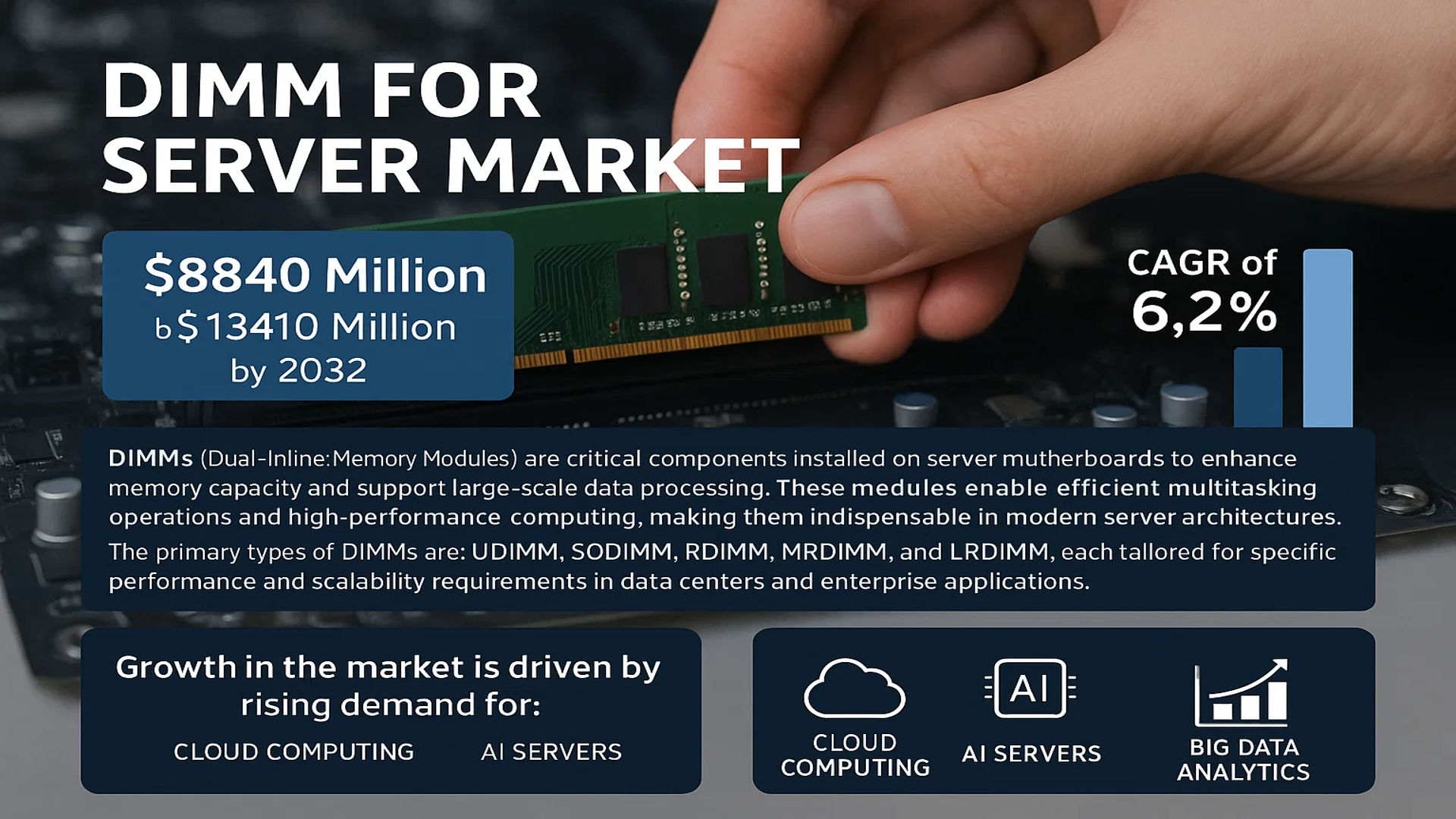
The global DIMM for Server Market was valued at 8840 million in 2024 and is projected to reach US$ 13410 million by 2032, at a CAGR of 6.2% during the forecast period.
DIMM (Dual-Inline Memory Modules) are critical components installed on server motherboards to enhance memory capacity and support large-scale data processing. These modules enable efficient multitasking operations and high-performance computing, making them indispensable in modern server architectures. The primary types of DIMMs include UDIMM, SODIMM, RDIMM, MRDIMM, and LRDIMM, each tailored for specific performance and scalability requirements in data centers and enterprise applications.
Growth in the market is driven by rising demand for cloud computing, AI servers, and big data analytics. The increasing adoption of high-bandwidth memory solutions, coupled with advancements in energy-efficient technologies, is further propelling market expansion. Key players such as Samsung, SK Hynix, and Micron Technology dominate the competitive landscape, leveraging innovations in memory architecture to meet evolving industry needs. While North America leads in market share, Asia-Pacific is emerging as a high-growth region due to rapid digital transformation.
MARKET DYNAMICS
MARKET DRIVERS
Explosive Growth in Cloud Computing and Data Center Expansion to Propel DIMM Demand
The global DIMM for server market is experiencing significant growth due to the unprecedented expansion of cloud computing infrastructure and data centers. With enterprises increasingly adopting cloud-based solutions, the demand for high-performance server memory modules has surged. Hyperscale data center operators alone are projected to account for over 60% of total server DIMM demand by 2027, driving substantial market growth. The shift toward virtualization and containerized workloads has particularly increased the need for higher memory capacities, with average server memory configurations growing at approximately 15% annually since 2020.
AI and HPC Workloads Accelerating High-Bandwidth DIMM Adoption
Artificial intelligence and high-performance computing applications are creating new demand for advanced DIMM technologies. Memory bandwidth has become a critical bottleneck in AI training workloads, leading to rapid adoption of high-performance RDIMM and LRDIMM modules. The AI server segment already represents nearly 25% of total server DIMM shipments, with this share expected to double within the next five years. Current AI servers frequently utilize memory configurations exceeding 1TB per system, driving innovation in memory density and power efficiency.
Enterprise Digital Transformation Initiatives Fueling Market Expansion
Widespread enterprise digital transformation efforts are significantly contributing to server DIMM market growth. Businesses across sectors are upgrading their IT infrastructure to support data-intensive applications, with memory capacity emerging as a critical performance factor. The finance sector’s adoption of in-memory databases for real-time analytics alone has driven a 30% year-over-year increase in high-capacity RDIMM deployment. Furthermore, the healthcare sector’s adoption of memory-intensive genomic sequencing and medical imaging applications continues to create new demand.
Memory manufacturers are responding to these demands with innovative new product lines, with over 15 new DIMM models introduced in 2023 alone featuring advanced technologies like 3D-stacked memory and enhanced error correction.
MARKET RESTRAINTS
Memory Market Cyclicality and Price Volatility Impacting Adoption
The server DIMM market faces significant challenges from cyclical memory pricing and supply chain uncertainties. DRAM pricing fluctuations of up to 40% year-over-year create budgeting challenges for enterprise IT departments, potentially delaying server refresh cycles. This volatility stems from the semiconductor industry’s inherent boom-bust cycles, which have historically created periods of oversupply and shortages. Current market conditions show signs of inventory correction, with some DIMM configurations experiencing price reductions exceeding 25% in early 2024.
Technology Transition Challenges with New Memory Architectures
The industry’s transition to new memory technologies presents integration challenges that may temporarily restrain market growth. The shift from DDR4 to DDR5 server DIMMs has introduced compatibility issues with existing server platforms, requiring costly BIOS updates and firmware modifications. While DDR5 offers substantial performance benefits, its adoption in enterprise environments remains gradual, currently representing less than 15% of total server DIMM shipments. The simultaneous support for multiple memory generations increases complexity for IT managers and could slow broader market adoption.
Complexity of Heterogeneous Memory System Integration
The increasing complexity of modern server memory subsystems poses additional challenges for DIMM adoption. Modern servers often incorporate multiple DIMM types (RDIMMs, LRDIMMs, NVDIMMs) on the same platform, requiring careful capacity balancing and placement optimization. This complexity has led to a measurable increase in system configuration errors, with some enterprises reporting up to 20% higher incidence of memory-related support incidents during platform transitions. These challenges are particularly pronounced in mixed-workload environments where performance optimization proves critical.
MARKET OPPORTUNITIES
Emerging CXL-enabled Memory Expansion Solutions to Open New Market Segments
The Compute Express Link (CXL) standard presents significant growth opportunities for the server DIMM market. CXL-enabled memory expansion solutions allow for unprecedented memory scaling beyond traditional DIMM slot limitations, with projected market growth exceeding $5 billion by 2027. Major hyperscalers are actively testing CXL memory pooling solutions that could revolutionize data center memory architectures. Early deployments suggest potential memory utilization improvements of 30-40% in virtualized environments.
Growing Demand for Energy-Efficient Server Memory in Sustainable Data Centers
Environmental sustainability initiatives are creating new opportunities for energy-efficient DIMM solutions. With data center power consumption under increasing scrutiny, memory manufacturers are developing low-voltage DIMMs that reduce power consumption by up to 25% without sacrificing performance. These solutions align with the growing adoption of power-aware server provisioning strategies, particularly in regions with strict environmental regulations. The European market for energy-efficient server memory is projected to grow at nearly 10% CAGR through 2030.
Expansion of Edge Computing Driving Specialized DIMM Requirements
The rapid expansion of edge computing infrastructure presents unique opportunities for specialized DIMM solutions. Edge environments demand memory modules with enhanced reliability and ruggedized designs to operate in uncontrolled conditions. Market analysis indicates the edge computing segment will account for nearly 20% of industrial server DIMM shipments by 2026, requiring products with extended temperature ranges and shock/vibration resistance. This segment represents a $1.2 billion opportunity for memory manufacturers able to address these specialized requirements.
DIMM FOR SERVER MARKET TRENDS
Expansion in Data Center Deployments Drives DIMM for Server Market Growth
The global DIMM for server market is witnessing robust growth, propelled by increasing investments in data center infrastructure worldwide. With cloud computing and AI applications demanding higher memory bandwidth and capacity, enterprises are rapidly adopting high-performance server DIMMs. The market is projected to grow at a CAGR of 6.2%, reaching $13.41 billion by 2032. Emerging technologies like DDR5 and NVDIMMs (Non-Volatile DIMMs) are gaining traction as they offer faster data transfer rates and persistent memory solutions, crucial for mission-critical applications in financial services and real-time analytics.
Other Trends
AI and HPC Workloads Demand Advanced Memory Solutions
The rising adoption of AI servers and high-performance computing (HPC) systems is accelerating the shift toward high-capacity DIMMs. AI training models require large memory pools, making LRDIMMs (Load-Reduced DIMMs) and MRDIMMs (Multiplexer Rank DIMMs) particularly valuable for reducing power consumption while maintaining performance. The market for AI servers is expected to exceed 1.5 million units by 2025, directly fueling demand for specialized server memory modules capable of handling complex neural network computations.
Edge Computing and 5G Deployment Enhance Memory Requirements
The proliferation of edge computing and 5G networks is driving the need for distributed memory solutions with low-latency access. Server DIMMs in edge data centers must balance high-speed performance with energy efficiency, leading to innovations such as DRAM stacking technologies and advanced power management features. Additionally, the telecom sector’s shift toward virtualization and network function virtualization (NFV) is creating new opportunities for memory manufacturers, with projections indicating a 15% annual increase in memory demand from telecom applications.
Sustainability Initiatives Influence DIMM Design
With data centers accounting for over 2% of global electricity consumption, sustainability has become a key trend shaping the server DIMM market. Manufacturers are focusing on low-power DDR5 modules and advanced cooling solutions to reduce energy usage. The transition towards 3D-stacked memory architectures and silicon photonics for improved thermal efficiency is also gaining momentum, aligning with global efforts to minimize the carbon footprint of large-scale computing environments.
COMPETITIVE LANDSCAPE
Key Industry Players
Innovation and Capacity Expansion Drive Market Competition in Server DIMM Segment
The global DIMM for Server market exhibits an increasingly competitive yet consolidated structure, dominated by memory chip giants alongside emerging regional players. Samsung leads the market with its comprehensive portfolio of high-performance server memory solutions, including cutting-edge RDIMM and LRDIMM products that cater to AI server applications. The company’s technological edge is complemented by its massive production capacity and partnerships with major cloud service providers.
SK Hynix and Micron Technology follow closely, collectively holding significant market share in 2024. These manufacturers are intensifying competition through aggressive R&D investments in next-generation DDR5 server DIMMs and 3D-stacked memory architectures. Their technological advancements directly address the growing demand for low-latency, high-bandwidth memory in data center applications.
The competitive landscape benefits from continuous capacity expansions across Asia, where leading players are establishing new fabrication plants to meet the booming demand. Regional contenders such as Changxin Memory Technologies (CXMT) are gaining traction by offering competitively priced alternatives, particularly in the Chinese market which represents one of the fastest-growing regions for server DIMM adoption.
Meanwhile, module manufacturers like Kingston Technology and SMART Modular Technologies are strengthening their positions through flexible customization options and enhanced supply chain resilience. These companies focus on the enterprise segment where reliability and long-term support often outweigh pure performance metrics.
List of Key DIMM for Server Manufacturers
- Samsung (South Korea)
- SK Hynix (South Korea)
- Micron Technology (U.S.)
- Changxin Memory Technologies (CXMT) (China)
- Kingston Technology Company, Inc. (U.S.)
- SMART Modular Technologies (U.S.)
- ADATA Technology (Taiwan)
- Rambus (U.S.)
- Kimtigo (China)
- Transcend (Taiwan)
- Innodisk (Taiwan)
- TeamGroup (Taiwan)
- Apacer Technology (Taiwan)
- G.SKILL (Taiwan)
- Shenzhen Longsys (China)
- Ramaxel (China)
Segment Analysis:
By Type
RDIMM Segment Gains Prominence for High-Performance Server Applications
The market is segmented based on type into:
- UDIMM (Unbuffered DIMM)
- SODIMM (Small Outline DIMM)
- RDIMM (Registered DIMM)
- MRDIMM (Multi-rank DIMM)
- LRDIMM (Load Reduced DIMM)
- Others
By Application
AI Server Segment Exhibits Strong Growth Due to Rising Adoption in Machine Learning Workloads
The market is segmented based on application into:
- AI Server
- General Purpose Server
- High Performance Computing (HPC)
- Cloud Computing Infrastructure
- Enterprise Storage Solutions
By Technology
DDR5 Technology Adoption Accelerates with Growing Demand for Higher Bandwidth
The market is segmented based on technology into:
- DDR3
- DDR4
- DDR5
- Others
By Capacity
High Capacity DIMMs Gain Traction for Data Intensive Applications
The market is segmented based on capacity into:
- 8GB
- 16GB
- 32GB
- 64GB
- 128GB and above
Regional Analysis: DIMM for Server Market
Asia-Pacific
Led by China, Japan, and India, the Asia-Pacific region dominates the global DIMM for Server market, accounting for over 42% of global revenue share in 2024. China maintains its position as both the largest producer and consumer of server memory modules, driven by massive domestic data center construction projects from Alibaba Cloud, Tencent, and Huawei. The Chinese government’s $60 billion investment in national cloud infrastructure and AI development programs strongly supports RDIMM and LRDIMM adoption. While cost-competitive UDIMMs remain popular among small/medium enterprises, hyperscale data center operators increasingly demand high-capacity RDIMMs (128GB+) to support AI workloads. Japan’s mature server market shows preference for Micron and Samsung’s latest DDR5 modules, while India emerges as a high-growth hub with Reliance Jio and Adani Group investing $5 billion in data center expansion.
North America
The U.S. represents the second-largest market for server DIMMs, with major cloud service providers (AWS, Microsoft Azure, Google Cloud) driving 68% of regional demand. Recent advancements in CXL (Compute Express Link) technology adoption among Tier-1 server OEMs are accelerating the shift toward intelligent memory pooling architectures. American manufacturers like Micron Technology and SMART Modular Technologies lead in developing low-latency memory solutions for AI training servers, with RDIMM capacities reaching 256GB per module. Canadian market growth remains steady, supported by academic HPC clusters and provincial cloud initiatives, though semiconductor import dependency creates supply chain vulnerabilities during global shortages.
Europe
Germany and the UK collectively account for 39% of Europe’s server DIMM market, propelled by strict data sovereignty regulations (GDPR) requiring localized cloud infrastructure. SAP’s HANA in-memory database deployments generate sustained demand for high-reliability RDIMMs, with Bosch and Siemens emerging as key industrial users. The EU Chips Act allocates €3.3 billion for memory semiconductor R&D, fostering local partnerships between Infineon and academic institutions. Nordic countries demonstrate above-average growth at 7.8% CAGR, as Oslo and Stockholm become preferred locations for green data centers utilizing Micron’s 1β DDR5 energy-efficient modules that reduce power consumption by 23% versus previous generations.
South America
Brazil captures 51% of the region’s server memory market, where banking sector modernization and e-commerce expansion fuel demand for UDIMM and SODIMM solutions. Limited local manufacturing capacity creates import reliance, with Kingston and ADATA commanding 73% market share through distributor networks. Argentina shows promising adoption of renewable energy-powered micro data centers, though economic instability and import restrictions hinder consistent supply of high-end RDIMM modules. Chile emerges as a niche market for mining industry HPC applications, where ruggedized server configurations require industrial-grade memory solutions from Innodisk and Apacer.
Middle East & Africa
The UAE and Saudi Arabia drive 68% of regional DIMM consumption through sovereign cloud initiatives like Khazna Data Centers and Saudi National Cloud. Dubai’s Smart City projects necessitate edge computing deployments utilizing low-power SODIMMs, while oil/gas sector supercomputers demand fault-tolerant RDIMM configurations. South Africa remains the manufacturing hub for Africa, with Telkom and Dimension Data specifying server builds using Samsung’s PMIC-equipped modules for voltage regulation in unstable power environments. Though political instability in some markets creates procurement challenges, the African Continental Free Trade Area (AfCFTA) is gradually improving access to enterprise-grade memory solutions.
Report Scope
This market research report provides a comprehensive analysis of the Global DIMM for Server Market, covering the forecast period 2024–2032. It offers detailed insights into market dynamics, technological advancements, competitive landscape, and key trends shaping the industry.
Key focus areas of the report include:
- Market Size & Forecast: Historical data and future projections for revenue, unit shipments, and market value across major regions and segments. The global DIMM for Server market was valued at USD 8,840 million in 2024 and is projected to reach USD 13,410 million by 2032, growing at a CAGR of 6.2%.
- Segmentation Analysis: Detailed breakdown by product type (UDIMM, SODIMM, RDIMM, MRDIMM, LRDIMM), application (AI Server, General Purpose Server), and end-user industries (data centers, cloud computing, HPC, enterprise applications).
- Regional Outlook: Insights into market performance across North America, Europe, Asia-Pacific, Latin America, and the Middle East & Africa, with country-level analysis for key markets like the U.S., China, Japan, and Germany.
- Competitive Landscape: Profiles of leading market participants including Samsung, SK Hynix, Micron Technology, Changxin Memory Technologies (CXMT), and Kingston Technology, covering their product portfolios, market shares, and strategic initiatives.
- Technology Trends & Innovation: Assessment of emerging technologies including higher bandwidth modules, lower latency solutions, energy-efficient designs, and intelligent memory management systems.
- Market Drivers & Restraints: Evaluation of factors such as growing cloud computing demand, AI server adoption, and data center expansion, along with challenges like supply chain constraints and semiconductor shortages.
- Stakeholder Analysis: Strategic insights for memory manufacturers, server OEMs, data center operators, and investors regarding market opportunities and competitive positioning.
The report employs both primary and secondary research methodologies, including interviews with industry experts, analysis of company financial reports, and validation of market data through multiple reliable sources.
FREQUENTLY ASKED QUESTIONS:
What is the current market size of Global DIMM for Server Market?
->DIMM for Server Market was valued at 8840 million in 2024 and is projected to reach US$ 13410 million by 2032, at a CAGR of 6.2% during the forecast period.
Which key companies operate in Global DIMM for Server Market?
-> Key players include Samsung, SK Hynix, Micron Technology, Changxin Memory Technologies (CXMT), and Kingston Technology, among others.
What are the key growth drivers?
-> Key growth drivers include increasing cloud computing adoption, AI server deployments, data center expansion, and growing demand for high-performance computing solutions.
Which region dominates the market?
-> Asia-Pacific is the largest market, driven by China’s growing server production and data center investments, while North America leads in technological innovation.
What are the emerging trends?
-> Emerging trends include development of higher bandwidth DDR5 modules, increased memory capacities, energy-efficient designs, and intelligent memory management solutions.

Get Sample Report PDF for Exclusive Insights
Report Sample Includes
- Table of Contents
- List of Tables & Figures
- Charts, Research Methodology, and more...
 Download Sample Report PDF


