SEMICONDUCTOR INSIGHT
MARKET RESEARCH REPORT

Digital Security Cameras Market

2026 to 2034
MARKET INTELLIGENCE
ACROSS KEY REGIONS
2026 EDITION
CONSUMER ELECTRONICS Semiconductor Market Research

Digital Security Cameras Market

Trends, Technological Advancements and Business Strategies 2026–2034

◷
UPDATED 04 November 2026
▤
REPORT LENGTH Detailed Report
▣
REPORT CODE cab8fa056203
▯
FORMATS PDF

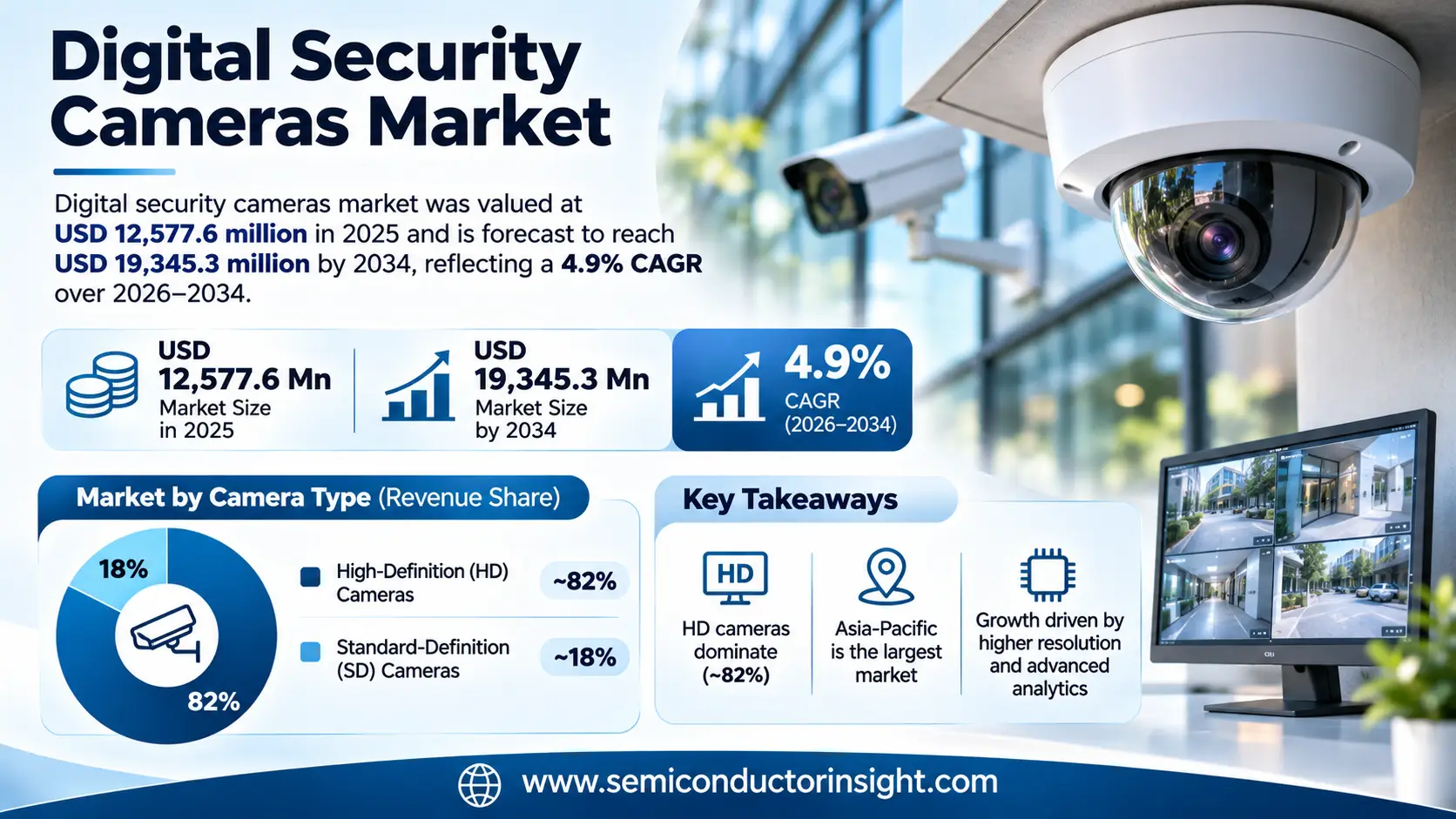
Digital security cameras market was valued at USD 12,577.6 million in 2025 and is forecast to reach USD 19,345.3 million by 2034, reflecting a 4.9% CAGR over 2026–2034. Asia-Pacific remains the largest regional market, supported by dense electronics manufacturing and extensive institutional and commercial surveillance deployment. Its sales outlook remains tied to identifiable camera shipments rather than expenditure on whole security programs.

Get the sample PDF with study scope, segmentation and methodology details.

Key Statistics

2025 Market Size
USD 12,577.6 million
2034 Projected Size
USD 19,345.3 million
CAGR (2026–2034)
4.9%
Largest Market in 2025
Asia-Pacific (~46%)

Key Takeaways

  • Market outlook: Digital security camera revenue is estimated at USD 12,577.6 million in 2025 and projected to reach USD 19,345.3 million by 2034. Demand includes professional IP surveillance cameras and related connected video devices, with advanced imaging and analytics increasingly influencing unit value.
  • HD leadership: High-definition cameras account for an estimated ~82% of value because enterprise and government buyers require detail adequate for identification and incident review. Standard-definition equipment remains in smaller inherited installations and inexpensive retrofits, although new projects increasingly specify network connectivity and video analytics. Over the reporting period, the 4.9% CAGR reflects a mix of refresh purchases and growth in networked facilities.
  • Application mix: Enterprise sites represent an estimated ~28% of 2025 demand, closely followed by government applications at ~27%. Retail centers account for ~18%, healthcare ~15% and tourism ~12%, reflecting different retention, privacy and installation requirements for security and conferencing video.
  • Regional footprint: Asia-Pacific holds an estimated ~46% share, supported by Chinese camera manufacturers and deployment across major Asian commercial centers. North America represents ~27% and Europe ~19%, where surveillance cyber hygiene, channel support and technical compliance shape purchasing choices.
  • Technology transition: Manufacturers introduced 4K edge-analytics cameras and enhanced image sensors during 2026, while ONVIF announced the eventual replacement of its Profile S interoperability pathway with Profile T. Buyers must weigh improved analytics against network load, lifecycle security updates and maintenance labor.

Digital Security Cameras Market Overview

Digital security cameras market was valued at USD 12,577.6 million in 2025 and is forecast to reach USD 19,345.3 million by 2034, reflecting a 4.9% CAGR over 2026–2034. Asia-Pacific remains the largest regional market, supported by dense electronics manufacturing and extensive institutional and commercial surveillance deployment. Its sales outlook remains tied to identifiable camera shipments rather than expenditure on whole security programs.

Base year: 2025 · Estimated year: 2026 · Forecast period: 2026–2034 · Historical data: 2020–2024 · Values in USD million

Digital security cameras turn image-sensor signals into video used for protection, monitoring, identification and operational awareness. Modern systems combine optics, image processing, on-device software and network interfaces that move footage to recorders or cloud services. A fixed dome camera in a hospital and a conference webcam in an enterprise boardroom may both be digital imaging devices, but their environmental hardening, data retention and managed-security requirements differ substantially.

The market encompasses SD and HD digital cameras purchased for government, enterprise, shopping-center, healthcare and tourism settings. The named vendor universe spans network surveillance suppliers and certain business-video camera brands, so associated connected camera hardware is considered where used in the described applications. Software-only subscriptions, installed networking infrastructure, cloud storage and complete alarm-service contracts are excluded unless they are embedded with the supplied camera product.

Buyers increasingly specify useful image quality under difficult conditions rather than nominal resolution alone. A 4K sensor is valuable only if low-light handling, lens selection, compression and available bandwidth preserve evidence of an actual incident. On-device classification can filter irrelevant motion and reduce the volume of video reviewed by staff, but security integrators must tune the models to the site and retain privacy safeguards.

Security cameras have long service lives relative to consumer electronics. Many operators replace devices through planned refresh cycles, firmware support expiry or changes in compliance expectations. ONVIF interoperability profiles reduce some integration risk across recorders and camera vendors, although the lifecycle of an existing camera still depends on authenticated access, network segmentation and whether its manufacturer supplies updates over time.

Segment Analysis: By Type

High-definition cameras dominate with an estimated ~82% of 2025 sales, while standard-definition cameras retain an estimated ~18% of value. HD includes mainstream high-resolution network cameras and 4K or higher variants with improved dynamic range and embedded analysis. SD primarily appears in older low-bandwidth systems, lower-cost installations and device categories where identifying fine image details is not a purchasing priority.

Type Function Market position
HD Estimated ~82% share. Network-connected HD cameras support forensic review, human or vehicle classification and remote management across stores, government buildings and hospitals. Performance depends on optics, night illumination, encoder efficiency, security firmware and qualified storage. Products in this category can range from conventional 1080p models to 4K and specialist multi-sensor units. Customers often pay more for edge processing and reliable support than for incremental pixel count alone.
SD Estimated ~18% share. Standard-definition models remain relevant where cabling, storage, display endpoints or site budgets limit replacement options. Older analog-to-digital conversion systems and low-priority monitoring locations may continue using modest image resolution even when IP recording is introduced. System planners assess whether poor detail creates unacceptable evidence risk; if so, the upgrade usually requires changes to networking and storage as well as a new camera.

Segment Analysis: By Application

Enterprises and government facilities account for an estimated ~55% of combined camera applications as organizations protect buildings, personnel and controlled areas. Retail Shopping Centers, Healthcare and Tourism represent distinct deployment conditions. Camera hardware revenue should not be confused with expenditure on control-room staff, video-management software, cloud retention or installation services, which can materially exceed the equipment price over its useful life.

Application Demand characteristics
Government Estimated ~27% share. Municipal buildings, public transport and civic spaces use digital camera systems for safety, traffic oversight and evidence collection under formal procurement procedures. Buyers require secure device administration, stated retention rules and interoperability with existing recording infrastructure. A camera that offers advanced object recognition can still be disqualified if its security support, certification or maintenance access does not meet the purchasing authority’s requirements.
Enterprises Estimated ~28% share. Corporate offices, warehouses and factories deploy network cameras to protect assets and investigate events. Enterprises also purchase conferencing and collaboration cameras, creating a wider digital imaging mix than physical surveillance alone. Managers evaluate total deployment cost, including network ports, recurring storage and administration, while security teams demand password management, encrypted access and reliable firmware updates across large estates.
Retail Shopping Centers Estimated ~18% share. Stores and malls rely on cameras for incident review, loss prevention and crowd-flow analysis. High-contrast entrances, variable lighting and changing product layouts make real-world image quality important. Retail buyers often prefer easy-to-maintain devices with local analytics that can flag after-hours movement without generating continuous false alarms. Installation position and privacy signage influence effectiveness as much as nominal sensor specification.
Healthcare Estimated ~15% share. Hospitals need secure observation around entrances, emergency departments, pharmacies and infrastructure rooms while respecting patient confidentiality. Healthcare video systems require carefully separated permissions and well-defined retention practices. Camera placement is limited in treatment and private areas, so the ability to configure privacy masking, audit access and integrate with existing operations can weigh more heavily than the newest analytics feature.
Tourism Estimated ~12% share. Hotels, resorts, transport hubs and visitor attractions install cameras at public entrances, car parks and shared facilities. Purchasing emphasizes overnight image performance, ease of maintenance and service continuity during peak visitor periods. Operators must balance security visibility with visitor expectations of discretion. Outdoor and coastal sites can also require corrosion resistance and robust housings, changing the economical camera choice.

Regional Analysis

Digital camera demand combines domestic equipment manufacturing, distributor networks and site-specific installation across public and private facilities. Asia-Pacific holds an estimated ~46% of 2025 sales, North America ~27%, Europe ~19%, South America ~5% and Middle East & Africa ~3%. Revenue follows camera hardware purchases, rather than assigning the full value of video analytics services to device manufacturers.

Which regions have the strongest digital security camera demand and supply capabilities?

Asia’s scale reflects major Chinese and South Korean imaging suppliers and a wide base of commercial and municipal users. North American and European buyers generally place greater emphasis on documented cyber protection, integration support and equipment lifecycle assurance. Smaller regions depend more heavily on imported cameras and trained installation channels. Policies on biometric analytics, public surveillance and stored personal information influence deployment across all five markets.

Region Position Growth outlook Demand profile What decides supplier selection
Asia-Pacific An estimated ~46% ~5.6% CAGR Chinese production with Japanese and Korean imaging ecosystems Manufacturing scale and new urban installations sustain demand
North America An estimated ~27% ~4.5% CAGR United States professional security and smart facility networks Cybersecurity expectations and large installed estates shape refresh purchases
Europe An estimated ~19% ~4.0% CAGR Germany, United Kingdom and France site security programs Privacy governance, interoperability and support influence procurement
South America An estimated ~5% ~3.8% CAGR Brazil and regional transport and retail estates Import costs and integrator maintenance networks affect installations
Middle East & Africa An estimated ~3% ~4.2% CAGR Gulf infrastructure and South African commercial facilities Outdoor performance and public-space monitoring shape equipment mix

Asia-Pacific LARGEST · ~46% SHARE

Why is Asia-Pacific the largest camera market?

Asia-Pacific commands an estimated ~46% share as camera assembly capacity, image-sensor ecosystems and deployment demand converge. Chinese companies supply broad surveillance portfolios, South Korean vendors emphasize analytics and Japan contributes established imaging engineering. Public transport, factory campuses, apartment complexes and retail operations create varied customer programs. Buyers increasingly compare cyber support and usable low-light video, not simply the camera price shown in catalogues. Across Asia-Pacific, 2025 electronics sourcing shapes 2026 project delivery, while 2029 sensor revisions and 2034 camera service requirements reward suppliers with durable local channels.

Market positionAn estimated ~46% share
Growth outlook~5.6% CAGR
Demand profileAsian imaging supply chains
Market access gateHigh-density urban deployment
Country Position in region What drives demand
China Equipment manufacturing and large deployment programs Chinese manufacturers offer extensive camera catalogues covering fixed domes, outdoor bullets and network PTZ products. Production scale can support competitive prices, but global customers scrutinize security support, component traceability and legal purchasing restrictions. Domestic buildings, industrial parks and transport services create broad demand; installers still need site surveys to ensure appropriate lens placement and effective network access controls. Chinese surveillance manufacturers can compare 2025 processor inventories with 2026 firmware requirements, revise distribution contracts in 2029 and prepare 2034 service stock for widely deployed models.
Japan Reliable imaging and specialty surveillance systems Japanese camera engineering emphasizes sensor image quality, optics, environmental durability and controlled performance across product generations. Suppliers serving transport and industrial applications benefit from buyers that specify reliable operation under unusual light and weather conditions. Integrators may select fewer higher-performance devices when a wide dynamic range or low-light image is more valuable than an inexpensive camera count. Japanese integrators may document 2025 rail-station image quality, test 2026 low-light replacements, align 2029 network security audits and maintain 2034 spare-camera availability for older facilities.
South Korea Intelligent video equipment and industrial security South Korean suppliers such as Hanwha Vision develop camera processing platforms and edge analytics for professional security users. Factory environments and smart building projects encourage deployment of rugged, manageable IP devices. Customers compare object classification performance against false-alert rates and consider upgrade compatibility when modernizing a large installed camera fleet over several purchasing cycles. Indian regional distributors can map 2025 municipal tender experiences to 2026 installer-training programs, evaluate 2029 network refresh budgets and develop 2034 maintenance options for traffic observation networks.

Market instances

  • Railway and subway platforms Public transport agencies monitor platforms, station entrances and passenger circulation to support incident response. A useful system requires careful coverage of faces and moving crowds despite backlighting and glare. Operators may need local video processing to identify unusual activity quickly, but retention and data-access rules remain central to lawful deployment and passenger trust. A retail center installing 4K cameras in 2025 may calibrate motion zones in 2026, revisit shelf and aisle layouts by 2029 and update privacy controls before 2034 technology refreshes.
  • Factory perimeter monitoring Manufacturing sites use fixed network cameras and motorized zoom units to observe access gates, yards and equipment storage areas. Dust, vibration and night conditions make housing quality and illumination important. Security teams value centralized configuration that can enforce credentials and firmware updates, particularly when hundreds of devices are installed alongside operational technology networks. Urban transport teams can compare 2025 platform events to 2026 camera angles, inspect 2029 night-time visibility and schedule 2034 fiber upgrades for a growing passenger network.
  • Retail analytics at the edge Large shopping complexes can run person or vehicle classification directly on compatible camera processors instead of continuously exporting raw streams for analysis. The technical benefit depends on correct placement, operator review and tuning to local conditions. Commercial success also requires staff training and privacy controls that prevent unrelated customer behavior from being collected without a legitimate purpose. Warehouse operators may document 2025 gate intrusions, test 2026 infrared range, consider 2029 battery backup changes and retain 2034 export compatibility for evidence video.
In the full report: China, Japan and South Korea; device manufacturing, transport surveillance, factories and retail monitoring.

North America REGIONAL · ~27% SHARE

How are North American organizations upgrading camera networks?

North America represents an estimated ~27% of global value, sustained by enterprise offices, commercial properties, schools and critical infrastructure. Purchasers replace cameras to improve night images and cyber resilience as older devices reach support expiry. A substantial installed base gives distributors and systems integrators an ongoing role in designing network capacity, storage and maintenance plans. Local privacy obligations also constrain some biometric or audio-analysis uses. North American buyers can connect 2025 eligibility procedures to 2026 installation orders, schedule 2029 cybersecurity assessments and retain 2034 replacement strategies for distributed assets.

Market positionAn estimated ~27% share
Growth outlook~4.5% CAGR
Demand profileEnterprise security refreshes
Market access gateCamera lifecycle protection
Country Position in region What drives demand
United States Enterprise installations and advanced analytics buyers United States corporate and public-sector customers buy cameras through professional dealers and large integrators. The purchase decision often includes network architecture, credential protection and vendor support commitments. Axis, Hanwha and other suppliers sell devices that can classify people or vehicles locally, but camera evidence remains subject to workplace and civic privacy policies and must be handled by approved operators. United States buyers should compare 2025 security procurement rules with 2026 camera eligibility lists, incorporate 2029 encryption refresh milestones and plan 2034 field-device retirement policies.
Canada Weather-resistant surveillance and facility operations Canadian facilities face cold temperatures, seasonal darkness and large outdoor areas. Public buildings, commercial warehouses and transit properties may select cameras with heating, protective housings and dependable low-light imaging. Integrators evaluate electrical power, mounting access and device management across distributed sites, because maintenance visits in remote locations can cost more than an incremental sensor upgrade. Canadian campuses may use 2025 incident reviews to define 2026 video coverage, update retention arrangements in 2029 and document 2034 support obligations for dispersed properties.
Mexico Industrial parks and cross-border supply-chain facilities Mexican manufacturing campuses and logistics zones use video to monitor vehicle gates, loading areas and property access. Installation programs prioritize durable equipment, network availability and local technical service. A camera’s advertised analytics are most useful when security guards can verify an alert and dispatch a response; projects with inadequate staffing may favor simpler recording over complex unmaintained detection rules. Mexican logistics operators can evaluate 2025 cargo-yard footage, prioritize 2026 entry-gate improvements, budget 2029 recording replacements and assess 2034 service arrangements for exposed cameras.

Market instances

  • Warehouse access and loading docks Distribution facilities need video views that capture vehicle identification, cargo handoffs and after-hours entry. Lighting changes near large doors can overwhelm inexpensive sensors, motivating customers to specify wide dynamic range and suitable lens angles. Proper timestamp synchronization with access-control systems improves incident reconstruction, while camera security configuration prevents unauthorized remote viewing. Airport terminal projects launched in 2025 can refine 2026 passenger-area coverage, revisit 2029 access permissions and plan 2034 replacement of end-of-support cameras.
  • School and campus surveillance Education facilities balance safety monitoring with students’ expectations of privacy and data protection. Cameras may watch entrances, parking areas and shared corridors, but permissions and storage duration require institutional oversight. Upgrade projects often involve replacing outdated DVRs and cameras together, so integration compatibility and network planning drive project cost beyond the camera hardware. Office-campus operators may use 2025 incident patterns to place 2026 dome cameras, assess 2029 software licenses and arrange 2034 recording continuity without exposing sensitive employee footage.
  • Hybrid meeting room video Corporate collaboration areas may combine conferencing cameras and room control equipment, particularly because the named product scope includes business-video suppliers. These devices prioritize framing, speech presentation and user experience instead of forensic evidence retention. Purchasers compare remote fleet administration and privacy shutters with image quality, showing why a broad digital camera category cannot be interpreted as surveillance-only spending. Logistics-center security teams can sample 2025 vehicle-image quality, test 2026 barcode-area cameras, rebalance 2029 storage budgets and review 2034 night-vision performance requirements.
In the full report: United States, Canada and Mexico; corporate campuses, logistics security and collaboration video.

Europe REGIONAL · ~19% SHARE

Why do European projects emphasize privacy and interoperability?

Europe accounts for an estimated ~19% share, with demand in manufacturing sites, transport, healthcare and retail. Customers are sensitive to the security of networked devices and the lawful handling of recorded images. ONVIF standards help multi-vendor installations function together, while industry discussions about retiring Profile S increase attention to authentication and secure streaming. Long procurement cycles create value for vendors that maintain technical documentation and local service partners. European demand reflects 2025 privacy compliance and 2026 purchasing specifications, with 2029 software reviews and 2034 end-of-life planning reinforcing the role of qualified integrators.

Market positionAn estimated ~19% share
Growth outlook~4.0% CAGR
Demand profilePrivacy and cyber controls
Market access gateMulti-vendor integration
Country Position in region What drives demand
Germany Industrial plant security and technical procurement German factories and transport operators seek robust surveillance under detailed equipment and data-management requirements. Buyers test whether a camera can integrate with their existing recorder and video-management environment without weak default credentials. Technical support and firmware maintenance influence product approval, especially where a facility plans to operate cameras for many years without replacing the surrounding network. German industrial security teams can compare 2025 access observations with 2026 deployment standards, schedule 2029 cyber assessments and maintain 2034 replacement plans for production campuses.
France Public buildings and mobility infrastructure French municipalities, transport hubs and businesses use cameras for incident review and building safety. Installation planning must respect lawful use, operator access and retention rules. Device choice depends on coverage and nighttime image quality as well as procurement approval, and public customers may require clear documentation before enabling automated person classification or audio-related detection. French railway facility managers may study 2025 platform recording failures, procure 2026 compliant cameras, inspect 2029 storage capacity and reserve 2034 funds for connected-device upgrades.
United Kingdom Corporate security and smart-building management United Kingdom offices, retail estates and rail facilities deploy video systems through established security integrators. Camera fleets often contain multiple generations and brands, making ONVIF compatibility and reliable network administration commercially important. Managers examine how long replacement devices will receive cyber patches and whether newer analytics can be used without surrendering control of sensitive video footage. United Kingdom security consultants can reference 2025 camera audits, write 2026 acceptance criteria, review 2029 privacy safeguards and plan 2034 firmware support at public buildings.

Market instances

  • City-centre incident management Municipal teams use public-space cameras to reconstruct incidents and assist emergency operations. Image evidence must be sufficiently clear without creating unjustified monitoring in private areas. The system design therefore includes field-of-view review, secure recording access and operator procedures. Enhanced edge analytics can assist search tasks, but local governance determines which functions may actually be enabled. Automotive plants can trace 2025 perimeter alarm failures, select 2026 vibration-resistant devices, document 2029 maintenance standards and protect 2034 machine-building security investment.
  • Industrial safety observation Camera systems may watch hazardous factory access points and material-handling areas where workers require unobstructed routes. A reliable device helps identify incidents, but video is not a substitute for engineered machine guarding or personnel training. Security buyers value durable mounts and auditable configuration because changes made by an installer can affect safety investigations months afterward. Public hospital facilities may revise 2025 corridor policies in 2026, verify camera limits during 2029 privacy audits and maintain 2034 operator access records at shared entrances.
  • Hospital entrance protection Healthcare sites need surveillance around public entrances, pharmacies and parking areas while shielding private clinical spaces. Cameras are installed with privacy zones and separate permission roles for security employees. Procurement weighs cyber vulnerability management, alarm integration and quiet overnight performance. Longer device maintenance cycles can favor vendors with published software support policies over low-cost products lacking updates. Railway security departments can preserve 2025 station-layout records, install 2026 network devices, test 2029 integration with emergency systems and specify 2034 video evidence retention procedures.
In the full report: Germany, France and United Kingdom; professional security integrators, healthcare and public infrastructure.

South America REGIONAL · ~5% SHARE

Which conditions influence camera adoption in South America?

South America contributes an estimated ~5% of global revenue as retail, urban security, industrial sites and tourism facilities add video coverage. Import duties, currency movement and trained installer capacity can materially change delivered project costs. Buyers often prefer network cameras that work with established management platforms, avoiding expensive replacement of recorders. Maintenance accessibility and power reliability can determine whether an ambitious camera installation delivers sustained service. South American distributors can review 2025 import patterns against 2026 tenders, adapt 2029 repair logistics and maintain 2034 supplies for installed recording networks.

Market positionAn estimated ~5% share
Growth outlook~3.8% CAGR
Demand profilePrice-sensitive project design
Market access gateService network availability
Country Position in region What drives demand
Brazil Retail chains and urban facility monitoring Brazilian shopping centers, transit facilities and manufacturing sites use video to support loss prevention and perimeter observation. Purchasers weigh image quality against import and integration costs. Regional distributors are important because maintenance and firmware servicing require equipment availability and trained technicians. A well-designed recorder and network plan may deliver greater reliability than adding cameras indiscriminately. Brazilian mall operators can contrast 2025 incident evidence with 2026 installation improvements, adjust 2029 service contracts and protect 2034 replacement access through local suppliers.
Argentina Commercial property security and retrofits Argentinian offices, shops and warehouses often improve existing surveillance incrementally. Where legacy recorders remain in service, compatibility and camera encoding options can constrain upgrades. Installers need to verify stable power and secure network access, while users evaluate whether a higher-resolution image provides better incident review without overwhelming available storage and bandwidth. Argentinian building managers may assess 2025 recorder compatibility, use 2026 product alternatives, plan 2029 budget revisions and sustain 2034 security coverage without replacing every device simultaneously.
Chile Mining facilities and transport terminals Chilean industrial operators monitor gates, vehicle yards and remote equipment areas exposed to dust and large temperature changes. Rugged housings and dependable remote access help facilities reduce unnecessary site visits. Network design is particularly important at isolated locations where transmitting all 4K streams continuously may be costly; local recording and selective retrieval can improve economics. Chilean mining sites can analyze 2025 dust-related optical failures, select 2026 protective housings, inspect 2029 network links and budget for 2034 remote maintenance arrangements.

Market instances

  • Retail entrance observation Shopping centers use video to review shoplifting incidents, vandalism and customer-flow bottlenecks. Camera placement at entrances must avoid severe backlighting and provide useful views without unnecessary intrusion. Operators balance the cost of additional analytics with practical staffing. A secure, easily serviced installation remains more valuable than the largest possible number of cameras. Brazilian retailers can compare 2025 loss trends with 2026 camera coverage, evaluate 2029 event filtering and maintain 2034 access controls for authorized investigation teams.
  • Public bus terminal installations Transport terminals need cameras overlooking boarding platforms, ticket areas and vehicle movements. Wide fields of view can create detail limitations, so integrators often combine overview cameras with focused entrance devices. Digital storage and network access must be controlled to protect evidence integrity, while maintenance budgets should cover cleaning and replacement of exposed outdoor units. South American bus depots may use 2025 passenger observations to change 2026 camera positions, check 2029 recorder health and schedule 2034 replacement of weather-exposed units.
  • Factory night-shift perimeter Industrial managers review video from perimeter gates and storage yards during low-staffed shifts. Infrared illumination can help, but reflections, dust and rain may produce false motion alerts. Device choices therefore consider weather sealing, power supply and a realistic incident response process. Manufacturers with nearby support partners may win contracts even when equipment prices are not the lowest. Factory patrol programs can review 2025 overnight footage, tune 2026 motion thresholds, examine 2029 sensor weathering and retain 2034 emergency power safeguards for perimeter evidence.
In the full report: Brazil, Argentina and Chile; retail, industrial perimeter and transit surveillance.

Middle East & Africa REGIONAL · ~3% SHARE

Where are camera systems most important in Middle East and Africa?

Middle East & Africa holds an estimated ~3% share, with infrastructure construction, transport facilities, industrial compounds and commercial properties shaping demand. Gulf buyers often request outdoor cameras capable of sustained operation during intense heat and dust, while South African sites emphasize practical service support and secure monitoring. Imported hardware dominates many projects, leaving integrator training and replacement-part availability as major differentiators. Middle Eastern and African projects link 2025 site conditions to 2026 equipment qualification, 2029 infrastructure expansions and 2034 service plans in harsh outdoor environments.

Market positionAn estimated ~3% share
Growth outlook~4.2% CAGR
Demand profileHarsh-climate surveillance
Market access gateInfrastructure monitoring
Country Position in region What drives demand
Saudi Arabia Large public facilities and infrastructure programs Saudi transport developments, business districts and industrial facilities use surveillance to monitor access and maintain public safety. Outdoor cameras must withstand heat, dust and demanding maintenance conditions. Projects may specify centralized video management across multiple sites, so cybersecurity and open integration features matter alongside optical quality and day-night performance. Saudi infrastructure teams can identify 2025 desert exposure failures, test 2026 thermal tolerance, require 2029 service audits and preserve 2034 spare-part availability for high-heat installations. A verified maintenance network reduces the downtime from unplanned field failures.
United Arab Emirates Hotels, airports and urban transport environments United Arab Emirates properties and transport hubs demand camera systems that combine clear images with professional support. Tourism venues and shopping complexes need extensive coverage without intrusive installation in private spaces. Buyers consider corrosion, heat exposure and infrastructure downtime, while large integrators require devices they can configure consistently across multiple facilities. United Arab Emirates hospitality security can review 2025 visitor privacy requirements, set 2026 installation boundaries, reassess 2029 coverage maps and continue 2034 equipment-service planning.
South Africa Commercial security and critical-site monitoring South African warehouses, office parks and utility sites use digital camera systems to protect people and equipment. Electricity interruptions and variable network access encourage careful power-backup and recording decisions. Purchasing teams prefer reliable outdoor devices and responsive local installers, because cameras without maintenance quickly lose value when dirty lenses or unsupported firmware degrade practical security. South African utilities can evaluate 2025 outage interruptions, choose 2026 backup power plans, test 2029 resilient recording and safeguard 2034 serviceability at remote substations.

Market instances

  • Airport and transport infrastructure Modern terminals require camera views at entrances, passenger areas and logistics zones. A project may need specialized wide-area coverage and restricted access to recorded footage. Operators must also plan for network redundancy and mechanical servicing. The difference between a successful system and a collection of expensive devices lies in integrated operations and trained incident response. Airport security authorities may audit 2025 terminal coverage, specify 2026 privacy zones, test 2029 emergency video routing and plan 2034 software-maintenance budgets.
  • Industrial desert site monitoring Energy and manufacturing sites in arid environments expose cameras to high daytime temperatures and airborne particles. Selecting a suitable housing, lens heater or protective cleaning arrangement can be as important as choosing resolution. Some remote sites benefit from selective event transmission to conserve network capacity, with local recording retained until a trained operator requests footage. Desert manufacturing complexes can log 2025 airborne-dust accumulation, install 2026 sealed cameras, revisit 2029 heat performance and build 2034 remote inspection schedules.
  • Hospitality property surveillance Resorts and hotels install cameras around public corridors, access points and parking areas to protect guests and staff. Procurement must avoid creating surveillance in private guest areas. Operators value unobtrusive form factors and reliable night imaging, but they also need disciplined access permissions and a replacement supply route that does not interrupt operations during busy seasons. Hotel operators can study 2025 lobby complaints, adjust 2026 public-space camera placement, review 2029 retention permissions and sustain 2034 technical support across guest property groups.
In the full report: Saudi Arabia, United Arab Emirates and South Africa; transport facilities, hospitality and industrial monitoring.

Key Digital Security Cameras Manufacturers and Competitive Landscape

Digital security camera competition spans Hikvision, Dahua, Axis Communications, Hanwha Vision, i-PRO, VIVOTEK, MOBOTIX and Arlo, together with numerous regional distributors and specialized network-camera providers. Competition depends not only on sensor resolution but also on chipsets, firmware update commitments, cybersecurity certificates and proven integration with installed video-management software. A buyer planning a 2029 modernization program must confirm the exact supported camera model rather than rely on broad corporate branding.

Axis positions open integration and network-video security as important differentiators. Its cameras may be attractive to large enterprise operators maintaining several generations of equipment, particularly when ONVIF profiles and firmware management must be documented. Hanwha Vision markets its Wisenet camera platforms around enhanced image processing and AI functions. Both suppliers therefore compete for projects where lifecycle support, detection quality and resilience carry more weight than initial unit prices.

Chinese manufacturers Hikvision and Dahua retain extensive camera portfolios and distribution reach, particularly for mainstream IP surveillance. Customer access in individual countries can also depend on procurement restrictions, security assessment requirements and local regulations. Beyond conventional surveillance, the supplier list contains Poly, now part of HP, as well as Ring under Amazon; these names should not be mistaken for independent industrial-camera fabricators merely because their historical brands appear in procurement records.

Independent i-PRO develops professional surveillance cameras and analytics after its separation from Panasonic, while VIVOTEK and MOBOTIX address network-video use cases with their own product strategies. Arlo primarily serves connected consumer and smaller premises markets. Integrators often evaluate these offerings by analytics accuracy, light sensitivity, support coverage, cybersecurity response and total site ownership cost. An established camera may be commercially preferable to a newly announced higher-resolution model when operators cannot support its extra storage demand.

Tier structure

Tier Companies Basis of competition
Global and regional professional video specialists Axis Communications; Hanwha Vision; i-PRO; VIVOTEK; MOBOTIX Specialized security-video providers emphasize reliable imaging, industrial housing options and management integration. Equipment acceptance can require cybersecurity documentation, local service capability and field evidence that cameras operate under variable lighting. Their products are often selected through an installer or systems-integrator relationship rather than purchased as anonymous imaging components.
Broad-range surveillance and connected-premises suppliers Hikvision; Dahua; Arlo Technologies; Ring (Amazon) These brands cover multiple price bands and premises categories. Large product portfolios offer flexibility in lens type, resolution and deployment cost, while connected-doorbell vendors address smaller property installations. Procurement remains conditioned by applicable regional rules, privacy settings, storage architecture and the ability to maintain supported software after installation.

Key companies profiled

  • Axis Communications
  • Hikvision
  • Dahua Technology
  • Hanwha Vision
  • i-PRO
  • VIVOTEK
  • MOBOTIX
  • Arlo Technologies
  • Ring (Amazon)

Digital Security Cameras Production Capacity Analysis

Digital camera capacity depends on CMOS image-sensor supply, lens and optics assembly, secure electronics design, surface-mount manufacturing and high-volume functional testing. An advertised annual camera output number does not necessarily indicate capacity for a specified thermal range, weatherproof rating or cybersecurity configuration. For example, a 4K outdoor dome may require distinct optics, sensor calibration and ingress testing compared with a basic indoor SD model.

(‘Image-sensor and lens availability’, ‘Image-sensor supply can limit the ability to change products quickly, especially where low-light performance or wide dynamic range requires a particular sensor generation. Image signal processors and memory components must match codec and analytics requirements. The manufacturer then calibrates lens focus, checks infrared behavior and verifies sensor cleanliness. Even at the same 2026 factory, two visually similar models can have different component lead times and acceptance yields.’)

(‘Firmware validation and shipment testing’, ‘Assemblers load secure device firmware, test network interfaces and calibrate recording and exposure behavior before releasing products. Maintaining 5MP and 8MP models alongside older cameras adds complexity because each needs supported software and management-platform checks. Outdoor products also require ingress protection and temperature testing. A factory therefore balances line speed with the risk of shipping a camera whose electronic security or weather resistance fails after field installation.’)

Digital Security Cameras Market Dynamics: Drivers, Restraints and Opportunities

Network-video replacement, government security modernization and growing demand for analytic capabilities support camera hardware shipments. Adoption faces offsetting pressure from privacy and cybersecurity compliance, fragmented legacy networks, video retention costs and price competition. Buyers typically replace cameras according to a site maintenance cycle rather than in step with every new image sensor, moderating short-term revenue acceleration even as software capabilities become more sophisticated.

MARKET DRIVERS

Drivers Impact Analysis*

Market Drivers Impact Rank CAGR Contribution (%) 2026–2028 2029–2031 2032–2034
Enterprise IP-video modernization and refresh High +2.60% High High High
Public infrastructure and facility safety Medium-High +1.80% High Medium Medium
Edge analytics and low-light imaging upgrades Medium +1.45% Medium High High
Residential, retail and hospitality camera demand Low-Medium +0.85% Medium Medium High
Others (healthcare and connected transport sites) Low +0.50% Low Medium Medium

IP camera replacement programs

Many sites still operate older video systems with limited remote diagnostics and inconsistent support for current network security. Replacing these cameras can improve evidence capture, controlled access and central management. The strongest commercial effect arises from planned multi-building upgrades that specify cameras, mounts and firmware support across several years. Such programs make camera revenues less dependent on one-off household purchases than the wider connected-device category.

Government and infrastructure protection

Municipal offices, transit operations and public utilities require observation of access points and equipment corridors. Camera purchasing is guided by coverage studies and procurement processes that often favor documented reliability and secure video access. Public projects can boost orders, but the relationship between a tender announcement and actual camera hardware revenue depends on installation schedules, available funds and acceptance testing at each location.

Edge intelligence and better night imaging

Camera processors increasingly classify motion and detect objects without sending every frame to a central server. This can reduce video bandwidth and operator workload when analytics are tuned to actual site conditions. Low-light sensors, higher dynamic range and infrared illumination also improve usability at entrances or outdoor perimeters. Adoption benefits premium models, although real-world alert accuracy and device maintenance remain decisive.

MARKET RESTRAINTS

Restraints Impact Analysis*

Market Restraints Impact Rank CAGR Contribution (%) 2026–2028 2029–2031 2032–2034
Privacy rules, security compliance and IT review High -1.20% High High Medium
Network and storage integration expense Medium -0.65% High Medium Medium
Others (price pressure and upgrade deferrals) Low -0.45% Medium Medium Low
*CAGR contribution shows the percentage points each factor adds to or removes from the forecast CAGR for 2026–2034; driver contributions less restraint contributions equal the market CAGR. Period columns rate the strength of each factor in that window.

Security and privacy compliance

Professional surveillance requires a defensible reason for collecting footage and controlled access to personal images. Cybersecurity reviews may delay installation while buyers inspect default credentials, encryption, video storage rights and vulnerability-support commitments. Regional procurement restrictions can further narrow the permitted vendor list. These issues affect the sale of cameras directly, even when the customer has already approved spending on broader security infrastructure.

Integration and operating expenditure

A low camera purchase price can mask substantial costs for switches, wiring, licenses, video servers and retention storage. Higher resolution increases bandwidth and recording demands unless the system uses efficient codecs and sensible event schedules. Older cameras may also need compatibility bridges. Customers postpone replacements when operations teams cannot fund the surrounding network and support work necessary to use new hardware effectively.

Competitive pricing and upgrade timing

Camera products can become interchangeable in less complex indoor applications, encouraging aggressive tender pricing. An organization that already has acceptable picture quality may keep its existing network for several more years, particularly where there is no new incident or maintenance failure. Manufacturers must therefore sustain margins through reliability, imaging performance and after-sales support instead of expecting every resolution increase to create immediate replacement demand.

MARKET OPPORTUNITIES

Secure video architecture for regulated buyers

Large customers increasingly assess cameras as network-connected computing devices rather than passive optical equipment. Vendors can win higher-value contracts by documenting firmware signing, software support windows and integration with approved user-access systems. A demonstrable approach to vulnerability response matters in healthcare and government procurement. These capabilities can distinguish established suppliers in situations where several brands offer similar nominal sensor resolution.

Thermal-resistant and difficult-light deployments

Industrial yards, transport facilities and outdoor campuses expose cameras to glare, nighttime shadows, dust and severe temperature cycles. Suppliers offering appropriate housings and reliable exposure control can target these installations with differentiated models. The opportunity is greatest when a device reduces false alarms and maintenance visits rather than merely increasing image dimensions. Site-level trials are essential before scaling an order.

Privacy-aware edge event processing

Local analytics can identify relevant incidents while limiting the video streams transmitted to centralized systems. This creates opportunities where bandwidth or retention budgets constrain camera deployments. Products that support selective masking and clear event configuration may also help operators implement site privacy policies. Marketing claims alone are insufficient; buyers need measured accuracy, secure access and documented ability to disable unsuitable functions.

Digital Security Cameras Supply Chain Analysis

The digital camera hardware chain connects image-sensor fabrication, optical lenses, electronic assembly, firmware installation, distributor networks and field integrators. The customer sees a branded device, but camera performance depends on several upstream stages and on support provided after installation. A secure lifecycle includes serviceable firmware and replacement parts, not merely functioning optics at the factory exit.

Image sensors and image-processing ICsCMOS suppliers and processor developers deliver sensors and chipsets suitable for indoor, outdoor or low-light use. Manufacturers select formats with enough supported life to sustain customer programs and manage image-processing heat.
Lenses, housings and board integrationOptical assemblies, protective domes and waterproof bodies are integrated with image electronics. Design attention includes sensor alignment, anti-reflective performance, thermal behavior, infrared reflection and reliable power.
Secure firmware and functional qualificationFactories configure device identity, load approved firmware and check streaming, exposure and event analytics. Field compatibility and cybersecurity support form part of the accepted product specification.
Distributors, integrators and after-sales serviceRegional channels install cameras, configure recording and provide maintenance. Customers depend on firmware support, replacement equipment and suitable storage planning throughout the useful life.

CMOS procurement and optics compatibility. Digital cameras typically use integrated CMOS image sensors paired with a lens that resolves sufficient detail across the intended scene. A sensor substitution can alter low-light performance, pixel noise and video bandwidth even when the nominal resolution remains 4K. Manufacturers therefore need an approved component list and test images taken under realistic operating conditions. Long equipment lifetimes make supply continuity important for facilities expanding an installation over successive budget years.

Enclosures and outdoor durability. Indoor cameras prioritize unobtrusive installation and efficient cooling, while industrial or street-side units need sealed housings and resistance to temperature extremes. Dome covers must avoid reflections from infrared illumination, and lens coatings need to tolerate cleaning and contamination. Product failures caused by water ingress or fogged optics can create costly site visits. A dependable housing supplier is thus a core part of commercial competitiveness.

Firmware, interfaces and testing. Unlike traditional analog cameras, many network models require continuous software upkeep to address security vulnerabilities and preserve interoperability. The factory tests encrypted communications, video frame rates and device-reset behavior alongside visual focus. ONVIF profile support can simplify multi-brand deployments, but a listed profile is not a guarantee that every advanced analytic function interoperates. Integrators should validate actual combinations of cameras, video servers and management systems.

Installation, maintenance and returns. Products move from manufacturer to regional channel and then to installers who connect network power and recording facilities. Delivery cost includes mounts, cabling, training and later cleaning of outdoor units. Defective devices can disrupt security coverage, so spare cameras and a workable returns policy matter. Large projects often favor a brand with responsive regional support even when another product lists a lower hardware price or slightly higher pixel specification.

Recent Developments in the Digital Security Cameras Market

  • 9 October 2025 ONVIF ANNOUNCES PROFILE S SUNSET
    ONVIF announced a planned end of support for Profile S, a legacy video-streaming interoperability profile, prompting video-system stakeholders to assess alternatives such as Profile T. The decision bears on cameras used in multi-brand networks and can influence 2026 procurement specifications. It does not mean that previously installed Profile S devices instantly stop functioning; upgrade and interoperability planning depends on each hardware and management-platform implementation. Source
  • 19 January 2026 HANWHA VISION SECOND-GENERATION X SERIES
    Hanwha Vision introduced the second generation of its X Series cameras using its Wisenet9 imaging technology, positioning the portfolio around improved scene analysis and image quality. Customers considering upgrades should distinguish these product features from guaranteed improvements at every location. Detection behavior still depends on viewing angle, installation height and site conditions; the announcement is relevant as evidence of continuing innovation in premium professional network cameras. Source
  • 17 February 2026 AXIS PERSPECTIVES SURVEY ON INTELLIGENT VIDEO
    Axis Communications released its perspectives research examining evolving expectations for intelligent video in security and operational settings. This is an industry survey rather than evidence of revenue earned from camera sales, but it identifies the buyer conversation around analytics, integration and measurable outcomes. Camera manufacturers can use such signals to prioritize processing features and support services without assuming each stated interest converts directly into installed hardware. Source
  • 19 March 2026 I-PRO CAMERAS WITH GENERATIVE AI AT THE EDGE
    i-PRO announced cameras incorporating generative AI capabilities at the edge, extending its professional video portfolio into more sophisticated local analysis. The launch demonstrates that new functionality can be embedded in the camera processor rather than entirely dependent on a distant server. Buyers should evaluate security permissions, analytic accuracy and compute limits before treating the technology as a replacement for human incident review. Source
  • 23 March 2026 AXIS INTRODUCES COMPACT 4K MINI DOMES
    Axis announced compact mini-dome cameras designed to deliver 4K images with on-device analytical capabilities. Such models target installations where discreet mounting and reliable incident evidence are important, for example retail ceilings or office corridors. The announcement indicates incremental product improvement in network video, not a new definition of the worldwide camera market. Storage, viewing distance and installation constraints remain central to choosing an appropriate model. Source

REPORT SCOPE & SEGMENTATION

Attribute Details
Study Period 2020–2034
Base Year 2025
Estimated Year 2026
Forecast Period 2026–2034
Historical Period 2020–2024
Market Size Unit USD million
2025 Market Value USD 12,577.6 million
2034 Market Forecast USD 19,345.3 million
Growth Rate 4.9%
Largest Regional Market Asia-Pacific
Market Coverage Professional digital video security camera hardware and related camera products
By Type SD; HD
By Application Government; Enterprises; Retail Shopping Centers; Healthcare; Tourism
By Region Five regional hardware markets assessed according to camera deployment, purchase channels and regional installation conditions.
Asia-PacificChina, Japan, India
North AmericaUnited States, Canada, Mexico
EuropeGermany, France, United Kingdom
South AmericaBrazil, Argentina, Chile
Middle East & AfricaSaudi Arabia, United Arab Emirates, South Africa
Key Companies Profiled Hikvision; Dahua Technology; Axis Communications; Hanwha Vision; i-PRO; VIVOTEK; MOBOTIX; Arlo Technologies; Ring (Amazon); Logitech; Yealink; Poly (HP)
Customization Scope Optional deeper analysis covers privacy compliance, AI-on-camera performance, video management interfaces and fleet firmware support.

Frequently Asked Questions

How large is the digital security camera market?

Digital camera hardware sales are valued at USD 12,577.6 million in 2025 and are forecast at USD 19,345.3 million by 2034, a 4.9% CAGR across the nine-year interval. The figures encompass the device categories in this market, not annual expenditure on guarding staff, hosted storage, installation or complete security operations centers. Camera upgrades occur over a facility maintenance cycle and need not track software investment year by year.

What distinguishes SD cameras from HD models?

Standard-definition devices generally deliver fewer recorded pixels and may remain adequate for basic observation in low-bandwidth or older installations. High-definition cameras support clearer identification and include many 4K and higher products. HD accounts for an estimated ~82% of market value. Image quality still depends on optics, compression, lighting and placement rather than resolution alone.

Which application generates the strongest demand?

Enterprises account for an estimated ~28% of 2025 hardware value, supported by offices, warehouses and industrial campuses. Government installations follow at roughly ~27%, with different procurement and retention requirements. Retail centers need incident evidence and reliable footfall observations; healthcare and tourism sites place additional emphasis on privacy and visitor experience. No one application can be treated as a proxy for total video-security spending.

Which region has the largest share?

Asia-Pacific leads with an estimated ~46% in 2025, reflecting substantial electronics production and camera installations across China, India and other Asian markets. North America represents an estimated ~27%, while Europe accounts for about ~19%. Country procurement rules, local installers and network infrastructure mean that manufacturing strength and end-market hardware purchases do not always occur in the same location.

Why are ONVIF video profiles important?

ONVIF provides standardized interfaces intended to help cameras, video recorders and management software interoperate. Profile T addresses modern IP streaming capabilities and supports functions that go beyond older Profile S specifications. Actual support depends on the particular device and software release. Buyers should test the exact equipment combination instead of treating an interoperability logo as proof that all video analytics will transfer automatically.

How does on-camera AI change the buying decision?

Edge analytics can detect selected movement patterns or objects while reducing the need to transmit every video frame for central computation. Advanced camera processors may improve the usefulness of alerts, but results remain sensitive to scene complexity, lighting and device configuration. Managers should review false-alarm rates and privacy requirements before paying for functions that may not add measurable operational value.

What limits surveillance camera replacements?

Large installations can face high costs for networking, recording, site wiring and integration with existing control systems. Privacy policies and cybersecurity reviews may also slow purchasing. A dependable older device can remain in use when a facility has no clear reason to replace it. These factors reduce the commercial impact of frequent camera announcements, even as new models improve optical or analytic capabilities.

Who supplies professional network cameras?

Established names include Axis Communications, Hanwha Vision, i-PRO, Hikvision, Dahua, VIVOTEK and MOBOTIX, while Arlo and Amazon-owned Ring have different strengths in connected premises. Historical corporate labels also need care: i-PRO separated from Panasonic and Poly is associated with HP. Purchasing teams should verify vendor ownership, the exact product family and current regulatory eligibility in each market.

Do 4K cameras always improve security outcomes?

Higher pixel count can help resolve distant detail, but broad viewing angles, motion blur, poor optics or insufficient light may limit actual identification. Four times as many pixels also impose greater recording and network demands unless advanced compression or selective recording is used. Site design, incident-response procedures and camera maintenance often have more influence than nominal sensor dimensions alone.

What should a buyer ask before commissioning cameras?

The equipment tender should specify required viewing coverage, illumination, data-retention policy, network security and acceptable downtime. Integrators should document camera placement, firmware support, service arrangements and compatibility with the selected recorder or management platform. The preferred product is one that delivers stable evidence capture and accountable maintenance within the facility budget, not automatically the newest or most expensive camera in a catalog.

Research Sources & Evidence Base

View research sources used for this overview
  1. www.onvif.org. ONVIF updates camera interoperability security standard, ONVIF updates camera interoperability security standard
  2. www.axis.com. Axis describes profiles S T and IP camera interoperability, Axis describes profiles S T and IP camera interoperability
  3. newsroom.axis.com. March 2026 4K AI-ready mini dome cameras, March 2026 4K AI-ready mini dome cameras
  4. newsroom.axis.com. March 2026 Axis 5MP and 4K PTRZ camera launch, March 2026 Axis 5MP and 4K PTRZ camera launch
  5. newsroom.axis.com. 2026 enterprise intelligent video research and use cases, 2026 enterprise intelligent video research and use cases
  6. i-pro.com. March 2026 iPRO on-camera generative AI, March 2026 iPRO on-camera generative AI
  7. www.hanwhavision.com. January 2026 Hanwha 2nd-gen X series Wisenet9, January 2026 Hanwha 2nd-gen X series Wisenet9
  8. www.hanwhavision.com. December 2025 Hanwha camera portfolio 2026 preview, December 2025 Hanwha camera portfolio 2026 preview
  9. supportportal.hanwhavision.com. Hanwha 8MP outdoor AI PTZ camera operating range, Hanwha 8MP outdoor AI PTZ camera operating range
  10. www.hanwhavision.com. 2026 camera introductions including 45MP broad-area, 2026 camera introductions including 45MP broad-area
  11. www.hanwhavision.com. camera product applications retail security transport utilities, camera product applications retail security transport utilities
  12. www.securityindustry.org. Security Industry Association 2026 AI trends, Security Industry Association 2026 AI trends
  13. www.securityindustry.org. SIA security equipment AI and hardware procurement, SIA security equipment AI and hardware procurement
  14. www.securityindustry.org. SIA security purchasing survey and top interest in AI, SIA security purchasing survey and top interest in AI
  15. www.securityindustry.org. research on deep learning video camera adoption 2023–2027, research on deep learning video camera adoption 2023–2027
  16. www.onvif.org. camera model declaration for ONVIF profiles and streaming, camera model declaration for ONVIF profiles and streaming
Digital Security Cameras Market Trends, Technological Advancements and Business Strategies 2026–2034

Get Sample Report PDF for Exclusive Insights

Report Sample Includes

  • Table of Contents
  • List of Tables & Figures
  • Charts, Research Methodology, and more...

PDF Icon Download Sample Report PDF

Download Sample Report

Table of Content

Table of Contents
1 Research Methodology and Statistical Scope
1.1 Market Definition and Statistical Scope of Digital Security Cameras
1.2 Key Market Segments
1.2.1 Digital Security Cameras Segment by Type
1.2.2 Digital Security Cameras Segment by Application
1.3 Methodology & Sources of Information
1.3.1 Research Methodology
1.3.2 Research Process
1.3.3 Market Breakdown and Data Triangulation
1.3.4 Base Year
1.3.5 Report Assumptions & Caveats
2 Digital Security Cameras Market Overview
2.1 Global Market Overview
2.1.1 Global Digital Security Cameras Market Size (M USD) Estimates and Forecasts (2026-2034)
2.1.2 Global Digital Security Cameras Sales Estimates and Forecasts (2026-2034)
2.2 Market Segment Executive Summary
2.3 Global Market Size by Region
3 Digital Security Cameras Market Competitive Landscape
3.1 Global Digital Security Cameras Sales by Manufacturers (2019-2025)
3.2 Global Digital Security Cameras Revenue Market Share by Manufacturers (2019-2025)
3.3 Digital Security Cameras Market Share by Company Type (Tier 1, Tier 2, and Tier 3)
3.4 Global Digital Security Cameras Average Price by Manufacturers (2019-2025)
3.5 Manufacturers Digital Security Cameras Sales Sites, Area Served, Product Type
3.6 Digital Security Cameras Market Competitive Situation and Trends
3.6.1 Digital Security Cameras Market Concentration Rate
3.6.2 Global 5 and 10 Largest Digital Security Cameras Players Market Share by Revenue
3.6.3 Mergers & Acquisitions, Expansion
4 Digital Security Cameras Industry Chain Analysis
4.1 Digital Security Cameras Industry Chain Analysis
4.2 Market Overview of Key Raw Materials
4.3 Midstream Market Analysis
4.4 Downstream Customer Analysis
5 The Development and Dynamics of Digital Security Cameras Market
5.1 Key Development Trends
5.2 Driving Factors
5.3 Market Challenges
5.4 Market Restraints
5.5 Industry News
5.5.1 New Product Developments
5.5.2 Mergers & Acquisitions
5.5.3 Expansions
5.5.4 Collaboration/Supply Contracts
5.6 Industry Policies
6 Digital Security Cameras Market Segmentation by Type
6.1 Evaluation Matrix of Segment Market Development Potential (Type)
6.2 Global Digital Security Cameras Sales Market Share by Type (2019-2025)
6.3 Global Digital Security Cameras Market Size Market Share by Type (2019-2025)
6.4 Global Digital Security Cameras Price by Type (2019-2025)
7 Digital Security Cameras Market Segmentation by Application
7.1 Evaluation Matrix of Segment Market Development Potential (Application)
7.2 Global Digital Security Cameras Market Sales by Application (2019-2025)
7.3 Global Digital Security Cameras Market Size (M USD) by Application (2019-2025)
7.4 Global Digital Security Cameras Sales Growth Rate by Application (2019-2025)
8 Digital Security Cameras Market Segmentation by Region
8.1 Global Digital Security Cameras Sales by Region
8.1.1 Global Digital Security Cameras Sales by Region
8.1.2 Global Digital Security Cameras Sales Market Share by Region
8.2 North America
8.2.1 North America Digital Security Cameras Sales by Country
8.2.2 U.S.
8.2.3 Canada
8.2.4 Mexico
8.3 Europe
8.3.1 Europe Digital Security Cameras Sales by Country
8.3.2 Germany
8.3.3 France
8.3.4 U.K.
8.3.5 Italy
8.3.6 Russia
8.4 Asia Pacific
8.4.1 Asia Pacific Digital Security Cameras Sales by Region
8.4.2 China
8.4.3 Japan
8.4.4 South Korea
8.4.5 India
8.4.6 Southeast Asia
8.5 South America
8.5.1 South America Digital Security Cameras Sales by Country
8.5.2 Brazil
8.5.3 Argentina
8.5.4 Columbia
8.6 Middle East and Africa
8.6.1 Middle East and Africa Digital Security Cameras Sales by Region
8.6.2 Saudi Arabia
8.6.3 UAE
8.6.4 Egypt
8.6.5 Nigeria
8.6.6 South Africa
9 Key Companies Profile
9.1 Hikvision
9.1.1 Hikvision Digital Security Cameras Basic Information
9.1.2 Hikvision Digital Security Cameras Product Overview
9.1.3 Hikvision Digital Security Cameras Product Market Performance
9.1.4 Hikvision Business Overview
9.1.5 Hikvision Digital Security Cameras SWOT Analysis
9.1.6 Hikvision Recent Developments
9.2 Dahua
9.2.1 Dahua Digital Security Cameras Basic Information
9.2.2 Dahua Digital Security Cameras Product Overview
9.2.3 Dahua Digital Security Cameras Product Market Performance
9.2.4 Dahua Business Overview
9.2.5 Dahua Digital Security Cameras SWOT Analysis
9.2.6 Dahua Recent Developments
9.3 Logitech
9.3.1 Logitech Digital Security Cameras Basic Information
9.3.2 Logitech Digital Security Cameras Product Overview
9.3.3 Logitech Digital Security Cameras Product Market Performance
9.3.4 Logitech Digital Security Cameras SWOT Analysis
9.3.5 Logitech Business Overview
9.3.6 Logitech Recent Developments
9.4 Axis Communications
9.4.1 Axis Communications Digital Security Cameras Basic Information
9.4.2 Axis Communications Digital Security Cameras Product Overview
9.4.3 Axis Communications Digital Security Cameras Product Market Performance
9.4.4 Axis Communications Business Overview
9.4.5 Axis Communications Recent Developments
9.5 Panasonic i-Pro Sensing Solutions
9.5.1 Panasonic i-Pro Sensing Solutions Digital Security Cameras Basic Information
9.5.2 Panasonic i-Pro Sensing Solutions Digital Security Cameras Product Overview
9.5.3 Panasonic i-Pro Sensing Solutions Digital Security Cameras Product Market Performance
9.5.4 Panasonic i-Pro Sensing Solutions Business Overview
9.5.5 Panasonic i-Pro Sensing Solutions Recent Developments
9.6 Poly
9.6.1 Poly Digital Security Cameras Basic Information
9.6.2 Poly Digital Security Cameras Product Overview
9.6.3 Poly Digital Security Cameras Product Market Performance
9.6.4 Poly Business Overview
9.6.5 Poly Recent Developments
9.7 Hanwha Techwin
9.7.1 Hanwha Techwin Digital Security Cameras Basic Information
9.7.2 Hanwha Techwin Digital Security Cameras Product Overview
9.7.3 Hanwha Techwin Digital Security Cameras Product Market Performance
9.7.4 Hanwha Techwin Business Overview
9.7.5 Hanwha Techwin Recent Developments
9.8 Honeywell
9.8.1 Honeywell Digital Security Cameras Basic Information
9.8.2 Honeywell Digital Security Cameras Product Overview
9.8.3 Honeywell Digital Security Cameras Product Market Performance
9.8.4 Honeywell Business Overview
9.8.5 Honeywell Recent Developments
9.9 Arlo Technologies
9.9.1 Arlo Technologies Digital Security Cameras Basic Information
9.9.2 Arlo Technologies Digital Security Cameras Product Overview
9.9.3 Arlo Technologies Digital Security Cameras Product Market Performance
9.9.4 Arlo Technologies Business Overview
9.9.5 Arlo Technologies Recent Developments
9.10 Microsoft
9.10.1 Microsoft Digital Security Cameras Basic Information
9.10.2 Microsoft Digital Security Cameras Product Overview
9.10.3 Microsoft Digital Security Cameras Product Market Performance
9.10.4 Microsoft Business Overview
9.10.5 Microsoft Recent Developments
9.11 VIVOTEK
9.11.1 VIVOTEK Digital Security Cameras Basic Information
9.11.2 VIVOTEK Digital Security Cameras Product Overview
9.11.3 VIVOTEK Digital Security Cameras Product Market Performance
9.11.4 VIVOTEK Business Overview
9.11.5 VIVOTEK Recent Developments
9.12 Ring
9.12.1 Ring Digital Security Cameras Basic Information
9.12.2 Ring Digital Security Cameras Product Overview
9.12.3 Ring Digital Security Cameras Product Market Performance
9.12.4 Ring Business Overview
9.12.5 Ring Recent Developments
9.13 360 Technology Limited
9.13.1 360 Technology Limited Digital Security Cameras Basic Information
9.13.2 360 Technology Limited Digital Security Cameras Product Overview
9.13.3 360 Technology Limited Digital Security Cameras Product Market Performance
9.13.4 360 Technology Limited Business Overview
9.13.5 360 Technology Limited Recent Developments
9.14 AverMedia
9.14.1 AverMedia Digital Security Cameras Basic Information
9.14.2 AverMedia Digital Security Cameras Product Overview
9.14.3 AverMedia Digital Security Cameras Product Market Performance
9.14.4 AverMedia Business Overview
9.14.5 AverMedia Recent Developments
9.15 Mobotix
9.15.1 Mobotix Digital Security Cameras Basic Information
9.15.2 Mobotix Digital Security Cameras Product Overview
9.15.3 Mobotix Digital Security Cameras Product Market Performance
9.15.4 Mobotix Business Overview
9.15.5 Mobotix Recent Developments
9.16 BizConf Telecom
9.16.1 BizConf Telecom Digital Security Cameras Basic Information
9.16.2 BizConf Telecom Digital Security Cameras Product Overview
9.16.3 BizConf Telecom Digital Security Cameras Product Market Performance
9.16.4 BizConf Telecom Business Overview
9.16.5 BizConf Telecom Recent Developments
9.17 Yealink Network Tech
9.17.1 Yealink Network Tech Digital Security Cameras Basic Information
9.17.2 Yealink Network Tech Digital Security Cameras Product Overview
9.17.3 Yealink Network Tech Digital Security Cameras Product Market Performance
9.17.4 Yealink Network Tech Business Overview
9.17.5 Yealink Network Tech Recent Developments
10 Digital Security Cameras Market Forecast by Region
10.1 Global Digital Security Cameras Market Size Forecast
10.2 Global Digital Security Cameras Market Forecast by Region
10.2.1 North America Market Size Forecast by Country
10.2.2 Europe Digital Security Cameras Market Size Forecast by Country
10.2.3 Asia Pacific Digital Security Cameras Market Size Forecast by Region
10.2.4 South America Digital Security Cameras Market Size Forecast by Country
10.2.5 Middle East and Africa Forecasted Consumption of Digital Security Cameras by Country
11 Forecast Market by Type and by Application (2025-2030)
11.1 Global Digital Security Cameras Market Forecast by Type (2025-2030)
11.1.1 Global Forecasted Sales of Digital Security Cameras by Type (2025-2030)
11.1.2 Global Digital Security Cameras Market Size Forecast by Type (2025-2030)
11.1.3 Global Forecasted Price of Digital Security Cameras by Type (2025-2030)
11.2 Global Digital Security Cameras Market Forecast by Application (2025-2030)
11.2.1 Global Digital Security Cameras Sales (K Units) Forecast by Application
11.2.2 Global Digital Security Cameras Market Size (M USD) Forecast by Application (2025-2030)
12 Conclusion and Key FindingsList of Tables
Table 1. Introduction of the Type
Table 2. Introduction of the Application
Table 3. Market Size (M USD) Segment Executive Summary
Table 4. Digital Security Cameras Market Size Comparison by Region (M USD)
Table 5. Global Digital Security Cameras Sales (K Units) by Manufacturers (2019-2025)
Table 6. Global Digital Security Cameras Sales Market Share by Manufacturers (2019-2025)
Table 7. Global Digital Security Cameras Revenue (M USD) by Manufacturers (2019-2025)
Table 8. Global Digital Security Cameras Revenue Share by Manufacturers (2019-2025)
Table 9. Company Type (Tier 1, Tier 2, and Tier 3) & (based on the Revenue in Digital Security Cameras as of 2022)
Table 10. Global Market Digital Security Cameras Average Price (USD/Unit) of Key Manufacturers (2019-2025)
Table 11. Manufacturers Digital Security Cameras Sales Sites and Area Served
Table 12. Manufacturers Digital Security Cameras Product Type
Table 13. Global Digital Security Cameras Manufacturers Market Concentration Ratio (CR5 and HHI)
Table 14. Mergers & Acquisitions, Expansion Plans
Table 15. Industry Chain Map of Digital Security Cameras
Table 16. Market Overview of Key Raw Materials
Table 17. Midstream Market Analysis
Table 18. Downstream Customer Analysis
Table 19. Key Development Trends
Table 20. Driving Factors
Table 21. Digital Security Cameras Market Challenges
Table 22. Global Digital Security Cameras Sales by Type (K Units)
Table 23. Global Digital Security Cameras Market Size by Type (M USD)
Table 24. Global Digital Security Cameras Sales (K Units) by Type (2019-2025)
Table 25. Global Digital Security Cameras Sales Market Share by Type (2019-2025)
Table 26. Global Digital Security Cameras Market Size (M USD) by Type (2019-2025)
Table 27. Global Digital Security Cameras Market Size Share by Type (2019-2025)
Table 28. Global Digital Security Cameras Price (USD/Unit) by Type (2019-2025)
Table 29. Global Digital Security Cameras Sales (K Units) by Application
Table 30. Global Digital Security Cameras Market Size by Application
Table 31. Global Digital Security Cameras Sales by Application (2019-2025) & (K Units)
Table 32. Global Digital Security Cameras Sales Market Share by Application (2019-2025)
Table 33. Global Digital Security Cameras Sales by Application (2019-2025) & (M USD)
Table 34. Global Digital Security Cameras Market Share by Application (2019-2025)
Table 35. Global Digital Security Cameras Sales Growth Rate by Application (2019-2025)
Table 36. Global Digital Security Cameras Sales by Region (2019-2025) & (K Units)
Table 37. Global Digital Security Cameras Sales Market Share by Region (2019-2025)
Table 38. North America Digital Security Cameras Sales by Country (2019-2025) & (K Units)
Table 39. Europe Digital Security Cameras Sales by Country (2019-2025) & (K Units)
Table 40. Asia Pacific Digital Security Cameras Sales by Region (2019-2025) & (K Units)
Table 41. South America Digital Security Cameras Sales by Country (2019-2025) & (K Units)
Table 42. Middle East and Africa Digital Security Cameras Sales by Region (2019-2025) & (K Units)
Table 43. Hikvision Digital Security Cameras Basic Information
Table 44. Hikvision Digital Security Cameras Product Overview
Table 45. Hikvision Digital Security Cameras Sales (K Units), Revenue (M USD), Price (USD/Unit) and Gross Margin (2019-2025)
Table 46. Hikvision Business Overview
Table 47. Hikvision Digital Security Cameras SWOT Analysis
Table 48. Hikvision Recent Developments
Table 49. Dahua Digital Security Cameras Basic Information
Table 50. Dahua Digital Security Cameras Product Overview
Table 51. Dahua Digital Security Cameras Sales (K Units), Revenue (M USD), Price (USD/Unit) and Gross Margin (2019-2025)
Table 52. Dahua Business Overview
Table 53. Dahua Digital Security Cameras SWOT Analysis
Table 54. Dahua Recent Developments
Table 55. Logitech Digital Security Cameras Basic Information
Table 56. Logitech Digital Security Cameras Product Overview
Table 57. Logitech Digital Security Cameras Sales (K Units), Revenue (M USD), Price (USD/Unit) and Gross Margin (2019-2025)
Table 58. Logitech Digital Security Cameras SWOT Analysis
Table 59. Logitech Business Overview
Table 60. Logitech Recent Developments
Table 61. Axis Communications Digital Security Cameras Basic Information
Table 62. Axis Communications Digital Security Cameras Product Overview
Table 63. Axis Communications Digital Security Cameras Sales (K Units), Revenue (M USD), Price (USD/Unit) and Gross Margin (2019-2025)
Table 64. Axis Communications Business Overview
Table 65. Axis Communications Recent Developments
Table 66. Panasonic i-Pro Sensing Solutions Digital Security Cameras Basic Information
Table 67. Panasonic i-Pro Sensing Solutions Digital Security Cameras Product Overview
Table 68. Panasonic i-Pro Sensing Solutions Digital Security Cameras Sales (K Units), Revenue (M USD), Price (USD/Unit) and Gross Margin (2019-2025)
Table 69. Panasonic i-Pro Sensing Solutions Business Overview
Table 70. Panasonic i-Pro Sensing Solutions Recent Developments
Table 71. Poly Digital Security Cameras Basic Information
Table 72. Poly Digital Security Cameras Product Overview
Table 73. Poly Digital Security Cameras Sales (K Units), Revenue (M USD), Price (USD/Unit) and Gross Margin (2019-2025)
Table 74. Poly Business Overview
Table 75. Poly Recent Developments
Table 76. Hanwha Techwin Digital Security Cameras Basic Information
Table 77. Hanwha Techwin Digital Security Cameras Product Overview
Table 78. Hanwha Techwin Digital Security Cameras Sales (K Units), Revenue (M USD), Price (USD/Unit) and Gross Margin (2019-2025)
Table 79. Hanwha Techwin Business Overview
Table 80. Hanwha Techwin Recent Developments
Table 81. Honeywell Digital Security Cameras Basic Information
Table 82. Honeywell Digital Security Cameras Product Overview
Table 83. Honeywell Digital Security Cameras Sales (K Units), Revenue (M USD), Price (USD/Unit) and Gross Margin (2019-2025)
Table 84. Honeywell Business Overview
Table 85. Honeywell Recent Developments
Table 86. Arlo Technologies Digital Security Cameras Basic Information
Table 87. Arlo Technologies Digital Security Cameras Product Overview
Table 88. Arlo Technologies Digital Security Cameras Sales (K Units), Revenue (M USD), Price (USD/Unit) and Gross Margin (2019-2025)
Table 89. Arlo Technologies Business Overview
Table 90. Arlo Technologies Recent Developments
Table 91. Microsoft Digital Security Cameras Basic Information
Table 92. Microsoft Digital Security Cameras Product Overview
Table 93. Microsoft Digital Security Cameras Sales (K Units), Revenue (M USD), Price (USD/Unit) and Gross Margin (2019-2025)
Table 94. Microsoft Business Overview
Table 95. Microsoft Recent Developments
Table 96. VIVOTEK Digital Security Cameras Basic Information
Table 97. VIVOTEK Digital Security Cameras Product Overview
Table 98. VIVOTEK Digital Security Cameras Sales (K Units), Revenue (M USD), Price (USD/Unit) and Gross Margin (2019-2025)
Table 99. VIVOTEK Business Overview
Table 100. VIVOTEK Recent Developments
Table 101. Ring Digital Security Cameras Basic Information
Table 102. Ring Digital Security Cameras Product Overview
Table 103. Ring Digital Security Cameras Sales (K Units), Revenue (M USD), Price (USD/Unit) and Gross Margin (2019-2025)
Table 104. Ring Business Overview
Table 105. Ring Recent Developments
Table 106. 360 Technology Limited Digital Security Cameras Basic Information
Table 107. 360 Technology Limited Digital Security Cameras Product Overview
Table 108. 360 Technology Limited Digital Security Cameras Sales (K Units), Revenue (M USD), Price (USD/Unit) and Gross Margin (2019-2025)
Table 109. 360 Technology Limited Business Overview
Table 110. 360 Technology Limited Recent Developments
Table 111. AverMedia Digital Security Cameras Basic Information
Table 112. AverMedia Digital Security Cameras Product Overview
Table 113. AverMedia Digital Security Cameras Sales (K Units), Revenue (M USD), Price (USD/Unit) and Gross Margin (2019-2025)
Table 114. AverMedia Business Overview
Table 115. AverMedia Recent Developments
Table 116. Mobotix Digital Security Cameras Basic Information
Table 117. Mobotix Digital Security Cameras Product Overview
Table 118. Mobotix Digital Security Cameras Sales (K Units), Revenue (M USD), Price (USD/Unit) and Gross Margin (2019-2025)
Table 119. Mobotix Business Overview
Table 120. Mobotix Recent Developments
Table 121. BizConf Telecom Digital Security Cameras Basic Information
Table 122. BizConf Telecom Digital Security Cameras Product Overview
Table 123. BizConf Telecom Digital Security Cameras Sales (K Units), Revenue (M USD), Price (USD/Unit) and Gross Margin (2019-2025)
Table 124. BizConf Telecom Business Overview
Table 125. BizConf Telecom Recent Developments
Table 126. Yealink Network Tech Digital Security Cameras Basic Information
Table 127. Yealink Network Tech Digital Security Cameras Product Overview
Table 128. Yealink Network Tech Digital Security Cameras Sales (K Units), Revenue (M USD), Price (USD/Unit) and Gross Margin (2019-2025)
Table 129. Yealink Network Tech Business Overview
Table 130. Yealink Network Tech Recent Developments
Table 131. Global Digital Security Cameras Sales Forecast by Region (2025-2030) & (K Units)
Table 132. Global Digital Security Cameras Market Size Forecast by Region (2025-2030) & (M USD)
Table 133. North America Digital Security Cameras Sales Forecast by Country (2025-2030) & (K Units)
Table 134. North America Digital Security Cameras Market Size Forecast by Country (2025-2030) & (M USD)
Table 135. Europe Digital Security Cameras Sales Forecast by Country (2025-2030) & (K Units)
Table 136. Europe Digital Security Cameras Market Size Forecast by Country (2025-2030) & (M USD)
Table 137. Asia Pacific Digital Security Cameras Sales Forecast by Region (2025-2030) & (K Units)
Table 138. Asia Pacific Digital Security Cameras Market Size Forecast by Region (2025-2030) & (M USD)
Table 139. South America Digital Security Cameras Sales Forecast by Country (2025-2030) & (K Units)
Table 140. South America Digital Security Cameras Market Size Forecast by Country (2025-2030) & (M USD)
Table 141. Middle East and Africa Digital Security Cameras Consumption Forecast by Country (2025-2030) & (Units)
Table 142. Middle East and Africa Digital Security Cameras Market Size Forecast by Country (2025-2030) & (M USD)
Table 143. Global Digital Security Cameras Sales Forecast by Type (2025-2030) & (K Units)
Table 144. Global Digital Security Cameras Market Size Forecast by Type (2025-2030) & (M USD)
Table 145. Global Digital Security Cameras Price Forecast by Type (2025-2030) & (USD/Unit)
Table 146. Global Digital Security Cameras Sales (K Units) Forecast by Application (2025-2030)
Table 147. Global Digital Security Cameras Market Size Forecast by Application (2025-2030) & (M USD)
List of Figures
Figure 1. Product Picture of Digital Security Cameras
Figure 2. Data Triangulation
Figure 3. Key Caveats
Figure 4. Global Digital Security Cameras Market Size (M USD), 2026-2034
Figure 5. Global Digital Security Cameras Market Size (M USD) (2026-2034)
Figure 6. Global Digital Security Cameras Sales (K Units) & (2026-2034)
Figure 7. Evaluation Matrix of Segment Market Development Potential (Type)
Figure 8. Evaluation Matrix of Segment Market Development Potential (Application)
Figure 9. Evaluation Matrix of Regional Market Development Potential
Figure 10. Digital Security Cameras Market Size by Country (M USD)
Figure 11. Digital Security Cameras Sales Share by Manufacturers in 2023
Figure 12. Global Digital Security Cameras Revenue Share by Manufacturers in 2023
Figure 13. Digital Security Cameras Market Share by Company Type (Tier 1, Tier 2 and Tier 3): 2023
Figure 14. Global Market Digital Security Cameras Average Price (USD/Unit) of Key Manufacturers in 2023
Figure 15. The Global 5 and 10 Largest Players: Market Share by Digital Security Cameras Revenue in 2023
Figure 16. Evaluation Matrix of Segment Market Development Potential (Type)
Figure 17. Global Digital Security Cameras Market Share by Type
Figure 18. Sales Market Share of Digital Security Cameras by Type (2019-2025)
Figure 19. Sales Market Share of Digital Security Cameras by Type in 2023
Figure 20. Market Size Share of Digital Security Cameras by Type (2019-2025)
Figure 21. Market Size Market Share of Digital Security Cameras by Type in 2023
Figure 22. Evaluation Matrix of Segment Market Development Potential (Application)
Figure 23. Global Digital Security Cameras Market Share by Application
Figure 24. Global Digital Security Cameras Sales Market Share by Application (2019-2025)
Figure 25. Global Digital Security Cameras Sales Market Share by Application in 2023
Figure 26. Global Digital Security Cameras Market Share by Application (2019-2025)
Figure 27. Global Digital Security Cameras Market Share by Application in 2023
Figure 28. Global Digital Security Cameras Sales Growth Rate by Application (2019-2025)
Figure 29. Global Digital Security Cameras Sales Market Share by Region (2019-2025)
Figure 30. North America Digital Security Cameras Sales and Growth Rate (2019-2025) & (K Units)
Figure 31. North America Digital Security Cameras Sales Market Share by Country in 2023
Figure 32. U.S. Digital Security Cameras Sales and Growth Rate (2019-2025) & (K Units)
Figure 33. Canada Digital Security Cameras Sales (K Units) and Growth Rate (2019-2025)
Figure 34. Mexico Digital Security Cameras Sales (Units) and Growth Rate (2019-2025)
Figure 35. Europe Digital Security Cameras Sales and Growth Rate (2019-2025) & (K Units)
Figure 36. Europe Digital Security Cameras Sales Market Share by Country in 2023
Figure 37. Germany Digital Security Cameras Sales and Growth Rate (2019-2025) & (K Units)
Figure 38. France Digital Security Cameras Sales and Growth Rate (2019-2025) & (K Units)
Figure 39. U.K. Digital Security Cameras Sales and Growth Rate (2019-2025) & (K Units)
Figure 40. Italy Digital Security Cameras Sales and Growth Rate (2019-2025) & (K Units)
Figure 41. Russia Digital Security Cameras Sales and Growth Rate (2019-2025) & (K Units)
Figure 42. Asia Pacific Digital Security Cameras Sales and Growth Rate (K Units)
Figure 43. Asia Pacific Digital Security Cameras Sales Market Share by Region in 2023
Figure 44. China Digital Security Cameras Sales and Growth Rate (2019-2025) & (K Units)
Figure 45. Japan Digital Security Cameras Sales and Growth Rate (2019-2025) & (K Units)
Figure 46. South Korea Digital Security Cameras Sales and Growth Rate (2019-2025) & (K Units)
Figure 47. India Digital Security Cameras Sales and Growth Rate (2019-2025) & (K Units)
Figure 48. Southeast Asia Digital Security Cameras Sales and Growth Rate (2019-2025) & (K Units)
Figure 49. South America Digital Security Cameras Sales and Growth Rate (K Units)
Figure 50. South America Digital Security Cameras Sales Market Share by Country in 2023
Figure 51. Brazil Digital Security Cameras Sales and Growth Rate (2019-2025) & (K Units)
Figure 52. Argentina Digital Security Cameras Sales and Growth Rate (2019-2025) & (K Units)
Figure 53. Columbia Digital Security Cameras Sales and Growth Rate (2019-2025) & (K Units)
Figure 54. Middle East and Africa Digital Security Cameras Sales and Growth Rate (K Units)
Figure 55. Middle East and Africa Digital Security Cameras Sales Market Share by Region in 2023
Figure 56. Saudi Arabia Digital Security Cameras Sales and Growth Rate (2019-2025) & (K Units)
Figure 57. UAE Digital Security Cameras Sales and Growth Rate (2019-2025) & (K Units)
Figure 58. Egypt Digital Security Cameras Sales and Growth Rate (2019-2025) & (K Units)
Figure 59. Nigeria Digital Security Cameras Sales and Growth Rate (2019-2025) & (K Units)
Figure 60. South Africa Digital Security Cameras Sales and Growth Rate (2019-2025) & (K Units)
Figure 61. Global Digital Security Cameras Sales Forecast by Volume (2026-2034) & (K Units)
Figure 62. Global Digital Security Cameras Market Size Forecast by Value (2026-2034) & (M USD)
Figure 63. Global Digital Security Cameras Sales Market Share Forecast by Type (2025-2030)
Figure 64. Global Digital Security Cameras Market Share Forecast by Type (2025-2030)
Figure 65. Global Digital Security Cameras Sales Forecast by Application (2025-2030)
Figure 66. Global Digital Security Cameras Market Share Forecast by Application (2025-2030)