
Key Statistics
Key Takeaways
- 4K remains the largest resolution class. Professional production has largely normalised 4K as the minimum practical acquisition standard, while higher-resolution 5K and 6K systems gain share where reframing, visual effects and finishing flexibility justify greater storage and processing requirements. This means market growth is driven more by mix upgrade than by a simple transition from film to digital acquisition.
- North America leads demand. The report page assigns roughly 35% of global demand to North America and around 20% to Europe, reflecting the scale of film, television and streaming production infrastructure. The region’s installed rental houses, studios and post-production networks create a dense replacement and upgrade market for professional cinema bodies, accessories and media workflows.
- Professional users are the economic core. Rental houses, studios, independent production companies and cinematographers purchase or rent cameras based on image quality, reliability, lens ecosystems, media workflow and service support. Amateur and prosumer users add unit volume but remain more price-sensitive, increasing competitive pressure in the lower tiers.
- Camera competition is becoming more ecosystem-driven. Sensor performance, dynamic range, RAW codecs, storage, networking, monitoring and lens compatibility now shape the value proposition as much as resolution alone. Nikon’s acquisition of RED in 2024 illustrates the strategic importance of combining camera engineering, optical ecosystems and professional cinema relationships.
- AI and cloud workflows are becoming part of camera differentiation. Modern camera platforms increasingly connect directly to high-speed storage, network production and automated image workflows. Blackmagic’s URSA Cine platform, for example, integrates high-speed media, 10G/100G Ethernet and cloud-oriented file movement, showing how camera hardware is converging with production infrastructure.
- Rental economics restrain direct sales. Premium cinema cameras are frequently purchased by rental houses rather than end production companies, so manufacturers must win fleet-level adoption rather than only individual cinematographer preference. The resulting procurement structure can lengthen replacement cycles while rewarding brands with strong reliability, accessory compatibility and residual value.
Digital Movie Cameras Market Overview
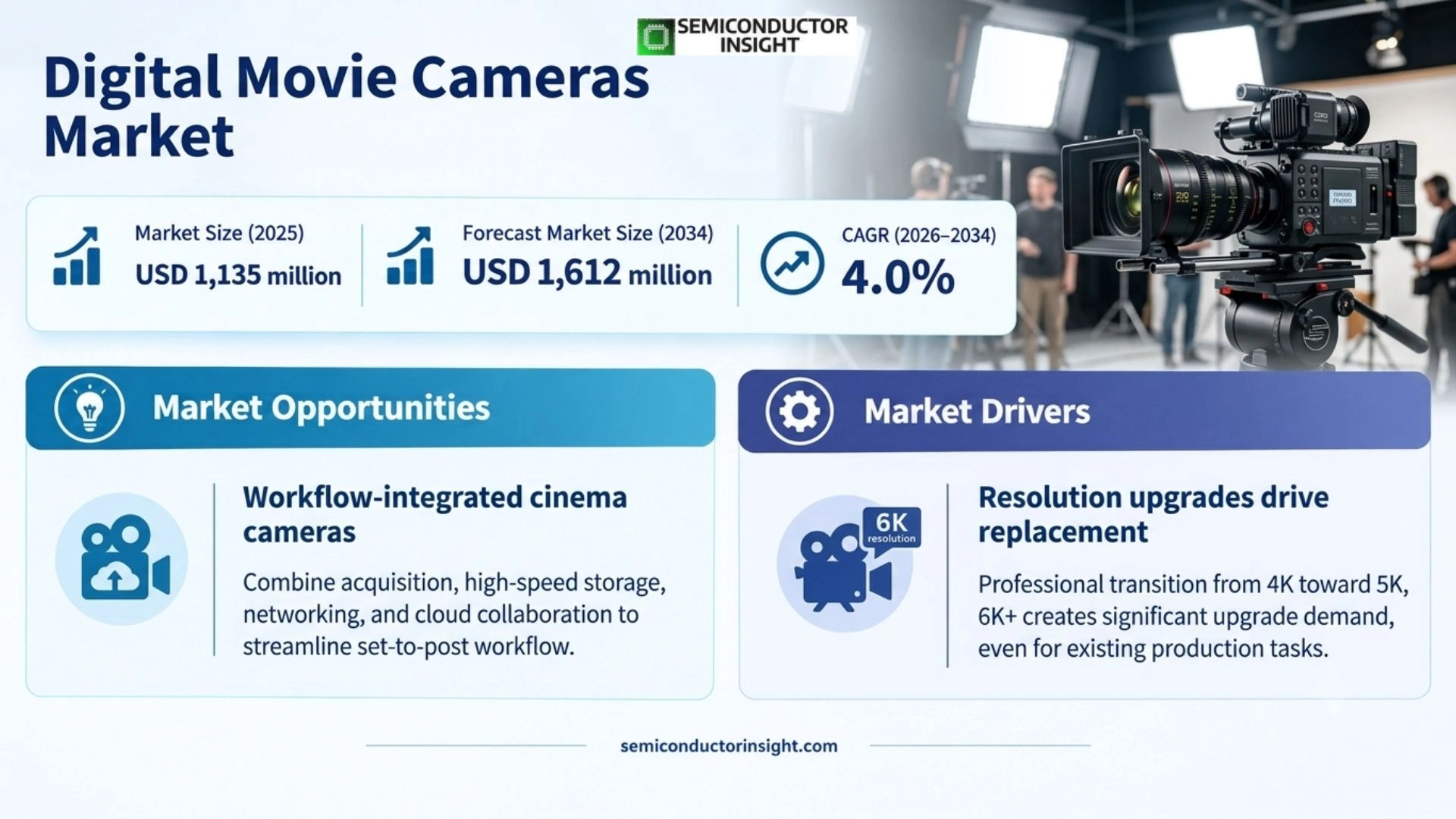
Digital Movie Cameras Market was was approximately USD 1.09 billion in 2024 and USD 1.49 billion in 2032, with a 2025 market size of USD 1,135 million, a 2034 projected value of USD 1,612 million, and a 4.0% CAGR for 2026–2034. North America is the largest regional market, supported by its concentration of film, television, streaming and rental infrastructure.
A digital movie camera is a professional or prosumer imaging system that records moving images electronically rather than onto photographic film. In cinema applications, the camera is not an isolated imaging device: it is the front end of a production chain that includes lenses, monitoring, recording media, colour management, on-set networking, post-production and final mastering. Camera purchasing therefore depends on how well the body fits the production workflow, how reliably it maintains image quality under demanding conditions, and whether the ecosystem can be reused across projects and crews.
The market spans professional cinema cameras used for feature films, scripted television, commercials, documentary work and premium streaming productions, together with lower-priced systems used by independent filmmakers, education, corporate production and enthusiast creators. The commercial boundary is defined by the report’s digital movie camera scope rather than by all interchangeable-lens video devices. This distinction matters because the highest-value demand is associated with professional image capture and production workflows, where dynamic range, colour science, RAW or log recording, lens compatibility and service infrastructure justify higher system prices.
Resolution remains a central market axis, but it is no longer the only one. 4K is widely established in professional acquisition, while 5K and 6K capture create additional flexibility for reframing, visual effects and finishing. Large-format sensors, advanced colour pipelines, high-speed recording and direct network connectivity are increasingly used to differentiate premium products. The customer requirement is therefore to preserve image quality while reducing workflow friction; suppliers respond by integrating storage, networking, autofocus, media management and on-set tools, expanding the commercial value of the camera body.
The market is changing now because cinema production has become more digital, distributed and data-intensive. Cameras increasingly connect to cloud collaboration, high-speed storage and broadcast or network protocols, while DCI continues to revise cinema-system specifications and HDR requirements. The result is a gradual shift from hardware-only competition to workflow competition, with suppliers trying to own a larger share of the production chain through media formats, connectivity, lenses, accessories, monitoring, software and services.
Segment Analysis: By Type
By type, the report identifies 4K Resolution, 5K Resolution, 6K Resolution and Others. 4K is the largest class because it balances image quality, storage, post-production burden and compatibility with established production workflows. 5K and 6K are growing faster as cinematographers and production teams increasingly value cropping flexibility, visual-effects headroom and large-format image capture, while other resolutions remain relevant in specialised and legacy applications.
| Type | Acquisition profile | Market position |
|---|---|---|
| 4K Resolution | Digital cinema acquisition around 4K provides a balance between detailed image capture and manageable data rates for editing, storage and finishing. It fits a broad range of professional and independent workflows and remains compatible with established production infrastructure. | Largest type. The commercial advantage comes from workflow compatibility and sufficient quality for mainstream production rather than maximum resolution. Suppliers compete through sensor performance, dynamic range, codecs, lens systems and reliable recording as they defend a mature but high-volume product class. |
| 5K Resolution | 5K capture provides additional pixels for reframing, stabilisation and post-production while retaining a manageable workflow for many professional projects. It often serves as a bridge between standard 4K delivery and higher-end large-format acquisition. | A growth-oriented category where added resolution is justified by production flexibility. Buyers are less interested in headline pixel count than in how much usable latitude the extra data provides without overwhelming storage, processing or media costs. |
| 6K Resolution | 6K systems provide substantial oversampling for 4K delivery and more room for creative cropping, visual effects and large-format presentation. They are particularly attractive where the same capture must serve multiple output formats or where post-production requires additional image latitude. | Fast-growing type. 6K adoption is helped by falling sensor and processing costs and by cameras that integrate high-speed media and network workflows. The segment remains premium, but the price-performance gap to 4K is narrowing as manufacturers reuse common electronics and processing platforms. |
| Others | Other resolutions cover specialised systems, legacy production formats and configurations outside the principal 4K–6K classes. Their demand is application-specific and can include niche production, high-speed capture or workflows where operational compatibility matters more than mainstream resolution. | A smaller category that remains commercially relevant because professional production environments retain equipment for long periods. Suppliers and rental houses can sustain these products where replacement would disrupt lenses, accessories, media and established crew workflows. |
Pricing and system value by resolution
Resolution affects product pricing, but premium camera economics are increasingly determined by the entire acquisition system. A 6K or higher camera can justify a higher price when it adds dynamic range, fast recording, reliable RAW workflows, larger-format sensors, networking or lens flexibility that reduces production friction. Conversely, a lower-resolution camera can remain commercially attractive when its ecosystem is deep, durable and rental-friendly. The buyer is therefore evaluating total production value rather than simply paying for more pixels, which makes sensor performance, media costs and accessory compatibility important parts of competitive positioning.
Segment Analysis: By Application
By application, the report groups demand into Professional Users and Amateur Users. Professional users drive the majority of economic value because production houses, rental fleets and working cinematographers purchase equipment based on reliability, image performance and workflow integration. Amateur users add a broader volume pool, but demand is more price-sensitive and more exposed to substitution from high-end mirrorless and hybrid cameras.
| Application | Demand characteristics |
|---|---|
| Professional Users | Professional demand is triggered by paid production requirements, camera rental fleet economics, cinematographer preference, project specifications and the need to integrate reliably with established lenses, monitoring and post-production workflows. Buyers care about consistency, support, serviceability and residual value because a camera failure or incompatible workflow can delay a commercial shoot or increase production cost. |
| Amateur Users | Amateur demand is driven by falling technology costs, creator activity, independent filmmaking and the desire to obtain cinematic image quality without a full rental or studio infrastructure. The purchasing decision weighs price, autofocus, ease of use, social-media compatibility and portability more heavily. Suppliers that simplify professional features into smaller bodies can expand the segment while maintaining clearer separation from flagship rental-focused systems. |
Regional Analysis
North America leads the digital movie camera market with approximately 35% of global demand on the report page, followed by Europe at around 20%. The region’s leadership reflects the concentration of Hollywood and streaming production, rental houses, post-production facilities and established cinematography networks. Asia Pacific is the fastest strategic growth region because local film and television production is expanding and manufacturers are increasingly targeting emerging creator and professional markets.
How does regional demand differ across the digital movie cameras market?
Regional camera demand varies according to the structure of the production ecosystem. North America benefits from deep professional rental fleets and studio demand. Europe combines high-end cinema production with strong public-service and commercial television markets. Asia Pacific has the strongest long-term expansion opportunity as local film industries, streaming services and independent production grow. Latin America remains closely linked to independent production and rental economics, while the Middle East & Africa are project- and broadcaster-led, with growth dependent on local production investment and distribution infrastructure.
| Region | Position | Growth outlook | Demand profile | Supplier selection |
|---|---|---|---|---|
| North America | Largest | High | Studio, streaming and rental-house led | Image performance, established rental ecosystems, service, lenses, workflow compatibility and residual value. |
| Europe | Second largest | Moderate-high | Cinema, television and commercial production | Colour science, reliability, lens ecosystem, service support and production-house familiarity. |
| Asia Pacific | Fastest strategic growth | Highest | Expanding film and streaming production | Price-performance, creator access, local service, ecosystem breadth and distribution reach. |
| Latin America | Smaller established market | Moderate | Independent production and rental led | Rental availability, total system cost, ruggedness and dealer support. |
| Middle East & Africa | Emerging base | Moderate | Project, broadcast and commercial production | Regional distribution, support, training and fit with mixed production workflows. |
Competitive Landscape
Competition is concentrated around manufacturers that combine sensor development, colour science, lens compatibility, media ecosystems and professional service. The market includes long-established camera brands, specialist cinema companies and fast-moving entrants that attack particular price or workflow niches. Rental houses are especially influential because one fleet decision can place a camera in many productions and shape cinematographer familiarity. The strongest commercial position therefore comes from combining technical credibility with a reliable support ecosystem, not from resolution alone.
The leading camera suppliers compete through combinations of sensor design, colour science, lens compatibility, recording formats and global professional distribution. Premium brands defend their position through long production histories, dependable field performance and strong relationships with rental houses and cinematographers, while workflow-focused challengers differentiate through high-resolution capture, integrated storage, networking and post-production connectivity. This creates several defensible competitive tiers rather than one uniform pricing structure.
Specialist cinema brands and imaging challengers compete by concentrating on particular performance-to-price or workflow niches. Some emphasise RAW flexibility, others focus on compact form factors, high-speed acquisition, large-format sensors or integrated cloud workflows. Because a camera can remain in a professional fleet for years, buyers evaluate lifecycle support, accessory compatibility, residual value and firmware continuity alongside image specifications, making ecosystem depth a major barrier to displacement.
Key Industry Players
| Player | Competitive role |
|---|---|
| Canon Inc. | Major professional imaging supplier with Cinema EOS and broad lens/electronics ecosystem. Competition is shaped by image quality, workflow fit, service support, price-performance and ecosystem compatibility rather than one specification in isolation. |
| Sony Group Corporation | Professional cinema and imaging supplier with VENICE and FX platforms and deep sensor capabilities. Competition is shaped by image quality, workflow fit, service support, price-performance and ecosystem compatibility rather than one specification in isolation. |
| Panasonic Holdings Corporation | Professional camera supplier spanning cinema and broader production workflows, including VariCam-family systems. Competition is shaped by image quality, workflow fit, service support, price-performance and ecosystem compatibility rather than one specification in isolation. |
| JVCKENWOOD Corporation | Professional video and production equipment supplier with camera and workflow products. Competition is shaped by image quality, workflow fit, service support, price-performance and ecosystem compatibility rather than one specification in isolation. |
| ARRI AG | High-end cinema specialist known for premium imaging systems, production reliability and established rental relationships. Competition is shaped by image quality, workflow fit, service support, price-performance and ecosystem compatibility rather than one specification in isolation. |
| Blackmagic Design Pty. Ltd. | Workflow-focused camera supplier integrating high-resolution capture, storage, networking and post-production tools. Competition is shaped by image quality, workflow fit, service support, price-performance and ecosystem compatibility rather than one specification in isolation. |
| RED Digital Cinema | Professional cinema camera specialist known for proprietary RAW workflows and high-end digital acquisition. Competition is shaped by image quality, workflow fit, service support, price-performance and ecosystem compatibility rather than one specification in isolation. |
| Vision Research (Ametek), Inc. (Phantom) | Specialised high-speed imaging supplier serving demanding technical and production applications. Competition is shaped by image quality, workflow fit, service support, price-performance and ecosystem compatibility rather than one specification in isolation. |
| Kinefinity | Cinema camera specialist focused on high-resolution professional systems and value-oriented configurations. Competition is shaped by image quality, workflow fit, service support, price-performance and ecosystem compatibility rather than one specification in isolation. |
| Nikon Corporation | Imaging company that acquired RED and is expanding its role in professional digital cinema cameras. Competition is shaped by image quality, workflow fit, service support, price-performance and ecosystem compatibility rather than one specification in isolation. |
| Hitachi, Ltd. | Professional imaging and broadcast technology supplier serving specialised video workflows. Competition is shaped by image quality, workflow fit, service support, price-performance and ecosystem compatibility rather than one specification in isolation. |
| Silicon Imaging | Digital cinema imaging participant with a niche position in professional acquisition systems. Competition is shaped by image quality, workflow fit, service support, price-performance and ecosystem compatibility rather than one specification in isolation. |
| Grass Valley (Belden Inc.) | Professional video technology supplier linked to production, broadcast and media infrastructure. Competition is shaped by image quality, workflow fit, service support, price-performance and ecosystem compatibility rather than one specification in isolation. |
| DJI | Imaging and stabilisation company extending camera-system adoption through integrated gimbal and production ecosystems. Competition is shaped by image quality, workflow fit, service support, price-performance and ecosystem compatibility rather than one specification in isolation. |
| Z CAM | Specialist cinema and compact professional camera supplier focused on flexible high-resolution systems. Competition is shaped by image quality, workflow fit, service support, price-performance and ecosystem compatibility rather than one specification in isolation. |
How competition is won
Winning a professional cinema account typically requires convincing more than one buyer. Cinematographers may prioritise image character and handling; rental houses focus on fleet utilisation, durability and accessory compatibility; production companies care about schedule reliability and post-production efficiency. Manufacturers that can satisfy all three groups create a stronger installed base, while brands that depend on one specification can lose momentum when a competing camera offers a better total workflow or economics.
Production Capacity Analysis
Production capacity for digital movie cameras depends on image-sensor sourcing, high-speed processing electronics, precision mechanical assembly, lens-mount manufacturing, recording-media integration, firmware development and quality assurance. Unlike commodity consumer cameras, professional cinema systems also require long product-support periods and service capacity because productions cannot tolerate unexpected failures. Capacity therefore needs to cover both physical unit output and the engineering and support infrastructure required to maintain a professional ecosystem.
The semiconductor layer includes image sensors, processors, high-speed memory interfaces and connectivity controllers. Manufacturers can reuse common electronics across camera families, but premium cinema products still require custom tuning for colour science, readout, thermal behaviour and recording reliability. The supply-chain constraint is therefore often a combination of component availability and engineering qualification. A sensor may exist in volume, but using it in a high-end cinema product can require months of tuning, firmware validation and production testing.
Mechanical and optical integration provides a second capacity gate. Professional bodies need robust mounts, thermal management, sealing, power systems, recording media interfaces and accessory compatibility. Rental fleets also demand long service lives, so suppliers must stock spare parts and maintain repair facilities well after the original production run. This means manufacturing capacity cannot be judged solely by body output; after-sales capacity can determine whether a brand is commercially credible with high-utilisation rental customers.
Capacity expansion is most valuable when it is paired with software and workflow scale. A new camera launch can increase demand for proprietary media, accessories, software tools and service training. Blackmagic’s URSA Cine platform illustrates how camera design is increasingly integrated with storage and networking, while Nikon’s RED acquisition illustrates the strategic value of combining technology platforms and professional distribution. The commercial implication is that future capacity will increasingly be organised around complete production ecosystems rather than stand-alone camera bodies.
Market Dynamics
The digital movie camera market is expanding steadily rather than explosively because digital acquisition is already mature in professional production. Growth comes from specification upgrades, new production formats, replacement of ageing fleets and expansion of independent and streaming content. The strongest forces are higher resolution, larger sensor formats, better dynamic range, faster recording and connected workflows, while restraints include premium equipment saturation, rental-driven procurement and competition from high-end hybrid cameras that can meet some professional needs at lower cost.
Market Drivers
| Driver | Directional impact* | Commercial mechanism |
|---|---|---|
| Higher-resolution acquisition | High | Production teams use 5K and 6K capture to gain reframing and visual-effects latitude, creating upgrade demand even where final delivery remains 4K. The customer requirement drives product response through sensor, processing and workflow innovation, which then changes supplier positioning and increases the market’s value per active production user. |
| Streaming production growth | Medium-high | More scripted and unscripted digital content expands professional camera utilisation and replacement demand across studios and rental fleets. The customer requirement drives product response through sensor, processing and workflow innovation, which then changes supplier positioning and increases the market’s value per active production user. |
| Workflow connectivity | Medium | High-speed networking, direct storage and cloud-oriented workflows create value by reducing on-set data friction and expanding the role of the camera system. The customer requirement drives product response through sensor, processing and workflow innovation, which then changes supplier positioning and increases the market’s value per active production user. |
| Independent and prosumer growth | Medium | Lower-cost cinema platforms bring professional features to smaller crews, expanding the addressable user base and creating upgrade paths into higher-end products. The customer requirement drives product response through sensor, processing and workflow innovation, which then changes supplier positioning and increases the market’s value per active production user. |
Resolution upgrades create replacement demand
The professional move from 4K toward 5K, 6K and higher-resolution systems creates a form of upgrade demand even when the underlying production requirement has not changed. Higher capture resolution can reduce reframing compromises, support visual effects and create deliverables for different screen formats. Suppliers benefit when they can deliver these advantages without a proportional increase in storage, workflow complexity or price. The result is a market where customers can justify replacement through workflow flexibility rather than waiting for a camera to become physically obsolete.
Streaming expands professional camera utilisation
The growth of streaming has increased the number and variety of scripted, unscripted and documentary projects requiring professional acquisition. This expands the utilisation of both owned and rented camera fleets, creating more frequent replacement opportunities as hours of use accumulate. Rental houses are especially important because they consolidate demand from many productions. Manufacturers that become standard rental options can therefore convert broader content growth into repeat fleet purchases rather than relying solely on direct sales to individual productions.
Connected production workflows increase system value
Professional camera value increasingly includes what happens after exposure. Blackmagic’s URSA Cine platform integrates high-speed internal storage, 10G Ethernet and cloud-oriented workflows, illustrating a broader shift toward networked acquisition. The customer requirement is faster movement of high-resolution media from set to editorial and collaboration teams; the supplier response is to integrate networking and storage into the camera ecosystem. Commercially, this increases the value of the camera but also raises switching costs because workflows become tied to particular media and software paths.
Independent production widens the customer base
Independent filmmakers and prosumer creators increasingly expect cinema features such as log recording, high dynamic range, interchangeable mounts, RAW or high-quality codecs and professional monitoring at lower prices. This creates an opportunity for established brands and specialists to move professional-grade technologies down the price curve. The market impact is twofold: the total user base grows, and successful prosumer users create a future upgrade pipeline toward professional systems as their production budgets and distribution requirements increase.
Market Restraints
| Restraint | Directional impact* | Commercial mechanism |
|---|---|---|
| High-end market saturation | Medium | Premium cinema demand is concentrated among a finite set of major production and rental customers, limiting unit growth in the flagship segment. The restraint affects demand by changing the buyer’s total cost calculation. Manufacturers therefore need to make the technical improvement translate into lower production friction or higher creative value rather than relying only on specifications. |
| Rental purchase cycles | Medium | Rental houses buy in fleet waves, so manufacturers can face long gaps between major purchases even when cameras remain heavily utilised. The restraint affects demand by changing the buyer’s total cost calculation. Manufacturers therefore need to make the technical improvement translate into lower production friction or higher creative value rather than relying only on specifications. |
| Hybrid-camera substitution | Medium | High-end mirrorless and hybrid systems can satisfy selected independent and commercial workloads, placing price pressure on specialised cinema bodies. The restraint affects demand by changing the buyer’s total cost calculation. Manufacturers therefore need to make the technical improvement translate into lower production friction or higher creative value rather than relying only on specifications. |
| Data and storage burden at high resolution | Low | Larger files increase media, backup and post-production costs, which can slow adoption when the image-quality benefit is not commercially necessary. The restraint affects demand by changing the buyer’s total cost calculation. Manufacturers therefore need to make the technical improvement translate into lower production friction or higher creative value rather than relying only on specifications. |
Flagship saturation limits unit expansion
The premium end of the market is protected by high technical expectations but constrained by the size of its core buyer base. Major studios and top rental houses cannot purchase unlimited quantities of the most expensive cinema systems, particularly when existing fleets remain productive and accessory ecosystems remain compatible. Manufacturers must therefore use product refreshes, workflow improvements and new sensor formats to create enough operational value to justify fleet upgrades, while avoiding a cycle of feature inflation that customers do not monetise.
Rental economics reduce the predictability of direct sales
Premium camera systems frequently move through rental houses, which can purchase large numbers of units but on a project and fleet-replacement cadence. A manufacturer can therefore have a strong production season without seeing an immediate proportional increase in end-user purchases. The commercial response is to build long-lived rental relationships, support spare parts and ensure accessories remain compatible across generations. Rental-led demand is not a weakness by itself; the restraint is that it makes revenue timing more cyclical than the underlying number of productions.
Hybrid cameras can absorb lower-budget workflows
High-end mirrorless and hybrid cameras increasingly deliver strong codecs, autofocus, stabilisation, large sensors and high resolutions that are sufficient for selected commercial, documentary and independent work. This does not eliminate the dedicated cinema market because professional productions still value robust thermal design, recording reliability, modularity and long-term service, but it narrows the gap in some projects. Dedicated cinema suppliers therefore face pressure to demonstrate why a larger system adds operational or creative value beyond basic image quality.
High-resolution workflows increase total production costs
More pixels create more data, and professional teams must budget for faster media, larger storage pools, backups, transfer bandwidth and post-production processing. A higher-resolution camera can therefore increase costs across the production chain even when the body price is acceptable. The commercial restraint appears when crews do not need the extra flexibility that 5K or 6K provides. Suppliers can mitigate this by improving compression efficiency, media integration and workflow tooling so the buyer can capture high-resolution material without a disproportionate production penalty.
Market Opportunities
Workflow-integrated cinema cameras
Cameras that combine acquisition, fast media, networking and cloud collaboration can capture value beyond the body itself. Blackmagic’s URSA Cine demonstrates this direction through internal high-speed storage, 10G Ethernet and cloud-oriented transfer. Suppliers benefit where production teams want fewer handoffs between set and post-production. The commercial implication is stronger ecosystem attachment and an opportunity to earn through media, software, accessories and workflow services alongside the camera body.
Large-format and higher-resolution systems
The continued shift toward 5K, 6K and large-format sensors creates premium opportunities where visual effects, reframing and large-screen presentation justify additional capture headroom. Suppliers that can combine resolution with manageable data rates and established lens systems can move buyers upward in value tier. The opportunity is particularly strong among rental fleets that need equipment capable of serving multiple production specifications with one camera platform.
Independent production and prosumer conversion
Lower-cost cinema products can attract independent filmmakers who need professional image characteristics without the budget of a major studio. Manufacturers can design simplified professional interfaces, compact bodies and flexible mounts to capture this group. The commercial implication extends beyond initial volume: creators who grow into larger productions can later become rental, studio or professional customers, producing an upgrade funnel from value products into higher-margin cinema ecosystems.
Professional cinema ecosystem consolidation
Nikon’s acquisition of RED shows that camera manufacturers see strategic value in combining imaging technology, professional cinema know-how and distribution. Other suppliers can respond by broadening their ecosystems through lenses, monitoring, media, software, service and rental support. The opportunity is strongest where a camera brand can make itself operationally sticky across multiple stages of production, reducing customer switching even when competitors match headline sensor specifications.
Supply Chain Analysis
Image sensors, processors, memory interfaces, power and connectivity devices
PCB assemblies, chassis, thermal systems, lens mounts, displays and control interfaces
Colour science, codecs, autofocus, RAW workflows, thermal testing and reliability validation
Distribution, rental fleets, cinematographer adoption, accessories, repairs and post-production integration
The first stage captures semiconductor and sensor value. Camera manufacturers depend on high-quality image sensors, processing ASICs, memory interfaces and connectivity components, but the commercially relevant challenge is not only obtaining those parts. Premium cinema products need image pipelines tuned for colour, dynamic range, readout and recording reliability. Suppliers with deeper control of image processing and firmware can extract more value from the same sensor architecture, making software and calibration an important part of supply-chain differentiation.
The second stage is camera electronics and mechanical integration. A professional cinema body must manage heat, power, shock, lens interfaces, recording media and user controls while maintaining repeatable performance over long production days. The supplier therefore captures value through precision assembly and quality testing rather than simple component aggregation. Manufacturing bottlenecks can appear in specialised mounts, displays, thermal components or custom boards even when commodity electronics are available in volume.
The third stage is imaging firmware, codecs and validation. This is where suppliers turn components into a production instrument through colour science, autofocus algorithms, recording formats, media control and thermal management. Every firmware release becomes part of product value because productions require predictable behaviour across long shoots. Manufacturers with mature validation processes can support multiple resolutions and recording modes without creating unacceptable field failure rates, which strengthens brand credibility in rental and studio fleets.
The fourth stage is the professional ecosystem of dealers, rental houses, cinematographers and service centres. Rental companies influence purchasing because they can introduce cameras to many productions, while service centres protect the value of installed fleets. Manufacturers that support repairs, spare parts, training and accessory compatibility can extend product life and maintain customer trust. This ecosystem stage often determines whether technical superiority converts into sustained market share, because production buyers are reluctant to risk a schedule on unsupported equipment.
Recent Developments
February 19, 2026
DCI approved the High Dynamic Range D-Cinema Addendum v1.2.2, defining HDR reference-display requirements and tolerances around critical image parameters for review rooms and exhibition theatres. The development matters to camera suppliers because professional acquisition is increasingly evaluated as part of an end-to-end colour and display workflow rather than as a standalone recording device. DCI.
January 29, 2026
DCI approved Digital Cinema System Specification v1.5.0, continuing the revision cycle that began with the original 2006 specification. The ongoing standards process reinforces interoperability, security and consistent technical performance as cinema equipment evolves. For camera manufacturers, standards work supports buyer confidence and encourages suppliers to design products that fit a wider production and exhibition ecosystem. DCI Specification.
April 12, 2024
Nikon announced completion of the acquisition of RED.com after acquiring 100% of the company. Nikon stated that RED would remain a wholly owned subsidiary and that the combination would support expansion of the professional digital cinema camera market. The development is structurally important because it adds another major imaging group to the strategic consolidation of professional cinema technology. Nikon.
Current product cycle
Blackmagic continues to market URSA Cine systems at 12K and 17K, with large-format RGBW sensors, up to 16 stops of dynamic range and high-speed Ethernet options. The platform also integrates internal high-capacity storage and cloud-oriented media workflows. The significance is that camera competition is shifting toward complete data and collaboration systems, not only sensor resolution. Blackmagic Design.
Current professional product portfolio
Professional camera makers continue to release bodies that move beyond simple resolution upgrades into sensor-format, workflow and networking improvements. Canon, Sony, ARRI, Panasonic, Blackmagic and Nikon/RED each occupy different points on that spectrum, reinforcing a market structure where buyers evaluate imaging performance together with lenses, media, service and production compatibility.
Report Scope & Segmentation
| Attribute | Details |
|---|---|
| Report title | Digital Movie Cameras Market, Global Business Strategies 2025-2032. The client page provides the controlling published scope and market anchors. |
| 2025 market size | USD 1,135 million. |
| 2034 projected size | USD 1,612 million. |
| CAGR | 4.0% for 2026–2034. |
| By Type | 4K Resolution; 5K Resolution; 6K Resolution; Others. |
| By Application | Professional Users; Amateur Users. |
| Regions | North America; Europe; Asia Pacific; Latin America; Middle East & Africa. |
| Company universe | Canon Inc.; Sony Group Corporation; Panasonic Holdings Corporation; JVCKENWOOD Corporation; ARRI AG; Blackmagic Design Pty. Ltd.; RED Digital Cinema; Vision Research (Ametek), Inc. (Phantom); Kinefinity; Nikon Corporation; Hitachi, Ltd.; Silicon Imaging; Grass Valley (Belden Inc.); DJI; Z CAM. |
Frequently Asked Questions
What is the digital movie cameras market size in 2025?
The global market is approximately USD 1,135 million in 2025, with the outlook extending through 2034.
What is the projected 2034 market size?
The market reaches approximately USD 1,612 million by 2034, with growth continuing across the 2025–2034 outlook.
What CAGR applies from 2026 to 2034?
The market is expected to grow at approximately 4.0% during 2026–2034, supported by professional production upgrades, higher-resolution acquisition and broader digital workflows.
Which resolution class is largest?
4K Resolution is the largest class because it provides a practical balance between image quality, storage requirements and compatibility with professional production workflows. Higher-resolution 5K and 6K products are growing as production teams seek additional reframing and visual-effects flexibility.
Which application group is economically dominant?
Professional Users represent the core value pool because studios, production companies, rental houses and professional cinematographers purchase or rent systems based on reliability, imaging quality, workflow integration and service support.
Which region leads the market?
North America is the leading region, representing approximately 35% of global market demand on the report page. Europe follows at about 20%, while Asia Pacific is described as a promising growth region because local film and production ecosystems are expanding.
Why are rental houses important?
Rental houses are influential because they purchase fleets that can be used across many productions. A camera accepted into a rental fleet gains exposure to multiple crews and cinematographers, while manufacturers benefit from recurring fleet replacement opportunities. Rental economics also make reliability, service and accessory compatibility important purchasing criteria.
Why are 5K and 6K cameras growing?
5K and 6K systems provide additional pixels for reframing, visual effects and multiple delivery formats. The market opportunity is strongest where the workflow can absorb the higher data volume and where the production benefits from additional image flexibility.
What recent development changed competitive structure?
Nikon completed its acquisition of RED in April 2024, bringing RED’s professional digital cinema technology into Nikon’s imaging business. Nikon said the combination was intended to support expansion in the professional digital cinema camera market, reinforcing the importance of ecosystem scale and strategic consolidation.
Which companies are covered in the competitive universe?
The report page profiles Canon, Sony, Panasonic, JVCKENWOOD, ARRI, Blackmagic Design, RED Digital Cinema, Vision Research, Kinefinity, Nikon, Hitachi, Silicon Imaging, Grass Valley, DJI and Z CAM. The market spans large imaging companies, specialist cinema brands and workflow-oriented challengers.

Get Sample Report PDF for Exclusive Insights
Report Sample Includes
- Table of Contents
- List of Tables & Figures
- Charts, Research Methodology, and more...
 Download Sample Report PDF


