Dicing Blade Market, Trends, Business Strategies 2026-2034

Dicing Blade market was valued at USD 1,312 million in 2025 and is expected to reach USD 1,838 million by 2034, growing at a CAGR of 4.7% during the forecast period.

PDF Icon Download Sample Report PDF
  • Quick Dispatch

    All Orders

  • Secure Payment

    100% Secure Payment

Price range: $1,500.00 through $4,250.00

Clear

Dicing Blade Market Insights

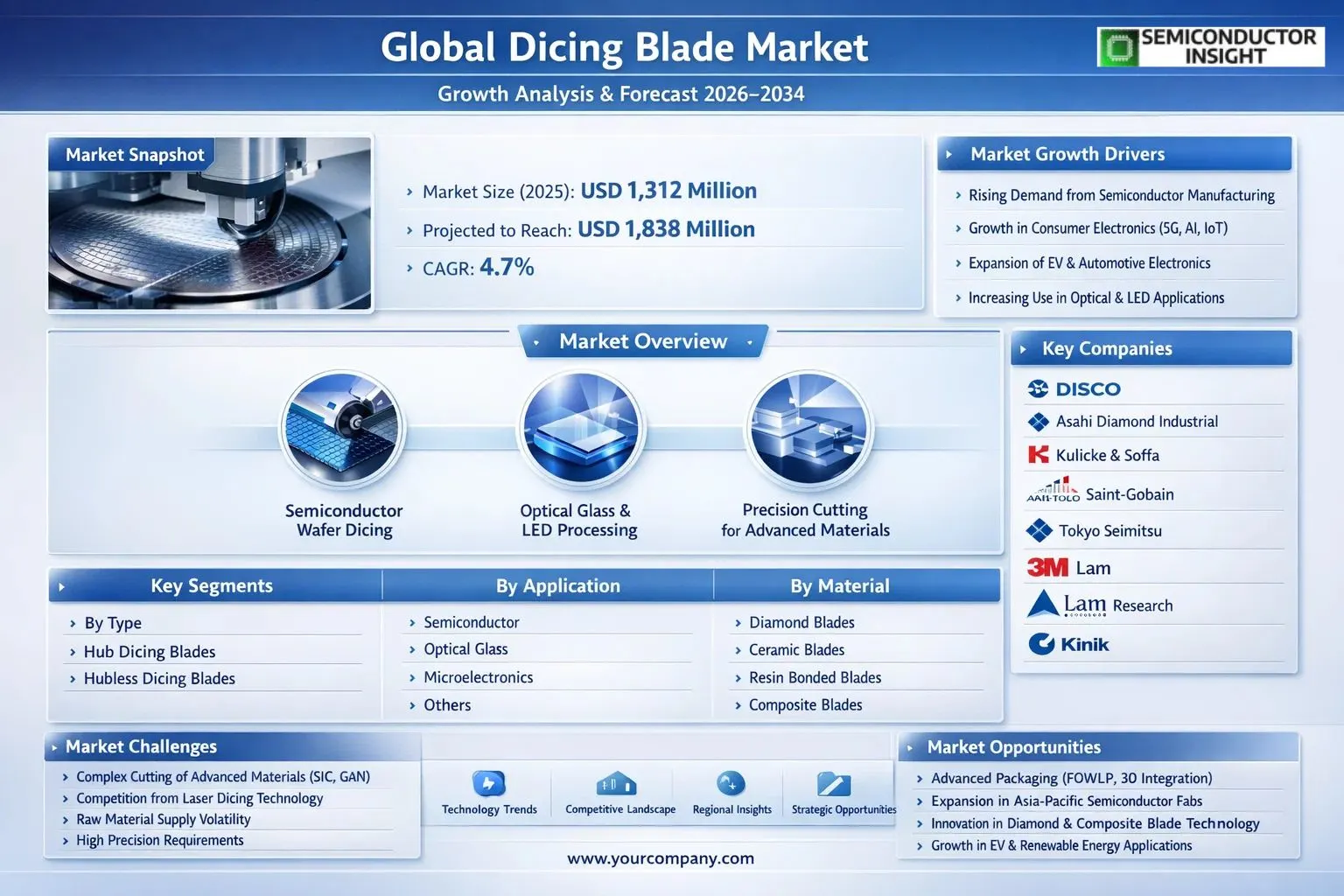
Dicing Blade market size was valued at USD 1,312 million in 2025. The market is projected to grow from USD 1,373 million in 2026 to USD 1,838 million by 2034, exhibiting a CAGR of 4.7% during the forecast period.

A Dicing Blade is a precision cutting tool engineered for slicing thin, high-value materials such as semiconductor wafers, optical glass, LEDs, and integrated circuits. Typically fabricated from diamond particles, superhard metals, or advanced ceramics, dicing blades deliver exceptional hardness and wear resistance essential for maintaining dimensional accuracy in critical manufacturing processes. The three principal blade categories , Diamond Dicing Blades, suited for hard substrates such as silicon wafers, gallium arsenide, and sapphire; Ceramic Dicing Blades, designed for softer materials including electronic packaging components and optical elements; and Resin Bonded Dicing Blades, preferred in mass production settings for their cost-effectiveness on medium-hardness substrates , collectively address a broad spectrum of industrial cutting requirements.

The market is gaining steady momentum, driven primarily by accelerating demand from the global semiconductor industry, where the proliferation of 5G, artificial intelligence, and IoT technologies continues to intensify wafer production volumes. Furthermore, expanding applications in optics, LED display manufacturing, and electric vehicle battery component processing are broadening the demand base for precision dicing solutions. Key market participants such as DISCO Corporation, Asahi Diamond Industrial, and Kulicke & Soffa Industries maintain strong competitive positions through continuous investment in blade technology, product quality, and manufacturing scale.
Dicing Blade Market Insights

MARKET DRIVERS

Surging Demand from Semiconductor and Electronics Manufacturing

Dicing Blade market is experiencing robust growth, primarily driven by the accelerating expansion of the semiconductor industry. As the demand for miniaturized, high-performance electronic components continues to rise, precision wafer dicing has become an indispensable process in chip fabrication. Dicing blades are critical tools used to cut semiconductor wafers into individual dies, and their quality directly impacts the yield and performance of finished chips. The widespread proliferation of consumer electronics, including smartphones, tablets, wearables, and laptops, has sustained high production volumes at semiconductor fabrication facilities worldwide, creating consistent demand for advanced dicing consumables.

Growth in Automotive Electronics and EV Applications

The rapid transition toward electric vehicles (EVs) and advanced driver-assistance systems (ADAS) has introduced a significant new demand vector for the dicing blade market. Power semiconductors, including silicon carbide (SiC) and gallium nitride (GaN) devices used in EV powertrains and charging infrastructure, require highly specialized dicing processes. These wide-bandgap materials are considerably harder and more brittle than conventional silicon, necessitating advanced diamond dicing blades capable of maintaining tight tolerances and minimizing chipping. Automotive-grade semiconductor production volumes have been scaling steadily, reinforcing capital investments in precision dicing equipment and associated consumables such as dicing blades.

The accelerating global transition to electric mobility is expected to remain one of the most significant long-term drivers for the dicing blade market, as power semiconductor content per vehicle continues to increase substantially compared to conventional internal combustion engine platforms.

Furthermore, the ongoing advancement of 5G telecommunications infrastructure and the rollout of high-frequency RF components are creating additional demand for compound semiconductor wafer dicing. The dicing blade market benefits from these multi-industry tailwinds, with manufacturers continually developing blades with enhanced bond systems, diamond grit distributions, and hub geometries to address the evolving material requirements of next-generation semiconductor devices.

MARKET CHALLENGES

Technical Complexities Associated with Advanced Substrate Materials

One of the primary challenges confronting the dicing blade market is the increasing material complexity of modern semiconductor substrates. The industry’s shift toward compound semiconductors such as SiC, GaN, indium phosphide (InP), and lithium niobate (LiNbO₃) presents significant processing difficulties. These materials exhibit high hardness, thermal sensitivity, and fracture-prone characteristics that make conventional dicing approaches insufficient. Developing blades that can consistently deliver clean cuts, low edge chipping, and acceptable blade life on such substrates demands continuous R&D investment and close collaboration between blade manufacturers and end-users. Inconsistent dicing outcomes can result in elevated die loss rates, directly impacting the profitability of semiconductor manufacturers.

Other Challenges

Competition from Laser Dicing Technologies

The growing adoption of laser dicing and stealth dicing techniques poses a structural challenge to the conventional dicing blade market. Laser-based methods offer advantages in processing ultra-thin wafers, fragile substrates, and small die geometries without physical contact, reducing the risk of mechanical damage. As laser dicing equipment costs decline and process maturity improves, a portion of the addressable market for mechanical dicing blades may be displaced, particularly in advanced logic and memory chip manufacturing segments where wafer thicknesses continue to shrink.

Supply Chain Volatility and Raw Material Constraints

Dicing blade manufacturers depend on consistent access to synthetic diamond abrasives, precision metal bond materials, and resinoid components. Fluctuations in the availability and pricing of these raw materials, often influenced by global supply chain disruptions, trade policy changes, and energy cost dynamics, can negatively affect production economics. Smaller blade manufacturers with limited procurement leverage may face margin compression during periods of input cost escalation, constraining their ability to invest in product development or capacity expansion within the dicing blade market.

MARKET RESTRAINTS

High Capital Investment Requirements and Blade Lifecycle Limitations

A notable restraint within the dicing blade market is the relatively short operational lifespan of dicing blades, which results in recurring consumable costs for semiconductor manufacturers. While this creates a steady replacement demand, it also prompts end-users to seek cost-reduction strategies, including blade dressing optimization, reduced feed rates, and extended blade reuse protocols. Manufacturers operating on thin margins may delay consumable procurement or standardize on lower-cost blade variants, potentially limiting revenue growth for premium blade suppliers. Additionally, the high precision machinery required for blade dicing represents a substantial capital commitment, which may deter smaller or emerging semiconductor packaging operations from scaling their dicing capacity.

Geopolitical Pressures and Export Control Regulations

The semiconductor industry, and by extension the dicing blade market, is increasingly exposed to geopolitical tensions and evolving export control frameworks, particularly those governing the transfer of precision manufacturing equipment and advanced materials between major economies. Regulatory restrictions can disrupt established supply chains, limit market access, and introduce compliance costs for both blade manufacturers and their customers. Companies with globally distributed production and customer bases must navigate an increasingly complex regulatory landscape, which can slow market expansion and increase operational overhead in key regional markets.

MARKET OPPORTUNITIES

Expansion of Advanced Packaging Technologies and Heterogeneous Integration

The widespread adoption of advanced semiconductor packaging formats, including fan-out wafer-level packaging (FOWLP), chip-on-wafer-on-substrate (CoWoS), and 2.5D/3D integration architectures, is creating meaningful new opportunities for the dicing blade market. These packaging technologies involve precision singulation of reconstituted wafers, interposers, and multi-die assemblies, often requiring application-specific blade formulations. As leading-edge logic and high-bandwidth memory (HBM) production scales to support artificial intelligence (AI) and data center workloads, the volume and technical diversity of dicing requirements is set to expand, driving demand for specialized blade products tailored to these emerging process nodes and substrate configurations.

Growing Semiconductor Manufacturing Investments in Asia-Pacific and Emerging Markets

Significant government-backed and private-sector investments in new semiconductor fabrication and advanced packaging facilities across Asia-Pacific, including expansions in Taiwan, South Korea, Japan, India, and Southeast Asia, are expected to generate substantial incremental demand for dicing consumables. The dicing blade market stands to benefit directly from greenfield fab construction and capacity ramp-up activities, as new production lines require qualification and stocking of dicing blades across multiple substrate types. Additionally, the development of domestic semiconductor ecosystems in regions such as India and parts of Southeast Asia represents a nascent but growing opportunity for blade suppliers to establish early-mover advantages through technical partnerships and localized support infrastructure.

Innovation in Blade Formulations for Next-Generation Device Requirements

Ongoing material science innovation presents a compelling opportunity for dicing blade manufacturers to differentiate through proprietary bond systems, optimized diamond concentration profiles, and novel hub designs engineered for specific substrate-die combinations. As device geometries shrink and substrate materials diversify, the technical barrier to entry for high-performance blade development increases, favoring established manufacturers with deep application expertise. Investment in application engineering capabilities and close collaboration with semiconductor OEMs during process qualification stages can enable blade suppliers to secure long-term supply agreements, creating durable revenue streams and reinforcing competitive positioning within Dicing Blade market.

MAIN TITLE HERE () Trends


Semiconductor Industry Expansion Fueling Demand for Dicing Blades

The Dicing Blade Market is witnessing robust momentum, largely propelled by the accelerating growth of the global semiconductor industry. As technologies such as 5G, artificial intelligence, and the Internet of Things become increasingly mainstream, the demand for precision-cut semiconductor wafers has intensified significantly. Dicing blades , engineered from diamond particles, superhard metals, or ceramics , are integral to the fabrication of integrated circuits, MEMS devices, and optical chips. The push toward chip miniaturization and enhanced performance has placed greater emphasis on high-precision cutting tools, making dicing blades a critical component in modern electronics manufacturing. Asia-Pacific, particularly China, Japan, and South Korea, continues to represent a dominant regional market due to its concentration of semiconductor fabrication facilities and electronics manufacturers.

Other Trends

Adoption of Laser-Assisted Cutting Technology

One of the most prominent technological trends shaping the Dicing Blade Market is the integration of laser-assisted cutting technology. This advancement significantly reduces thermal effects during the cutting process, resulting in improved precision and lower material damage rates. Manufacturers are increasingly combining conventional blade dicing with laser scribing techniques to handle ultra-thin wafers and fragile substrates more effectively. This hybrid approach is particularly relevant in the production of advanced LED displays and optical components, where material integrity is paramount.

Rise of Diamond-Coated and Composite Material Blades

Innovation in blade materials is another key trend within the Dicing Blade Market. Diamond-coated blades are gaining traction due to their superior durability and extended service life compared to conventional variants. Simultaneously, composite material blades , which combine the properties of multiple materials , are being adopted for their ability to improve cutting efficiency across a range of substrate hardness levels. These developments are particularly beneficial in high-volume manufacturing environments where consistent blade performance directly impacts yield rates and operational costs.

Electric Vehicle and Renewable Energy Sectors Creating New Growth Avenues

Beyond semiconductors and optics, the Dicing Blade Market is experiencing growing demand from the electric vehicle and new energy sectors. Precision cutting tools are essential in the manufacture of battery components and power electronics used in EV powertrains and energy storage systems. As global EV adoption accelerates and governments expand renewable energy infrastructure, the need for reliable, high-performance dicing solutions in these applications is expected to strengthen. Leading market participants, including DISCO Corporation, Asahi Diamond Industrial, and Saint-Gobain, are actively investing in product development to address these evolving downstream requirements and maintain competitive positioning in an increasingly dynamic marketplace.

COMPETITIVE LANDSCAPE

Key Industry Players

Global Dicing Blade Market: Competitive Dynamics, Leading Manufacturers, and Strategic Positioning (2025–2034)

Dicing Blade market, valued at approximately USD 1,312 million in 2025 and projected to reach USD 1,838 million by 2034 at a CAGR of 4.7%, is characterized by a moderately concentrated competitive structure dominated by a handful of technologically advanced players. DISCO Corporation stands as the undisputed market leader, leveraging decades of expertise in precision cutting equipment and consumables, including hub and hubless dicing blades engineered for semiconductor wafers, MEMS, optical chips, and integrated circuits. Alongside DISCO, companies such as Asahi Diamond Industrial, Tokyo Seimitsu, and Saint-Gobain command significant market share through robust R&D capabilities, extensive distribution networks, and long-standing relationships with tier-1 semiconductor and electronics manufacturers. These incumbents continue to invest in advanced technologies such as laser-assisted cutting, diamond-coated blades, and composite material formulations to strengthen their competitive moats. The Asia-Pacific region , particularly Japan, China, South Korea, and Southeast Asia , remains the epicenter of both production and consumption, given the concentration of semiconductor fabrication and LED manufacturing facilities in this geography.

Beyond the dominant players, the dicing blade competitive landscape is increasingly being shaped by emerging regional manufacturers and specialty suppliers targeting niche application segments. Companies such as Kinik, UKAM, Kulicke & Soffa Industries, and Shanghai Sinyang are carving out competitive positions by offering cost-effective alternatives and application-specific blade solutions for optical glass, microelectronics, and electric vehicle battery component processing. The proliferation of 5G, AI, and IoT technologies has intensified downstream demand, prompting smaller entrants , including Lande Precision Tools, Hongye Cutting Tools, and Suzhou Sail Science & Technology , to accelerate product development cycles and expand their customer bases across Asia and Europe. While large manufacturers benefit from economies of scale and superior material sourcing, competitive pressure continues to compress margins industry-wide, driving innovation in resin-bonded and ceramic blade technologies. Raw material volatility, particularly in industrial diamond supply chains, remains a key risk factor influencing the strategic sourcing and pricing decisions of all market participants.

List of Key Dicing Blade Companies Profiled

Segment Analysis:

Segment Category Sub-Segments Key Insights
By Type
  • Hub Dicing Blades
  • Hubless Dicing Blades
Hub Dicing Blades represent the leading segment within the dicing blade market by type, owing to their structural rigidity and suitability for high-speed, high-precision cutting operations in semiconductor wafer processing.

  • Hub dicing blades are widely favored in semiconductor fabrication environments due to their superior stability during high-velocity cutting, which minimizes chipping and micro-cracking on sensitive wafer surfaces.
  • Their design allows for easy mounting and alignment in automated dicing equipment, making them highly compatible with modern semiconductor manufacturing lines where throughput and precision are paramount.
  • Hubless dicing blades, while increasingly preferred for ultra-thin wafer applications and fine-pitch cutting, continue to serve a complementary role, particularly in advanced packaging and MEMS device production where kerf width reduction is a critical requirement.
By Application
  • Semiconductor
  • Optical Glass
  • Microelectronics
  • Others
Semiconductor stands as the dominant application segment, driven by the relentless pace of chip miniaturization, the proliferation of 5G infrastructure, and the expanding role of artificial intelligence and IoT-connected devices across global industries.

  • The semiconductor application demands dicing blades of exceptional hardness and thermal stability, as the cutting process must preserve the integrity of increasingly thin and densely packed integrated circuits, MEMS sensors, and optical chips.
  • Optical Glass is emerging as a high-growth application area, fueled by the surge in demand for precision-cut optical components used in smartphones, automotive LiDAR systems, and advanced display technologies, where dimensional accuracy is non-negotiable.
  • The Microelectronics segment benefits from ongoing miniaturization trends in consumer electronics and wearable devices, necessitating blades capable of delivering clean, burr-free cuts on extremely delicate substrates without compromising component reliability.
By End User
  • Semiconductor Manufacturers
  • Electronics & Microelectronics Companies
  • Optical Component Producers
  • LED Manufacturers
  • Others (EV Battery & New Energy Producers)
Semiconductor Manufacturers constitute the foremost end-user group in the dicing blade market, as the production of integrated circuits, memory chips, and power devices fundamentally relies on precision dicing at multiple stages of wafer fabrication.

  • Leading semiconductor fabricators consistently invest in advanced dicing blade technologies to support the transition toward smaller node geometries, requiring blades that can maintain cutting precision across heterogeneous materials without introducing structural defects.
  • LED manufacturers represent a rapidly growing end-user category, particularly as demand for energy-efficient lighting solutions and high-brightness displays continues to expand across consumer, automotive, and industrial sectors, each requiring precise sapphire and compound semiconductor substrate cutting.
  • The emerging segment of electric vehicle and new energy technology producers is increasingly contributing to end-user demand, as the precision cutting of battery management components and power electronics substrates becomes integral to next-generation EV architecture development.
By Material Composition
  • Diamond Dicing Blades
  • Ceramic Dicing Blades
  • Resin Bonded Dicing Blades
  • Composite Material Blades
Diamond Dicing Blades lead the material composition segment due to their unmatched hardness, wear resistance, and ability to deliver ultra-precise cuts on the hardest substrates encountered in semiconductor and optical manufacturing processes.

  • Diamond blades are indispensable for cutting silicon wafers, gallium arsenide, and sapphire substrates, where the combination of extreme hardness and minimal thermal impact during cutting is essential to preserving the functional integrity of the processed material.
  • Ceramic dicing blades serve a distinct and growing niche within softer material processing, including electronic packaging and optical component fabrication, where their controlled abrasiveness provides clean surface finishes without the risk of excessive material stress or fracture propagation.
  • Resin bonded blades are increasingly attractive in high-volume production environments due to their cost-effectiveness and moderate cutting efficiency, offering manufacturers a practical balance between performance and operational expenditure across medium-hardness material applications.
By Technology
  • Conventional Dicing Blades
  • Laser-Assisted Dicing Blades
  • Diamond-Coated Dicing Blades
Conventional Dicing Blades continue to hold strong market presence as the established technology backbone for standard wafer and substrate dicing operations, offering broad compatibility with existing dicing equipment deployed across semiconductor and electronics manufacturing facilities worldwide.

  • Laser-assisted dicing blade technology is gaining considerable traction as manufacturers seek to minimize thermal stress, reduce kerf loss, and improve overall cutting accuracy, particularly when processing ultra-thin and fragile substrates that are prone to cracking under mechanical stress alone.
  • Diamond-coated dicing blades represent a significant technological advancement, as the diamond coating substantially extends blade service life, reduces frequency of blade replacement, and lowers total cost of ownership for high-throughput semiconductor fabrication operations.
  • The development of composite material blades that integrate properties of multiple abrasive materials is driving a new wave of innovation, enabling manufacturers to achieve superior cutting efficiency and surface quality outcomes across a broader range of challenging substrate materials encountered in advanced electronics and photonics manufacturing.

Regional Analysis: Dicing Blade Market

Asia-Pacific

Asia-Pacific stands as the undisputed leading region in Dicing Blade market, driven by its commanding presence in semiconductor fabrication, electronics manufacturing, and advanced packaging industries. The region is home to some of the world’s most prolific semiconductor foundries and wafer processing facilities, particularly concentrated in economies such as Japan, South Korea, Taiwan, and China. Japan, historically renowned for precision engineering and cutting tool innovation, continues to serve as a critical hub for dicing blade manufacturing and technological advancement. South Korea and Taiwan contribute significantly through their robust semiconductor ecosystems, where demand for ultra-thin, high-precision dicing blades remains consistently strong. China, meanwhile, is rapidly scaling its domestic semiconductor manufacturing capacity, generating a surge in demand for dicing blades across multiple application segments. The region benefits from well-established supply chains, deep technical expertise, and strong government-backed initiatives supporting semiconductor self-sufficiency. Investment in advanced packaging technologies, including fan-out wafer-level packaging and 3D IC integration, further reinforces Asia-Pacific’s dominant position in the dicing blade market throughout the forecast period of 2026 to 2034.
Semiconductor Manufacturing Hub
Asia-Pacific hosts the highest concentration of semiconductor wafer fabrication plants globally. The continuous expansion of fab capacity across Japan, Taiwan, South Korea, and China creates sustained demand for precision dicing blades used in wafer singulation processes. This manufacturing density gives the region an unparalleled advantage in driving dicing blade market growth and technological refinement.
Advanced Packaging Adoption
The rapid adoption of advanced semiconductor packaging technologies across Asia-Pacific is a key catalyst for dicing blade market expansion. As chipmakers shift toward heterogeneous integration and miniaturized packaging formats, the precision requirements for dicing blades intensify, pushing manufacturers in the region to innovate with ultra-thin and high-durability blade solutions tailored to evolving industry specifications.
Government & Policy Support
Several Asia-Pacific governments have launched aggressive semiconductor investment programs aimed at building domestic chip production capabilities. These policy-driven initiatives are directly stimulating procurement of precision cutting tools, including dicing blades, across newly established and expanded fabrication facilities. The strategic focus on semiconductor independence accelerates regional market momentum in the dicing blade sector.
Consumer Electronics Demand
Asia-Pacific remains the world’s largest producer and consumer of electronic devices, sustaining a perpetual pipeline of demand for dicing blades used in the manufacture of chips powering smartphones, tablets, wearables, and IoT devices. The region’s consumer electronics industry directly reinforces the dicing blade market by maintaining high-volume wafer processing requirements throughout the forecast period.

North America
North America represents a significant and technologically advanced segment of Dicing Blade market. The United States, in particular, is witnessing a strategic renaissance in domestic semiconductor manufacturing, fueled by federal legislation encouraging chip fabrication on home soil. This policy-driven resurgence is translating into increased investments in precision cutting tools, including dicing blades, as new and expanded fabrication facilities come online. The region’s strong presence in defense electronics, aerospace, and medical device manufacturing creates specialized demand for high-precision dicing blades capable of processing a diverse range of substrate materials. Canada contributes modestly through its growing photonics and compound semiconductor research sectors. The North American dicing blade market is further shaped by close collaboration between leading semiconductor companies, tooling manufacturers, and academic research institutions, ensuring a consistent pipeline of innovation that aligns blade performance with next-generation chip design requirements.

Europe
Europe occupies a strategically important position in the dicing blade market, underpinned by its strong industrial base in automotive electronics, power semiconductors, and precision engineering. Germany, the Netherlands, and France are particularly notable for their semiconductor equipment manufacturing capabilities and their role in developing cutting-edge chip fabrication technologies. The European dicing blade market benefits from the region’s leadership in electric vehicle development, where power semiconductor components require highly precise singulation processes. The European Chips Act, designed to bolster the continent’s semiconductor manufacturing capacity, is expected to generate incremental demand for precision dicing blades as new fabrication investments materialize. Additionally, Europe’s well-developed ecosystem of mid-sized precision tooling companies positions the region as both a significant consumer and a contributor to global dicing blade technological advancement throughout the 2026 to 2034 period.

South America
South America currently represents an emerging and evolving participant in Dicing Blade market. Brazil leads the region in electronics manufacturing and semiconductor assembly activities, with a growing focus on localizing portions of the electronics supply chain. While South America’s overall contribution to the dicing blade market remains comparatively limited relative to more established regions, gradual industrialization and rising investments in electronics infrastructure are creating nascent demand for precision cutting tools. The expansion of telecommunications networks and consumer electronics adoption across urban centers in Brazil, Argentina, and Chile is stimulating broader semiconductor usage, which in turn supports incremental dicing blade market development. Regional market growth in South America is expected to accelerate steadily as foreign direct investment in electronics manufacturing increases and local technical capabilities continue to develop over the forecast period.

Middle East & Africa
The Middle East and Africa region represents the early-stage frontier of Dicing Blade market, with demand primarily driven by electronics imports, telecommunications infrastructure expansion, and a growing interest in establishing local technology manufacturing capabilities. Countries within the Gulf Cooperation Council, particularly the United Arab Emirates and Saudi Arabia, are actively pursuing economic diversification strategies that include technology and advanced manufacturing sectors, which may over time generate demand for semiconductor processing equipment including dicing blades. Africa’s expanding digital economy and mobile technology penetration are contributing to broader semiconductor consumption across the continent, although direct dicing blade market activity remains limited. As regional industrial capacity develops and international technology partnerships deepen, the Middle East and Africa are anticipated to gradually increase their relevance within Dicing Blade market landscape during the 2026 to 2034 forecast horizon.

Report Scope

This market research report provides a comprehensive analysis of the Dicing Blade Market, covering the forecast period 2026–2034. It offers detailed insights into market dynamics, technological advancements, competitive landscape, and key trends shaping the industry.

Key focus areas of the report include:

  • Market Overview: The report begins with an overview outlining its current market scenario, key growth indicators, and industry transformation drivers. It discusses macroeconomic factors, demand–supply balance, regulatory landscape, and the strategic role of semiconductors in powering advancements across industries such as automotive, telecommunications, consumer electronics, and industrial automation.
  • Market Size & Forecast: Historical data and future projections for revenue, unit shipments, and market value across major regions and segments.
  • Segmentation Analysis: Detailed breakdown by product type, technology, application, and end-user industry to identify high-growth segments and investment opportunities.
  • Regional Insights: Insights into market performance across North America, Europe, Asia-Pacific, Latin America, and the Middle East & Africa, including country-level analysis where relevant.
  • Competitive Landscape: Profiles of leading market participants, including their product offerings, R&D focus, manufacturing capacity, pricing strategies, and recent developments such as mergers, acquisitions, and partnerships.
  • Technology Trends & Innovation: Assessment of emerging technologies, integration of AI/IoT, semiconductor design trends, fabrication techniques, and evolving industry standards.
  • Market Drivers & Restraints: Evaluation of factors driving market growth along with challenges, supply chain constraints, regulatory issues, and market-entry barriers.
  • Stakeholder Insights: Insights for component suppliers, OEMs, system integrators, investors, and policymakers regarding the evolving ecosystem and strategic opportunities.

Primary and secondary research methods are employed, including interviews with industry experts, data from verified sources, and real-time market intelligence to ensure the accuracy and reliability of the insights presented.

FREQUENTLY ASKED QUESTIONS:

What is the current market size of the Dicing Blade Market?

-> Dicing Blade market was valued at USD 1,312 million in 2025 and is expected to reach USD 1,838 million by 2034, growing at a CAGR of 4.7% during the forecast period.

Which key companies operate in the Dicing Blade Market?

-> Key players include DISCO Corporation, Asahi Diamond Industrial, Kulicke & Soffa Industries, Saint-Gobain, Tokyo Seimitsu, 3M, Lam Research Corporation, Kinik, UKAM, and Bosch Abrasives, among others.

What are the key growth drivers?

-> Key growth drivers include the rapid growth of the semiconductor industry fueled by 5G, AI, and IoT adoption, rising demand from optics and LED markets, and the expanding electric vehicle and new energy sector requiring precision cutting of batteries and electronic components.

Which region dominates the market?

-> Asia is the fastest-growing and dominant region in the Dicing Blade Market, driven by the strong presence of semiconductor manufacturing hubs in China, Japan, South Korea, and Southeast Asia, while North America and Europe also represent significant market shares.

What are the emerging trends?

-> Emerging trends include laser-assisted cutting technology to reduce thermal effects and improve precision, diamond coated blades for enhanced durability and extended service life, and composite material blades that combine the benefits of multiple materials to improve cutting efficiency and quality.

Dicing Blade Market, Trends, Business Strategies 2026-2034

Get Sample Report PDF for Exclusive Insights

Report Sample Includes

  • Table of Contents
  • List of Tables & Figures
  • Charts, Research Methodology, and more...

PDF Icon Download Sample Report PDF
SKU: 50d795a39d96
Category:
License Type

Corporate License, Excel License, PDF and Excel Databook License

Download Sample Report

Table of Content

1 Introduction to Research & Analysis Reports
1.1 Dicing Blade Market Definition
1.2 Market Segments
1.2.1 Segment by Type
1.2.2 Segment by Application
1.3 Global Dicing Blade Market Overview
1.4 Features & Benefits of This Report
1.5 Methodology & Sources of Information
1.5.1 Research Methodology
1.5.2 Research Process
1.5.3 Base Year
1.5.4 Report Assumptions & Caveats
2 Global Dicing Blade Overall Market Size
2.1 Global Dicing Blade Market Size: 2025 VS 2034
2.2 Global Dicing Blade Market Size, Prospects & Forecasts: 2020-2034
2.3 Global Dicing Blade Sales: 2020-2034
3 Company Landscape
3.1 Top Dicing Blade Players in Global Market
3.2 Top Global Dicing Blade Companies Ranked by Revenue
3.3 Global Dicing Blade Revenue by Companies
3.4 Global Dicing Blade Sales by Companies
3.5 Global Dicing Blade Price by Manufacturer (2020-2026)
3.6 Top 3 and Top 5 Dicing Blade Companies in Global Market, by Revenue in 2025
3.7 Global Manufacturers Dicing Blade Product Type
3.8 Tier 1, Tier 2, and Tier 3 Dicing Blade Players in Global Market
3.8.1 List of Global Tier 1 Dicing Blade Companies
3.8.2 List of Global Tier 2 and Tier 3 Dicing Blade Companies
4 Sights by Product
4.1 Overview
4.1.1 Segment by Type – Global Dicing Blade Market Size Markets, 2025 & 2034
4.1.2 Hub Dicing Blades
4.1.3 Hubless Dicing Blades
4.2 Segment by Type – Global Dicing Blade Revenue & Forecasts
4.2.1 Segment by Type – Global Dicing Blade Revenue, 2020-2026
4.2.2 Segment by Type – Global Dicing Blade Revenue, 2026-2034
4.2.3 Segment by Type – Global Dicing Blade Revenue Market Share, 2020-2034
4.3 Segment by Type – Global Dicing Blade Sales & Forecasts
4.3.1 Segment by Type – Global Dicing Blade Sales, 2020-2026
4.3.2 Segment by Type – Global Dicing Blade Sales, 2026-2034
4.3.3 Segment by Type – Global Dicing Blade Sales Market Share, 2020-2034
4.4 Segment by Type – Global Dicing Blade Price (Manufacturers Selling Prices), 2020-2034
5 Sights by Application
5.1 Overview
5.1.1 Segment by Application – Global Dicing Blade Market Size, 2025 & 2034
5.1.2 Semiconductor
5.1.3 Optical Glass
5.1.4 Microelectronics
5.1.5 Others
5.2 Segment by Application – Global Dicing Blade Revenue & Forecasts
5.2.1 Segment by Application – Global Dicing Blade Revenue, 2020-2026
5.2.2 Segment by Application – Global Dicing Blade Revenue, 2026-2034
5.2.3 Segment by Application – Global Dicing Blade Revenue Market Share, 2020-2034
5.3 Segment by Application – Global Dicing Blade Sales & Forecasts
5.3.1 Segment by Application – Global Dicing Blade Sales, 2020-2026
5.3.2 Segment by Application – Global Dicing Blade Sales, 2026-2034
5.3.3 Segment by Application – Global Dicing Blade Sales Market Share, 2020-2034
5.4 Segment by Application – Global Dicing Blade Price (Manufacturers Selling Prices), 2020-2034
6 Sights by Region
6.1 By Region – Global Dicing Blade Market Size, 2025 & 2034
6.2 By Region – Global Dicing Blade Revenue & Forecasts
6.2.1 By Region – Global Dicing Blade Revenue, 2020-2026
6.2.2 By Region – Global Dicing Blade Revenue, 2026-2034
6.2.3 By Region – Global Dicing Blade Revenue Market Share, 2020-2034
6.3 By Region – Global Dicing Blade Sales & Forecasts
6.3.1 By Region – Global Dicing Blade Sales, 2020-2026
6.3.2 By Region – Global Dicing Blade Sales, 2026-2034
6.3.3 By Region – Global Dicing Blade Sales Market Share, 2020-2034
6.4 North America
6.4.1 By Country – North America Dicing Blade Revenue, 2020-2034
6.4.2 By Country – North America Dicing Blade Sales, 2020-2034
6.4.3 United States Dicing Blade Market Size, 2020-2034
6.4.4 Canada Dicing Blade Market Size, 2020-2034
6.4.5 Mexico Dicing Blade Market Size, 2020-2034
6.5 Europe
6.5.1 By Country – Europe Dicing Blade Revenue, 2020-2034
6.5.2 By Country – Europe Dicing Blade Sales, 2020-2034
6.5.3 Germany Dicing Blade Market Size, 2020-2034
6.5.4 France Dicing Blade Market Size, 2020-2034
6.5.5 U.K. Dicing Blade Market Size, 2020-2034
6.5.6 Italy Dicing Blade Market Size, 2020-2034
6.5.7 Russia Dicing Blade Market Size, 2020-2034
6.5.8 Nordic Countries Dicing Blade Market Size, 2020-2034
6.5.9 Benelux Dicing Blade Market Size, 2020-2034
6.6 Asia
6.6.1 By Region – Asia Dicing Blade Revenue, 2020-2034
6.6.2 By Region – Asia Dicing Blade Sales, 2020-2034
6.6.3 China Dicing Blade Market Size, 2020-2034
6.6.4 Japan Dicing Blade Market Size, 2020-2034
6.6.5 South Korea Dicing Blade Market Size, 2020-2034
6.6.6 Southeast Asia Dicing Blade Market Size, 2020-2034
6.6.7 India Dicing Blade Market Size, 2020-2034
6.7 South America
6.7.1 By Country – South America Dicing Blade Revenue, 2020-2034
6.7.2 By Country – South America Dicing Blade Sales, 2020-2034
6.7.3 Brazil Dicing Blade Market Size, 2020-2034
6.7.4 Argentina Dicing Blade Market Size, 2020-2034
6.8 Middle East & Africa
6.8.1 By Country – Middle East & Africa Dicing Blade Revenue, 2020-2034
6.8.2 By Country – Middle East & Africa Dicing Blade Sales, 2020-2034
6.8.3 Turkey Dicing Blade Market Size, 2020-2034
6.8.4 Israel Dicing Blade Market Size, 2020-2034
6.8.5 Saudi Arabia Dicing Blade Market Size, 2020-2034
6.8.6 UAE Dicing Blade Market Size, 2020-2034
7 Manufacturers & Brands Profiles
7.1 DISCO Corporation
7.1.1 DISCO Corporation Company Summary
7.1.2 DISCO Corporation Business Overview
7.1.3 DISCO Corporation Dicing Blade Major Product Offerings
7.1.4 DISCO Corporation Dicing Blade Sales and Revenue in Global (2020-2026)
7.1.5 DISCO Corporation Key News & Latest Developments
7.2 Asahi Diamond Industrial
7.2.1 Asahi Diamond Industrial Company Summary
7.2.2 Asahi Diamond Industrial Business Overview
7.2.3 Asahi Diamond Industrial Dicing Blade Major Product Offerings
7.2.4 Asahi Diamond Industrial Dicing Blade Sales and Revenue in Global (2020-2026)
7.2.5 Asahi Diamond Industrial Key News & Latest Developments
7.3 Kulicke & Soffa Industries
7.3.1 Kulicke & Soffa Industries Company Summary
7.3.2 Kulicke & Soffa Industries Business Overview
7.3.3 Kulicke & Soffa Industries Dicing Blade Major Product Offerings
7.3.4 Kulicke & Soffa Industries Dicing Blade Sales and Revenue in Global (2020-2026)
7.3.5 Kulicke & Soffa Industries Key News & Latest Developments
7.4 UKAM
7.4.1 UKAM Company Summary
7.4.2 UKAM Business Overview
7.4.3 UKAM Dicing Blade Major Product Offerings
7.4.4 UKAM Dicing Blade Sales and Revenue in Global (2020-2026)
7.4.5 UKAM Key News & Latest Developments
7.5 Ceiba
7.5.1 Ceiba Company Summary
7.5.2 Ceiba Business Overview
7.5.3 Ceiba Dicing Blade Major Product Offerings
7.5.4 Ceiba Dicing Blade Sales and Revenue in Global (2020-2026)
7.5.5 Ceiba Key News & Latest Developments
7.6 Shanghai Sinyang
7.6.1 Shanghai Sinyang Company Summary
7.6.2 Shanghai Sinyang Business Overview
7.6.3 Shanghai Sinyang Dicing Blade Major Product Offerings
7.6.4 Shanghai Sinyang Dicing Blade Sales and Revenue in Global (2020-2026)
7.6.5 Shanghai Sinyang Key News & Latest Developments
7.7 ITI
7.7.1 ITI Company Summary
7.7.2 ITI Business Overview
7.7.3 ITI Dicing Blade Major Product Offerings
7.7.4 ITI Dicing Blade Sales and Revenue in Global (2020-2026)
7.7.5 ITI Key News & Latest Developments
7.8 Kinik
7.8.1 Kinik Company Summary
7.8.2 Kinik Business Overview
7.8.3 Kinik Dicing Blade Major Product Offerings
7.8.4 Kinik Dicing Blade Sales and Revenue in Global (2020-2026)
7.8.5 Kinik Key News & Latest Developments
7.9 Saint-Gobain
7.9.1 Saint-Gobain Company Summary
7.9.2 Saint-Gobain Business Overview
7.9.3 Saint-Gobain Dicing Blade Major Product Offerings
7.9.4 Saint-Gobain Dicing Blade Sales and Revenue in Global (2020-2026)
7.9.5 Saint-Gobain Key News & Latest Developments
7.10 Tokyo Seimitsu
7.10.1 Tokyo Seimitsu Company Summary
7.10.2 Tokyo Seimitsu Business Overview
7.10.3 Tokyo Seimitsu Dicing Blade Major Product Offerings
7.10.4 Tokyo Seimitsu Dicing Blade Sales and Revenue in Global (2020-2026)
7.10.5 Tokyo Seimitsu Key News & Latest Developments
7.11 3M
7.11.1 3M Company Summary
7.11.2 3M Business Overview
7.11.3 3M Dicing Blade Major Product Offerings
7.11.4 3M Dicing Blade Sales and Revenue in Global (2020-2026)
7.11.5 3M Key News & Latest Developments
7.12 Lam Research Corporation
7.12.1 Lam Research Corporation Company Summary
7.12.2 Lam Research Corporation Business Overview
7.12.3 Lam Research Corporation Dicing Blade Major Product Offerings
7.12.4 Lam Research Corporation Dicing Blade Sales and Revenue in Global (2020-2026)
7.12.5 Lam Research Corporation Key News & Latest Developments
7.13 Xiamen Tungsten
7.13.1 Xiamen Tungsten Company Summary
7.13.2 Xiamen Tungsten Business Overview
7.13.3 Xiamen Tungsten Dicing Blade Major Product Offerings
7.13.4 Xiamen Tungsten Dicing Blade Sales and Revenue in Global (2020-2026)
7.13.5 Xiamen Tungsten Key News & Latest Developments
7.14 Sungold Abrasives
7.14.1 Sungold Abrasives Company Summary
7.14.2 Sungold Abrasives Business Overview
7.14.3 Sungold Abrasives Dicing Blade Major Product Offerings
7.14.4 Sungold Abrasives Dicing Blade Sales and Revenue in Global (2020-2026)
7.14.5 Sungold Abrasives Key News & Latest Developments
7.15 Lande Precision Tools
7.15.1 Lande Precision Tools Company Summary
7.15.2 Lande Precision Tools Business Overview
7.15.3 Lande Precision Tools Dicing Blade Major Product Offerings
7.15.4 Lande Precision Tools Dicing Blade Sales and Revenue in Global (2020-2026)
7.15.5 Lande Precision Tools Key News & Latest Developments
7.16 Hongye Cutting Tools
7.16.1 Hongye Cutting Tools Company Summary
7.16.2 Hongye Cutting Tools Business Overview
7.16.3 Hongye Cutting Tools Dicing Blade Major Product Offerings
7.16.4 Hongye Cutting Tools Dicing Blade Sales and Revenue in Global (2020-2026)
7.16.5 Hongye Cutting Tools Key News & Latest Developments
7.17 Bosch Abrasives
7.17.1 Bosch Abrasives Company Summary
7.17.2 Bosch Abrasives Business Overview
7.17.3 Bosch Abrasives Dicing Blade Major Product Offerings
7.17.4 Bosch Abrasives Dicing Blade Sales and Revenue in Global (2020-2026)
7.17.5 Bosch Abrasives Key News & Latest Developments
7.18 Suzhou Sail Science & Technology Co., Ltd.
7.18.1 Suzhou Sail Science & Technology Co., Ltd. Company Summary
7.18.2 Suzhou Sail Science & Technology Co., Ltd. Business Overview
7.18.3 Suzhou Sail Science & Technology Co., Ltd. Dicing Blade Major Product Offerings
7.18.4 Suzhou Sail Science & Technology Co., Ltd. Dicing Blade Sales and Revenue in Global (2020-2026)
7.18.5 Suzhou Sail Science & Technology Co., Ltd. Key News & Latest Developments
8 Global Dicing Blade Production Capacity, Analysis
8.1 Global Dicing Blade Production Capacity, 2020-2034
8.2 Dicing Blade Production Capacity of Key Manufacturers in Global Market
8.3 Global Dicing Blade Production by Region
9 Key Market Trends, Opportunity, Drivers and Restraints
9.1 Market Opportunities & Trends
9.2 Market Drivers
9.3 Market Restraints
10 Dicing Blade Supply Chain Analysis
10.1 Dicing Blade Industry Value Chain
10.2 Dicing Blade Upstream Market
10.3 Dicing Blade Downstream and Clients
10.4 Marketing Channels Analysis
10.4.1 Marketing Channels
10.4.2 Dicing Blade Distributors and Sales Agents in Global
11 Conclusion
12 Appendix
12.1 Note
12.2 Examples of Clients
12.3 DisclaimerList of Tables
Table 1. Key Players of Dicing Blade in Global Market
Table 2. Top Dicing Blade Players in Global Market, Ranking by Revenue (2025)
Table 3. Global Dicing Blade Revenue by Companies, (US$, Mn), 2020-2026
Table 4. Global Dicing Blade Revenue Share by Companies, 2020-2026
Table 5. Global Dicing Blade Sales by Companies, (K Units), 2020-2026
Table 6. Global Dicing Blade Sales Share by Companies, 2020-2026
Table 7. Key Manufacturers Dicing Blade Price (2020-2026) & (USD/Unit)
Table 8. Global Manufacturers Dicing Blade Product Type
Table 9. List of Global Tier 1 Dicing Blade Companies, Revenue (US$, Mn) in 2025 and Market Share
Table 10. List of Global Tier 2 and Tier 3 Dicing Blade Companies, Revenue (US$, Mn) in 2025 and Market Share
Table 11. Segment by Type – Global Dicing Blade Revenue, (US$, Mn), 2025 & 2034
Table 12. Segment by Type – Global Dicing Blade Revenue (US$, Mn), 2020-2026
Table 13. Segment by Type – Global Dicing Blade Revenue (US$, Mn), 2026-2034
Table 14. Segment by Type – Global Dicing Blade Sales (K Units), 2020-2026
Table 15. Segment by Type – Global Dicing Blade Sales (K Units), 2026-2034
Table 16. Segment by Application – Global Dicing Blade Revenue, (US$, Mn), 2025 & 2034
Table 17. Segment by Application – Global Dicing Blade Revenue, (US$, Mn), 2020-2026
Table 18. Segment by Application – Global Dicing Blade Revenue, (US$, Mn), 2026-2034
Table 19. Segment by Application – Global Dicing Blade Sales, (K Units), 2020-2026
Table 20. Segment by Application – Global Dicing Blade Sales, (K Units), 2026-2034
Table 21. By Region – Global Dicing Blade Revenue, (US$, Mn), 2026-2034
Table 22. By Region – Global Dicing Blade Revenue, (US$, Mn), 2020-2026
Table 23. By Region – Global Dicing Blade Revenue, (US$, Mn), 2026-2034
Table 24. By Region – Global Dicing Blade Sales, (K Units), 2020-2026
Table 25. By Region – Global Dicing Blade Sales, (K Units), 2026-2034
Table 26. By Country – North America Dicing Blade Revenue, (US$, Mn), 2020-2026
Table 27. By Country – North America Dicing Blade Revenue, (US$, Mn), 2026-2034
Table 28. By Country – North America Dicing Blade Sales, (K Units), 2020-2026
Table 29. By Country – North America Dicing Blade Sales, (K Units), 2026-2034
Table 30. By Country – Europe Dicing Blade Revenue, (US$, Mn), 2020-2026
Table 31. By Country – Europe Dicing Blade Revenue, (US$, Mn), 2026-2034
Table 32. By Country – Europe Dicing Blade Sales, (K Units), 2020-2026
Table 33. By Country – Europe Dicing Blade Sales, (K Units), 2026-2034
Table 34. By Region – Asia Dicing Blade Revenue, (US$, Mn), 2020-2026
Table 35. By Region – Asia Dicing Blade Revenue, (US$, Mn), 2026-2034
Table 36. By Region – Asia Dicing Blade Sales, (K Units), 2020-2026
Table 37. By Region – Asia Dicing Blade Sales, (K Units), 2026-2034
Table 38. By Country – South America Dicing Blade Revenue, (US$, Mn), 2020-2026
Table 39. By Country – South America Dicing Blade Revenue, (US$, Mn), 2026-2034
Table 40. By Country – South America Dicing Blade Sales, (K Units), 2020-2026
Table 41. By Country – South America Dicing Blade Sales, (K Units), 2026-2034
Table 42. By Country – Middle East & Africa Dicing Blade Revenue, (US$, Mn), 2020-2026
Table 43. By Country – Middle East & Africa Dicing Blade Revenue, (US$, Mn), 2026-2034
Table 44. By Country – Middle East & Africa Dicing Blade Sales, (K Units), 2020-2026
Table 45. By Country – Middle East & Africa Dicing Blade Sales, (K Units), 2026-2034
Table 46. DISCO Corporation Company Summary
Table 47. DISCO Corporation Dicing Blade Product Offerings
Table 48. DISCO Corporation Dicing Blade Sales (K Units), Revenue (US$, Mn) and Average Price (USD/Unit) & (2020-2026)
Table 49. DISCO Corporation Key News & Latest Developments
Table 50. Asahi Diamond Industrial Company Summary
Table 51. Asahi Diamond Industrial Dicing Blade Product Offerings
Table 52. Asahi Diamond Industrial Dicing Blade Sales (K Units), Revenue (US$, Mn) and Average Price (USD/Unit) & (2020-2026)
Table 53. Asahi Diamond Industrial Key News & Latest Developments
Table 54. Kulicke & Soffa Industries Company Summary
Table 55. Kulicke & Soffa Industries Dicing Blade Product Offerings
Table 56. Kulicke & Soffa Industries Dicing Blade Sales (K Units), Revenue (US$, Mn) and Average Price (USD/Unit) & (2020-2026)
Table 57. Kulicke & Soffa Industries Key News & Latest Developments
Table 58. UKAM Company Summary
Table 59. UKAM Dicing Blade Product Offerings
Table 60. UKAM Dicing Blade Sales (K Units), Revenue (US$, Mn) and Average Price (USD/Unit) & (2020-2026)
Table 61. UKAM Key News & Latest Developments
Table 62. Ceiba Company Summary
Table 63. Ceiba Dicing Blade Product Offerings
Table 64. Ceiba Dicing Blade Sales (K Units), Revenue (US$, Mn) and Average Price (USD/Unit) & (2020-2026)
Table 65. Ceiba Key News & Latest Developments
Table 66. Shanghai Sinyang Company Summary
Table 67. Shanghai Sinyang Dicing Blade Product Offerings
Table 68. Shanghai Sinyang Dicing Blade Sales (K Units), Revenue (US$, Mn) and Average Price (USD/Unit) & (2020-2026)
Table 69. Shanghai Sinyang Key News & Latest Developments
Table 70. ITI Company Summary
Table 71. ITI Dicing Blade Product Offerings
Table 72. ITI Dicing Blade Sales (K Units), Revenue (US$, Mn) and Average Price (USD/Unit) & (2020-2026)
Table 73. ITI Key News & Latest Developments
Table 74. Kinik Company Summary
Table 75. Kinik Dicing Blade Product Offerings
Table 76. Kinik Dicing Blade Sales (K Units), Revenue (US$, Mn) and Average Price (USD/Unit) & (2020-2026)
Table 77. Kinik Key News & Latest Developments
Table 78. Saint-Gobain Company Summary
Table 79. Saint-Gobain Dicing Blade Product Offerings
Table 80. Saint-Gobain Dicing Blade Sales (K Units), Revenue (US$, Mn) and Average Price (USD/Unit) & (2020-2026)
Table 81. Saint-Gobain Key News & Latest Developments
Table 82. Tokyo Seimitsu Company Summary
Table 83. Tokyo Seimitsu Dicing Blade Product Offerings
Table 84. Tokyo Seimitsu Dicing Blade Sales (K Units), Revenue (US$, Mn) and Average Price (USD/Unit) & (2020-2026)
Table 85. Tokyo Seimitsu Key News & Latest Developments
Table 86. 3M Company Summary
Table 87. 3M Dicing Blade Product Offerings
Table 88. 3M Dicing Blade Sales (K Units), Revenue (US$, Mn) and Average Price (USD/Unit) & (2020-2026)
Table 89. 3M Key News & Latest Developments
Table 90. Lam Research Corporation Company Summary
Table 91. Lam Research Corporation Dicing Blade Product Offerings
Table 92. Lam Research Corporation Dicing Blade Sales (K Units), Revenue (US$, Mn) and Average Price (USD/Unit) & (2020-2026)
Table 93. Lam Research Corporation Key News & Latest Developments
Table 94. Xiamen Tungsten Company Summary
Table 95. Xiamen Tungsten Dicing Blade Product Offerings
Table 96. Xiamen Tungsten Dicing Blade Sales (K Units), Revenue (US$, Mn) and Average Price (USD/Unit) & (2020-2026)
Table 97. Xiamen Tungsten Key News & Latest Developments
Table 98. Sungold Abrasives Company Summary
Table 99. Sungold Abrasives Dicing Blade Product Offerings
Table 100. Sungold Abrasives Dicing Blade Sales (K Units), Revenue (US$, Mn) and Average Price (USD/Unit) & (2020-2026)
Table 101. Sungold Abrasives Key News & Latest Developments
Table 102. Lande Precision Tools Company Summary
Table 103. Lande Precision Tools Dicing Blade Product Offerings
Table 104. Lande Precision Tools Dicing Blade Sales (K Units), Revenue (US$, Mn) and Average Price (USD/Unit) & (2020-2026)
Table 105. Lande Precision Tools Key News & Latest Developments
Table 106. Hongye Cutting Tools Company Summary
Table 107. Hongye Cutting Tools Dicing Blade Product Offerings
Table 108. Hongye Cutting Tools Dicing Blade Sales (K Units), Revenue (US$, Mn) and Average Price (USD/Unit) & (2020-2026)
Table 109. Hongye Cutting Tools Key News & Latest Developments
Table 110. Bosch Abrasives Company Summary
Table 111. Bosch Abrasives Dicing Blade Product Offerings
Table 112. Bosch Abrasives Dicing Blade Sales (K Units), Revenue (US$, Mn) and Average Price (USD/Unit) & (2020-2026)
Table 113. Bosch Abrasives Key News & Latest Developments
Table 114. Suzhou Sail Science & Technology Co., Ltd. Company Summary
Table 115. Suzhou Sail Science & Technology Co., Ltd. Dicing Blade Product Offerings
Table 116. Suzhou Sail Science & Technology Co., Ltd. Dicing Blade Sales (K Units), Revenue (US$, Mn) and Average Price (USD/Unit) & (2020-2026)
Table 117. Suzhou Sail Science & Technology Co., Ltd. Key News & Latest Developments
Table 118. Dicing Blade Capacity of Key Manufacturers in Global Market, 2023-2026 (K Units)
Table 119. Global Dicing Blade Capacity Market Share of Key Manufacturers, 2023-2026
Table 120. Global Dicing Blade Production by Region, 2020-2026 (K Units)
Table 121. Global Dicing Blade Production by Region, 2026-2034 (K Units)
Table 122. Dicing Blade Market Opportunities & Trends in Global Market
Table 123. Dicing Blade Market Drivers in Global Market
Table 124. Dicing Blade Market Restraints in Global Market
Table 125. Dicing Blade Raw Materials
Table 126. Dicing Blade Raw Materials Suppliers in Global Market
Table 127. Typical Dicing Blade Downstream
Table 128. Dicing Blade Downstream Clients in Global Market
Table 129. Dicing Blade Distributors and Sales Agents in Global Market

List of Figures
Figure 1. Dicing Blade Product Picture
Figure 2. Dicing Blade Segment by Type in 2025
Figure 3. Dicing Blade Segment by Application in 2025
Figure 4. Global Dicing Blade Market Overview: 2025
Figure 5. Key Caveats
Figure 6. Global Dicing Blade Market Size: 2025 VS 2034 (US$, Mn)
Figure 7. Global Dicing Blade Revenue: 2020-2034 (US$, Mn)
Figure 8. Dicing Blade Sales in Global Market: 2020-2034 (K Units)
Figure 9. The Top 3 and 5 Players Market Share by Dicing Blade Revenue in 2025
Figure 10. Segment by Type – Global Dicing Blade Revenue, (US$, Mn), 2025 & 2034
Figure 11. Segment by Type – Global Dicing Blade Revenue Market Share, 2020-2034
Figure 12. Segment by Type – Global Dicing Blade Sales Market Share, 2020-2034
Figure 13. Segment by Type – Global Dicing Blade Price (USD/Unit), 2020-2034
Figure 14. Segment by Application – Global Dicing Blade Revenue, (US$, Mn), 2025 & 2034
Figure 15. Segment by Application – Global Dicing Blade Revenue Market Share, 2020-2034
Figure 16. Segment by Application – Global Dicing Blade Sales Market Share, 2020-2034
Figure 17. Segment by Application -Global Dicing Blade Price (USD/Unit), 2020-2034
Figure 18. By Region – Global Dicing Blade Revenue, (US$, Mn), 2026 & 2034
Figure 19. By Region – Global Dicing Blade Revenue Market Share, 2020 VS 2025 VS 2034
Figure 20. By Region – Global Dicing Blade Revenue Market Share, 2020-2034
Figure 21. By Region – Global Dicing Blade Sales Market Share, 2020-2034
Figure 22. By Country – North America Dicing Blade Revenue Market Share, 2020-2034
Figure 23. By Country – North America Dicing Blade Sales Market Share, 2020-2034
Figure 24. United States Dicing Blade Revenue, (US$, Mn), 2020-2034
Figure 25. Canada Dicing Blade Revenue, (US$, Mn), 2020-2034
Figure 26. Mexico Dicing Blade Revenue, (US$, Mn), 2020-2034
Figure 27. By Country – Europe Dicing Blade Revenue Market Share, 2020-2034
Figure 28. By Country – Europe Dicing Blade Sales Market Share, 2020-2034
Figure 29. Germany Dicing Blade Revenue, (US$, Mn), 2020-2034
Figure 30. France Dicing Blade Revenue, (US$, Mn), 2020-2034
Figure 31. U.K. Dicing Blade Revenue, (US$, Mn), 2020-2034
Figure 32. Italy Dicing Blade Revenue, (US$, Mn), 2020-2034
Figure 33. Russia Dicing Blade Revenue, (US$, Mn), 2020-2034
Figure 34. Nordic Countries Dicing Blade Revenue, (US$, Mn), 2020-2034
Figure 35. Benelux Dicing Blade Revenue, (US$, Mn), 2020-2034
Figure 36. By Region – Asia Dicing Blade Revenue Market Share, 2020-2034
Figure 37. By Region – Asia Dicing Blade Sales Market Share, 2020-2034
Figure 38. China Dicing Blade Revenue, (US$, Mn), 2020-2034
Figure 39. Japan Dicing Blade Revenue, (US$, Mn), 2020-2034
Figure 40. South Korea Dicing Blade Revenue, (US$, Mn), 2020-2034
Figure 41. Southeast Asia Dicing Blade Revenue, (US$, Mn), 2020-2034
Figure 42. India Dicing Blade Revenue, (US$, Mn), 2020-2034
Figure 43. By Country – South America Dicing Blade Revenue Market Share, 2020-2034
Figure 44. By Country – South America Dicing Blade Sales, Market Share, 2020-2034
Figure 45. Brazil Dicing Blade Revenue, (US$, Mn), 2020-2034
Figure 46. Argentina Dicing Blade Revenue, (US$, Mn), 2020-2034
Figure 47. By Country – Middle East & Africa Dicing Blade Revenue, Market Share, 2020-2034
Figure 48. By Country – Middle East & Africa Dicing Blade Sales, Market Share, 2020-2034
Figure 49. Turkey Dicing Blade Revenue, (US$, Mn), 2020-2034
Figure 50. Israel Dicing Blade Revenue, (US$, Mn), 2020-2034
Figure 51. Saudi Arabia Dicing Blade Revenue, (US$, Mn), 2020-2034
Figure 52. UAE Dicing Blade Revenue, (US$, Mn), 2020-2034
Figure 53. Global Dicing Blade Production Capacity (K Units), 2020-2034
Figure 54. The Percentage of Production Dicing Blade by Region, 2025 VS 2034
Figure 55. Dicing Blade Industry Value Chain
Figure 56. Marketing Channels