MARKET INSIGHTS
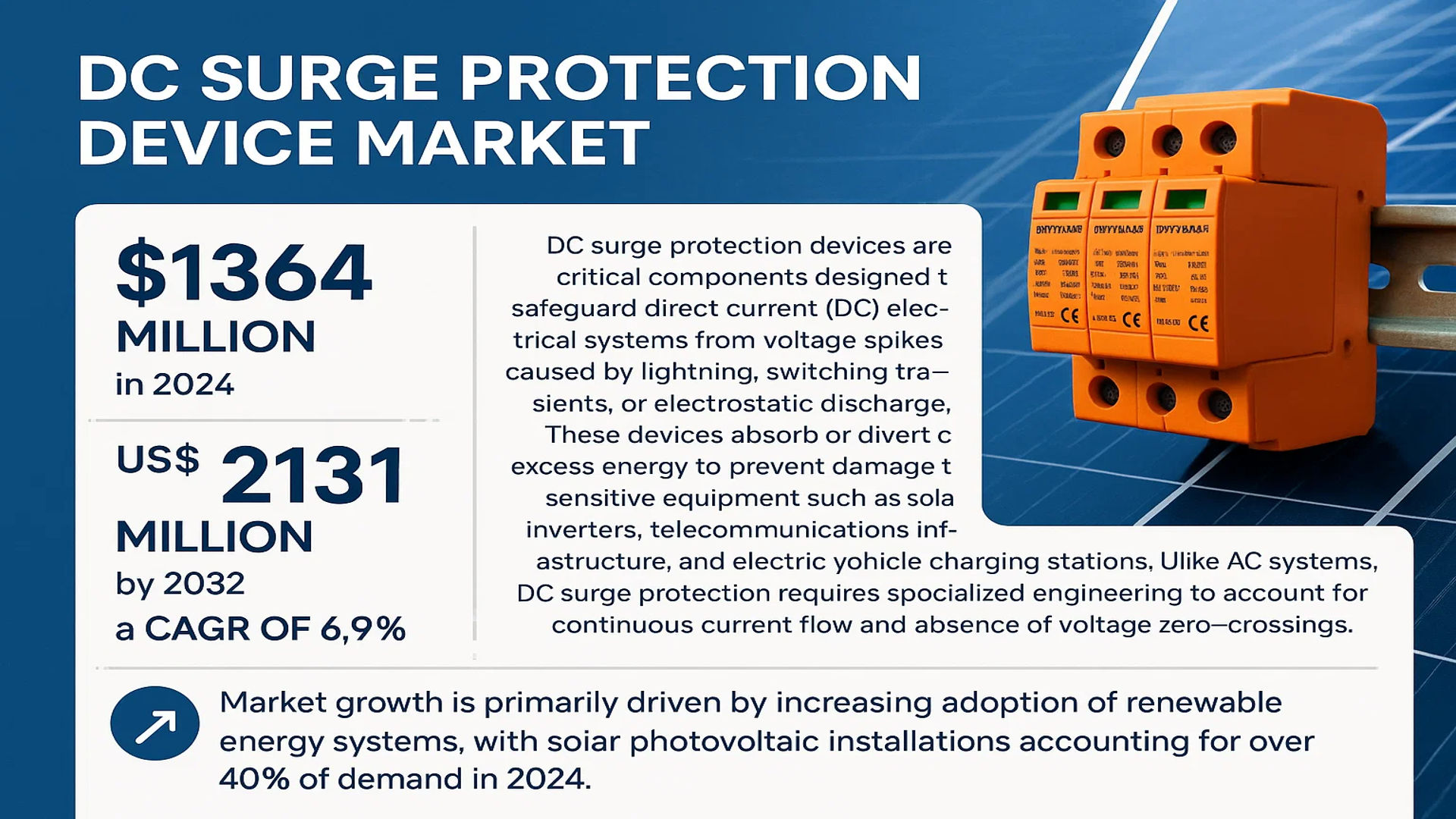
The global DC Surge Protection Device Market was valued at 1364 million in 2024 and is projected to reach US$ 2131 million by 2032, at a CAGR of 6.9% during the forecast period.
DC surge protection devices are critical components designed to safeguard direct current (DC) electrical systems from voltage spikes caused by lightning, switching transients, or electrostatic discharge. These devices absorb or divert excess energy to prevent damage to sensitive equipment such as solar inverters, telecommunications infrastructure, and electric vehicle charging stations. Unlike AC systems, DC surge protection requires specialized engineering to account for continuous current flow and absence of voltage zero-crossings.
Market growth is primarily driven by increasing adoption of renewable energy systems, with solar photovoltaic installations accounting for over 40% of demand in 2024. The rapid expansion of 5G networks and data centers also contributes significantly, as these infrastructure projects require robust DC power protection solutions. Leading manufacturers like ABB and Schneider Electric are investing in smart protection technologies, integrating real-time monitoring capabilities that align with Industry 4.0 requirements for predictive maintenance and system reliability.
MARKET DYNAMICS
MARKET DRIVERS
Rising Adoption of Renewable Energy Systems Accelerates Market Growth
The global push toward renewable energy is a significant growth catalyst for DC surge protection devices. With solar photovoltaic installations projected to exceed 350 GW annually by 2025 and wind energy capacity growing at over 8% CAGR, the demand for reliable DC protection solutions is surging. These systems require robust surge protection to safeguard sensitive power electronics from lightning strikes and voltage fluctuations. The increasing deployment of utility-scale solar farms, which often operate at 1500V DC systems, particularly drives the need for high-voltage DC SPDs with enhanced performance characteristics.
Expansion of EV Charging Infrastructure Creates New Demand
The rapid growth of electric vehicle charging stations, expected to reach 30 million units globally by 2030, presents a substantial market opportunity. DC fast chargers, which operate at voltages up to 1000V, are particularly vulnerable to power surges during frequent connect/disconnect cycles. Manufacturers are responding with specialized DC surge protectors featuring ultra-fast response times below 25 nanoseconds and current capacities exceeding 40kA. The standardization of Combined Charging System (CCS) and CHAdeMO protocols has further increased the need for compatible protection solutions.
Telecommunications Infrastructure Upgrades Drive Technological Innovation
5G network expansion and the proliferation of edge computing facilities are creating new requirements for DC surge protection in telecom applications. Base station power systems, typically operating at 48V DC, require protection solutions that can handle repetitive surge events without degradation. Recent advancements include SPDs with real-time monitoring capabilities that alert operators to performance degradation, significantly improving maintenance efficiency across distributed network assets. The telecom sector’s shift toward renewable-powered sites is further amplifying demand for hybrid AC/DC protection systems.
MARKET CHALLENGES
Complex Certification Requirements Create Implementation Barriers
The DC surge protection market faces significant challenges from varying international standards and certification requirements. Products must comply with multiple regional standards such as IEC 61643-31, UL 1449 4th Edition, and GB/T 18802.31 (China), each with different testing methodologies. Achieving comprehensive certification can increase product development timelines by 6-12 months and raise compliance costs by 15-20%, particularly challenging for manufacturers targeting global markets. Smaller players often struggle with the resource-intensive certification process, potentially limiting market competition.
Other Challenges
Technical Limitations in High-Voltage Applications
While standard DC SPDs perform well in low-voltage applications (≤1000V), protecting mega-watt scale solar installations presents unique engineering challenges. Voltage clamping performance tends to degrade at very high DC voltages, requiring complex multi-stage protection designs that increase system cost and footprint. Thermal runaway risks in high-energy DC systems also necessitate additional safety mechanisms, adding to product complexity.
Supply Chain Constraints for Specialized Components
The industry faces periodic shortages of key components such as metal oxide varistors (MOVs) and gas discharge tubes, particularly those rated for high-voltage DC applications. Semiconductor supply chain disruptions have extended lead times for some critical components to 6-9 months, forcing manufacturers to maintain larger safety stocks and potentially impacting product margins.
MARKET RESTRAINTS
Price Sensitivity in Emerging Markets Limits Premium Product Adoption
While developed markets prioritize performance characteristics, price remains the primary purchasing criterion in many emerging economies. In price-sensitive regions, customers often opt for basic protection solutions or forego surge protection altogether, despite the long-term risk to equipment. This is particularly evident in small-scale solar installations and rural telecom deployments where budgets are constrained. Even a 10-15% price premium for enhanced protection features can significantly reduce market penetration in these segments.
Lack of Standardized Installation Practices Impacts Effectiveness
Improper installation significantly reduces the effectiveness of DC surge protection devices, creating a market restraint. Unlike AC systems where electrical codes often mandate proper SPD installation, DC systems frequently suffer from haphazard implementation. Common issues include inadequate grounding, excessive lead lengths, and incorrect coordination between protection stages. These installation deficiencies can degrade performance by 50% or more, leading to protection failures that undermine confidence in SPD solutions.
MARKET OPPORTUNITIES
Integration of IoT and Predictive Maintenance Creates Value-Added Solutions
The convergence of surge protection with IoT technologies presents a significant growth opportunity. Smart DC SPDs capable of real-time monitoring and predictive maintenance are gaining traction across industrial and utility applications. These advanced systems can detect gradual performance degradation, predict end-of-life, and automatically alert maintenance teams before protection is compromised. When integrated with building management or SCADA systems, they enable condition-based maintenance that reduces downtime risks. The smart SPD segment is projected to grow 3-4 times faster than conventional products through 2030.
Modular Design Approaches Enable Customization for Niche Applications
Manufacturers are developing modular DC surge protection systems that can be configured for specific voltage levels, current capacities, and protection stages. This flexibility allows tailored solutions for emerging applications like battery energy storage systems (BESS), which have unique surge protection requirements due to their bidirectional power flow characteristics. Modular designs also simplify field upgrades and maintenance, reducing total cost of ownership for end users while allowing manufacturers to serve diverse market segments from a common product platform.
Strategic Partnerships Across the Energy Value Chain
Leading SPD manufacturers are forming strategic alliances with solar inverter producers, EV charger manufacturers, and telecom equipment providers to develop integrated protection solutions. These collaborations enable optimized system designs where surge protection is engineered as an inherent component rather than an afterthought. For example, partnerships with battery manufacturers are yielding DC SPDs specifically tuned to protect lithium-ion battery management systems from both external surges and internal switching transients.
DC SURGE PROTECTION DEVICE MARKET TRENDS
Rising Adoption of Renewable Energy Systems Fuels DC Surge Protection Demand
The global shift toward renewable energy sources such as solar and wind power has significantly increased the demand for DC surge protection devices. These systems, which predominantly operate on direct current (DC), require robust protection against voltage spikes that can damage sensitive components like inverters and battery storage units. In 2024, the market for solar PV installations alone is projected to surpass 320 GW globally, directly correlating with a higher need for reliable surge protection solutions. Furthermore, advancements in DC surge protector design—such as improved clamping voltages below 600V and faster response times under 25 nanoseconds—are enhancing system reliability in harsh environmental conditions.
Other Trends
Smart Grid and IoT Integration
The integration of smart grid technologies and IoT-enabled monitoring in DC surge protectors is transforming the market landscape. Modern devices now feature remote diagnostics, real-time alerts, and predictive maintenance capabilities, reducing downtime in critical applications like telecommunications and industrial automation. For instance, over 40% of new DC surge protection units sold in 2024 include embedded communication modules for data logging and cloud-based analytics. This trend aligns with the broader Industry 4.0 movement, where connectivity and automation drive efficiency across power distribution networks.
Electrification of Transportation Infrastructure
The rapid expansion of electric vehicle (EV) charging infrastructure is creating substantial opportunities for DC surge protection devices. With global EV sales expected to reach 17 million units annually by 2025, the associated charging stations—many utilizing high-voltage DC fast chargers—require specialized protection against transient surges. Leading manufacturers are developing compact, high-current-rated protectors capable of handling 1,500V DC systems, catering to next-gen charging standards. Regulatory mandates in regions like Europe and North America, which enforce surge protection compliance in public charging networks, further accelerate this adoption.
While these trends highlight growth drivers, challenges such as supply chain volatility affecting metal-oxide varistor (MOV) production and price sensitivity in emerging markets persist. However, the market’s trajectory remains positive, supported by technological innovation and increasing investments in resilient power infrastructure worldwide.
COMPETITIVE LANDSCAPE
Key Industry Players
Strategic Product Innovation and Regional Expansion Drive Market Competition
The global DC surge protection device market is characterized by a highly competitive landscape, where established multinational corporations and specialized manufacturers vie for market share through technological advancements and regional expansions. ABB and Siemens dominate the market, leveraging their extensive distribution networks and comprehensive product portfolios that cater to industrial, commercial, and residential applications. These companies collectively held over 25% of the global market share in 2024, with their strong presence across Europe, North America, and Asia-Pacific regions.
Meanwhile, Schneider Electric and Eaton have been focusing on integrating smart DC surge protection solutions with IoT capabilities, positioning themselves as leaders in intelligent energy management systems. Their products are widely adopted in renewable energy projects, including solar farms and wind power plants, where reliable surge protection is critical.
Emerging players like DEHN and Phoenix Contact are gaining traction through specialization in high-performance surge protection devices for harsh environments. These companies are investing heavily in R&D to develop compact, modular solutions with enhanced durability and real-time monitoring features.
The market also features strong regional competitors, particularly in Asia, where companies such as ZJBENY and Wenzhou Arrester Electric are expanding their production capacities to meet growing domestic demand. These manufacturers compete aggressively on price while gradually improving product quality to challenge global brands.
List of Leading DC Surge Protection Device Manufacturers
- ABB (Switzerland)
- Siemens (Germany)
- Schneider Electric (France)
- Eaton (Ireland)
- Hitachi Energy (Switzerland)
- Phoenix Contact (Germany)
- DEHN (Germany)
- Rockwell Automation (U.S.)
- ZJBENY (China)
- Wenzhou Arrester Electric (China)
- Yueqing Feeo Electric (China)
- Havells (India)
Segment Analysis:
By Type
Type 1+2 Surge Protection Devices Dominate the Market for Comprehensive Protection in Critical Applications
The market is segmented based on type into:
- Type 1 Surge Protection Device
- Subtypes: Hardwired, Plug-in, and others
- Type 2 Surge Protection Device
- Type 1+2 Surge Protection Device
- Type 3 Surge Protection Device
- Others
By Application
Industrial Segment Leads Due to High Demand from Renewable Energy and Manufacturing Facilities
The market is segmented based on application into:
- Residential
- Commercial
- Industrial
- Subtypes: Solar power plants, Wind farms, Manufacturing facilities, Telecommunications
By Protection Level
High-Current Protection Segment Gains Traction for Critical Infrastructure Protection
The market is segmented based on protection level into:
- Low-current protection
- Medium-current protection
- High-current protection
By Technology
Smart Protection Devices Emerging as Key Growth Area with IoT Integration
The market is segmented based on technology into:
- Conventional surge protectors
- Smart surge protectors
- Subtypes: Cloud-connected, Self-monitoring, Remote control
Regional Analysis: DC Surge Protection Device Market
Asia-Pacific
The Asia-Pacific region dominates the global DC Surge Protection Device market, accounting for over 40% of total revenue share in 2024. This leadership position is driven by massive investments in renewable energy infrastructure across China (which alone contributes 60% of regional demand), India, and Japan. China’s rapid solar power expansion – with 392 GW of installed capacity as of 2023 – creates substantial demand for PV surge protection solutions. India’s ambitious renewable targets (500 GW by 2030) further propel market growth. While cost-effective solutions remain preferred, the region is witnessing a gradual shift toward intelligent, IoT-enabled devices as smart grid implementations accelerate.
North America
North America represents the second-largest market, valued at approximately $385 million in 2024. The U.S. leads with stringent UL standards and rapid EV charging infrastructure deployment (over 140,000 public chargers installed as of Q2 2024). Canada’s growing wind energy sector (projected to reach 18 GW by 2025) and Mexico’s favorable solar policies contribute to steady demand. However, higher adoption costs for advanced SPDs in commercial/industrial segments and supply chain disruptions pose temporary challenges. Key manufacturers focus on developing hybrid protection systems combining Type 1+2 devices for comprehensive coverage.
Europe
Europe maintains third position with Germany, France, and the UK collectively accounting for 65% of regional SPD demand. The EU’s Green Deal initiatives and strict EN 61643-31 standards drive technological advancements in DC protection. Germany’s Energiewende policy supports distributed solar generation, requiring sophisticated surge protection in microgrids. However, economic slowdowns in Southern Europe and lengthy certification processes temporarily restrain market expansion. Vendors emphasize compact, modular designs with remote monitoring capabilities to align with smart city projects across major urban centers.
Middle East & Africa
The MEA region shows promising growth potential (projected 8.2% CAGR through 2032), led by solar investments in the UAE (4 GW Al Dhafra project) and Saudi Arabia’s Vision 2030 renewable targets. South Africa remains the African leader with progressive IPP programs. Market maturity varies widely – while Gulf Cooperation Council countries demand high-end solutions for utility-scale projects, other regions prioritize basic protection due to budget constraints. Limited local manufacturing and technical expertise remain barriers, creating opportunities for international players through strategic partnerships.
South America
South America’s market, though smaller in absolute terms, is expanding steadily with Brazil and Chile as primary growth engines. Brazil’s distributed generation capacity surpassed 25 GW in 2023, primarily from solar, necessitating reliable DC protection. Argentina’s renewable auctions and Colombia’s transmission upgrades present new opportunities. However, currency volatility and uneven regulatory frameworks across countries continue to challenge consistent market development. Local manufacturers focus on ruggedized designs suitable for harsh environmental conditions prevalent in mining and industrial applications.
Report Scope
This market research report provides a comprehensive analysis of the global DC Surge Protection Device market, covering the forecast period 2024–2032. It offers detailed insights into market dynamics, technological advancements, competitive landscape, and key trends shaping the industry.
Key focus areas of the report include:
- Market Size & Forecast: Historical data and future projections for revenue, unit shipments, and market value across major regions and segments. The global DC Surge Protection Device market was valued at USD 1,364 million in 2024 and is projected to reach USD 2,131 million by 2032, growing at a CAGR of 6.9%.
- Segmentation Analysis: Detailed breakdown by product type (Type 1, Type 2, Type 1+2, Type 3, Others), application (Residential, Commercial, Industrial), and end-user industry to identify high-growth segments and investment opportunities.
- Regional Outlook: Insights into market performance across North America, Europe, Asia-Pacific, Latin America, and the Middle East & Africa, including country-level analysis where relevant. Asia-Pacific dominates with over 40% market share in 2024.
- Competitive Landscape: Profiles of leading market participants including ABB, Eaton, Schneider Electric, Siemens, and Phoenix Contact, covering their product offerings, R&D focus, manufacturing capacity, pricing strategies, and recent developments.
- Technology Trends & Innovation: Assessment of emerging technologies including smart monitoring systems, IoT integration, and advanced materials for surge protection components.
- Market Drivers & Restraints: Evaluation of factors driving market growth (renewable energy expansion, EV charging infrastructure) along with challenges (supply chain constraints, regulatory standards).
- Stakeholder Analysis: Insights for component suppliers, OEMs, system integrators, investors, and policymakers regarding the evolving ecosystem and strategic opportunities.
Primary and secondary research methods are employed, including interviews with industry experts, data from verified sources, and real-time market intelligence to ensure the accuracy and reliability of the insights presented.
FREQUENTLY ASKED QUESTIONS:
What is the current market size of Global DC Surge Protection Device Market?
-> DC Surge Protection Device Market was valued at 1364 million in 2024 and is projected to reach US$ 2131 million by 2032, at a CAGR of 6.9% during the forecast period.
Which key companies operate in Global DC Surge Protection Device Market?
-> Key players include ABB, Eaton, Schneider Electric, Siemens, Phoenix Contact, Hitachi Energy, and DEHN, among others.
What are the key growth drivers?
-> Key growth drivers include expansion of renewable energy systems, EV charging infrastructure development, and increasing demand for industrial automation.
Which region dominates the market?
-> Asia-Pacific holds the largest market share, driven by China’s solar power expansion and infrastructure development, while North America shows strong growth in EV charging applications.
What are the emerging trends?
-> Emerging trends include smart monitoring capabilities, integration with IoT platforms, and development of compact, high-efficiency protection modules for next-generation applications.

Get Sample Report PDF for Exclusive Insights
Report Sample Includes
- Table of Contents
- List of Tables & Figures
- Charts, Research Methodology, and more...