MARKET INSIGHTS
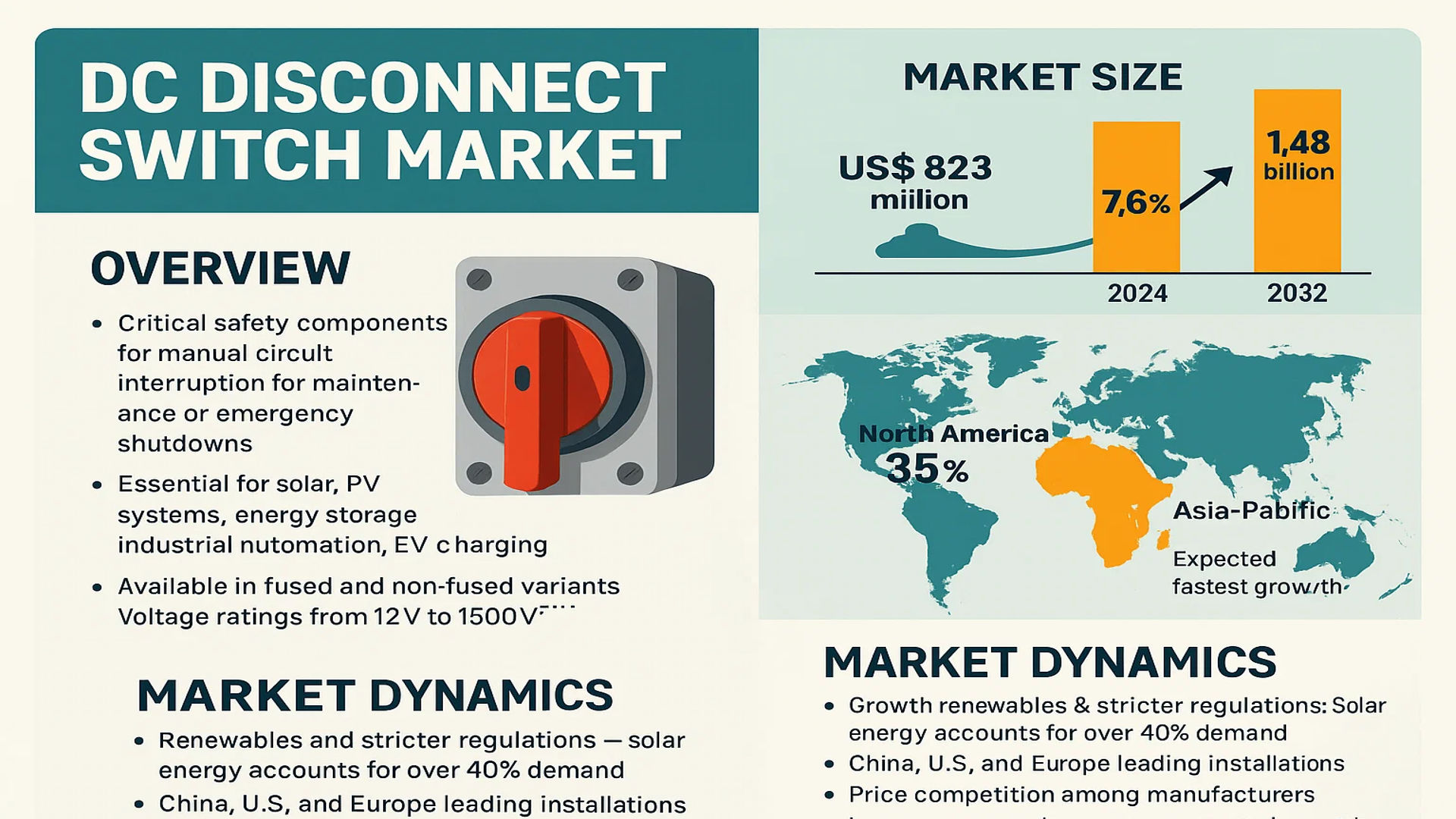
The global DC Disconnect Switch Market size was valued at US$ 823 million in 2024 and is projected to reach US$ 1.48 billion by 2032, at a CAGR of 7.6% during the forecast period 2025-2032. While North America currently leads with 35% market share, the Asia-Pacific region is expected to witness the fastest growth due to expanding solar energy infrastructure.
DC disconnect switches are critical safety components in electrical systems that provide manual circuit interruption for maintenance or emergency shutdowns. These devices function as physical disconnection points in DC power circuits, with common applications in solar PV systems, energy storage, industrial automation and electric vehicle charging infrastructure. The market offers both fused and non-fused variants, with voltage ratings typically ranging from 12V to 1500V depending on application requirements.
Market growth is primarily driven by increasing renewable energy investments and stricter electrical safety regulations worldwide. The solar energy sector accounts for over 40% of demand as global PV capacity continues expanding, with China, the U.S. and Europe leading installations. However, price competition among manufacturers remains intense, particularly in the commercial segment. Recent product innovations include smart disconnect switches with remote monitoring capabilities, responding to the growing demand for grid-connected renewable systems with advanced safety features.
MARKET DYNAMICS
MARKET DRIVERS
Rapid Expansion of Renewable Energy Infrastructure to Fuel DC Disconnect Switch Demand
The global shift toward renewable energy is significantly driving demand for DC disconnect switches. Solar photovoltaic (PV) installations, which rely heavily on DC power systems, are growing at an unprecedented rate. Over 230 GW of new solar capacity was added globally in a recent year, requiring robust DC safety components like disconnect switches. These switches play a critical role in isolating solar panels from inverters during maintenance or emergencies, making them indispensable in modern PV systems. Furthermore, government incentives and policies promoting clean energy adoption are accelerating market growth across residential, commercial and utility-scale applications.
Increasing Electrification of Transportation Networks to Boost Market Prospects
The electrification of transportation infrastructure presents substantial opportunities for DC disconnect switch manufacturers. Electric vehicle charging stations, which operate on DC power for fast-charging capabilities, are being deployed worldwide at an annual growth rate exceeding 30%. Each charging station requires multiple disconnect switches for safety isolation and circuit protection. Similarly, railway electrification projects and DC-powered metro systems are proliferating in urban centers, particularly in Asia and Europe. This transportation revolution is creating sustained demand for reliable DC switching solutions that can handle high voltages and currents safely.
Additionally, the modernization of industrial power systems is contributing to market expansion. Many manufacturing facilities are upgrading to DC-based automation and process control systems that require specialized disconnect switches for maintenance safety and emergency shutdown capabilities.
➤ Industrial facilities implementing Industry 4.0 technologies are prioritizing robust DC power protection systems with fail-safe disconnect capabilities as part of their operational safety protocols.
Furthermore, the development of microgrids and energy storage systems is creating new application areas for advanced DC disconnect switches designed for bidirectional power flow management.
MARKET RESTRAINTS
High Installation and Maintenance Costs to Constrain Market Penetration
While DC disconnect switches offer critical safety functions, their relatively high installation and maintenance costs present challenges for market growth. Industrial-grade DC switches designed for high-voltage applications can cost several times more than comparable AC switches due to arc-quenching requirements and specialized materials. This cost premium becomes particularly significant in large-scale solar farms where hundreds of switches may be required. Maintenance expenses further add to total cost of ownership, as DC switches often require more frequent inspections and replacement of arcing components compared to their AC counterparts.
Technical Complexities in High-Voltage DC Applications to Limit Adoption
DC power systems pose unique technical challenges that restrain switch adoption in certain applications. Unlike AC current which naturally crosses zero, DC current requires more complex arc interruption mechanisms to safely break circuits at high voltages. This technical complexity prevents simple adaptation of AC switch designs for DC applications and requires specialized engineering. The difficulty increases substantially in systems above 1,000V DC, which are becoming more common in utility-scale solar installations. These technical barriers often lead to extended product development cycles and higher R&D costs for manufacturers.
MARKET CHALLENGES
Supply Chain Disruptions and Material Shortages to Impact Production
The DC disconnect switch market faces ongoing challenges from global supply chain volatility. Many manufacturers rely on specialized electrical contacts made from silver-tin-oxide alloys and other materials that have experienced significant price fluctuations. Additionally, electronic components used in smart DC switches, such as sensors and communication modules, have faced extended lead times. These supply chain issues are compounded by geographical concentration of raw material production, making the market vulnerable to trade restrictions and logistics disruptions.
Other Challenges
Standards Fragmentation
The lack of unified global standards for DC disconnect switches creates compatibility issues and market fragmentation. Different regions and applications have varying requirements for voltage ratings, safety certifications, and performance metrics, forcing manufacturers to maintain multiple product variants and increasing complexity.
Safety Compliance Burdens
Stringent safety certification processes for DC switches in different jurisdictions add time and cost to product development. Meeting UL, IEC and other regional standards simultaneously requires extensive testing and documentation that can delay time-to-market for new products.
MARKET OPPORTUNITIES
Development of Smart and IoT-enabled DC Switches to Open New Revenue Streams
The integration of smart technologies into DC disconnect switches presents significant growth opportunities. Next-generation switches with embedded sensors, communication modules and predictive maintenance capabilities are gaining traction in industrial and utility applications. These intelligent switches can monitor contact wear, temperature fluctuations and operational history, enabling condition-based maintenance and reducing unplanned downtime. The industrial IoT revolution is driving demand for such connected solutions that can integrate with broader power management systems through protocols like Modbus or Ethernet/IP.
Emerging Markets in Asia-Pacific to Offer Substantial Growth Potential
Asia-Pacific represents the fastest-growing regional market for DC disconnect switches, driven by massive investments in renewable energy and infrastructure development. Countries like China and India are installing thousands of megawatts of new solar capacity annually, while Southeast Asian nations are rapidly electrifying their transportation networks. This regional growth is complemented by government initiatives promoting domestic manufacturing of electrical components, creating opportunities for both local producers and multinational corporations establishing regional production facilities.
Furthermore, technological advancements in solid-state DC switching and hybrid circuit breakers present new product development opportunities. These innovations promise faster switching speeds, longer operational life and reduced maintenance requirements compared to traditional mechanical switches.
DC DISCONNECT SWITCH MARKET TRENDS
Renewable Energy Integration Driving Market Expansion
The rapid adoption of solar and battery storage systems is significantly increasing the demand for DC disconnect switches across residential, commercial, and industrial applications. As photovoltaic installations grow at a compounded annual rate exceeding 12%, the need for reliable DC circuit protection has become critical. These switches serve as vital safety components, enabling rapid shutdown of DC power sources during maintenance or emergencies. Market analysis indicates that regions with strong renewable energy policies, such as North America and Europe, account for over 60% of global DC disconnect switch installations.
Other Trends
Smart Grid Modernization
Utilities worldwide are upgrading aging infrastructure to create more resilient power networks, creating substantial opportunities for advanced DC disconnect solutions. The integration of IoT-enabled switches with remote monitoring capabilities is becoming increasingly prevalent, particularly in large-scale solar farms and microgrid applications. While traditional electromechanical switches still dominate the market, smart disconnect solutions are projected to capture nearly 30% of the market share within five years due to their enhanced safety features and diagnostic capabilities.
Technological Advancements in Switch Design
Manufacturers are focusing on developing more compact, durable, and efficient DC disconnect switches to meet evolving industry requirements. Recent innovations include arc fault detection mechanisms and weather-resistant enclosures capable of withstanding extreme temperatures from -40°C to 85°C. The fused disconnect segment continues to lead the market due to its dual functionality of circuit protection and isolation, though non-fused alternatives are gaining traction in cost-sensitive applications. High-voltage DC systems above 1000V are driving demand for specialized switches with enhanced dielectric strength and reduced contact resistance.
COMPETITIVE LANDSCAPE
Key Industry Players
Established Brands and Emerging Innovators Compete for DC Disconnect Switch Market Dominance
The global DC disconnect switch market showcases a dynamic competitive landscape where multinational electrical component manufacturers dominate, while specialized players carve out significant niches. According to recent market analysis, the top five companies collectively held approximately 42-45% market share in 2024, indicating moderate industry consolidation. ABB and Eaton emerge as frontrunners, leveraging their extensive distribution networks and reputation for high-voltage equipment reliability across industrial applications.
Siemens and Schneider Electric follow closely, particularly strong in European and North American commercial sectors where their integrated energy management solutions create cross-selling opportunities. Market intelligence suggests these leaders are increasing R&D expenditure by 7-9% annually to develop smart disconnect switches with IoT capabilities, responding to growing demand for grid modernization.
Meanwhile, solar energy specialists like Beny Electric and SanTan Solar are gaining traction in the residential PV segment. Their growth underscores how renewable energy expansion creates opportunities for agile, application-specific manufacturers. The Chinese market sees particularly fierce competition, with domestic players like LS Electric capturing over 30% of regional sales through cost-competitive offerings.
Recent strategic moves include Eaton’s Q2 2024 acquisition of a DC switch startup to bolster its renewable energy portfolio, while Littelfuse expanded production capacity in Mexico to serve the growing North American solar market. Such developments indicate manufacturers are prioritizing both technological innovation and geographical footprint expansion to secure market position.
List of Key DC Disconnect Switch Manufacturers
- Beny Electric (China)
- Littelfuse (U.S.)
- ABB (Switzerland)
- Eaton (Ireland)
- Siemens (Germany)
- Schneider Electric (France)
- General Electric (U.S.)
- IMO Precision Controls (U.K.)
- Socomec (France)
- Leviton Manufacturing (U.S.)
- LS Electric (South Korea)
- Hindle Power (U.S.)
- SMA Solar Technology (Germany)
- Saelzer (Germany)
- B&J-USA (U.S.)
- SanTan Solar (U.S.)
Segment Analysis:
By Type
Fused Disconnector Switch Segment Leads Due to Enhanced Safety Features and Circuit Protection
The market is segmented based on type into:
- Fused Disconnector Switch
- Non-Fused Disconnector Switch
By Application
Industrial Segment Dominates with Widespread Use in Power Distribution Systems
The market is segmented based on application into:
- Industrial
- Commercial
- Residential
By Voltage Rating
Medium Voltage Segment Gains Traction for Utility and Industrial Applications
The market is segmented based on voltage rating into:
- Low Voltage
- Medium Voltage
- High Voltage
By Mounting Type
DIN Rail Mounting Preferred for Space-Efficient Installations in Compact Environments
The market is segmented based on mounting type into:
- Panel Mount
- DIN Rail Mount
- Wall Mount
Regional Analysis: DC Disconnect Switch Market
Asia-Pacific
The Asia-Pacific region dominates the global DC disconnect switch market, accounting for over 40% of total revenue in 2024. China’s aggressive renewable energy expansion, with plans to install 150 GW of solar capacity annually through 2030, creates sustained demand for safety switches in photovoltaic systems. India’s industrial sector modernization and Japan’s stringent electrical safety standards further propel market growth. While cost-conscious buyers favor non-fused disconnectors for small-scale applications, the rising adoption of smart grid technologies is driving premium product demand. Regional manufacturers continue gaining market share through competitive pricing and localization strategies.
North America
North America maintains strong DC disconnect switch adoption due to rigorous electrical safety codes and growing solar energy investments. The U.S. Infrastructure Act allocates $65 billion for power infrastructure upgrades, including modern switchgear requirements. Canadian market growth stems from renewable energy projects in provinces like Ontario and Alberta. High-value fused disconnect switches dominate commercial applications, particularly in data centers and industrial facilities. Regulatory emphasis on arc-flash protection continues to shape product innovation, with major players like Eaton and Leviton introducing UL-listed solutions for enhanced safety compliance.
Europe
European market growth is propelled by strict IEC standards and the rapid transition to renewable energy systems. Germany leads regional demand with its Energy Efficiency Directive 2023 mandating advanced safety components for solar installations. The Nordic countries show particular strength in marine and offshore wind applications, requiring ruggedized disconnect switches. While price sensitivity exists in Southern Europe, manufacturers offset this through compact, multi-functional designs. The pending revision of EU Low Voltage Directive (LVD) is expected to further standardize safety requirements across member states in coming years.
South America
Brazil accounts for nearly 60% of regional DC disconnect switch demand, driven by utility-scale solar projects and industrial facility upgrades. Argentina shows growing adoption in mining operations, though economic instability limits market expansion. The lack of uniform safety regulations across countries creates quality concerns, with an estimated 25-30% of the market served by non-certified imports. However, increasing foreign investments in renewable energy infrastructure are gradually raising standards and creating opportunities for premium product suppliers.
Middle East & Africa
The GCC countries lead regional adoption through massive solar projects like Saudi Arabia’s NEOM initiative and UAE’s solar parks. South Africa remains the most developed sub-Saharan market, though currency volatility impacts equipment procurement. While basic disconnect switches satisfy most current requirements, the transition to smart cities and large-scale renewable projects is driving demand for intelligent monitoring capabilities. The market shows strong potential but faces challenges from inconsistent regulatory enforcement and preference for low-cost alternatives in price-sensitive regions.
Report Scope
This market research report provides a comprehensive analysis of the global and regional DC Disconnect Switch markets, covering the forecast period 2025–2032. It offers detailed insights into market dynamics, technological advancements, competitive landscape, and key trends shaping the industry.
Key focus areas of the report include:
- Market Size & Forecast: Historical data and future projections for revenue, unit shipments, and market value across major regions and segments. The Global DC Disconnect Switch market was valued at US$ 823 million in 2024 and is projected to reach US$ 1.48 billion by 2032.
- Segmentation Analysis: Detailed breakdown by product type (Fused and Non-Fused Disconnector Switches), application (Industrial, Commercial, Residential), and end-user industry to identify high-growth segments and investment opportunities.
- Regional Outlook: Insights into market performance across North America, Europe, Asia-Pacific, Latin America, and the Middle East & Africa. The U.S. market is estimated at USD million in 2024, while China is projected to reach USD million.
- Competitive Landscape: Profiles of leading market participants including Beny Electric, ABB, Eaton, Siemens, Schneider Electric, and their product offerings, R&D focus, and recent developments.
- Technology Trends & Innovation: Assessment of emerging technologies, smart grid integration, and evolving safety standards in DC disconnect solutions.
- Market Drivers & Restraints: Evaluation of factors driving market growth including renewable energy adoption, along with challenges like supply chain constraints and regulatory compliance.
- Stakeholder Analysis: Insights for component suppliers, OEMs, system integrators, and investors regarding strategic opportunities in the DC disconnect ecosystem.
Primary and secondary research methods are employed, including interviews with industry experts and data from verified sources to ensure the accuracy and reliability of the insights presented.
FREQUENTLY ASKED QUESTIONS:
What is the current market size of Global DC Disconnect Switch Market?
-> DC Disconnect Switch Market size was valued at US$ 823 million in 2024 and is projected to reach US$ 1.48 billion by 2032, at a CAGR of 7.6% during the forecast period 2025-2032.
Which key companies operate in Global DC Disconnect Switch Market?
-> Key players include Beny Electric, ABB, Eaton, Siemens, Schneider Electric, General Electric, and Littelfuse, among others.
What are the key growth drivers?
-> Key growth drivers include rising solar energy installations, electrical safety regulations, and infrastructure modernization.
Which region dominates the market?
-> Asia-Pacific is the fastest-growing region, while North America remains a dominant market.
What are the emerging trends?
-> Emerging trends include smart disconnect switches, IoT-enabled monitoring, and compact modular designs.

Get Sample Report PDF for Exclusive Insights
Report Sample Includes
- Table of Contents
- List of Tables & Figures
- Charts, Research Methodology, and more...
 Download Sample Report PDF