MARKET INSIGHTS
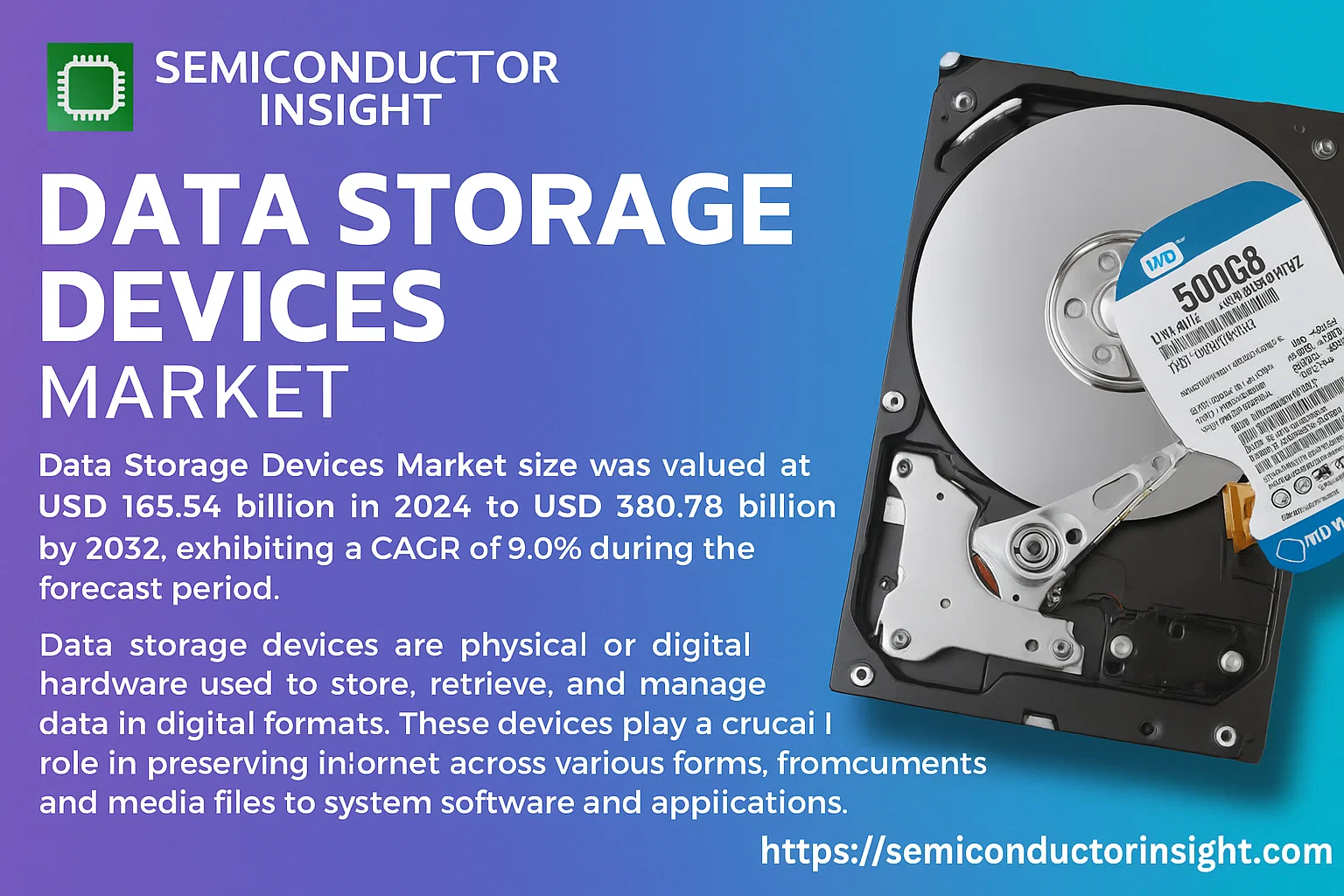
Global Data Storage Devices Market size was valued at USD 165.54 billion in 2024 to USD 380.78 billion by 2032, exhibiting a CAGR of 9.0% during the forecast period.
Data storage devices are physical or digital hardware used to store, retrieve, and manage data in digital formats. These devices play a crucial role in preserving information across various forms, from documents and media files to system software and applications. The primary categories include Primary Storage Devices, such as RAM for temporary data access, and Secondary Storage Devices like Hard Disk Drives (HDD), Solid-State Drives (SSD), optical discs, USB flash drives, and flash memory cards for long-term retention.
The market is experiencing robust growth primarily driven by the exponential increase in data generation from sources like IoT, social media, and enterprise digitization. Furthermore, advancements in technologies such as cloud computing, big data analytics, and artificial intelligence are creating sustained demand for high-capacity, high-performance storage solutions. The competitive landscape is intense, with key players including Samsung, SK Hynix, and Western Digital collectively holding a significant market share; for instance, the top five companies accounted for approximately 64% of global revenue in 2023.
MARKET DRIVERS
Exponential Growth in Data Generation
The relentless expansion of digital content creation, IoT device proliferation, and enterprise digital transformation initiatives are fuelling unprecedented data creation. Global data generation is projected to exceed 180 zettabytes by 2025, creating sustained demand for both consumer and enterprise-grade storage solutions. The need to store, manage, and analyze this data is a primary driver for the market.
Adoption of High-Performance Technologies
The transition to faster, more efficient storage technologies is a significant market driver. The adoption of Solid-State Drives (SSDs), particularly NVMe-based solutions, is accelerating as they offer superior speed and reliability compared to traditional Hard Disk Drives (HDDs). Enterprise investments in all-flash arrays for data centers are also propelling market growth, driven by the demands of AI, machine learning, and real-time analytics workloads.
➤ The rise of edge computing is decentralizing data storage requirements, creating new demand for robust, compact storage devices at the network periphery.
Furthermore, the proliferation of smartphones, tablets, and high-resolution media has entrenched the need for high-capacity, portable storage devices, driving consistent demand in the consumer segment and for professional content creators.
MARKET CHALLENGES
Rapid Technological Obsolescence
The data storage industry faces the constant challenge of technological obsolescence. As new, higher-capacity, and faster storage media are developed, existing products can quickly become outdated, compressing product lifecycles and putting pressure on manufacturers to continuously innovate. This rapid pace requires significant and ongoing investment in research and development.
Other Challenges
Price Volatility of Key Components
The market is susceptible to fluctuations in the prices of critical raw materials, such as NAND flash memory. Supply chain disruptions or changes in supply-demand dynamics can lead to significant price swings, impacting profit margins and product pricing strategies for device manufacturers.
Data Security and Privacy Concerns
As storage devices hold increasingly sensitive personal and corporate data, they become high-value targets for cyberattacks. Ensuring robust hardware-level encryption and physical security features adds complexity and cost to product development, while data privacy regulations impose additional compliance burdens.
MARKET RESTRAINTS
The Shift Towards Cloud-Based Storage Solutions
The growing preference for cloud storage service models, such as Storage-as-a-Service (STaaS), acts as a major restraint on the traditional data storage device market. Many enterprises are opting for the operational flexibility and scalability of cloud storage over capital expenditure on physical hardware, which dampens the growth of on-premises storage arrays and systems.
High Initial Investment for Advanced Storage Systems
The significant capital investment required for deploying state-of-the-art storage infrastructure, such as all-flash data centers or software-defined storage systems, can be a barrier for small and medium-sized enterprises. This high cost of entry can limit market penetration among certain customer segments, restraining overall market growth.
MARKET OPPORTUNITIES
Expansion in Emerging Economies
Rapid digitalization, increasing internet penetration, and economic growth in emerging markets across Asia-Pacific, Latin America, and Africa present substantial growth opportunities. The rising number of data centers and the expanding IT sector in these regions will drive demand for a wide range of storage devices.
Innovation in Next-Generation Storage Technologies
There is significant opportunity in the development and commercialization of next-generation storage technologies. Advancements in areas like Storage Class Memory (SCM), DNA data storage, and helium-filled HDDs promise higher densities, greater endurance, and improved energy efficiency, opening up new application areas and premium market segments.
Rising Demand for Hybrid Storage Solutions
The growing adoption of hybrid cloud environments creates a strong opportunity for storage solutions that seamlessly integrate on-premises infrastructure with cloud services. Devices and systems that offer efficient data tiering, management, and mobility between different storage mediums are well-positioned for growth.
Data Storage Devices Market Trends
Robust Market Expansion Fueled by the Digital Economy
The global Data Storage Devices market is demonstrating significant and sustained growth, projected to expand from a valuation of US$ 165,540 million in 2024 to US$ 380,780 million by 2032. This trajectory, representing a compound annual growth rate (CAGR) of 9.0% during the forecast period, is primarily driven by the explosive generation of data across all sectors. The rapid proliferation of digitalization, cloud computing, big data analytics, and artificial intelligence applications continues to fuel unprecedented demand for reliable and high-capacity storage solutions, creating a booming growth trend for the industry. These technologies are fundamental to modern business operations and consumer lifestyles, ensuring a steady upward trend for storage device manufacturers.
Other Trends
Secular Shift Towards Secondary Storage Devices
The market is broadly segmented into Primary Storage Devices, such as RAM for volatile, short-term data access, and Secondary Storage Devices, which provide permanent, non-volatile storage. Hard Disk Drives (HDDs), Solid-State Drives (SSDs), optical discs, USB flash drives, and flash memory cards fall under the secondary storage category. The demand for secondary storage devices significantly outpaces that of primary storage, as the need for archiving, backing up, and managing the vast volumes of data generated daily is paramount. SSDs, in particular, are gaining substantial market share due to their higher speed, durability, and declining cost per gigabyte compared to traditional HDDs.
Regional Growth Dynamics and Competitive Landscape
Geographically, North America remains the dominant market for data storage devices, supported by advanced IT infrastructure and early adoption of new technologies. Europe’s market is growing steadily, with consistent demand from both enterprise and consumer segments. Meanwhile, the Asia-Pacific region is poised to be the fastest-growing market, driven by rapid technological adoption, a booming digital economy, and significant investments in IT infrastructure. The market is highly competitive, with the top five players—including Samsung, SK Hynix, Kingston Technology, Micron Technology, and Western Digital—holding approximately 64.21% of the global revenue share in 2023. Competition is intense, centered on technological innovation, product performance, pricing, data security features, and brand reputation.
COMPETITIVE LANDSCAPE
Key Industry Players
A Highly Concentrated Market Driven by Technology and Scale
The global data storage devices market is characterized by intense competition and a high degree of consolidation, where technological leadership and manufacturing scale are paramount. The market is dominated by a handful of giants, with the top five players—Samsung, SK Hynix, Kingston Technology, Micron Technology, and Western Digital—collectively holding a significant revenue share of approximately 64.21% as of 2023. This dominance is largely rooted in the memory and storage semiconductor sectors, particularly for Solid-State Drives (SSDs) and NAND flash memory. These companies leverage massive R&D investments to drive innovation in storage density, speed, and power efficiency, securing their positions in both consumer and high-performance enterprise segments. Competition is fierce, driven by factors including price sensitivity, product differentiation, brand reputation, and the critical need for data security and reliability.
Beyond the market leaders, a diverse group of significant players competes in specific niches. Established hard disk drive (HDD) specialists like Seagate Technology and Toshiba remain formidable contenders, particularly in high-capacity storage for data centers. Major system integrators and enterprise solution providers such as Dell, HPE, IBM, Lenovo, and NetApp offer integrated storage systems and services, competing on performance, scalability, and comprehensive data management solutions. Furthermore, emerging challengers and flash-focused companies like Pure Storage, alongside regional powerhouses such as Huawei and ADATA, intensify the competitive dynamics by targeting specific applications, from hyper-converged infrastructure to consumer-grade portable storage. Other notable manufacturers contributing to the global supply chain include Nanya Technology, Winbond, Fujitsu, and optical media specialists like CMC Magnetics (Verbatim), RITEK Group, and Sony.
List of Key Data Storage Devices Companies Profiled
- Samsung
- SK Hynix
- Kingston Technology
- Micron Technology
- Western Digital
- Seagate Technology
- Dell Technologies
- Huawei
- Hewlett Packard Enterprise (HPE)
- Lenovo
- IBM
- NetApp
- Pure Storage
- Toshiba
- ADATA
Segment Analysis:
| Segment Category | Sub-Segments | Key Insights |
| By Type |
|
Secondary Storage Devices represent the dominant category, driven by the universal need for persistent, high-capacity storage for applications ranging from personal computing to enterprise data centers. While primary storage remains critical for active processing, the sheer volume of data generated by trends like big data and AI necessitates robust secondary storage solutions. The market is witnessing significant innovation, particularly in the transition from traditional Hard Disk Drives to faster and more reliable Solid-State Drives, which is reshaping performance expectations across all user segments. |
| By Application |
|
Enterprise applications constitute the leading segment due to the massive and continuously expanding data management requirements of modern businesses. The shift towards digital transformation, cloud computing infrastructure, and reliance on data analytics for decision-making fuels intense demand for sophisticated, scalable, and secure storage solutions. Enterprise needs prioritize reliability, speed for data-intensive workloads, and advanced features like data redundancy and security, which command higher value and drive significant market revenue compared to the consumer segment focused on personal media and document storage. |
| By End User |
|
IT & Telecom is the foremost end-user segment, acting as both a major consumer and an enabler of storage technologies. This sector’s leadership is anchored in its fundamental role in building and managing the digital infrastructure, including data centers and cloud services that support the entire economy. The insatiable demand for data processing, storage, and transmission capabilities, coupled with rapid technological advancements like 5G and IoT, creates a perpetual and high-growth market for advanced storage devices that offer speed, capacity, and resilience to handle massive data flows and critical operations. |
| By Storage Interface |
|
NVMe (Non-Volatile Memory Express) is emerging as the leading and most dynamic interface segment, revolutionizing data transfer speeds by leveraging PCIe lanes directly. This technology is critical for unlocking the full performance potential of modern Solid-State Drives, making it indispensable for high-performance computing, real-time analytics, and AI workloads where latency is a critical factor. While SATA and SAS interfaces remain widely used for cost-effective and reliable storage in many applications, the market trend strongly favors the adoption of NVMe for new enterprise deployments and premium consumer devices seeking maximum performance. |
| By Form Factor |
|
M.2 form factor is gaining significant traction and represents a leading growth area, particularly aligned with the rise of NVMe SSDs and the demand for compact, high-speed storage. Its small, streamlined design is ideal for space-constrained environments like ultra-thin laptops, compact desktops, and high-density servers, enabling better thermal management and simpler installation. While traditional 2.5-inch and 3.5-inch drives continue to dominate in volume for bulk storage applications due to their cost-effectiveness and high capacity, the M.2 form factor is critical for applications where performance per cubic inch and power efficiency are paramount considerations. |
Regional Analysis: Data Storage Devices Market
The concentration of major cloud service providers and data center operators in North America generates immense demand for high-density storage systems. This ecosystem prioritizes scalability, energy efficiency, and rapid data retrieval speeds, driving innovation in enterprise-grade SSDs and storage area networks tailored for massive, multi-tenant environments.
A mature enterprise sector is aggressively pursuing digital transformation, necessitating upgrades from legacy storage systems to modern, agile solutions. This shift creates a strong market for hybrid flash arrays, hyperconverged infrastructure, and storage management software that can handle diverse workloads from big data analytics to real-time applications.
Strict data protection regulations and a high awareness of cybersecurity risks compel organizations to invest in secure, resilient storage with advanced features like encryption-at-rest and immutable backups. This regulatory landscape fosters a market for compliant storage solutions that ensure data integrity and meet legal requirements for data retention.
Home to leading storage technology vendors and academic research institutions, North America is a hotbed for innovation. This results in the early commercialization of emerging technologies like computational storage and storage-class memory, which gradually trickle down to broader markets, maintaining the region’s competitive edge.
Europe
Europe represents a significant and mature market for data storage devices, characterized by a strong emphasis on data privacy, sovereignty, and sustainability. The region’s dynamics are heavily influenced by regulations like the GDPR, which mandate strict controls over data storage and processing, driving demand for secure and compliant storage solutions. Countries such as Germany, the UK, and France have robust industrial and financial sectors that require high-performance storage for applications ranging from automated manufacturing to fintech. There is a growing trend towards adopting green data center technologies, influencing the demand for energy-efficient storage systems. The market is also seeing increased investment in edge computing infrastructure, which necessitates robust, localized storage solutions to support IoT and real-time analytics across various industries.
Asia-Pacific
The Asia-Pacific region is the fastest-growing market for data storage devices, fueled by rapid digitalization, expanding internet penetration, and the burgeoning technology sectors in countries like China, India, Japan, and South Korea. The proliferation of smartphones, growth of e-commerce, and government initiatives promoting digital economies are creating massive amounts of data that need to be stored and processed. Large-scale data center construction projects, particularly in Southeast Asia, are driving demand for high-capacity storage arrays. The region also exhibits strong growth in demand for consumer-grade storage devices, including external hard drives and USB flash drives, alongside enterprise needs. However, the market is highly diverse, with varying levels of technological maturity and different regulatory environments across countries.
South America
The data storage devices market in South America is in a growth phase, with Brazil and Argentina being the key contributors. Economic fluctuations and infrastructure challenges have historically tempered growth, but increasing digital adoption in banking, telecom, and the public sector is creating new opportunities. The market is primarily driven by the need for basic data center expansion and modernization of legacy systems. Cloud adoption is growing steadily, prompting investments in supporting storage infrastructure. Price sensitivity is a significant factor, often leading to a preference for cost-effective storage solutions, though there is a gradual uptake of more advanced technologies among larger enterprises and multinational corporations operating in the region.
Middle East & Africa
The Middle East and Africa region presents an emerging market with considerable potential, though it is characterized by uneven development. Gulf Cooperation Council countries, particularly the UAE and Saudi Arabia, are leading the charge with ambitious smart city projects and digital transformation initiatives, driving demand for advanced storage solutions in government and enterprise sectors. In contrast, many parts of Africa are focusing on building foundational digital infrastructure, leading to demand for entry-level and mid-range storage systems. The region is also seeing growth in data center investments, which fuels the need for associated storage hardware. Political and economic stability varies widely, influencing the pace of market development across different countries.
Report Scope
This market research report provides a comprehensive analysis of the Data Storage Devices Market, covering the forecast period 2025–2032. It offers detailed insights into market dynamics, technological advancements, competitive landscape, and key trends shaping the industry.
Key focus areas of the report include:
- Market Overview: The report begins with an overview outlining its current market scenario, key growth indicators, and industry transformation drivers. It discusses macroeconomic factors, demand–supply balance, regulatory landscape, and the strategic role of data storage in powering advancements across industries such as enterprise IT, consumer electronics, cloud computing, and artificial intelligence.
- Market Size & Forecast: Historical data and future projections for revenue, unit shipments, and market value across major regions and segments.
- Segmentation Analysis: Detailed breakdown by product type, technology, application, and end-user industry to identify high-growth segments and investment opportunities.
- Regional Insights: Insights into market performance across North America, Europe, Asia-Pacific, Latin America, and the Middle East & Africa, including country-level analysis where relevant.
- Competitive Landscape: Profiles of leading market participants, including their product offerings, R&D focus, manufacturing capacity, pricing strategies, and recent developments such as mergers, acquisitions, and partnerships.
- Technology Trends & Innovation: Assessment of emerging technologies, integration of AI/cloud, storage design trends, fabrication techniques, and evolving industry standards.
- Market Drivers & Restraints: Evaluation of factors driving market growth along with challenges, supply chain constraints, regulatory issues, and market-entry barriers.
- Stakeholder Insights: Insights for component suppliers, OEMs, system integrators, investors, and policymakers regarding the evolving ecosystem and strategic opportunities.
Primary and secondary research methods are employed, including interviews with industry experts, data from verified sources, and real-time market intelligence to ensure the accuracy and reliability of the insights presented.
FREQUENTLY ASKED QUESTIONS:
What is the current market size of Data Storage Devices Market?
-> Global Data Storage Devices Market was valued at USD 165,540 million in 2024 and is projected to reach USD 380,780 million by 2032, exhibiting a CAGR of 9.0% during the forecast period.
Which key companies operate in Data Storage Devices Market?
-> Key players include Samsung, SK Hynix, Kingston Technology, Micron Technology, and Western Digital, among others. The global top five players held approximately 64.21% market share in 2023.
What are the key growth drivers?
-> Key growth drivers include increasing data generation, the rapid development of digitalization, cloud computing, big data, and artificial intelligence technologies.
Which region dominates the market?
-> North America is expected to continue as the leading market, while Asia-Pacific is projected to be one of the fastest-growing regions.
What are the emerging trends?
-> Emerging trends include the rise of cloud and hybrid storage solutions, advancements in storage technologies, and high-performance storage devices focusing on data security.

Get Sample Report PDF for Exclusive Insights
Report Sample Includes
- Table of Contents
- List of Tables & Figures
- Charts, Research Methodology, and more...
 Download Sample Report PDF