Cylinder Inductive Proximity Sensor Market Insights
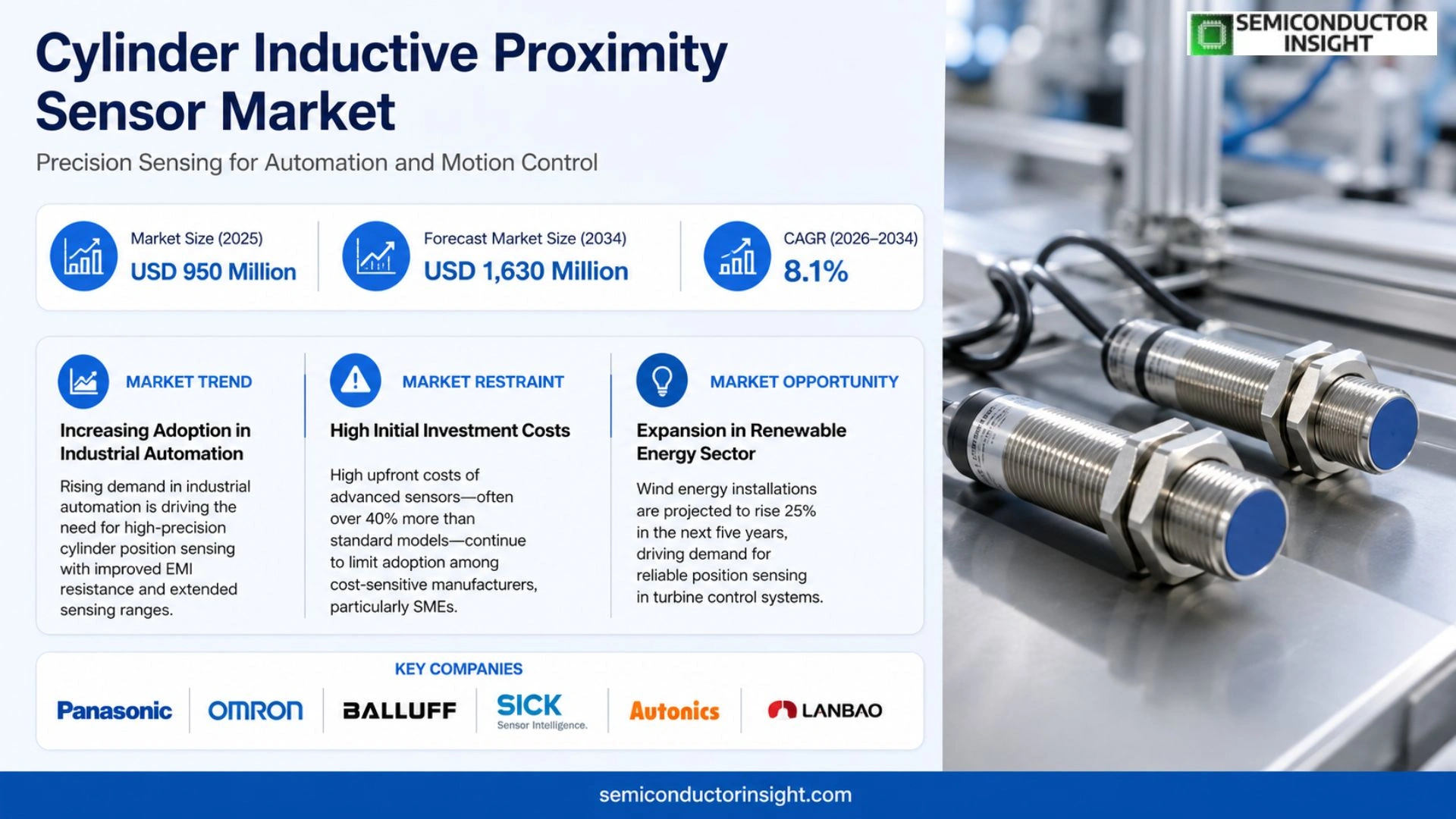
Global cylinder inductive proximity sensor market size was valued at USD 950 million in 2025. The market is projected to grow from USD 1,028 million in 2026 to USD 1,630 million by 2034, exhibiting a CAGR of 8.1% during the forecast period.
Cylinder inductive proximity sensors are non-contact devices used to detect the position of pneumatic or hydraulic cylinders in industrial automation systems. These sensors operate by generating an electromagnetic field and detecting changes caused by metallic targets, typically piston rods or cylinder bodies. Common variants include shielded and unshielded designs, with sensing ranges up to 40mm depending on application requirements.
The market growth is driven by increasing automation across manufacturing sectors and stricter safety regulations requiring precise position monitoring. Recent technological advancements have introduced IO-Link compatible sensors with diagnostic capabilities, while miniaturization trends enable integration into compact machinery designs. Key manufacturers are focusing on developing corrosion-resistant models for harsh environments like food processing and chemical plants.
MARKET DRIVERS
Growing Industrial Automation Demand
Cylinder inductive proximity sensor market is experiencing robust growth due to increasing adoption in industrial automation. These sensors play critical roles in position detection and object counting in manufacturing lines. Over 45% of modern automated production facilities now incorporate cylinder inductive proximity sensors for their reliability in harsh environments.
Advancements in Smart Manufacturing
Industry 4.0 initiatives are driving demand for intelligent sensing solutions. Cylinder inductive proximity sensors with IO-Link capabilities have seen a 32% adoption increase in smart factories. Their ability to provide diagnostic data and remote configuration supports predictive maintenance strategies.
➤ Global market for cylinder inductive proximity sensors in automotive assembly applications grew by 18.7% last year, reflecting increased automation in vehicle production.
Stringent safety regulations across industries continue to push demand for these non-contact sensing solutions that eliminate mechanical wear and improve operational safety.
MARKET CHALLENGES
Technical Limitations in Extreme Environments
While cylinder inductive proximity sensors perform well in most industrial settings, they face challenges in ultra-high temperature applications exceeding 120°C. This limits their use in certain metal processing and energy sector applications where alternative sensor types are preferred.
Other Challenges
Competition from Alternative Technologies
Ultrasonic and capacitive proximity sensors are gaining ground in applications requiring longer sensing ranges or non-metal detection capabilities.
MARKET RESTRAINTS
High Initial Investment Costs
The adoption of premium cylinder inductive proximity sensors with advanced features faces resistance due to cost concerns, particularly among small and medium-sized manufacturers. The price differential between standard and smart sensors can exceed 40%, creating adoption barriers in cost-sensitive markets.
MARKET OPPORTUNITIES
Expansion in Renewable Energy Sector
The growing renewable energy sector presents significant opportunities for cylinder inductive proximity sensor manufacturers. Wind turbine installations are forecasted to increase by 25% over the next five years, creating demand for robust position sensing solutions in turbine control systems.
Cylinder Inductive Proximity Sensor Market Trends
Increasing Adoption in Industrial Automation
Cylinder inductive proximity sensor market is experiencing strong growth due to rising demand in industrial automation systems. These sensors play a critical role in detecting cylinder positions with high precision, enabling seamless operation of pneumatic systems. Major manufacturers are focusing on developing sensors with better electromagnetic interference resistance and extended sensing ranges to meet complex industrial requirements.
Other Trends
Growing Expansion in Automotive Applications
Automotive production lines are increasingly utilizing cylinder inductive proximity sensors for assembly automation. Their ability to withstand harsh environments while maintaining accuracy makes them ideal for robotic welding stations, paint shop applications, and engine assembly lines. The automotive sector accounts for approximately 22% of total demand for these sensors globally.
Advancements in Digital Type Sensors
Digital cylinder inductive proximity sensors are gaining traction due to their improved signal processing capabilities and easier integration with modern PLC systems. Leading manufacturers are incorporating smart diagnostics and IO-Link communication features to provide real-time monitoring of cylinder operations, reducing maintenance costs in manufacturing facilities.
Asia Pacific Market Growth
The Asia Pacific region demonstrates the fastest growth in cylinder inductive proximity sensor adoption, driven by expanding manufacturing activities in China, Japan, and South Korea. Local production of automation equipment has increased demand for reliable position sensing solutions, with regional manufacturers capturing significant market share through competitive pricing strategies.
Enhanced Durability in Harsh Environments
New product developments focus on creating cylinder inductive proximity sensors with IP67 and IP69K protection ratings. These sensors maintain operational reliability in extreme conditions found in food processing, chemical plants, and outdoor industrial applications. Manufacturers are using specialized housings and advanced sealing techniques to prevent contamination and corrosion.
COMPETITIVE LANDSCAPE
Key Industry Players
Market Dominated by Automation Technology Leaders
Global cylinder inductive proximity sensor market is concentrated among established automation component manufacturers, with PANASONIC and Omron leading through their comprehensive sensor portfolios. These top players collectively hold approximately 35% market share in 2025, benefitting from strong R&D capabilities and global distribution networks. Balluf, Sick, and Pepperl+Fuchs maintain significant positions by specializing in industrial sensing solutions with certifications for harsh environments.
Emerging competitors like Lanbao and Tuya are gaining traction through cost-competitive offerings, particularly in Asian markets. Niche specialists such as Autonics and Macher Sensor focus on application-specific solutions for automotive and pharmaceutical sectors. The competitive landscape features technology differentiation in analog vs. digital sensor capabilities and compliance with industry-specific standards.
List of Key Cylinder Inductive Proximity Sensor Companies Profiled
- PANASONIC
- Omron
- Balluf
- Sick
- Autonics
- Lanbao
- Keyence
- Rockwell Automation
- Tuya
- Pepperl+Fuchs
- Macher Sensor
- Acmeto
- IFM Electronic
- Turck
- Eaton Corporation
Segment Analysis:
| Segment Category | Sub-Segments | Key Insights |
| By Type |
|
Digital Type is gaining traction due to stronger noise immunity and better signal processing capabilities. This segment shows:
|
| By Application |
|
Automotive continues as the dominant application segment due to:
|
| By End User |
|
OEMs represent the most significant demand source because:
|
| By Technology |
|
Inductive Proximity leads the technology segment with:
|
| By Sensing Range |
|
Medium Range sensors dominate due to:
|
Regional Analysis: Cylinder Inductive Proximity Sensor Market
Asia-Pacific
China leads in cylinder inductive proximity sensor adoption through its extensive factory automation projects and thriving electric vehicle production. Major industrial hubs in Guangdong and Jiangsu provinces drive demand for high-precision sensing solutions in assembly line applications.
Japan’s market growth stems from advanced robotics integration and quality-focused manufacturing practices. Domestic sensor manufacturers emphasize extreme environmental tolerance and maintenance-free operation features preferred in semiconductor fabrication plants.
South Korea’s cylinder inductive proximity sensor market benefits from smart factory conversions and rising investments in IoT-enabled manufacturing. Sensor miniaturization trends align with the country’s electronics and display panel production requirements.
Thailand, Vietnam, and Malaysia show accelerating adoption as production bases shift to ASEAN countries. Local manufacturers prioritize cost-effective cylinder inductive proximity sensors suitable for medium-duty industrial applications.
Europe
Europe maintains a strong position in Cylinder inductive proximity sensor market through its focus on industrial automation and machinery safety standards. Germany’s Mittelstand manufacturers drive innovation in rugged sensing solutions for harsh environments. The region’s emphasis on energy-efficient manufacturing processes increases demand for low-power consumption sensor variants. Eastern European countries are experiencing growth as manufacturing capacity expands in Poland, Czech Republic, and Hungary, creating new opportunities for sensor integration in production facilities.
North America
The North American cylinder inductive proximity sensor market benefits from reshoring initiatives and advanced manufacturing investments. U.S. manufacturers prefer sensors with superior EMI resistance and extended temperature ranges for diverse industrial applications. Canada’s oil and gas sector generates steady demand for explosion-proof sensor variants. Increasing automation in Mexico’s automotive manufacturing plants contributes to regional market expansion, with integrated sensor solutions gaining traction.
Middle East & Africa
Middle Eastern markets show growing cylinder inductive proximity sensor adoption, primarily in oil and gas infrastructure and construction equipment applications. UAE’s industrial diversification policies create new automation opportunities. African markets remain nascent but demonstrate potential in mining equipment and food processing applications, with South Africa serving as the regional hub for sensor technology adoption and distribution.
South America
Brazil dominates the South American cylinder inductive proximity sensor market through its established automotive and agricultural machinery industries. Argentina and Chile show increasing automation in mining operations, requiring robust sensing solutions. Economic factors influence procurement strategies, with regional manufacturers balancing quality requirements and cost considerations when selecting sensor suppliers.
Report Scope
This market research report provides a comprehensive analysis of the Cylinder Inductive Proximity Sensor Market , covering the forecast period 2026–2034. It offers detailed insights into market dynamics, technological advancements, competitive landscape, and key trends shaping the industry.
Key focus areas of the report include:
- Market Overview: The report begins with an overview outlining its current market scenario, key growth indicators, and industry transformation drivers. It discusses macroeconomic factors, demand–supply balance, regulatory landscape, and the strategic role of semiconductors in powering advancements across industries such as automotive, telecommunications, consumer electronics, and industrial automation.
- Market Size & Forecast: Historical data and future projections for revenue, unit shipments, and market value across major regions and segments.
- Segmentation Analysis: Detailed breakdown by product type, technology, application, and end-user industry to identify high-growth segments and investment opportunities.
- Regional Insights: Insights into market performance across North America, Europe, Asia-Pacific, Latin America, and the Middle East & Africa, including country-level analysis where relevant.
- Competitive Landscape: Profiles of leading market participants, including their product offerings, R&D focus, manufacturing capacity, pricing strategies, and recent developments such as mergers, acquisitions, and partnerships.
- Technology Trends & Innovation: Assessment of emerging technologies, integration of AI/IoT, semiconductor design trends, fabrication techniques, and evolving industry standards.
- Market Drivers & Restraints: Evaluation of factors driving market growth along with challenges, supply chain constraints, regulatory issues, and market-entry barriers.
- Stakeholder Insights: Insights for component suppliers, OEMs, system integrators, investors, and policymakers regarding the evolving ecosystem and strategic opportunities.
Primary and secondary research methods are employed, including interviews with industry experts, data from verified sources, and real-time market intelligence to ensure the accuracy and reliability of the insights presented.
FREQUENTLY ASKED QUESTIONS:
What is the current market size of Cylinder Inductive Proximity Sensor Market?
-> Cylinder Inductive Proximity Sensor Market was valued at USD 950 million in 2025 and is expected to reach USD 1630 million by 2034.
What is the growth rate of Cylinder Inductive Proximity Sensor Market?
-> The market is projected to grow at a CAGR of 8.1% during 2025-2034.
Which key companies operate in Cylinder Inductive Proximity Sensor Market?
-> Key players include PANASONIC, Omron, Balluf, Sick, Autonics, Lanbao, Keyence, Rockwell, Tuya, Pepperl+Fuchs, among others.
What are the key application areas?
-> Major applications include Aerospace & Defense, Automotive, Food & Beverage, Pharmaceuticals, and Others.
Which region dominates the market?
-> The U.S. market size is estimated at USD million in 2025, while China is projected to reach USD million.

Get Sample Report PDF for Exclusive Insights
Report Sample Includes
- Table of Contents
- List of Tables & Figures
- Charts, Research Methodology, and more...
 Download Sample Report PDF