CW DFB Laser Diode Market Insights
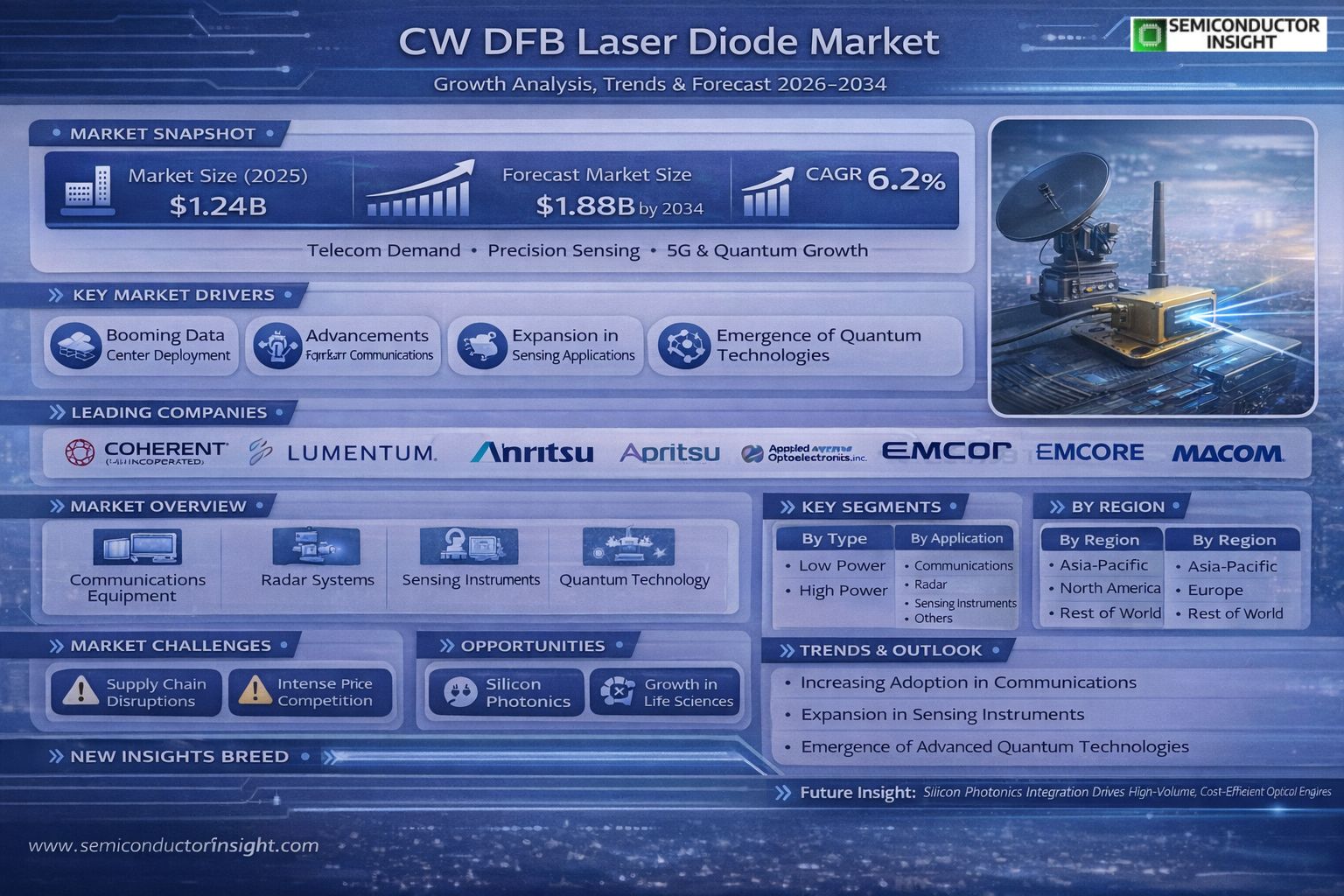
Global CW DFB laser diode market size was valued at USD 1.243 billion in 2025. The market is projected to grow from USD 1.320 billion in 2026 to USD 1.882 billion by 2034, exhibiting a CAGR of 6.2% during the forecast period.
A Continuous Wave (CW) Distributed Feedback (DFB) laser diode is a semiconductor laser characterized by high wavelength stability and superior beam quality. Unlike pulsed variants, CW DFB laser diodes provide a continuous and stable optical output, making them essential for applications demanding long-term operational stability and consistent power. Their core technology integrates a distributed feedback grating structure directly into the laser cavity, which enables precise wavelength control and results in exceptionally low noise output.
The market growth is primarily driven by escalating demand within the telecommunications sector for high-speed data transmission and dense wavelength division multiplexing (DWDM) systems. Furthermore, their adoption is expanding rapidly in sensing instruments for gas detection, environmental monitoring, and industrial process control due to their spectral purity. While North America remains a significant market, Asia-Pacific, particularly China and Japan, is witnessing accelerated growth fueled by massive investments in 5G infrastructure and advanced manufacturing. Key industry players such as II-VI Incorporated (now Coherent Corp.), Lumentum, and Mitsubishi Electric are actively engaged in product innovation and strategic collaborations to strengthen their market position.
MARKET DRIVERS
Explosive Growth in Data Center and 5G Infrastructure
The insatiable global demand for high-speed data transmission is a primary force propelling the CW DFB Laser Diode Market. As data centers scale to support cloud computing and 5G networks deploy dense fiber backhaul, the need for reliable, single-frequency, and narrow-linewidth laser sources for coherent communication systems intensifies. These diodes are critical components in transceivers for long-haul and metro networks, driving substantial market growth. The transition towards higher-order modulation formats like 16-QAM and 64-QAM further necessitates the precision offered by CW DFB lasers.
Advancements in Sensing and Metrology Applications
Beyond telecommunications, the CW DFB Laser Diode Market is bolstered by its expanding role in precision sensing. Their stable single-mode emission makes them ideal for gas sensing (TDLAS), fiber optic sensing (FOS), and Light Detection and Ranging (LiDAR) systems used in autonomous vehicles and topographic mapping. The push for industrial automation and environmental monitoring is creating robust demand for these high-performance laser sources, establishing a second key revenue stream for manufacturers.
➤ Global trend towards miniaturization and photonic integration is accelerating the development of high-power, chip-scale CW DFB lasers, opening new application spaces in biomedical diagnostics and quantum technology.
Finally, sustained R&D investment in quantum computing and atomic clocks is a significant driver. The ultra-narrow linewidth and frequency stability of CW DFB laser diodes are fundamental for cooling and manipulating atoms, positioning this market at the forefront of next-generation scientific and computing breakthroughs.
MARKET CHALLENGES
Technical Complexity and Precise Manufacturing Demands
Fabricating a high-quality CW DFB Laser Diode requires sophisticated processes like electron-beam lithography for grating formation and meticulous control over epitaxial growth. This results in complex manufacturing, lower yields compared to simpler Fabry-Perot lasers, and consequently higher unit costs. Maintaining consistent performance parameters such as side-mode suppression ratio (SMSR) and wavelength stability across production batches remains a significant technical hurdle for the CW DFB Laser Diode Market.
Other Challenges
Intense Price Competition from Alternative Technologies
The market faces competitive pressure from other single-frequency solutions, including external-cavity diode lasers (ECDLs) and distributed Bragg reflector (DBR) lasers. In cost-sensitive applications, particularly some sensing segments, these alternatives can challenge the market position of dedicated CW DFB modules.
Supply Chain and Material Dependency
The reliance on specific high-purity semiconductor materials (e.g., InP for telecom bands) and specialized fabrication equipment creates supply chain vulnerabilities. Geopolitical factors and availability of key substrates can impact production capacity and lead times, constraining market scalability.
MARKET RESTRAINTS
High Cost of Deployment and Testing
The premium cost of CW DFB laser diodes, driven by complex fabrication, serves as a primary market restraint. For many potential end-users in industrial or research settings, the total cost of ownership,which includes the laser, temperature controllers, and precise current drivers,can be prohibitive. This limits adoption in applications where performance margins are less critical. Furthermore, rigorous testing and characterization required to ensure reliability over long operational lifetimes add to the overall system cost, slowing market penetration in price-sensitive verticals.
MARKET OPPORTUNITIES
Integration with Silicon Photonics and Co-Packaged Optics
The convergence of the CW DFB Laser Diode Market with silicon photonics platforms presents a transformative opportunity. Developing hybrid or heterogeneous integration techniques to efficiently couple InP-based DFB lasers onto silicon chips can enable high-volume, low-cost production of advanced optical engines. This is critical for the next evolution of data center interconnects and co-packaged optics (CPO), promising significant power and performance benefits that will drive future demand.
Emergence of New Application in Life Sciences and Healthcare
There is substantial untapped potential within biomedical fields. The specific wavelengths and stability of CW DFB lasers are ideal for advanced applications like flow cytometry, DNA sequencing, and optical coherence tomography (OCT). As point-of-care diagnostics and lab-on-a-chip technologies advance, the demand for compact, reliable laser sources will create a lucrative new segment for the CW DFB Laser Diode Market, moving beyond its traditional industrial and telecom base.
Expansion in Quantum Information Processing
The burgeoning field of quantum technology represents a high-growth frontier. CW DFB laser diodes are essential workhorses for ion trapping, quantum communication (QKD), and quantum sensing. As these technologies transition from research labs to commercial Pilotlines, the requirement for robust, mass-producible single-frequency lasers will surge, offering a long-term and high-value opportunity for specialized players in the market.
MAIN TITLE HERE (CW DFB Laser Diode Market) Trends
Increasing Demand for Precision Sensing and Measurement
The CW DFB Laser Diode market is witnessing a significant trend driven by the escalating demand for high-precision sensing instruments. These components are critical in applications like environmental monitoring, industrial process control, and scientific research due to their high wavelength stability and low noise output, which enable accurate, long-term stable operation. The shift towards automation and Industry 4.0 principles further necessitates reliable optical sensing solutions where the performance of CW DFB laser diodes is indispensable for ensuring measurement integrity and system reliability.
Other Trends
Expansion in Optical Communications Infrastructure
There is a marked trend towards the integration of CW DFB laser diodes in next-generation communications equipment, particularly for metropolitan and long-haul networks. Their ability to provide a continuous, stable, and single-frequency output makes them suitable for dense wavelength-division multiplexing (DWDM) systems. This application trend is a key growth segment for the CW DFB Laser Diode Market, as telecom operators worldwide continue to invest in upgrading network capacity and speed.
Competitive Landscape and Technological Advancements
The competitive landscape is characterized by the presence of established players like II-VI Incorporated, Lumentum, and Anritsu, who focus on technological innovation to enhance output power and wavelength range. A trend observed is the development of devices offering improved power efficiency and thermal management to cater to both low-power and high-power application segments. These advancements are crucial for expanding the applicability of CW DFB laser diodes into new areas, including advanced radar systems and specialized scientific instrumentation, sustaining momentum in the CW DFB Laser Diode Market.
COMPETITIVE LANDSCAPE
Key Industry Players
A Consolidating Market Driven by Innovation in Communications and Sensing
Global CW DFB laser diode market features a landscape dominated by established photonics and semiconductor giants. II-VI Incorporated (now Coherent Corp.) and Lumentum Operations LLC are widely recognized as market leaders, commanding significant revenue share. Their strength is built on extensive R&D, vertically integrated manufacturing, and a broad portfolio catering to high-volume telecommunications and datacom applications. The market structure is moderately concentrated, with the top five players accounting for a substantial portion of global revenue. Competition is intensifying around performance parameters such as wavelength stability, output power, and spectral purity, which are critical for advanced applications in coherent communications and precision sensing instruments.
Beyond the leading players, a tier of specialized and niche manufacturers drives innovation in specific segments. Companies like Nanoplus and Innolume excel in providing custom and novel wavelength DFB lasers for gas sensing and scientific applications. Vendors such as TOPTICA eagleyard and Sacher Lasertechnik are key in the high-performance scientific and industrial metrology sectors. Meanwhile, players like MACOM, Mitsubishi Electric, and Applied Optoelectronics are formidable competitors in the commercial markets for telecommunications and radar systems. This diverse ecosystem ensures robust supply and continuous technological advancement across both high-power and low-power CW DFB laser diode segments.
List of Key CW DFB Laser Diode Companies Profiled
- Coherent Corp. (II-VI Incorporated)
- Lumentum Operations LLC
- Anritsu Corporation
- Applied Optoelectronics, Inc.
- EMCORE Corporation
- Innolume GmbH
- MACOM Technology Solutions
- Mitsubishi Electric Corporation
- Thorlabs, Inc.
- nanoplus Nanosystems and Technologies GmbH
- QD Laser, Inc.
- TOPTICA eagleyard GmbH
- Nolatech GmbH
- Sacher Lasertechnik GmbH
- Gooch & Housego (G&H)
Segment Analysis:
| Segment Category | Sub-Segments | Key Insights |
| By Type |
|
Low Power lasers are the cornerstone for precision applications demanding exceptional wavelength stability over prolonged operation. They are favored for telecom and sensing modules where energy efficiency and minimal thermal drift are critical design parameters. The underlying driver is the robust demand from fiber optic communication systems and compact sensing instruments, which rely on the inherent low-noise output and reliability of these diodes for consistent signal integrity. |
| By Application |
|
Communications Equipment serves as the primary application segment, driven by the essential role of these diodes in enabling high-speed, long-haul optical fiber networks. Their distributed feedback grating structure provides the exact wavelength control necessary for dense wavelength-division multiplexing systems. This technical superiority creates a high barrier to entry and fosters strong, ongoing relationships between leading manufacturers and major telecom infrastructure providers, solidifying its dominant market position. |
| By End User |
|
Telecom Service Providers & Network Operators are the pivotal end-user group due to their massive, continuous investments in upgrading and expanding global data infrastructure. These large-scale buyers require components that guarantee network reliability and performance, creating a stable and high-volume demand channel. The procurement strategy for this segment is typically characterized by long-term supply agreements and stringent qualification processes, which benefit established manufacturers with proven track records in quality and volume production. |
| By Wavelength Band |
|
C-band & L-band diodes represent the technologically critical and commercially dominant segment, as these wavelengths are the standard for minimizing signal loss in silica-based optical fibers. Their supremacy is locked in by decades of entrenched network architecture and component standardization. Continuous innovation focuses on enhancing the power efficiency and spectral purity within these bands to meet the escalating data capacity demands of next-generation networks, thereby reinforcing their leading status. |
| By Packaging Technology |
|
Butterfly Packages are the leading packaging format for high-performance applications, particularly in communications and demanding sensing roles. This leadership is attributed to their superior thermal management capabilities, which are essential for maintaining the wavelength stability of the CW DFB laser during continuous operation. The package design also allows for integrated monitoring components, such as thermoelectric coolers and photodiodes, offering system designers a complete, reliable, and high-performance module solution that justifies its premium positioning in the market. |
Regional Analysis: Global CW DFB Laser Diode Market
Asia-Pacific
Asia-Pacific’s CW DFB Laser Diode Market growth is fundamentally linked to telecom expansion. The component is critical for backbone and metropolitan area networks. The relentless deployment of 5G and ongoing upgrades to existing fiber optic networks ensure sustained, high-volume demand. This application segment creates a stable and predictable revenue stream for manufacturers across the region.
The region possesses a vertically integrated manufacturing landscape for the CW DFB Laser Diode Market. From wafer epitaxy to final packaging and testing, localized expertise reduces logistical hurdles and time-to-market. This integration fosters cost efficiencies and allows for rapid scaling of production to meet global demand, solidifying Asia-Pacific’s role as Global production hub.
Leading research institutes and corporate R&D centers in Japan, South Korea, and China are pioneering advancements in the CW DFB Laser Diode Market. Focus areas include higher output power, improved thermal stability, and integration with silicon photonics. This concentrated innovation effort ensures the region defines future performance benchmarks and application standards for Global market.
Beyond telecommunications, the CW DFB Laser Diode Market in Asia-Pacific benefits from robust demand in sensing and instrumentation. Applications in gas detection, precision metrology, and biomedical equipment are growing rapidly. This diversification mitigates market risk and drives development of application-specific CW DFB laser diode variants tailored to niche industrial and scientific needs.
North America
North America holds a strategically vital position in the CW DFB Laser Diode Market, characterized by high-value innovation and demand for cutting-edge performance. The region’s market is propelled by substantial defense and aerospace contracts, where these lasers are essential for secure communication systems, LiDAR, and advanced sensing. Furthermore, leading North American technology companies drive demand for CW DFB laser diodes in data center interconnects and high-performance computing, requiring components with exceptional reliability and spectral purity. The presence of major telecom operators investing in dense wavelength-division multiplexing (DWDM) systems for network upgrades also sustains a steady, high-specification demand. The regional CW DFB Laser Diode Market is less about volume manufacturing and more about designing and specifying the advanced components that define next-generation system performance globally.
Europe
The European CW DFB Laser Diode Market is distinguished by its strong emphasis on precision engineering, research excellence, and specialized industrial applications. Germany, the UK, and France are central hubs where demand is driven by the automotive sector for LiDAR in autonomous vehicles, and by the industrial manufacturing sector for high-precision machine vision and spectroscopy. European research initiatives and photonics clusters foster innovation in quantum technology and medical diagnostics, creating demand for ultra-stable and narrow-linewidth CW DFB laser diodes. The market here prioritizes quality, certification, and meeting stringent regulatory standards, particularly for medical and aerospace applications. While not the volume leader, Europe’s CW DFB Laser Diode Market is critical for pioneering high-end applications that gradually filter into broader commercial use.
South America
The CW DFB Laser Diode Market in South America is in a developing phase, with growth primarily linked to the modernization of telecommunications infrastructure. Brazil and Argentina are key markets where investments in expanding broadband internet access and upgrading cellular networks are generating demand for optical components. The region’s market is currently defined by cost-effective procurement and integration rather than local manufacturing or advanced R&D. Demand stems from telecom operators and system integrators who source CW DFB laser diodes for use in fiber optic transmission equipment. While nascent, the market shows potential for growth as digital transformation initiatives gain momentum, though it remains susceptible to regional economic fluctuations and currency volatility affecting capital expenditure.
Middle East & Africa
The Middle East & Africa region represents an emerging segment of Global CW DFB Laser Diode Market. Growth is primarily concentrated in the Gulf Cooperation Council (GCC) nations, where sovereign wealth funds are investing in smart city projects and telecom infrastructure, thereby creating demand for optical networking components. In Africa, market development is closely tied to international investments in subsea cable landing points and terrestrial fiber networks to improve connectivity. The regional CW DFB Laser Diode Market is characterized by project-based demand, heavily dependent on large-scale infrastructure developments. Local manufacturing is minimal, making the region a net importer, with growth closely following the pace of major digital infrastructure and energy sector projects.
Report Scope
This market research report provides a comprehensive analysis of the CW DFB Laser Diode Market, covering the forecast period 2026–2034. It offers detailed insights into market dynamics, technological advancements, competitive landscape, and key trends shaping the industry.
Key focus areas of the report include:
- Market Overview: The report begins with an overview outlining its current market scenario, key growth indicators, and industry transformation drivers. It discusses macroeconomic factors, demand–supply balance, regulatory landscape, and the strategic role of semiconductors in powering advancements across industries such as automotive, telecommunications, consumer electronics, and industrial automation.
- Market Size & Forecast: Historical data and future projections for revenue, unit shipments, and market value across major regions and segments.
- Segmentation Analysis: Detailed breakdown by product type, technology, application, and end-user industry to identify high-growth segments and investment opportunities.
- Regional Insights: Insights into market performance across North America, Europe, Asia-Pacific, Latin America, and the Middle East & Africa, including country-level analysis where relevant.
- Competitive Landscape: Profiles of leading market participants, including their product offerings, R&D focus, manufacturing capacity, pricing strategies, and recent developments such as mergers, acquisitions, and partnerships.
- Technology Trends & Innovation: Assessment of emerging technologies, integration of AI/IoT, semiconductor design trends, fabrication techniques, and evolving industry standards.
- Market Drivers & Restraints: Evaluation of factors driving market growth along with challenges, supply chain constraints, regulatory issues, and market-entry barriers.
- Stakeholder Insights: Insights for component suppliers, OEMs, system integrators, investors, and policymakers regarding the evolving ecosystem and strategic opportunities.
Primary and secondary research methods are employed, including interviews with industry experts, data from verified sources, and real-time market intelligence to ensure the accuracy and reliability of the insights presented.
FREQUENTLY ASKED QUESTIONS:
What is the current market size of CW DFB Laser Diode Market?
-> Global CW DFB Laser Diode market was valued at USD 1243 million in 2025 and is projected to reach USD 1882 million by 2034, at a CAGR of 6.2% during the forecast period.
Which key companies operate in CW DFB Laser Diode Market?
-> Key players include II-VI Incorporated, Lumentum, Anritsu, Applied Optoelectronics, EMCORE Corporation, Innolume, MACOM, Mitsubishi Electric, Thorlabs, and Nanoplus, among others.
What are the key growth drivers?
-> Key growth drivers include the demand for high wavelength stability and low noise output in communications, sensing, and radar applications, technological advancements in semiconductor lasers, and the need for long-term stable operation in various instruments.
Which region dominates the market?
-> The report provides detailed regional analysis, with specific market size estimations for key regions like the U.S. and China. It covers market performance across North America, Europe, Asia, South America, and the Middle East & Africa.
What are the emerging trends?
-> Emerging trends include the increasing adoption in communications equipment and sensing instruments, technological innovation in distributed feedback grating structures, and the development of products for specialized applications requiring continuous and stable laser output.

Get Sample Report PDF for Exclusive Insights
Report Sample Includes
- Table of Contents
- List of Tables & Figures
- Charts, Research Methodology, and more...