MARKET INSIGHTS
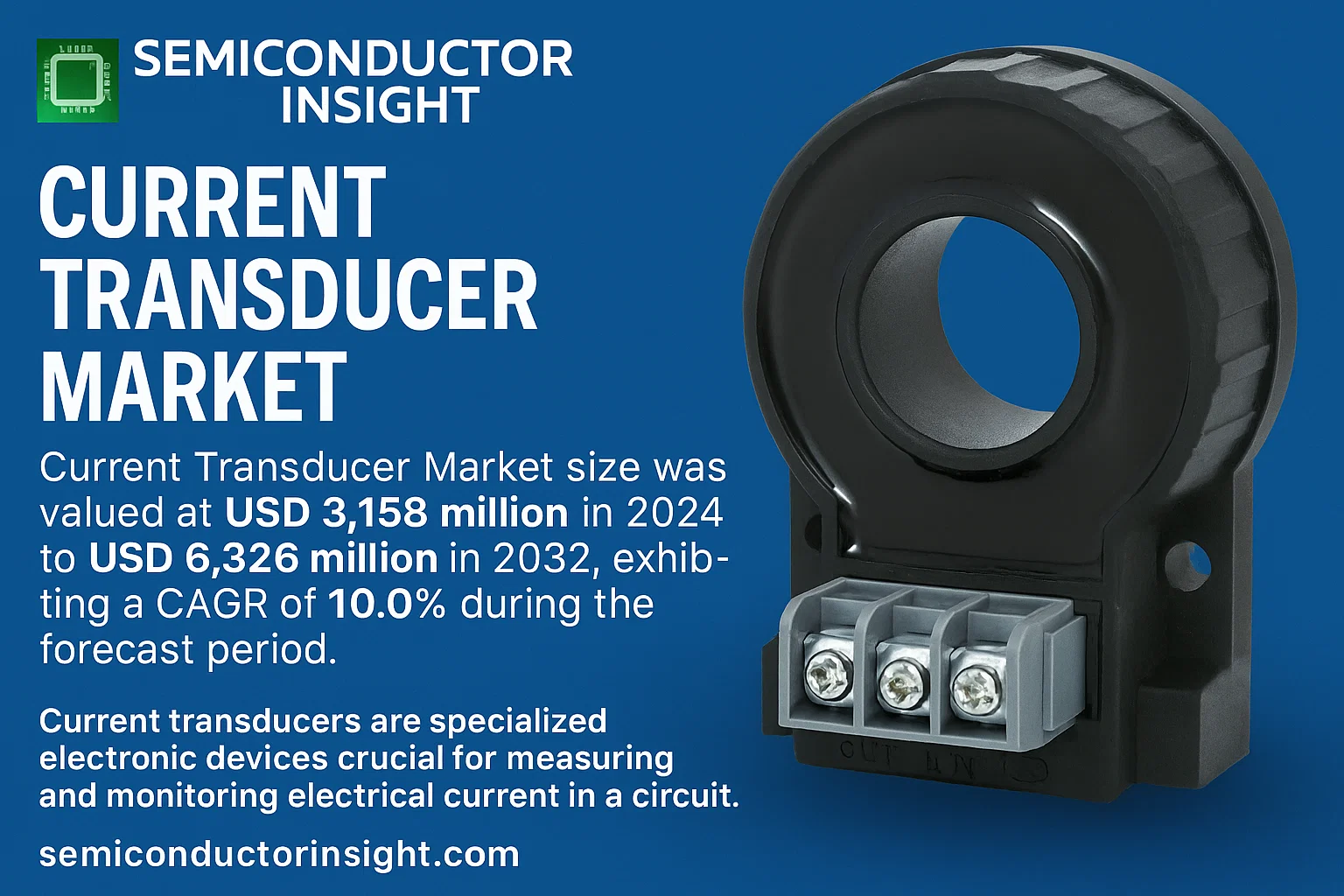
Global Current Transducer Market size was valued at USD 3,158 million in 2024 to USD 6,326 million by 2032, exhibiting a CAGR of 10.0% during the forecast period.
Current transducers are specialized electronic devices crucial for measuring and monitoring electrical current in a circuit. These devices convert a primary current into a standardized, proportional output signal, such as a lower-level current or voltage, which can be safely and easily measured by control systems. They encompass various technologies such as Hall Effect-based sensors, shunt-based sensors, and xMR (Magneto-Resistive) sensors.
The market is experiencing robust growth due to several factors, including the accelerating adoption of renewable energy systems like solar and wind power, which require precise current monitoring for inverters and grid integration. Furthermore, the rising demand for industrial automation and the proliferation of electric vehicles (EVs) are significant contributors to market expansion. Initiatives by key players in developing more accurate and compact solutions are also expected to fuel market growth. For instance, leading manufacturers are focusing on innovations like closed-loop Hall Effect sensors for high-precision applications in motor drives and power supplies. Asahi Kasei Microdevices, Allegro Microsystems, LEM Holding, and TDK Micronas are some of the key players that operate in the market with a wide range of portfolios.
MARKET DRIVERS
Growth in Renewable Energy Integration
The global push towards renewable energy sources, particularly solar and wind power, is a primary driver for the current transducer market. These systems require precise monitoring of current flow for efficient power conversion, grid synchronization, and safety. The need for high-accuracy current measurement in inverters and power conditioning units is fueling demand for advanced transducers.
Expansion of Smart Grid Infrastructure
Investments in modernizing electrical grids into smart grids are accelerating worldwide. Current transducers are critical components for intelligent energy management, enabling real-time monitoring, fault detection, and load balancing. This infrastructure upgrade cycle creates sustained demand for reliable and connected current sensing solutions.
➤ The global market for current transducers is projected to grow at a compound annual growth rate of approximately 6.5% over the next five years, largely propelled by these industrial and energy sector advancements.
Furthermore, the industrial automation trend and the rise of the Industrial Internet of Things (IIoT) are significant drivers. Modern manufacturing and process control systems depend on accurate current measurement for motor control, predictive maintenance, and operational efficiency, boosting the adoption of transducers in these applications.
MARKET CHALLENGES
Price Sensitivity and Intense Competition
The market is characterized by high competition among numerous global and regional players, leading to pricing pressures. While high-performance, feature-rich transducers command premium prices, there is strong demand for cost-effective solutions, particularly in price-sensitive emerging markets, which can squeeze profit margins for manufacturers.
Other Challenges
Technological Complexity and Miniaturization
Designing transducers that offer high accuracy, broader frequency ranges, and smaller form factors to fit into compact modern electronics presents significant engineering challenges. Achieving this without compromising on performance or increasing costs requires continuous R&D investment.
Supply Chain Disruptions
The reliance on specific raw materials and electronic components, such as specialized magnetic cores and semiconductors, makes the market vulnerable to supply chain bottlenecks and price volatility, which can impact production schedules and lead times.
MARKET RESTRAINTS
High Initial Investment for Advanced Solutions
The adoption of high-accuracy, isolated current transducers based on technologies like closed-loop Hall-effect or fluxgate principles involves a higher initial cost compared to traditional current transformers or shunt resistors. This cost factor can be a significant restraint for small and medium-sized enterprises or for applications where cost is a primary decision criterion.
Technical Limitations in Extreme Environments
Performance limitations under extreme conditions, such as very high temperatures, strong external magnetic fields, or high levels of electromagnetic interference, can restrain market growth in demanding applications like automotive, aerospace, and heavy industry, where reliability is paramount.
MARKET OPPORTUNITIES
Rise of Electric Vehicles (EVs) and Charging Infrastructure
The exponential growth of the electric vehicle market presents a massive opportunity. Current transducers are essential for battery management systems (BMS), motor drives, and fast-charging stations, requiring robust, high-precision current sensing for safety and efficiency. This sector demands transducers capable of handling high currents and DC measurement.
Expansion in Data Center and IT Power Management
The relentless growth of cloud computing, big data, and hyperscale data centers drives the need for sophisticated power distribution and management systems. Current transducers are vital for monitoring power usage effectiveness (PUE) and ensuring the reliability of uninterruptible power supplies (UPS) and server power supplies, opening a high-growth avenue.
Development of IoT-Enabled Smart Sensors
Integrating current transducers with wireless communication capabilities and embedded intelligence for IoT applications is a key frontier. These smart sensors enable remote monitoring, diagnostics, and data analytics for assets across the energy, industrial, and building automation sectors, creating new value-added opportunities beyond simple measurement.
Current Transducer Market Trends
Sustained Market Expansion Driven by Industrial and Automotive Sectors
The global current transducer market is demonstrating robust growth, with a valuation of $3,158 million in 2024 projected to surge to $6,326 million by 2032, reflecting a compound annual growth rate (CAGR) of 10.0%. This expansion is primarily fueled by increasing demand for precise current measurement and monitoring across diverse industries. The industrial sector remains the dominant application, accounting for approximately 48% of the market share, as industries worldwide seek to enhance energy efficiency and operational safety. Concurrently, the automotive industry’s rapid transition to electric vehicles is creating substantial demand for reliable current sensing solutions in battery management and power conversion systems.
Other Trends
Technological Dominance and Regional Market Leadership
Hall Effect Current Sensors are the dominant technology, holding a significant 63% share of the market. Their widespread adoption is attributed to their non-contact measurement capability, high reliability, and isolation from the primary circuit. From a geographical standpoint, Europe currently leads the global market with a share of about 28%, supported by a strong industrial base and stringent energy efficiency regulations. It is closely followed by North America at 24% and China at 20%, with the Asia-Pacific region expected to exhibit the fastest growth during the forecast period due to rapid industrialization and infrastructure development.
Consolidated Competitive Landscape and Strategic Developments
The market is characterized by a consolidated competitive landscape, with the top five players—including Asahi Kasei Microdevices, Allegro Microsystems, Melexis, TDK Micronas, and LEM Holding—collectively holding over 52% of the market share. These key players are actively engaged in strategies such as mergers, acquisitions, and the development of advanced, miniaturized products with higher accuracy and wider frequency ranges. There is a clear trend towards the integration of current transducers with digital interfaces and IoT connectivity, enabling real-time data acquisition and predictive maintenance capabilities for smart grids and industrial automation.
COMPETITIVE LANDSCAPE
Key Industry Players
A concentrated market led by a handful of technology innovators
The global current transducer market is characterized by a high degree of consolidation, where the top five players collectively command over 52% of the market share. LEM Holding stands out as a dominant force, particularly renowned for its high-performance transducers used in demanding industrial and automotive applications. Other major players like Asahi Kasei Microdevices, Allegro Microsystems, Melexis, and TDK Micronas reinforce this concentrated landscape through their strong technological expertise, particularly in Hall Effect and xMR-based sensor technologies. These leaders compete intensely on innovation, product reliability, and global distribution networks, setting the benchmark for performance and quality.
Beyond the top-tier players, a range of other significant companies serve niche applications and regional markets, contributing to the overall competitive dynamics. Established electronics giants such as Texas Instruments, Infineon Technologies, and Honeywell leverage their broad semiconductor portfolios to offer integrated solutions. The automotive sector is heavily served by suppliers like Robert Bosch, DENSO, and Continental. Additionally, specialized manufacturers like Kohshin Electric Corporation, Tamura Corporation, and Sinomags hold important positions, particularly in Asia-Pacific. Emerging players, including MultiDimension Technology and CRRC, are also gaining traction with advanced magnetic sensor solutions, indicating a continuous evolution within the competitive field.
List of Key Current Transducer Companies Profiled
- LEM Holding
- Asahi Kasei Microdevices (AKM)
- Allegro Microsystems
- Melexis
- TDK Micronas
- Infineon Technologies
- Honeywell
- Sinomags
- Kohshin Electric Corporation
- Pulse Electronics Corporation
- Robert Bosch
- DENSO
- Tamura Corporation
- Texas Instruments
- Continental
Segment Analysis:
| Segment Category | Sub-Segments | Key Insights |
| By Type |
|
Hall Effect Current Sensor maintains a commanding position due to its wide operating range, electrical isolation capabilities, and robust performance across diverse applications. Its non-contact measurement principle offers distinct advantages in terms of safety and minimal power loss, making it a versatile and reliable choice for modern power monitoring and control systems. The continued innovation in Hall Effect technology, enhancing its accuracy and temperature stability, ensures its stronghold in the market, particularly as industrial automation and energy efficiency demands escalate globally. |
| By Application |
|
Industrial applications form the dominant and most demanding segment for current transducers, driven by the critical need for precise power management, motor control, and energy monitoring in manufacturing, process control, and heavy machinery. The sector’s relentless drive towards automation and smart manufacturing, coupled with stringent energy efficiency regulations, fuels the adoption of advanced current sensing solutions. This segment requires devices with high reliability, long-term stability, and the ability to operate in harsh industrial environments, fostering continued technological advancement and market growth. |
| By End User |
|
OEMs (Original Equipment Manufacturers) represent the most influential end-user segment, as they integrate current transducers directly into new equipment ranging from industrial robots and automotive systems to consumer electronics and renewable energy inverters. Their demand is shaped by requirements for miniaturization, cost-effectiveness, and seamless integration, driving innovation in transducer design. Long-term supply agreements and the critical role of these components in ensuring end-product performance and safety solidify OEMs as the cornerstone of market demand and technological development. |
| By Technology Maturity |
|
Established Technologies like Hall Effect sensors lead the market by virtue of their proven reliability, extensive supplier base, and well-understood performance characteristics that meet the needs of a broad application spectrum. The maturity of this technology translates into competitive pricing, robust supply chains, and a wealth of application knowledge, making it the default choice for many standard applications. While emerging technologies offer enhancements in specific areas like precision or size, the entrenched position, continuous incremental improvements, and cost-competitiveness of established solutions ensure their continued leadership in the foreseeable future. |
| By Sales Channel |
|
Direct Sales is the predominant channel, particularly for high-volume OEM contracts and customized solutions requiring close technical collaboration between manufacturers and large industrial or automotive clients. This channel facilitates deep integration, ensures consistent quality control, and allows for tailored product development to meet specific application requirements. The complexity of the products and the need for strong technical support and long-term partnerships inherently favor direct relationships, making this channel crucial for capturing significant market share and driving innovation in close alignment with key customer needs. |
Regional Analysis: Current Transducer Market
The region’s dominance is underpinned by a mature and highly efficient manufacturing base, particularly for electronics and sensors. This allows for competitive pricing and rapid scalability, meeting the high-volume demands of global industrial and energy sectors. Local suppliers provide a comprehensive ecosystem that reduces lead times and costs.
Massive, ongoing investments in upgrading and expanding national power grids drive significant demand. The push towards smart grids, which require precise current monitoring for stability and efficiency, is a key growth driver. This is complemented by the build-out of new industrial zones that integrate advanced electrical systems from the outset.
As a global leader in renewable energy installation, the region requires sophisticated current transducers for inverter control, power quality monitoring, and grid connection in solar and wind farms. Government mandates and subsidies for clean energy ensure a long-term, sustained demand for high-performance transducers in this application segment.
The rapid adoption of Industry 4.0 principles across manufacturing sectors fuels the need for precise current sensing in motor drives, robotics, and automated assembly lines. This trend is particularly strong in the region’s automotive and consumer electronics industries, where efficiency and process control are paramount.
North America
The North American market is characterized by a strong emphasis on technological innovation and the modernization of aging electrical infrastructure. Significant investments in smart grid technologies and the integration of renewable energy sources create a steady demand for high-accuracy and reliable current transducers. The region’s stringent regulatory standards for energy efficiency and safety compel utilities and industrial facilities to adopt advanced monitoring solutions. Furthermore, the presence of major market players and research institutions fosters a competitive environment focused on developing next-generation transducer technologies with enhanced features like communication capabilities and miniaturization.
Europe
Europe maintains a robust market driven by its ambitious climate goals and a well-established industrial base. The region’s strong focus on energy efficiency and the decarbonization of its economy, particularly through the European Green Deal, accelerates the adoption of current transducers in renewable energy systems, electric vehicle charging infrastructure, and smart buildings. High safety standards and a mature manufacturing sector demand precision instruments, fostering a market for high-quality, often customized, transducer solutions. Cross-border energy interconnections also create a need for standardized and interoperable current measurement devices across the continent.
South America
The current transducer market in South America is growing, primarily fueled by investments in power generation and industrial development. Countries like Brazil and Chile are expanding their renewable energy capacities, especially in hydropower, wind, and solar, which increases the requirement for current monitoring in generation and transmission. Industrial growth in mining and agriculture also contributes to demand. However, market development can be uneven, influenced by economic fluctuations and the pace of infrastructure investment across different countries within the region.
Middle East & Africa
This region presents a market with significant potential, driven by large-scale investments in power infrastructure and economic diversification efforts, particularly in the Gulf Cooperation Council (GCC) countries. The development of smart cities and industrial hubs creates new applications for current transducers. In Africa, the focus is on electrification projects and the development of renewable energy resources to address power deficits. While the market is growing from a smaller base, the long-term outlook is positive, though it is challenged by varying levels of economic development and infrastructure maturity across the vast region.
Report Scope
This market research report provides a comprehensive analysis of the Current Transducer Market, covering the forecast period 2025–2032. It offers detailed insights into market dynamics, technological advancements, competitive landscape, and key trends shaping the industry.
Key focus areas of the report include:
- Market Overview: The report begins with an overview outlining its current market scenario, key growth indicators, and industry transformation drivers. It discusses macroeconomic factors, demand–supply balance, regulatory landscape, and the strategic role of semiconductors in powering advancements across industries such as automotive, telecommunications, consumer electronics, and industrial automation.
- Market Size & Forecast: Historical data and future projections for revenue, unit shipments, and market value across major regions and segments.
- Segmentation Analysis: Detailed breakdown by product type, technology, application, and end-user industry to identify high-growth segments and investment opportunities.
- Regional Insights: Insights into market performance across North America, Europe, Asia-Pacific, Latin America, and the Middle East & Africa, including country-level analysis where relevant.
- Competitive Landscape: Profiles of leading market participants, including their product offerings, R&D focus, manufacturing capacity, pricing strategies, and recent developments such as mergers, acquisitions, and partnerships.
- Technology Trends & Innovation: Assessment of emerging technologies, integration of AI/IoT, semiconductor design trends, fabrication techniques, and evolving industry standards.
- Market Drivers & Restraints: Evaluation of factors driving market growth along with challenges, supply chain constraints, regulatory issues, and market-entry barriers.
- Stakeholder Insights: Insights for component suppliers, OEMs, system integrators, investors, and policymakers regarding the evolving ecosystem and strategic opportunities.
Primary and secondary research methods are employed, including interviews with industry experts, data from verified sources, and real-time market intelligence to ensure the accuracy and reliability of the insights presented.
FREQUENTLY ASKED QUESTIONS:
What is the current market size of Current Transducer Market?
-> Global Current Transducer Market was valued at USD 3158 million in 2024 and is projected to reach USD 6326 million by 2032, exhibiting a CAGR of 10.0% during the forecast period.
Which key companies operate in Current Transducer Market?
-> Key players include Asahi Kasei Microdevices, Allegro Microsystems, Melexis, TDK Micronas, and LEM Holding, among others. The top five players hold a share over 52%.
What are the key growth drivers?
-> Key growth drivers include technological advancements in sensor technology, increasing demand for energy-efficient solutions, and the growing adoption of current transducers in industrial automation and automotive applications.
Which region dominates the market?
-> Europe is the largest market, with a share of about 28%, followed by North America and China with shares of 24% and 20%, respectively.
What are the emerging trends?
-> Emerging trends include the dominance of Hall Effect Current Sensor technology, accounting for 63% market share, and the significant application of current transducers in the Industrial sector, which holds about 48% share.

Get Sample Report PDF for Exclusive Insights
Report Sample Includes
- Table of Contents
- List of Tables & Figures
- Charts, Research Methodology, and more...
 Download Sample Report PDF