Current-Sensing Precision Resistor for Photovoltaic Market Insights
Global Current-Sensing Precision Resistor for Photovoltaic market was valued at USD 64.18 million in 2025. The market is projected to reach USD 152 million by 2032, exhibiting a CAGR of 13.5% during the forecast period.
A Current-Sensing Precision Resistor for Photovoltaic is a high-accuracy resistor specifically designed for photovoltaic systems to accurately measure current flow in solar power equipment. This resistor maintains stable current-sensing performance under extreme conditions, such as high temperatures and intense sunlight, providing precise current data that optimizes power output and energy efficiency management. These resistors are commonly used in inverters, charge controllers, and battery management systems, supporting real-time monitoring and fault detection to enhance the performance and reliability of photovoltaic systems.
The market is experiencing robust growth driven by the rapid expansion of solar photovoltaic installations worldwide, fueled by government incentives for renewable energy and declining costs of solar panels. According to the International Energy Agency, global solar PV capacity additions reached 447 GW in 2023, underscoring the surging demand for efficient components like precision resistors. Furthermore, advancements in high-efficiency inverters and energy storage solutions are amplifying the need for reliable current sensing. Key players such as YAGEO Corporation, Cyntec, TA-I TECHNOLOGY, Viking Tech, Fenghua Advanced Technology, Littelfuse, and VISHAY lead the industry with innovative portfolios tailored for harsh PV environments.
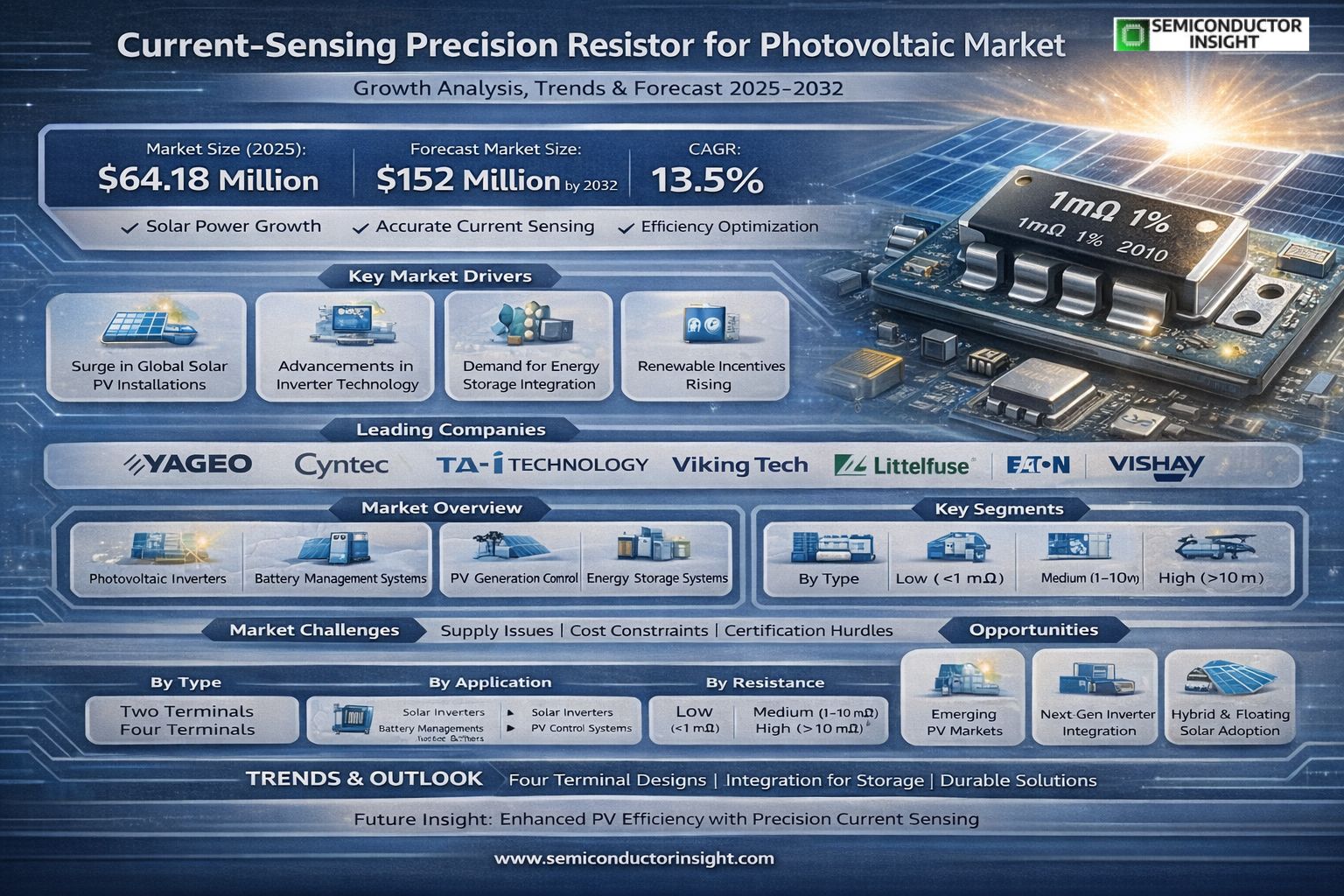
MARKET DRIVERS
Surge in Global Solar PV Installations
The rapid expansion of photovoltaic systems worldwide is a primary driver for Current-Sensing Precision Resistor for Photovoltaic Market. With global solar capacity surpassing 1,000 GW in 2023 and projected to grow at a CAGR of over 20% through 2030, demand for accurate current monitoring in inverters has intensified. These resistors enable precise measurement essential for maximum power point tracking (MPPT), boosting overall system efficiency.
Advancements in Inverter Technology
Innovations in solar inverters, particularly string and central inverters, rely heavily on high-precision resistors for current sensing to ensure fault detection and energy optimization. The shift toward smart inverters with grid-support features further amplifies this need, as they require resistors with low TCR (temperature coefficient of resistance) below 50 ppm/°C for reliable performance in varying environmental conditions.
➤ Regulatory Push for Renewables: Government incentives like the U.S. Inflation Reduction Act have accelerated PV deployments, increasing resistor demand by 15-20% annually in key markets.
Additionally, the integration of energy storage with PV systems demands even higher precision, positioning current-sensing precision resistors as critical components in the evolving photovoltaic ecosystem.
MARKET CHALLENGES
Supply Chain Vulnerabilities
Current-Sensing Precision Resistor for Photovoltaic Market faces significant hurdles from fluctuating raw material supplies, particularly metal alloys used in low-ohm shunts. Disruptions, such as those seen in 2022, led to a 10-15% price hike, impacting manufacturer margins and delaying PV project timelines.
Other Challenges
Intense Competition and Technological Shifts
Emerging integrated sensing solutions in power modules challenge traditional discrete resistors, pressuring incumbents to innovate rapidly while maintaining cost competitiveness in a market dominated by Asian suppliers holding over 60% share.
Moreover, achieving ultra-low resistance values (below 1 mΩ) without compromising stability poses engineering difficulties, especially under high currents up to 100A in utility-scale PV farms.
MARKET RESTRAINTS
High Material and Manufacturing Costs
Elevated costs of precision materials like manganin and nickel-chromium alloys restrain growth in Current-Sensing Precision Resistor for Photovoltaic Market. These components require specialized thin-film deposition processes, driving unit prices 20-30% higher than standard resistors and limiting adoption in cost-sensitive residential PV segments.
Stringent certification standards, including IEC 61730 for PV safety, add compliance burdens, with testing cycles extending lead times by 4-6 months. This is particularly acute in Europe, where over 70% of inverters demand UL-listed precision sensing elements.
Furthermore, thermal management challenges in high-power PV applications can degrade resistor performance over time, necessitating frequent replacements and capping market penetration in harsh climates.
MARKET OPPORTUNITIES
Expansion in Emerging PV Markets
Current-Sensing Precision Resistor for Photovoltaic Market holds substantial promise in Asia-Pacific and Middle East regions, where PV capacity additions are forecasted to exceed 300 GW by 2028. Local manufacturing hubs in India and Saudi Arabia offer localization benefits, reducing import dependencies.
Advancements in wide-bandgap semiconductors like SiC and GaN in inverters create demand for next-gen resistors with tolerances under 0.5%, enabling higher efficiency levels above 99%. This aligns with the global push for net-zero emissions.
Hybrid PV-storage and floating solar projects further unlock opportunities, as they require robust current-sensing for bidirectional power flow, potentially growing the segment by 25% CAGR through 2030.
Current-Sensing Precision Resistor for Photovoltaic Market Trends
Rising Integration in Photovoltaic Inverters
Current-Sensing Precision Resistor for Photovoltaic Market sees strong momentum from the expanding solar energy sector, where these high-accuracy components are essential for inverters. Designed to measure current flow precisely under high temperatures and sunlight exposure, they enable real-time monitoring that optimizes power output in photovoltaic systems. Inverters, a dominant application segment, rely on these resistors for stable performance, fault detection, and efficiency gains, aligning with global shifts toward renewable energy infrastructure.
Other Trends
Shift Toward Four-Terminal Configurations
Market dynamics highlight a growing preference for four-terminal Current-Sensing Precision Resistor for Photovoltaic designs over traditional two-terminal variants, offering superior accuracy in complex photovoltaic setups. This evolution supports advanced current sensing in charge controllers and power generation systems, reducing errors in harsh environmental conditions prevalent in solar installations.
Expansion in Battery Management Systems
Battery management systems represent another key growth area within Current-Sensing Precision Resistor for Photovoltaic Market, where precise resistors facilitate reliable energy storage and discharge monitoring. As photovoltaic deployments integrate more storage solutions, demand surges for components that maintain stability, enhancing overall system reliability and extending battery life.
Dominance of Leading Manufacturers
Key players such as YAGEO Corporation, Cyntec, TA-I TECHNOLOGY, Viking Tech, and VISHAY continue to shape Current-Sensing Precision Resistor for Photovoltaic Market through innovation and market share leadership. Their focus on product development, including enhanced tolerance for extreme conditions, drives competitive advancements. Regional trends show Asia, particularly China, leading adoption due to massive photovoltaic capacity additions, followed by North America and Europe, where regulatory pushes for clean energy bolster component integration in diverse applications like control systems.
COMPETITIVE LANDSCAPE
Key Industry Players
Dominant Manufacturers in Current-Sensing Precision Resistor for Photovoltaic Market
Current-Sensing Precision Resistor for Photovoltaic Market features a moderately concentrated competitive landscape, led by established global electronics giants with specialized expertise in high-accuracy passive components. YAGEO Corporation emerges as a frontrunner, leveraging its vast production scale and photovoltaic-optimized designs to capture significant revenue share among the top players. VISHAY and Littelfuse follow closely, benefiting from robust R&D in low TCR and high-stability resistors essential for solar inverters and charge controllers. This oligopolistic structure is fueled by the sector’s rapid growth, projected at a 13.5% CAGR through 2032, where top five firms hold the majority of global revenue, emphasizing reliability under extreme PV conditions like high temperatures and UV exposure.
Beyond leaders, niche innovators such as Cyntec, TA-I TECHNOLOGY, and Viking Tech provide specialized four-terminal solutions for precise current measurement in battery management systems and power generation controls. Other key contributors including Juneway Electronics, Fenghua Advanced Technology, EATON, Panasonic, and ROHM enhance market diversity with tailored offerings for real-time monitoring and fault detection. These players focus on differentiation through advanced metallization and pulse-handling capabilities, supporting photovoltaic efficiency amid rising solar deployments in Asia and North America, while navigating supply chain challenges and technological shifts toward higher power densities.
List of Key Current-Sensing Precision Resistor for Photovoltaic Companies Profiled
- YAGEO Corporation
- Cyntec
- TA-I TECHNOLOGY
- Juneway Electronics
- Viking Tech
- Fenghua Advanced Technology
- Littelfuse
- IET Labs
- EATON
- VISHAY
- Panasonic
- ROHM
Segment Analysis:
| Segment Category | Sub-Segments | Key Insights |
| By Type |
|
Two Terminals
|
| By Application |
|
Photovoltaic Inverter
|
| By End User |
|
Utility-Scale Installations
|
| By Mounting Type |
|
Surface Mount (SMD)
|
| By Resistance Range |
|
Low Resistance (<1 mΩ)
|
Regional Analysis: Current-Sensing Precision Resistor for Photovoltaic Market
Asia-Pacific
Asia-Pacific excels as the global manufacturing epicenter for Current-Sensing Precision Resistor for Photovoltaic Market, leveraging economies of scale and advanced automation. Proximity to photovoltaic supply chains minimizes logistics costs, enabling just-in-time delivery for large-scale projects.
Robust government subsidies and mandates for solar adoption propel demand for precision current-sensing resistors. Initiatives prioritize local content, boosting domestic firms’ market share in photovoltaic applications.
Regional R&D emphasizes metal foil and thin-film technologies for superior stability in Current-Sensing Precision Resistor for Photovoltaic Market, addressing high-temperature and humidity challenges in tropical climates.
Strong export capabilities supply global photovoltaic markets, with customized resistors meeting international standards for efficiency and reliability in diverse solar setups.
North America
North America exhibits steady advancement in Current-Sensing Precision Resistor for Photovoltaic Market, fueled by technological innovation and supportive clean energy frameworks. The United States and Canada prioritize high-reliability components for commercial and utility-scale solar farms, where precision current sensing ensures optimal power conversion. Leading firms focus on resistors with ultra-low resistance values to minimize power losses in modern inverters. Strategic partnerships between resistor specialists and photovoltaic integrators drive custom developments for bifacial modules and tracking systems. Regulatory emphasis on grid stability encourages adoption of advanced sensing solutions. The market benefits from a skilled workforce advancing hybrid designs combining sensing with protection features. Investments in domestic production aim to reduce import dependencies, enhancing supply security amid growing solar capacity additions.
Europe
Europe maintains a mature position in Current-Sensing Precision Resistor for Photovoltaic Market, underpinned by stringent efficiency standards and ambitious decarbonization goals. Germany and other nations lead in rooftop and community solar, demanding resistors with exceptional tolerance for fluctuating loads. Emphasis on circular economy principles promotes recyclable materials in precision components. Collaborative R&D consortia develop next-gen resistors for microinverters, improving harvest from shaded arrays. EU directives on renewable integration favor high-accuracy sensing to support virtual power plants. Market dynamics reflect a shift towards premium, long-life products, with certifications ensuring compliance across borders. Local fabrication clusters in Eastern Europe provide cost-effective scaling.
South America
South America shows promising growth in Current-Sensing Precision Resistor for Photovoltaic Market, propelled by abundant solar resources and expanding off-grid applications. Brazil and Chile spearhead utility projects in remote areas, requiring rugged current-sensing resistors resilient to dust and temperature extremes. Emerging local assembly reduces lead times for photovoltaic deployments in agriculture and mining. Government auctions for solar capacity stimulate demand for reliable components in string inverters. Focus on affordability drives adoption of standardized precision resistors. Regional integration with Latin American supply networks fosters technology transfer, enhancing system performance in hybrid renewable setups.
Middle East & Africa
The Middle East & Africa region emerges as a high-potential arena in Current-Sensing Precision Resistor for Photovoltaic Market, harnessing solar abundance for energy diversification. UAE and Saudi Arabia invest heavily in mega-solar parks, necessitating precision resistors for large-scale inverters under intense heat. South Africa’s hybrid projects prioritize sensing accuracy for battery storage integration. Harsh climates spur demand for thermally stable components. International aid and PPPs accelerate off-grid solar in Africa, favoring durable, low-maintenance resistors. Knowledge exchange with Asian suppliers builds local expertise, positioning the region for sustained expansion.
Report Scope
This market research report provides a comprehensive analysis of Current-Sensing Precision Resistor for Photovoltaic Market, covering the forecast period 2025–2032. It offers detailed insights into market dynamics, technological advancements, competitive landscape, and key trends shaping the industry.
Key focus areas of the report include:
- Market Overview: The report begins with an overview outlining its current market scenario, key growth indicators, and industry transformation drivers. It discusses macroeconomic factors, demand–supply balance, regulatory landscape, and the strategic role of current-sensing precision resistors in powering advancements across industries such as photovoltaic inverters, charge controllers, battery management systems, and power generation control systems.
- Market Size & Forecast: Historical data and future projections for revenue, unit shipments, and market value across major regions and segments.
- Segmentation Analysis: Detailed breakdown by product type, technology, application, and end-user industry to identify high-growth segments and investment opportunities.
- Regional Insights: Insights into market performance across North America, Europe, Asia-Pacific, Latin America, and the Middle East & Africa, including country-level analysis where relevant.
- Competitive Landscape: Profiles of leading market participants, including their product offerings, R&D focus, manufacturing capacity, pricing strategies, and recent developments such as mergers, acquisitions, and partnerships.
- Technology Trends & Innovation: Assessment of emerging technologies, integration of AI/IoT, semiconductor design trends, fabrication techniques, and evolving industry standards.
- Market Drivers & Restraints: Evaluation of factors driving market growth along with challenges, supply chain constraints, regulatory issues, and market-entry barriers.
- Stakeholder Insights: Insights for component suppliers, OEMs, system integrators, investors, and policymakers regarding the evolving ecosystem and strategic opportunities.
Primary and secondary research methods are employed, including interviews with industry experts, data from verified sources, and real-time market intelligence to ensure the accuracy and reliability of the insights presented.
FREQUENTLY ASKED QUESTIONS:
What is the current market size of Current-Sensing Precision Resistor for Photovoltaic Market?
-> Global Current-Sensing Precision Resistor for Photovoltaic Market was valued at USD 64.18 million in 2025 and is projected to reach USD 152 million by 2032, at a CAGR of 13.5% during the forecast period.
Which key companies operate in Current-Sensing Precision Resistor for Photovoltaic Market?
-> Key players include YAGEO Corporation, Cyntec, TA-I TECHNOLOGY, Juneway Electronics, Viking Tech, Fenghua Advanced Technology, Littelfuse, IET Labs, EATON, VISHAY, among others.
What are the key growth drivers?
-> Key growth drivers include expansion of photovoltaic systems, rising demand for solar power equipment, and need for precise current measurement in inverters and battery management systems.
Which region dominates the market?
-> Asia is the fastest-growing region, while North America remains a key market.
What are the emerging trends?
-> Emerging trends include high-accuracy resistors for extreme conditions, real-time monitoring in PV systems, and integration in charge controllers for enhanced energy efficiency.

Get Sample Report PDF for Exclusive Insights
Report Sample Includes
- Table of Contents
- List of Tables & Figures
- Charts, Research Methodology, and more...
 Download Sample Report PDF