MARKET INSIGHTS
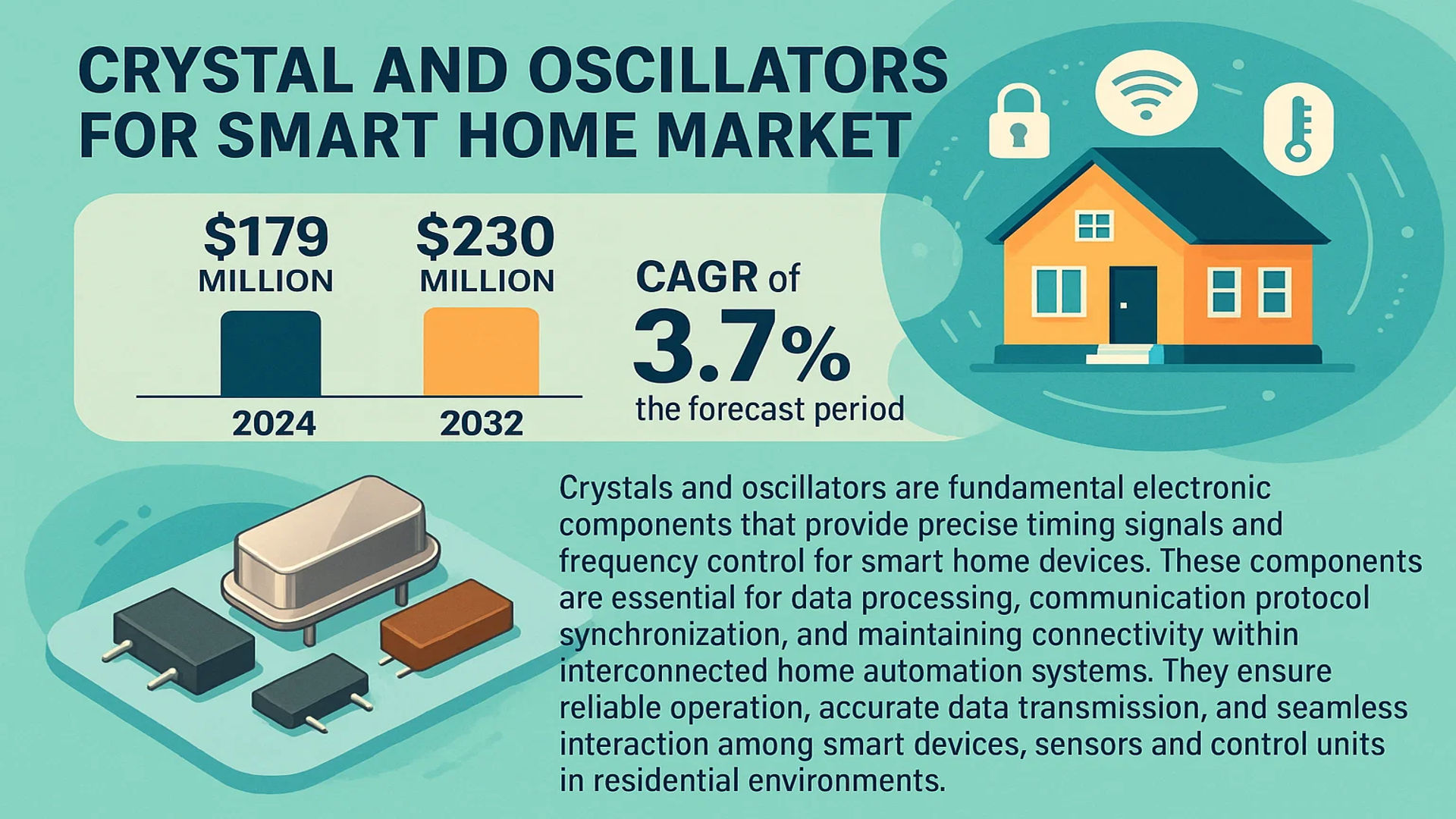
The global Crystal and Oscillators for Smart Home Market was valued at 179 million in 2024 and is projected to reach US$ 230 million by 2032, at a CAGR of 3.7% during the forecast period.
Crystals and oscillators are fundamental electronic components that provide precise timing signals and frequency control for smart home devices. These components are essential for data processing, communication protocol synchronization, and maintaining connectivity within interconnected home automation systems. They ensure reliable operation, accurate data transmission, and seamless interaction among smart devices, sensors, and control units in residential environments.
The market growth is primarily driven by the increasing adoption of smart home devices and IoT technologies, which require stable and accurate timing components for proper functionality. The proliferation of wireless connectivity standards such as Wi-Fi, Bluetooth, Zigbee, and Z-Wave in smart home applications further necessitates high-performance crystals and oscillators. However, manufacturers face challenges in maintaining frequency accuracy across varying environmental conditions while meeting demands for miniaturization and cost efficiency. Leading market players including Seiko Epson Corp, TXC Corporation, and Murata Manufacturing are continuously innovating to address these requirements and capitalize on the growing smart home ecosystem.
MARKET DYNAMICS
MARKET DRIVERS
Accelerated Smart Home Adoption Driving Component Demand
The global smart home market continues its robust expansion, with over 258 million households expected to adopt smart technologies by 2025. This massive growth trajectory directly fuels demand for precision timing components, as crystals and oscillators serve as the heartbeat of interconnected devices. Smart thermostats, security systems, lighting controls, and entertainment hubs all require stable frequency references to maintain synchronized operation. The proliferation of IoT-connected devices within residential environments has created an ecosystem where timing accuracy becomes non-negotiable for seamless user experiences. Manufacturers are responding by developing specialized components that can maintain precision across varying environmental conditions while consuming minimal power.
Wireless Protocol Proliferation Necessitating Advanced Timing Solutions
Modern smart homes utilize multiple wireless protocols simultaneously, including Wi-Fi 6/6E, Bluetooth 5.2, Zigbee 3.0, Thread, and Matter standards. Each protocol requires specific frequency stability characteristics, creating complex timing requirements that drive innovation in crystal and oscillator design. The emergence of Matter as a unifying standard has particularly intensified the need for components that can maintain synchronization across diverse device categories. Manufacturers are developing multi-protocol compatible oscillators that can switch between frequencies while maintaining phase noise performance below -150 dBc/Hz, ensuring reliable data transmission in crowded RF environments.
Furthermore, the transition to higher frequency bands for improved bandwidth and reduced latency demands components with enhanced frequency stability. The deployment of Wi-Fi 6E networks utilizing the 6 GHz spectrum requires oscillators capable of maintaining accuracy within ±10 ppm despite temperature variations and electromagnetic interference from numerous connected devices.
➤ For instance, leading manufacturers have introduced temperature-compensated crystal oscillators (TCXOs) that maintain frequency stability within ±0.5 ppm across industrial temperature ranges, enabling reliable operation in diverse smart home environments.
The continuous evolution of wireless standards and the increasing density of connected devices per household are driving sustained demand for advanced timing solutions that can support next-generation smart home infrastructure.
MARKET RESTRAINTS
Frequency Stability Challenges in Diverse Environmental Conditions
Smart home devices operate across widely varying environmental conditions, from temperature-controlled interiors to outdoor installations experiencing seasonal extremes. Maintaining frequency stability becomes particularly challenging when devices are subjected to temperature fluctuations exceeding 85°C range. Standard crystal units may experience frequency deviations up to ±30 ppm across this range, potentially disrupting communication protocols and device synchronization. This challenge is amplified in devices like smart thermostats and security cameras that must maintain reliable operation while experiencing direct sunlight exposure or winter conditions.
Additionally, humidity variations and mechanical stresses from device operation can affect crystal performance. Devices incorporating moving parts, such as smart blinds or robotic vacuum cleaners, introduce vibration that can impact oscillator stability. Manufacturers must address these environmental factors through advanced packaging techniques and compensation circuitry, increasing component complexity and cost.
Miniaturization Pressures Constraining Performance Parameters
The relentless drive toward smaller form factors in smart home devices creates significant engineering challenges for timing component manufacturers. Consumers increasingly expect discreet, aesthetically pleasing devices that blend into home environments, forcing designers to reduce component sizes dramatically. Crystal packages have shrunk from traditional 5.0×3.2mm dimensions to 2.0×1.6mm and smaller, creating inherent trade-offs between size, frequency stability, and power consumption.
Smaller crystal elements exhibit reduced Q-factor and increased susceptibility to environmental influences, requiring more sophisticated compensation techniques. This miniaturization trend particularly affects high-frequency applications above 100 MHz, where maintaining phase noise performance becomes increasingly difficult. The industry faces the constant challenge of balancing dimensional requirements with the need for robust performance across the device’s operational lifetime.
MARKET CHALLENGES
Supply Chain Vulnerabilities Impacting Component Availability
The global nature of electronic component manufacturing creates significant supply chain challenges for timing component producers. Recent disruptions have highlighted the vulnerability of crystal and oscillator supply networks, with lead times extending from typical 8-12 weeks to over 26 weeks for certain specifications. Raw material availability, particularly high-purity quartz crystals, remains constrained due to limited mining operations and processing capacity. The specialized equipment required for crystal fabrication and testing represents another bottleneck, with delivery times for new machinery exceeding 18 months.
Other Challenges
Quality Consistency Across Production Batches
Maintaining consistent performance characteristics across production batches presents ongoing challenges. Crystal frequency characteristics can vary slightly due to minute differences in cutting angles, electrode deposition, and sealing processes. While automated manufacturing has improved consistency, achieving tight tolerance control across high-volume production runs requires continuous process monitoring and adjustment.
Counterfeit Component Proliferation
The market faces increasing issues with counterfeit components that fail to meet specified performance parameters. These substandard products can cause system failures and reliability issues, particularly in safety-critical applications like smart security systems and environmental controls. The industry must implement robust authentication and traceability measures to protect product integrity.
MARKET OPPORTUNITIES
Emerging Energy Harvesting Applications Creating New Market Segments
The growing adoption of energy harvesting technologies in smart home devices presents significant opportunities for ultra-low-power timing solutions. Battery-free devices utilizing ambient light, thermal gradients, or RF energy harvesting require timing components with power consumption below 100 nA while maintaining adequate frequency stability. This emerging segment drives innovation in low-power oscillator design, particularly for devices that must operate for extended periods without external power sources.
Energy harvesting applications typically require components that can start quickly from sleep modes while maintaining frequency accuracy within ±20 ppm. Recent advancements in MEMS technology have enabled oscillators that consume less than 50 nA while providing stability suitable for most smart home communication protocols. These developments open new market opportunities in applications where traditional battery replacement is impractical or undesirable.
5G and Edge Computing Integration Driving Advanced Timing Requirements
The integration of 5G connectivity and edge computing capabilities into smart home ecosystems creates demand for higher-performance timing solutions. 5G small cells and gateways require timing accuracy within ±100 ppb to maintain network synchronization, driving adoption of oven-controlled crystal oscillators (OCXOs) and advanced TCXOs. Similarly, edge computing nodes processing local AI algorithms need stable clock references to ensure computational integrity and synchronization with cloud services.
This technological evolution represents a significant opportunity for component manufacturers to develop products meeting stricter requirements while maintaining cost-effectiveness for consumer applications. The convergence of communication and computing within smart home environments will continue to drive innovation in timing technology for the foreseeable future.
CRYSTAL AND OSCILLATORS FOR SMART HOME MARKET TRENDS
Miniaturization and Enhanced Frequency Stability Driving Component Innovation
The relentless drive toward smaller, more integrated smart home devices is fundamentally reshaping crystal and oscillator requirements. Manufacturers are under immense pressure to deliver components that not only occupy minimal PCB real estate but also maintain exceptional frequency stability in diverse operating environments. This has led to significant investments in advanced packaging technologies like wafer-level packaging (WLP) and chip-scale packaging (CSP), which allow for component sizes below 1.0mm x 0.8mm. Concurrently, the demand for improved performance has accelerated the adoption of MEMS (Micro-Electro-Mechanical Systems) technology over traditional quartz. MEMS-based oscillators offer superior resilience to mechanical shock, vibration, and temperature fluctuations, with typical stability ratings now reaching ±10 ppm over an industrial temperature range of -40°C to +85°C. This is critical for devices like smart sensors and wearables that experience dynamic environmental conditions. Furthermore, the integration of these components into System-in-Package (SiP) and multi-chip modules is becoming a standard approach to reduce overall system footprint and power consumption, which is paramount for battery-operated IoT endpoints.
Other Trends
Proliferation of Low-Power, Wide-Area Network (LPWAN) Protocols
The expansion of smart home ecosystems beyond the confines of local Wi-Fi and Bluetooth networks is a major trend, necessitating crystals and oscillators optimized for LPWAN protocols like LoRaWAN, NB-IoT, and LTE-M. These networks are designed for long-range communication and years of battery life, placing a premium on ultra-low power consumption from every component. Consequently, there is a growing market segment for oscillators with current consumption in the microampere range and sophisticated power management features such as standby and sleep modes. For instance, components supporting these protocols must maintain frequency accuracy to within ±20 ppm to ensure reliable data packets are received over distances exceeding several kilometers in urban settings. This trend is directly supporting the growth of outdoor smart home applications, including security cameras, environmental monitors, and smart irrigation systems, which require both extended range and minimal maintenance.
Rising Demand for High-Precision Timing in Mesh Networks
As smart homes become more complex, relying on robust mesh networking protocols such as Zigbee, Thread, and Z-Wave for device interoperability, the need for highly synchronized timing has become non-negotiable. These mesh networks depend on precise time synchronization across all nodes to efficiently manage communication, reduce packet collisions, and optimize network bandwidth. Crystals and oscillators with low jitter and excellent phase noise performance are essential to maintain the integrity of these time-sensitive networks. Even minor timing inaccuracies can lead to latency issues, dropped commands, and reduced overall system reliability. This is particularly crucial for applications requiring real-time responsiveness, such as smart lighting systems that synchronize across multiple rooms or advanced security systems that trigger instantaneous alerts. Consequently, component manufacturers are focusing on developing ultra-stable oscillators with jitter performance below 1 picosecond, ensuring that the ever-growing number of devices in a modern smart home can operate in seamless harmony.
COMPETITIVE LANDSCAPE
Key Industry Players
Companies Strive to Strengthen their Product Portfolio to Sustain Competition
The global competitive landscape for crystals and oscillators in the smart home market is fragmented yet dynamic, characterized by a mix of established electronic component manufacturers and specialized frequency control device producers. While the market is crowded with numerous players, a few key companies have established significant market share through technological innovation, extensive distribution networks, and strong relationships with smart home device manufacturers. Murata Manufacturing emerges as a dominant player, leveraging its comprehensive portfolio of quartz crystal units and oscillators alongside its global manufacturing capabilities and established presence in consumer electronics markets.
Seiko Epson Corporation and NDK (Nihon Dempa Kogyo Co., Ltd.) also command substantial market positions, particularly in the high-precision timing component segment. These Japanese manufacturers have built their reputation on exceptional quality control, frequency stability, and miniaturization capabilities—critical factors for space-constrained smart home devices. Their growth is further accelerated by the increasing demand for reliable timing components in Wi-Fi routers, smart hubs, and connected appliances across North American and European markets.
Additionally, these industry leaders are actively pursuing growth through strategic partnerships with IoT platform providers and smart home ecosystem developers. Recent collaborations focus on developing application-specific oscillators that address the unique timing requirements of Zigbee, Z-Wave, and Thread communication protocols, which are increasingly prevalent in smart home applications. Such specialized solutions enable these companies to differentiate their offerings and capture value in niche segments.
Meanwhile, Microchip Technology and SiTime Corporation are strengthening their competitive positioning through significant investments in MEMS (Micro-Electro-Mechanical Systems) oscillator technology. This approach addresses several market challenges simultaneously: MEMS oscillators offer superior shock and vibration resistance compared to traditional quartz crystals, better performance in temperature variations, and easier integration with other semiconductor components. Because smart home devices often operate in diverse environmental conditions and require robust performance, these technological advancements provide a competitive edge in the market.
The competitive environment is further intensified by several Taiwanese and Chinese manufacturers, including TXC Corporation and Siward Crystal Technology, who compete aggressively on cost efficiency while gradually improving their technological capabilities. These companies have gained traction by offering reliable timing components at competitive price points, making them attractive partners for smart home device manufacturers facing cost pressures. Their growing market presence is particularly notable in the Asian region, where smart home adoption is accelerating rapidly.
List of Key Crystal and Oscillator Companies Profiled
- Murata Manufacturing Co., Ltd. (Japan)
- Seiko Epson Corporation (Japan)
- NDK (Nihon Dempa Kogyo Co., Ltd.) (Japan)
- Microchip Technology Inc. (U.S.)
- SiTime Corporation (U.S.)
- TXC Corporation (Taiwan)
- Kyocera Crystal Device (KCD) Corporation (Japan)
- Daishinku Corp. (KDS) (Japan)
- Rakon Limited (New Zealand)
- Siward Crystal Technology Co., Ltd. (Taiwan)
- Micro Crystal AG (Switzerland)
- Hosonic Electronic Co., Ltd. (Taiwan)
- Failong Crystal Technologies Co., Ltd. (China)
- River Eletec Corporation (Japan)
- Zhejiang East Crystal Electronic Co., Ltd. (China)
- Guoxin Micro (China)
Segment Analysis:
By Type
Crystal Oscillators Segment Dominates the Market Due to Superior Frequency Stability and Integration Capabilities
The market is segmented based on type into:
- Crystal Units
- Subtypes: Quartz Crystal Units, Ceramic Resonators, and others
- Crystal Oscillators
- Subtypes: Temperature-Compensated Crystal Oscillators (TCXO), Oven-Controlled Crystal Oscillators (OCXO), Voltage-Controlled Crystal Oscillators (VCXO), and others
By Application
Smart Lighting Segment Leads Due to Proliferation of Connected Home Automation Systems
The market is segmented based on application into:
- Smart Air Conditioners
- Smart Refrigerators
- Smart Washing Machines
- Smart Lighting
- Others
By Frequency Range
32.768 kHz Segment Holds Significant Share Due to Universal Adoption in Real-Time Clock Circuits
The market is segmented based on frequency range into:
- 32.768 kHz
- 4-48 MHz
- Above 48 MHz
By Connectivity Protocol
Wi-Fi and Bluetooth Segment Dominates Owing to High Penetration in Smart Home Ecosystems
The market is segmented based on connectivity protocol into:
- Wi-Fi and Bluetooth
- Zigbee
- Z-Wave
- Thread
- Others
Regional Analysis: Crystal and Oscillators for Smart Home Market
Asia-Pacific
The Asia-Pacific region is the undisputed leader in the global Crystal and Oscillators for Smart Home market, accounting for over 55% of global consumption in 2024. This dominance is driven by massive manufacturing hubs in China, Taiwan, Japan, and South Korea, which produce the vast majority of the world’s smart home devices. The region’s robust electronics supply chain, including key component suppliers like TXC Corporation, NDK, and Murata Manufacturing, ensures readily available and cost-effective timing solutions. High consumer adoption rates, particularly in China and South Korea where smart home penetration exceeds 20%, fuel continuous demand. However, intense price competition among manufacturers places significant pressure on component costs, driving innovation toward more integrated and value-engineered crystal and oscillator solutions.
North America
North America represents a high-value, innovation-driven market characterized by stringent performance and reliability requirements. The region, led by the United States, has a smart home penetration rate of approximately 15% and is a key market for premium, feature-rich devices. Demand is heavily influenced by the need for robust wireless connectivity—supporting protocols like Wi-Fi 6E, Thread, and Matter—which requires high-stability, low-jitter oscillators. Major technology firms and smart home ecosystem developers prioritize components from suppliers like Microchip and SiTime that offer exceptional frequency accuracy and temperature stability. Furthermore, a strong focus on data security and privacy mandates the use of reliable timing components to ensure encrypted communications remain synchronized and impervious to timing-based attacks.
Europe
The European market is shaped by a strong regulatory environment focused on energy efficiency and environmental sustainability, such as the EU’s Ecodesign Directive. This drives demand for ultra-low-power crystals and oscillators, particularly in battery-operated sensors and smart lighting systems that form the backbone of European smart homes. The region shows a growing preference for interoperable systems compliant with the new Matter standard, necessitating timing components that can maintain synchronization across diverse device ecosystems from different manufacturers. While adoption rates are high in Western European nations like Germany and the UK, growth is steady rather than explosive, with a focus on quality, durability, and compliance over sheer volume.
South America
The South American market is in a growth phase, presenting significant long-term opportunities. Economic factors remain a primary constraint, leading to a preference for cost-sensitive crystal units over higher-precision oscillators in many consumer applications. The market is currently dominated by entry-level smart devices, such as smart plugs and lighting, where basic timing functionality is sufficient. Brazil and Argentina are the most active markets, though infrastructure challenges and economic volatility can lead to fluctuating demand. As the middle class expands and urbanization continues, the demand for more sophisticated smart home systems is expected to gradually increase, subsequently driving the need for more advanced timing components.
Middle East & Africa
This region is an emerging market with potential concentrated in wealthier Gulf Cooperation Council (GCC) nations like the UAE and Saudi Arabia. High disposable income drives the adoption of luxury smart home systems, creating a niche demand for high-performance, reliable oscillators that can perform in extreme ambient temperatures. However, the broader regional market is still nascent. Development is often hampered by a lack of standardized connectivity infrastructure and a fragmented regulatory landscape. While the long-term outlook is positive, aligned with major urban development projects, current growth is incremental and focused on specific high-end residential and commercial projects.
Report Scope
This market research report provides a comprehensive analysis of the global and regional Crystal and Oscillators for Smart Home markets, covering the forecast period 2025–2032. It offers detailed insights into market dynamics, technological advancements, competitive landscape, and key trends shaping the industry.
Key focus areas of the report include:
- Market Size & Forecast: Historical data and future projections for revenue, unit shipments, and market value across major regions and segments.
- Segmentation Analysis: Detailed breakdown by product type, technology, application, and end-user industry to identify high-growth segments and investment opportunities.
- Regional Outlook: Insights into market performance across North America, Europe, Asia-Pacific, Latin America, and the Middle East & Africa, including country-level analysis where relevant.
- Competitive Landscape: Profiles of leading market participants, including their product offerings, R&D focus, manufacturing capacity, pricing strategies, and recent developments such as mergers, acquisitions, and partnerships.
- Technology Trends & Innovation: Assessment of emerging technologies, integration of AI/IoT, semiconductor design trends, fabrication techniques, and evolving industry standards.
- Market Drivers & Restraints: Evaluation of factors driving market growth along with challenges, supply chain constraints, regulatory issues, and market-entry barriers.
- Stakeholder Analysis: Insights for component suppliers, OEMs, system integrators, investors, and policymakers regarding the evolving ecosystem and strategic opportunities.
Primary and secondary research methods are employed, including interviews with industry experts, data from verified sources, and real-time market intelligence to ensure the accuracy and reliability of the insights presented.
FREQUENTLY ASKED QUESTIONS:
What is the current market size of Global Crystal and Oscillators for Smart Home Market?
-> Crystal and Oscillators for Smart Home Market was valued at 179 million in 2024 and is projected to reach US$ 230 million by 2032, at a CAGR of 3.7% during the forecast period.
Which key companies operate in Global Crystal and Oscillators for Smart Home Market?
-> Key players include Seiko Epson Corp, TXC Corporation, NDK, Murata Manufacturing, Microchip Technology, SiTime, Rakon, Hosonic Electronic, and Siward Crystal Technology, among others.
What are the key growth drivers?
-> Key growth drivers include rising smart home adoption, proliferation of wireless connectivity protocols, increasing demand for energy-efficient devices, and enhanced focus on smart home security.
Which region dominates the market?
-> Asia-Pacific is the dominant market, accounting for over 45% of global revenue in 2024, driven by strong manufacturing presence and high smart home device adoption rates.
What are the emerging trends?
-> Emerging trends include miniaturization of components, development of ultra-low power oscillators, integration of MEMS technology, and advancement in temperature-compensated crystal oscillators (TCXOs) for improved performance in smart home applications.

Get Sample Report PDF for Exclusive Insights
Report Sample Includes
- Table of Contents
- List of Tables & Figures
- Charts, Research Methodology, and more...
 Download Sample Report PDF