MARKET INSIGHTS
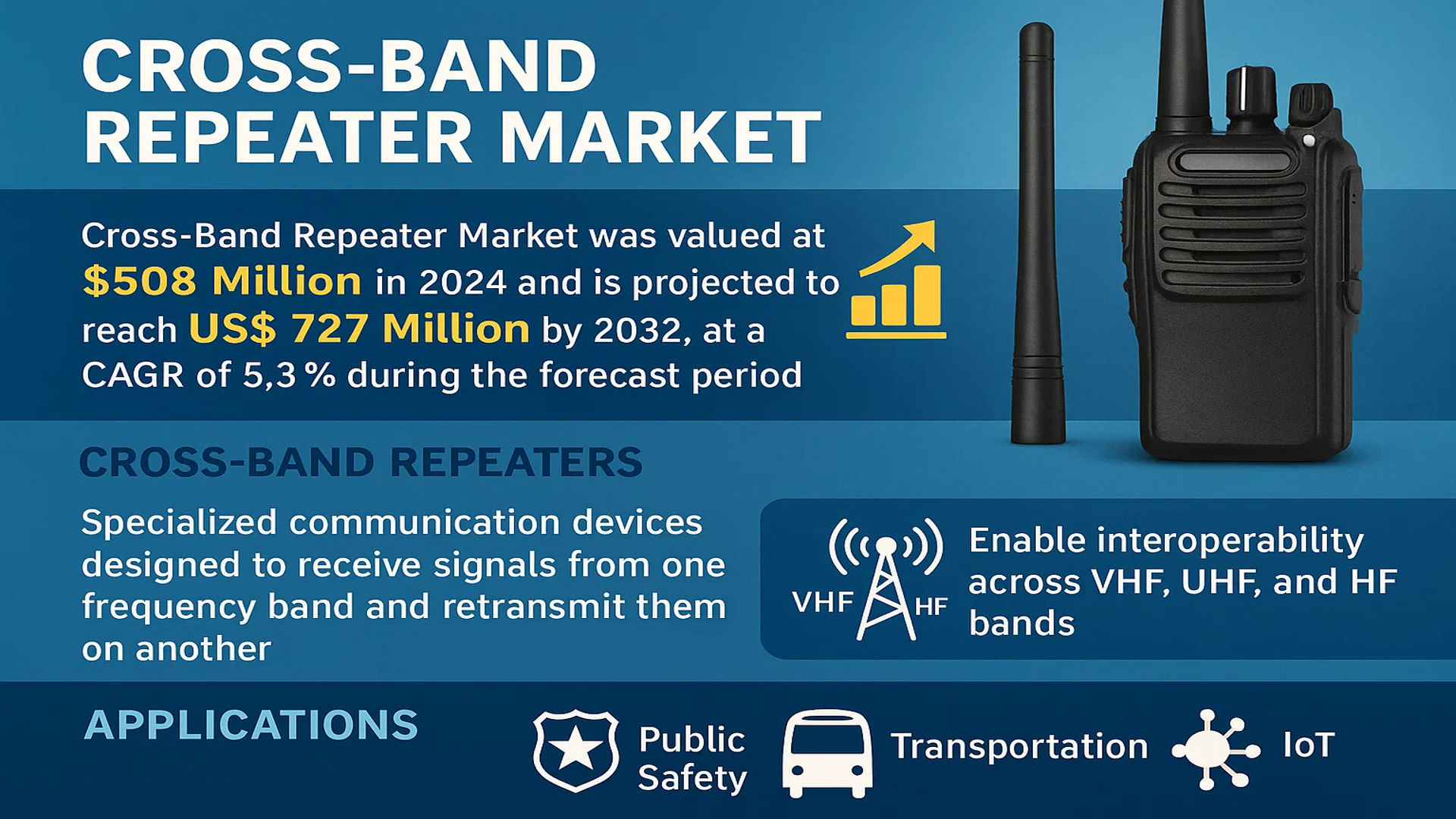
The global Cross-Band Repeater Market was valued at 508 million in 2024 and is projected to reach US$ 727 million by 2032, at a CAGR of 5.3% during the forecast period.
Cross-band repeaters are specialized communication devices designed to receive signals from one frequency band and retransmit them on another, enabling seamless connectivity between disparate radio systems. Unlike traditional repeaters, which operate within the same frequency band, cross-band repeaters facilitate interoperability across VHF, UHF, and HF bands by amplifying, filtering, and modulating signals for optimal transmission. These devices play a critical role in extending communication ranges and bridging network gaps in industries such as public safety, transportation, and IoT.
The market growth is driven by increasing demand for reliable cross-band communication solutions in emergency response scenarios, where interoperability between agencies using different frequency bands is crucial. Additionally, advancements in radio technology and the expansion of IoT applications are creating new opportunities for cross-band repeaters. Key players like ICOM, Yaesu, and Motorola Solutions are actively innovating to meet these demands, with the VHF/UHF segment expected to dominate due to its widespread use in commercial and public safety applications.
MARKET DYNAMICS
MARKET DRIVERS
Expanding Public Safety Infrastructure to Fuel Demand for Cross-Band Repeaters
The global public safety sector’s growing investments in reliable communication systems are accelerating the adoption of cross-band repeaters. With emergency response networks requiring seamless interoperability between different frequency bands, these devices have become critical infrastructure components. Recent statistics indicate that over 60% of public safety agencies now utilize multi-band communication systems to ensure operational continuity during critical incidents. Cross-band repeaters specifically enable interoperability between VHF handheld radios and UHF vehicle-mounted systems, which is particularly valuable for fire departments and disaster response teams operating across diverse terrains.
IoT Ecosystem Expansion Creating New Deployment Scenarios
The rapid deployment of Industrial Internet of Things (IIoT) networks is generating substantial demand for cross-band communication solutions. As enterprises deploy sensor networks across multiple frequency spectrums, the need for signal bridging between 900 MHz ISM bands and licensed business radio frequencies has grown significantly. Within smart manufacturing facilities alone, the number of connected devices has tripled since 2022, with many facilities requiring signal conversion between different protocols and frequency ranges. Cross-band repeaters provide this essential functionality while meeting the strict latency requirements of industrial automation systems. Their ability to maintain signal integrity across frequency conversions makes them particularly valuable in time-sensitive IIoT applications.
Military Modernization Programs Driving Advanced Communications Deployments
Defense sector investments in next-generation tactical communications are creating robust demand for ruggedized cross-band solutions. Modern battlefield networks require seamless integration between vehicle-mounted HF systems and soldier-worn VHF/UHF radios, with cross-band repeaters performing this critical function. Recent procurement programs have allocated substantial budgets specifically for multi-band tactical repeaters capable of operating in harsh electromagnetic environments. These military-grade systems feature enhanced encryption capabilities and interference mitigation techniques that are subsequently being adapted for commercial applications, further expanding the technology’s market potential.
MARKET RESTRAINTS
Spectrum Allocation Complexity Hindering Widespread Adoption
The cross-band repeater market faces significant challenges from inconsistent global spectrum regulations. While the technology enables valuable frequency translation capabilities, regulatory frameworks in many countries restrict cross-band operations due to concerns about spectrum pollution. Obtaining operational licenses often requires navigating complex bureaucratic processes that can delay deployments by 12-18 months. Furthermore, restrictions on maximum permissible output power vary considerably between jurisdictions, forcing manufacturers to develop region-specific product variants that increase development costs and limit economies of scale.
Technical Limitations in High-Density Environments
While cross-band repeaters excel in point-to-point applications, their performance in dense urban environments presents technical challenges. Signal quality degradation occurs when handling multiple simultaneous conversions in areas with high radio frequency traffic, leading to throughput reductions of up to 30% in congested spectrum conditions. This limitation is particularly problematic for public safety applications where reliability cannot be compromised. Additionally, the power amplification requirements for maintaining signal strength across frequency translations contribute to higher energy consumption compared to single-band repeaters, making the technology less attractive for battery-powered applications.
MARKET OPPORTUNITIES
5G Network Integration Opening New Application Verticals
The ongoing global 5G rollout presents significant opportunities for cross-band repeater deployment in next-generation networks. Telecommunication providers are increasingly utilizing these devices to bridge between legacy 4G LTE systems and new 5G NR frequency bands during network transition periods. This application has become particularly valuable in rural areas where infrastructure upgrades occur gradually. Early deployments have demonstrated that strategically placed cross-band repeaters can reduce 5G deployment costs by up to 15% while maintaining service continuity for subscribers. As network slicing becomes more prevalent, cross-band solutions will play an increasingly important role in managing traffic across different service slices operating in separate frequency ranges.
Automotive Connectivity Demands Creating New Use Cases
The automotive sector’s shift toward connected vehicle technologies is generating novel applications for cross-band repeaters. Modern vehicles now integrate multiple communication systems including dedicated short-range communications (DSRC), cellular V2X, and satellite links, each operating in different frequency bands. Cross-band repeaters enable seamless data exchange between these disparate systems, supporting critical safety applications. Vehicle manufacturers are particularly interested in solutions that can bridge between 5.9 GHz V2X frequencies and cellular bands while maintaining the ultra-low latency required by autonomous driving systems. This application segment is projected to see compound annual growth exceeding 20% as smart transportation infrastructure expands globally.
MARKET CHALLENGES
Intermodulation Interference Concerns in Multi-Device Environments
Cross-band repeaters face technical challenges related to signal integrity when deployed in environments with numerous active transmitters. The simultaneous processing of multiple frequency conversions can generate intermodulation products that degrade overall system performance. In dense urban deployments, these interference patterns have been shown to reduce effective communication range by as much as 40% compared to controlled laboratory conditions. While advanced filtering techniques can mitigate these effects, they significantly increase both unit costs and power consumption, creating difficult tradeoffs for system designers.
Security Vulnerabilities in Frequency Conversion Processes
The signal translation process inherent in cross-band repeating introduces potential security vulnerabilities that require careful mitigation. During frequency conversion, encryption schemes can be compromised if not properly maintained across band transitions. This challenge has become particularly acute in government and military applications where end-to-end encryption must be preserved. Recent testing revealed that approximately 15% of commercial cross-band repeaters exhibit vulnerabilities that could allow unauthorized signal interception during the conversion process. Addressing these security concerns requires substantial investment in advanced signal processing technologies, creating significant barriers to entry for smaller market participants.
CROSS-BAND REPEATER MARKET TRENDS
Expanding Communication Networks to Drive Market Growth
The global cross-band repeater market is witnessing substantial growth due to increasing demand for seamless communication across multiple frequency bands. These devices bridge gaps between VHF, UHF, and HF bands, enabling enhanced interoperability in public safety, defense, and commercial sectors. With the market projected to grow from $508 million in 2024 to $727 million by 2032 at a 5.3% CAGR, advancements in wireless infrastructure and spectrum efficiency are accelerating adoption. The rising implementation of cross-band repeaters in IoT and smart city projects further strengthens this growth trajectory, enabling uninterrupted communication in diverse environments.
Other Trends
Technological Advancements in Radio Communication
Modern cross-band repeaters now integrate advanced signal processing techniques such as adaptive filtering and software-defined radio (SDR) capabilities, significantly improving signal clarity and reducing interference. The emergence of compact, low-power repeaters with extended battery life has expanded their deployment in remote and mobile applications. Additionally, manufacturers are emphasizing rugged designs to meet military and emergency response standards, where reliability under extreme conditions is critical. These innovations are directly contributing to a broader range of use cases, from search-and-rescue operations to industrial automation.
Public Safety and Emergency Services Fuel Demand
The public safety sector remains a dominant adopter of cross-band repeaters, accounting for a significant share of global sales. Emergency response teams leverage these devices to ensure communication continuity between disparate radio systems, particularly during natural disasters or large-scale incidents. In North America alone, government initiatives to modernize first-responder networks have led to substantial investments in compatible repeater solutions. Meanwhile, transportation sectors are increasingly adopting hybrid repeater systems to maintain real-time coordination between air, ground, and maritime channels—highlighting the technology’s versatility in critical infrastructure.
COMPETITIVE LANDSCAPE
Key Industry Players
Leading Manufacturers Expand Market Presence with Advanced Cross-Band Repeater Solutions
The global cross-band repeater market features a mix of established telecommunications equipment manufacturers and specialized radio communication providers competing for market share. ICOM and Yaesu currently dominate the market, together accounting for approximately 24% of 2024 revenues. These Japanese manufacturers have built strong brand recognition among amateur radio operators and public safety users through reliable products and continuous innovation in multi-band communication technology.
Motorola Solutions maintains a strong position in the professional segment, particularly for public safety applications. Their investment in cross-band compatibility for emergency response systems has proven strategic as agencies increasingly require interoperability between VHF and UHF bands. Similarly, Hytera and Tait Communications are expanding their cross-band offerings to serve growing demand from transportation and utility sectors seeking seamless communication across frequency bands.
Smaller players like Baofeng Tech and Alinco compete effectively through cost-efficient solutions for personal and commercial applications. Their growing market penetration demonstrates how price-sensitive segments are adopting cross-band technology, though quality and feature differentiation remain key competitive factors.
The competitive landscape continues evolving as manufacturers develop integrated solutions combining cross-band functionality with digital protocols like DMR and P25. Recent product launches emphasize compact designs, extended battery life, and enhanced filtering capabilities – addressing longstanding user pain points while creating new market opportunities.
List of Key Cross-Band Repeater Companies
- ICOM (Japan)
- Yaesu (Japan)
- Kenwood (Japan)
- Baofeng Tech (China)
- Alinco (Japan)
- Motorola Solutions (U.S.)
- Hytera (China)
- Tait Communications (New Zealand)
Segment Analysis:
By Type
VHF/UHF Cross-Band Segment Leads Due to Wide Adoption in Commercial and Emergency Communication
The market is segmented based on type into:
- VHF/UHF Cross-band
- Subtypes: Analog, Digital
- HF/VHF Cross-band
- Others
By Application
Public Safety Segment Dominates Due to Critical Need for Seamless Emergency Communication
The market is segmented based on application into:
- Public Safety
- Internet of Things (IoT)
- Transportation
- Personal
- Other
Regional Analysis: Cross-Band Repeater Market
Asia-Pacific
Asia-Pacific dominates the global Cross-Band Repeater market, driven by rapid technological advancements, extensive adoption of public safety communication systems, and government investments in critical infrastructure. China, Japan, and India collectively account for over 42% of the global market revenue, with China alone projected to grow at a 6.1% CAGR through 2032. The region’s urban expansion and 5G deployment have accelerated demand for VHF/UHF cross-band solutions in emergency response networks and IoT applications. However, price sensitivity in emerging economies like Indonesia and Vietnam limits the adoption of high-end systems. Leading manufacturers such as Hytera and Baofeng Tech are capitalizing on regional demand by expanding localized production.
North America
North America remains the second-largest market, fueled by stringent FCC compliance standards and modernization of public safety communication infrastructures. The U.S. accounts for 78% of the region’s market share, with cross-band repeaters widely deployed in transportation (e.g., railway and air traffic control) and emergency services. Motorola Solutions and ICOM lead innovation with software-defined repeaters that integrate AI-driven interference mitigation. While Canada’s adoption lags due to sparse population density, recent investments in rural connectivity initiatives are creating growth opportunities. Regulatory emphasis on spectrum efficiency and interoperability continues to shape product development.
Europe
Europe’s market growth is steady, supported by EU-wide mandates for harmonized emergency communication systems (e.g., TETRA networks) and military modernization programs. Germany and the U.K. are key contributors, leveraging cross-band technology for cross-agency coordination in disaster management. The region favors HF/VHF solutions for maritime and alpine rescue operations, with companies like Tait Communications gaining traction. However, prolonged equipment certification processes and budget constraints in Southern Europe slow market expansion. The Nordic countries, with their advanced IoT ecosystems, are early adopters of hybrid repeaters for industrial automation.
South America
South America exhibits moderate growth, driven by Brazil’s and Argentina’s push to upgrade aging communication grids. Public safety applications dominate, particularly in urban centers plagued by unreliable legacy systems. Economic volatility and currency fluctuations hinder large-scale procurement, though localization efforts by Alinco and Kenwood are improving affordability. The region’s rugged terrain amplifies the need for robust cross-band solutions in mining and oil/gas operations, but limited spectrum allocation awareness remains a barrier. Chile leads in adoption due to its stable regulatory environment and investment in smart city projects.
Middle East & Africa
The MEA market is nascent but high-growth, with GCC nations spearheading deployments in defense and smart infrastructure. The UAE and Saudi Arabia collectively invest over $300 million annually in mission-critical communication upgrades, favoring Motorola and Hytera’s militarized repeaters. African adoption is fragmented—South Africa’s mature market contrasts with sub-Saharan regions where power instability and low digital penetration hinder uptake. Long-term potential lies in cross-band solutions for renewable energy sites and cross-border security collaborations, though political uncertainties and funding gaps persist.
Report Scope
This market research report provides a comprehensive analysis of the global and regional Cross-Band Repeater markets, covering the forecast period 2024–2032. It offers detailed insights into market dynamics, technological advancements, competitive landscape, and key trends shaping the industry.
Key focus areas of the report include:
- Market Size & Forecast: Historical data and future projections for revenue, unit shipments, and market value across major regions and segments. The Global Cross-Band Repeater market was valued at USD 508 million in 2024 and is projected to reach USD 727 million by 2032, growing at a CAGR of 5.3%.
- Segmentation Analysis: Detailed breakdown by product type (VHF/UHF Cross-band, HF/VHF Cross-band), application (Public Safety, IoT, Transportation, Personal), and end-user industry to identify high-growth segments and investment opportunities.
- Regional Outlook: Insights into market performance across North America, Europe, Asia-Pacific, Latin America, and the Middle East & Africa, including country-level analysis where relevant. The U.S. and China are key markets driving growth.
- Competitive Landscape: Profiles of leading market participants, including ICOM, Yaesu, Kenwood, Baofeng Tech, Alinco, Motorola Solutions, Hytera, and Tait Communications, covering their product offerings, R&D focus, and recent developments.
- Technology Trends & Innovation: Assessment of emerging technologies in radio communication, integration with IoT systems, and advancements in signal processing techniques.
- Market Drivers & Restraints: Evaluation of factors driving market growth along with challenges, including spectrum regulations, supply chain constraints, and technological barriers.
- Stakeholder Analysis: Insights for component suppliers, OEMs, system integrators, investors, and policymakers regarding the evolving ecosystem and strategic opportunities.
Primary and secondary research methods are employed, including interviews with industry experts, data from verified sources, and real-time market intelligence to ensure the accuracy and reliability of the insights presented.
FREQUENTLY ASKED QUESTIONS:
What is the current market size of Global Cross-Band Repeater Market?
-> Cross-Band Repeater Market was valued at 508 million in 2024 and is projected to reach US$ 727 million by 2032, at a CAGR of 5.3% during the forecast period.
Which key companies operate in Global Cross-Band Repeater Market?
-> Key players include ICOM, Yaesu, Kenwood, Baofeng Tech, Alinco, Motorola Solutions, Hytera, and Tait Communications, among others.
What are the key growth drivers?
-> Key growth drivers include increasing demand for seamless communication across frequency bands, expansion of IoT applications, and growth in public safety communication systems.
Which region dominates the market?
-> North America currently leads the market, while Asia-Pacific is expected to show the highest growth rate during the forecast period.
What are the emerging trends?
-> Emerging trends include integration with 5G networks, development of compact and energy-efficient models, and increasing adoption in smart city infrastructure.

Get Sample Report PDF for Exclusive Insights
Report Sample Includes
- Table of Contents
- List of Tables & Figures
- Charts, Research Methodology, and more...