CPCI Chassis Market Insights
Global CPCI chassis market size was valued at USD 103 million in 2025. The market is projected to grow from USD 110.4 million in 2026 to USD 164 million by 2034, exhibiting a CAGR of 7.1% during the forecast period.
A CPCI chassis (CompactPCI chassis) is an industrial-grade housing designed for CompactPCI systems, used to install and protect CPCI standard backplanes and board components. It provides critical functions such as power distribution, heat dissipation, and physical protection, making it a foundational element for robust embedded computing systems. These chassis are widely deployed across demanding sectors including industrial control and automation equipment, communication networks, rail transit, and the aerospace and military industry.
The market is experiencing steady growth driven by several key factors, including the ongoing modernization of industrial automation under Industry 4.0 initiatives and the need for reliable hardware in next-generation communication infrastructure like 5G. Furthermore, stringent reliability requirements in transportation and defense applications continue to favor the proven ruggedness of CPCI-based systems. However, the market also faces challenges from competing form factors like VPX for high-performance applications. Initiatives by leading players to enhance product offerings with features like improved cooling for higher-density boards are crucial for maintaining relevance. Key global manufacturers operating in this space include Nvent, ELMA, Advantech, and Adlink, who hold a significant combined market share.
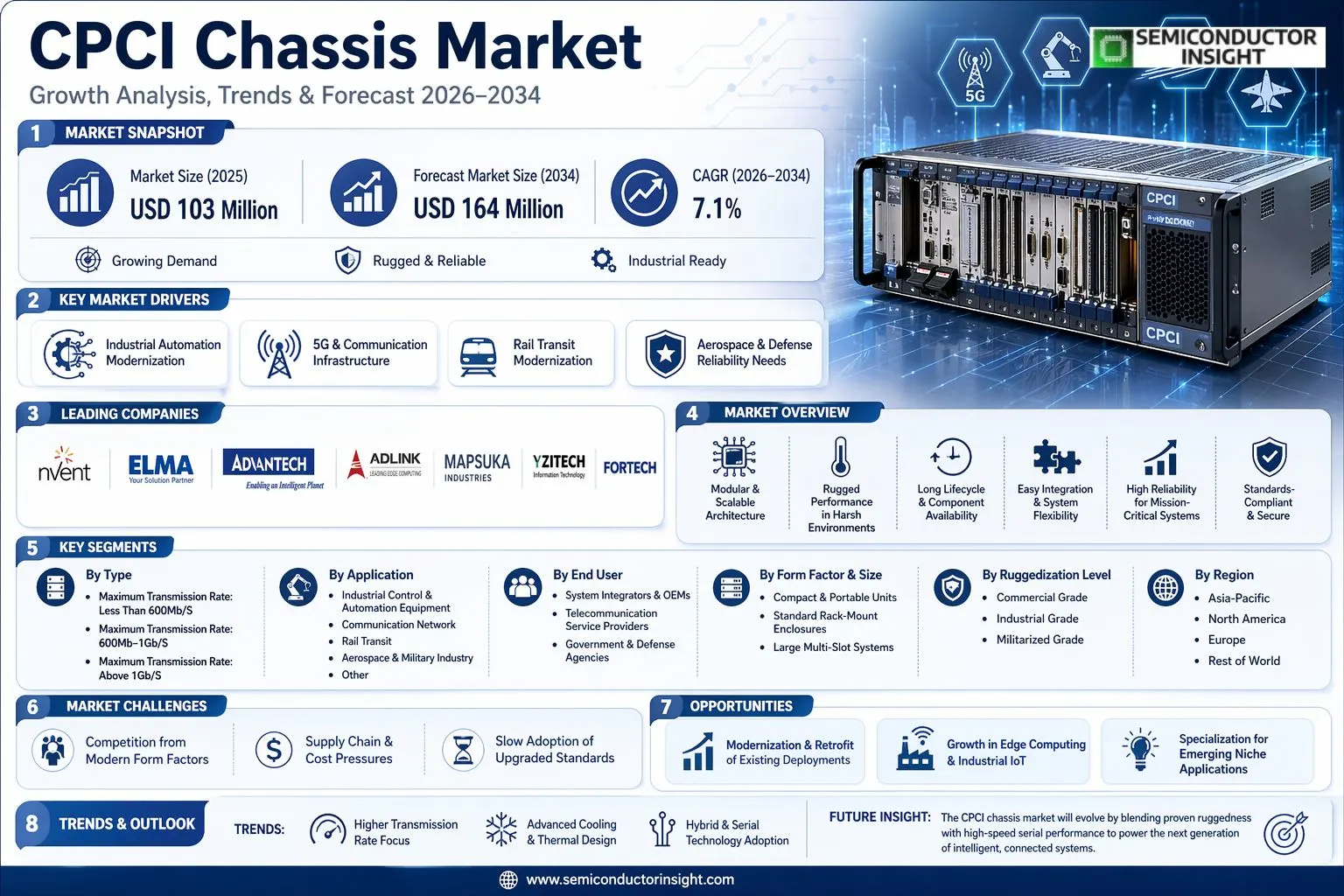
MARKET DRIVERS
Demand for High-Performance, Modular Computing Platforms
The deployment of advanced telecom infrastructure, including 5G core networks and Open RAN systems, is a primary driver for the CPCI Chassis Market. This architecture provides the modularity, ruggedness, and high-speed backplane performance required for signal processing and network function virtualization cards. The standard’s support for live insertion and robust mechanical design is crucial for mission-critical applications demanding minimal downtime. As industries move towards more distributed and edge-based computing models, the flexibility offered by a CPCI Chassis becomes increasingly valuable.
Adoption in Ruggedized Defense and Aerospace Systems
The defense and aerospace sectors heavily rely on the CPCI Chassis Market due to its compliance with stringent standards for shock, vibration, and extreme temperature operation. The form factor is extensively used in radar, electronic warfare, avionics, and command & control systems. Continued modernization of military platforms globally, alongside the growth in unmanned systems, ensures sustained demand for these reliable, modular chassis solutions that can integrate specialized single-board computers and I/O cards.
➤ The evolution to advanced serial fabrics like PCI Express, integrated within the CompactPCI Serial standard, extends the lifecycle and relevance of the CPCI platform, merging traditional ruggedness with modern high-throughput data communication capabilities.
Finally, the need for long-term stability and lifecycle management in industrial automation and transportation systems supports the CPCI Chassis Market. Manufacturers in these sectors require hardware platforms that will remain available and compatible for over a decade, a key benefit of this standardized architecture which mitigates obsolescence risks for embedded system integrators.
MARKET CHALLENGES
Competition from Modern, Compact Form Factors
A significant challenge for the CPCI Chassis Market is the ongoing competition from newer, more compact embedded standards such as VPX and MicroTCA. These standards often offer higher density, more advanced cooling solutions for rugged applications, and native support for the latest high-speed serial switch fabrics. For new system designs, especially in size, weight, and power-constrained applications, engineers may favor these newer architectures over traditional CPCI, potentially limiting market growth in certain high-tech segments.
Other Challenges
Supply Chain and Cost Pressures
The reliance on specialized components for ruggedized chassis, coupled with global electronic component shortages, can lead to extended lead times and increased costs. This impacts the overall value proposition of CPCI-based systems, especially for cost-sensitive projects.
Perception as a Legacy Technology
Despite its ongoing evolution, the core CPCI standard can be perceived as a legacy technology. This perception challenge requires continuous market education about the modern capabilities of the CPCI Chassis, particularly the advanced features of the CompactPCI Serial specification which bridges the gap to contemporary data transport needs.
MARKET RESTRAINTS
Slow Adoption Cycle for Upgraded Standards
A key restraint on the CPCI Chassis Market is the relatively slow adoption rate of its own advanced iterations, particularly CompactPCI Serial. While this standard addresses bandwidth limitations by transitioning to a purely serial fabric, the entrenched base of systems using the parallel PCI bus creates inertia. The long design and qualification cycles in key vertical markets like defense and industrial automation mean that migration to newer platforms within the CPCI ecosystem occurs gradually, restraining the pace of overall market refresh and innovation.
Market Maturity in Core Segments
The market for traditional parallel CPCI Chassis has reached a high level of maturity in its established applications. Growth is largely tied to the replacement and upgrade cycles of existing deployed systems rather than explosive new adoption. This maturity limits top-line expansion and puts pressure on vendors to differentiate through value-added services, advanced thermal management, and hybrid solutions that integrate new technologies into the proven CPCI mechanical form factor.
MARKET OPPORTUNITIES
Modernization and Retrofit of Existing Deployments
A substantial opportunity lies in the modernization of the extensive installed base of CPCI systems. By offering chassis and board-level solutions that enable an upgrade path,such as hybrid backplanes that support both legacy and serial cards,vendors in the CPCI Chassis Market can capture significant aftermarket and lifecycle extension business. This is particularly relevant in sectors like public transit and industrial control, where completely replacing a hardware platform is prohibitively expensive and disruptive.
Growth in Edge Computing and Industrial IoT
The expansion of Industrial IoT and edge computing creates a distinct opportunity for rugged, modular computing platforms. The CPCI Chassis, with its robust construction and modular design, is well-suited for harsh industrial environments where data acquisition, processing, and control occur locally. The ability to mix and match computing, networking, and I/O cards in a single, reliable enclosure aligns perfectly with the needs of smart factories, energy grids, and remote monitoring stations.
Specialization for Emerging Niche Applications
Opportunities exist for specialized chassis designs catering to emerging niches. This includes developing CPCI Chassis solutions optimized for specific roles in scientific instrumentation, medical imaging devices, or test & measurement equipment. By focusing on enhanced cooling for high-power processors, integration of specific power supply requirements, or custom front-panel interfaces, vendors can address high-value segments that still demand the core benefits of the CPCI standard.
CPCI Chassis Market Trends
Prioritization of High-Speed and Ruggedized Designs
The primary trend in the CPCI Chassis Market is the continuous push towards supporting higher transmission rates to meet modern data throughput demands. There is significant development and demand shifting towards chassis designed for maximum transmission rates above 1Gb/S. Consequently, manufacturers are enhancing backplane designs and cooling solutions to ensure signal integrity and thermal management under higher performance loads. This evolution is critical for advanced applications in communication networks and military systems where real-time data processing is paramount.
Other Trends
Consolidation Among Leading Suppliers
The competitive landscape of the CPCI Chassis Market is characterized by a concentrated presence of established industrial suppliers like Nvent, ELMA, Advantech, and Adlink. Market share is distributed among the top global players. This environment fosters competition focused on product reliability, modularity, and support for legacy systems, which are essential for industrial and aerospace clients who prioritize long lifecycle and proven interoperability.
Diverse Application-Driven Demand
Demand for CPCI chassis remains robust across a range of critical industries. While industrial automation and control equipment represent a foundational application, growth is particularly notable in the aerospace and military sectors, where the rugged nature and reliability of CPCI architecture are non-negotiable. Simultaneously, modernization in rail transit and communication infrastructure continues to generate steady demand for these industrial-grade enclosures.
Regional Market Dynamics and Supply Chain Focus
Geographically, North America and Asia are significant centers for the CPCI Chassis Market, with substantial manufacturing and end-user bases. The United States holds a major market position, driven by its advanced military and industrial sectors. China’s market is similarly pivotal, supported by its expansive manufacturing and rapid infrastructure development. A key industry-wide trend is the focus on ensuring resilient supply chains and component availability to mitigate production delays for these specialized hardware systems.
COMPETITIVE LANDSCAPE
Key Industry Players
Concentration and Strategic Focus Characterize a Mature Global Market
Global CPCI Chassis market displays a moderately concentrated competitive structure, where the top five players collectively held a significant revenue share in 2025. These established leaders, including nVent and ELMA, leverage extensive R&D capabilities and well-entrenched distribution networks to serve core verticals such as aerospace, defense, and industrial automation. Their product strategies emphasize robustness, advanced thermal management, and compliance with stringent military and industry standards. The competitive intensity is shaped by technological reliability, long product lifecycles, and deep customer relationships, with differentiation often achieved through customization, high-density packaging solutions, and support for varied transmission rate segments.
Beyond the top-tier global suppliers, the market includes a spectrum of significant niche and regional players who compete effectively through specialization and cost-optimized solutions. Companies like Advantech and Adlink possess formidable strength in industrial computing and embedded automation applications, often integrating chassis solutions with their broader hardware ecosystems. Other firms focus on specific geographic markets or unique applications within rail transit and communication infrastructure. This second tier enhances market dynamism by offering specialized products, such as chassis for harsh environments or with specific form factors, catering to the diverse requirements of the industrial control, communication network, and transportation segments. Innovations are generally incremental, focusing on enhanced durability, modularity, and adaptability to evolving backplane standards.
List of Key CPCI Chassis Companies Profiled
- nVent
- ELMA Electronic Inc.
- Advantech Co., Ltd.
- Adlink Technology Inc.
- Mapsuka Industries
- YZITECH Information Technology
- Yanxintong
- Fortech
- MEN Micro (now part of Abaco Systems)
- Kontron S&T AG
- Curtiss-Wright Defense Solutions
- PEP Modular Computers
- Emerson Network Power (now part of Vertiv)
- SIVA
- One Stop Systems, Inc.
Segment Analysis:
| Segment Category | Sub-Segments | Key Insights |
| By Type |
|
Maximum Transmission Rate: 600Mb-1Gb/S represents a balanced and widely adopted performance tier, offering a compelling middle ground for cost-sensitive yet data-intensive applications.
|
| By Application |
|
Industrial Control and Automation Equipment is the foundational application segment, driven by the pervasive need for rugged, reliable computing platforms in manufacturing and process environments.
|
| By End User |
|
System Integrators and OEMs constitute the most influential end-user group, acting as the primary channel that shapes product specifications and feature sets.
|
| By Form Factor & Size |
|
Standard Rack-Mount Enclosures dominate as the most prevalent form factor, representing the core design for centralized, high-density installations.
|
| By Ruggedization Level |
|
Industrial Grade ruggedization is the critical standard for the majority of market demand, bridging the gap between office-grade reliability and extreme environmental requirements.
|
Regional Analysis: Global CPCI Chassis Market
Asia-Pacific
The rapid expansion of 5G networks necessitates sophisticated, ruggedized base station hardware. CPCI chassis forms the core computing and signal processing framework for remote and edge telecom equipment, benefiting from its standardized form factor, high-speed backplane, and hot-swap capabilities, which are essential for minimizing network downtime.
As factories adopt smart manufacturing and Industry 4.0 principles, there is increasing demand for dependable control systems. The CPCI chassis market thrives here due to the platform’s determinism and ruggedness. It is widely used in machine vision, robotic control, and supervisory systems on factory floors where vibration and heat are constant challenges.
A dense network of specialized electronics manufacturers provides a significant competitive advantage. This ecosystem supports efficient prototyping, volume production, and customization of CPCI chassis and related boards, enabling swift responses to both local and global market needs with cost-effective solutions.
Major investments in public safety networks, intelligent transportation systems, and military modernization programs create a strong pull. The inherent ruggedness, modularity, and long-term component availability of the CPCI standard make it a preferred architectural choice for these critical, long-lifecycle applications.
North America
The North American CPCI chassis market is characterized by its focus on high-reliability, technologically advanced solutions primarily for defense, aerospace, and critical communication systems. The region’s dynamics are shaped by stringent performance and certification requirements in these sectors. Leading systems integrators leverage the inherent ruggedness and modularity of the CPCI platform to build mission-critical systems for avionics, battlefield management, and emergency response communications, creating sustained, specialized demand. Innovation trends are also significant, with a notable push towards integrating newer fabric technologies with legacy CPCI backplanes to extend system life and performance. Key market growth is tied to government-led initiatives and the ongoing modernization of legacy military and industrial control systems, where the CPCI chassis market offers a trusted, proven migration path.
Europe
Europe demonstrates a mature yet stable CPCI chassis market, anchored by its strong industrial base and emphasis on engineering excellence. The region’s dynamics are driven by sophisticated manufacturing, particularly in automotive test and measurement, industrial automation, and rail control systems. European vendors often compete on high-quality engineering, specialized customization, and compliance with region-specific industrial and safety standards. Sustainability and lifecycle management are increasingly important dynamics, supporting the use of standardized platforms like CPCI that allow for long-term maintenance and component sourcing. The market here is less about explosive growth and more about the steady replacement and upgrading of legacy industrial control systems, where the reliability and interoperability of the CPCI chassis market remain key value propositions.
South America
The CPCI chassis market in South America is in a developing phase, with growth primarily linked to gradual modernization efforts in the telecommunications and energy sectors. Market dynamics are influenced by investments in expanding mobile network coverage, including the beginning stages of 5G deployment, and in upgrading national power grid infrastructure. The adoption pattern favors robust, reliable platforms that can withstand diverse climatic conditions, aligning well with the core strengths of CPCI solutions. Furthermore, applications in scientific research and public safety are emerging as niche areas of growth. The regional market is price-sensitive and often relies on imported solutions, though there is a growing ecosystem of local system integrators adapting global CPCI chassis for specific regional infrastructure needs.
Middle East & Africa
The Middle East & Africa region presents a bifurcated dynamic for the CPCI chassis market. The Middle East, particularly the Gulf Cooperation Council nations, shows demand driven by large-scale infrastructure projects, smart city initiatives, and defense spending, where high-performance, rugged computing is essential. Africa’s market is more nascent, primarily centered around telecommunications expansion and the deployment of essential services in mining and power utilities. Across both sub-regions, environmental resilience is a paramount concern, making the ruggedness of CPCI platforms a significant advantage for deployments in harsh, remote, or climatically challenging environments. The overall market growth is tied closely to foreign investment in infrastructure and the strategic prioritization of digitization projects by national governments.
Report Scope
This market research report provides a comprehensive analysis of the CPCI Chassis Market , covering the forecast period 2026–2034. It offers detailed insights into market dynamics, technological advancements, competitive landscape, and key trends shaping the industry.
Key focus areas of the report include:
- Market Overview: The report begins with an overview outlining its current market scenario, key growth indicators, and industry transformation drivers. It discusses macroeconomic factors, demand–supply balance, regulatory landscape, and the strategic role of semiconductors in powering advancements across industries such as automotive, telecommunications, consumer electronics, and industrial automation.
- Market Size & Forecast: Historical data and future projections for revenue, unit shipments, and market value across major regions and segments.
- Segmentation Analysis: Detailed breakdown by product type, technology, application, and end-user industry to identify high-growth segments and investment opportunities.
- Regional Insights: Insights into market performance across North America, Europe, Asia-Pacific, Latin America, and the Middle East & Africa, including country-level analysis where relevant.
- Competitive Landscape: Profiles of leading market participants, including their product offerings, R&D focus, manufacturing capacity, pricing strategies, and recent developments such as mergers, acquisitions, and partnerships.
- Technology Trends & Innovation: Assessment of emerging technologies, integration of AI/IoT, semiconductor design trends, fabrication techniques, and evolving industry standards.
- Market Drivers & Restraints: Evaluation of factors driving market growth along with challenges, supply chain constraints, regulatory issues, and market-entry barriers.
- Stakeholder Insights: Insights for component suppliers, OEMs, system integrators, investors, and policymakers regarding the evolving ecosystem and strategic opportunities.
Primary and secondary research methods are employed, including interviews with industry experts, data from verified sources, and real-time market intelligence to ensure the accuracy and reliability of the insights presented.
FREQUENTLY ASKED QUESTIONS:
What is the current market size of CPCI Chassis Market?
-> Global CPCI Chassis Market was valued at USD 103 million in 2025 and is projected to reach USD 164 million by 2034, growing at a CAGR of 7.1% during the forecast period.
Which key companies operate in CPCI Chassis Market?
-> Key players include Nvent, ELMA, Advantech, Adlink, Mapsuka Industries, YZITECH Information Technology, Yanxintong, and Fortech, among others.
What are the key growth drivers?
-> Key growth drivers include advancements in industrial automation, expansion of communication networks, modernization of rail transit systems, and requirements for ruggedized systems in aerospace and military applications.
Which region dominates the market?
-> While specific regional revenue shares are analyzed in the report, the market is segmented across North America, Europe, Asia, South America, and the Middle East & Africa, with dynamic growth opportunities identified in each region.
What are the emerging trends?
-> Emerging trends include increasing adoption of higher transmission rate chassis segments (e.g., Above 1Gb/S), integration of advanced cooling solutions, and the development of modular and scalable chassis designs for diverse industrial applications.

Get Sample Report PDF for Exclusive Insights
Report Sample Includes
- Table of Contents
- List of Tables & Figures
- Charts, Research Methodology, and more...
 Download Sample Report PDF