Copper Wire Bonding Equipment Market Insights
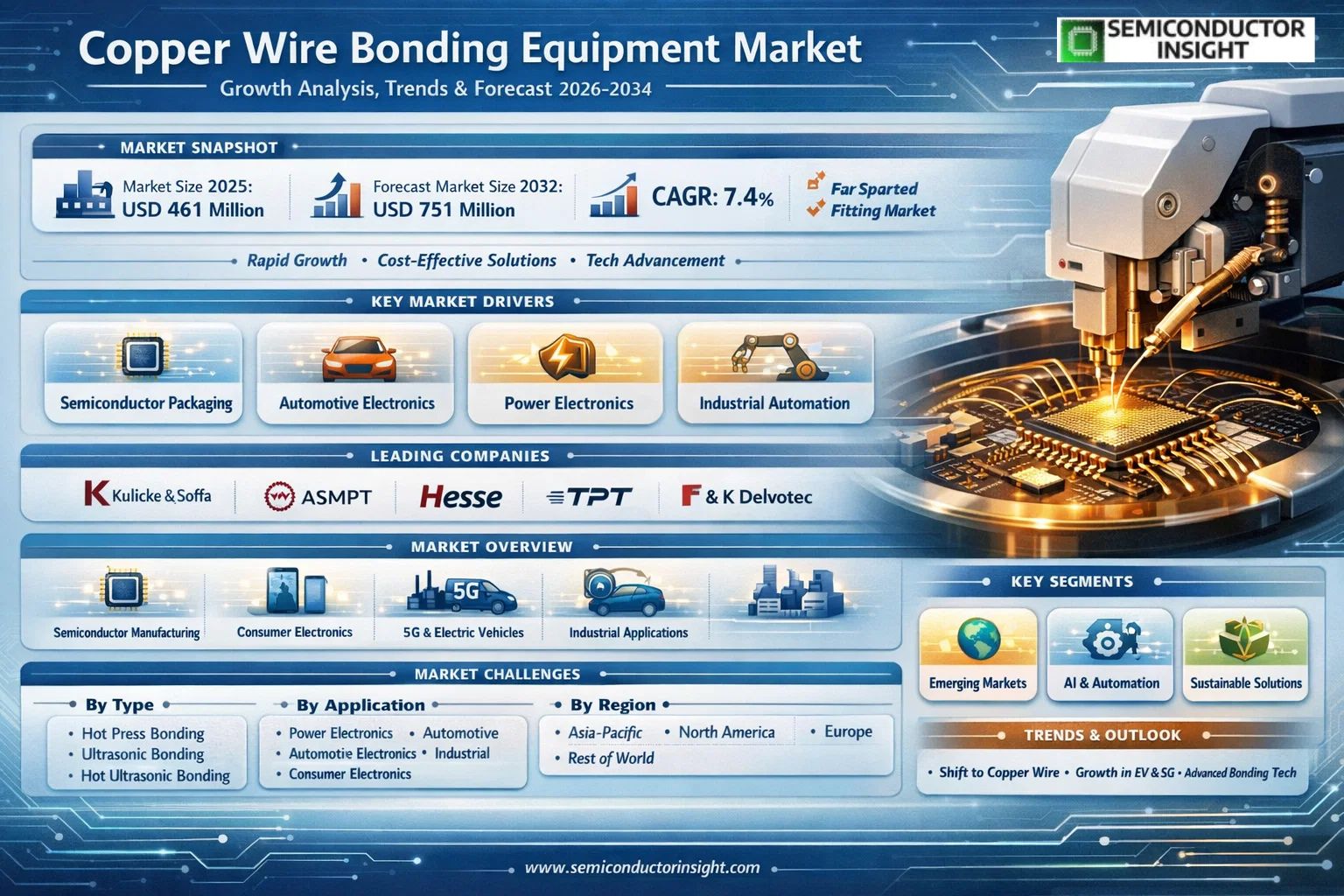
Global Copper Wire Bonding Equipment market size was valued at USD 461 million in 2025. The market is projected to reach USD 751 million by 2032, exhibiting a CAGR of 7.4% during the forecast period.
Copper wire bonding equipment mainly connects copper wires (or other metal wires) to the electrode pads of semiconductor chips or the I/O leads of electronic packaging shells through heating, pressure, and ultrasound. This equipment is a key device for copper wire bonding processes, with wide applications in microelectronics packaging, semiconductor manufacturing, and other fields. Wire bonding itself links tiny chip electrodes to external circuits, where factors like wire diameter, bonding pressure, time, and temperature critically influence quality and reliability.
The market is experiencing rapid growth due to surging demand in semiconductor packaging, advancements in power electronics, and the shift toward cost-effective copper wires over gold. Rising needs in automotive electronics, industrial automation, and consumer devices further drive expansion. Key players including Kulicke & Soffa, ASM Pacific Technology, Hesse GmbH, and KAJO Corporation dominate with innovative portfolios, fueling competition and technological progress.
MARKET DRIVERS
Cost-Effectiveness in Semiconductor Packaging
Copper Wire Bonding Equipment Market benefits significantly from the shift toward copper wire in semiconductor assembly, driven by its **substantially lower cost** compared to gold wire, which can be up to 40% cheaper. This economic advantage has propelled adoption in high-volume consumer electronics manufacturing, where cost savings directly impact profitability. As global semiconductor production scales, equipment demand rises to support efficient copper bonding processes.
Rising Demand from Automotive and 5G Sectors
Expansion in electric vehicles (EVs) and 5G infrastructure fuels Copper Wire Bonding Equipment Market, with automotive semiconductors requiring reliable, high-density interconnects. Copper bonding equipment enables finer pitches and higher yields, essential for advanced driver-assistance systems (ADAS). The market sees a projected CAGR of around 6-8% through 2028, supported by these technology-driven needs.
➤ Innovation in bonding tools enhances throughput by 20-30%, accelerating production cycles in memory and logic chip fabrication.
Overall, these drivers position Copper Wire Bonding Equipment Market for sustained growth amid increasing chip complexity and volume production worldwide.
MARKET CHALLENGES
Technical Reliability Issues
Copper Wire Bonding Equipment Market faces hurdles due to copper’s higher susceptibility to **oxidation and hardness**, leading to inconsistent bond strength compared to gold. Manufacturers must invest in advanced plasma cleaning and forming gas systems, complicating operations and raising equipment costs. These issues result in yield losses of up to 5-10% in initial production runs.
Other Challenges
Supply Chain Disruptions
Geopolitical tensions and raw material shortages, particularly in Asia-Pacific hubs, delay equipment delivery and inflate prices. Copper Wire Bonding Equipment Market experiences extended lead times, impacting OEM timelines for new device launches.
Skill gaps in operating sophisticated copper bonding machines further challenge market expansion, necessitating extensive training programs for technicians.
MARKET RESTRAINTS
Transition to Alternative Bonding Technologies
A key restraint on Copper Wire Bonding Equipment Market is the growing preference for **palladium-coated copper or silver wires**, which offer improved reliability without gold’s expense. High-end applications in power devices and LEDs favor these alternatives, limiting copper equipment deployment to mid-tier segments. Market share for pure copper bonding has stabilized at under 60% in recent years.
Regulatory pressures on electronic waste and material purity also hinder adoption, as stricter RoHS compliance demands enhanced recycling protocols for copper residues. This increases operational overhead for fabricators relying on Copper Wire Bonding Equipment Market solutions.
Additionally, slower throughput in copper processes versus optimized gold systems restrains scalability in ultra-high-volume fabs, capping market penetration in leading-edge nodes below 7nm. These factors collectively temper growth projections for Copper Wire Bonding Equipment Market despite underlying demand.
MARKET OPPORTUNITIES
Expansion in Emerging Economies
Copper Wire Bonding Equipment Market holds strong potential in Southeast Asia and India, where electronics manufacturing is booming with investments exceeding $20 billion annually. Local assembly plants for smartphones and appliances drive demand for cost-effective copper bonding setups, enabling regional players to compete globally.
Advancements in **AI-driven automation** for bonding equipment open doors to higher precision and reduced defects, appealing to Industry 4.0 adopters. Copper Wire Bonding Equipment Market could capture 15-20% additional share through retrofitting existing lines with smart controls.
Sustainability trends favor copper’s recyclability, positioning the market favorably against less eco-friendly options. Hybrid bonding innovations blending copper with advanced packaging further unlock opportunities in data center chips and wearables.
Copper Wire Bonding Equipment Market Trends
Shift to Copper Wire for Enhanced Reliability in Semiconductor Packaging
Copper wire bonding equipment facilitates the connection of copper wires to electrode pads on semiconductor chips using heat, pressure, and ultrasound, proving essential in microelectronics packaging and semiconductor manufacturing. This trend gains momentum as copper wire offers superior electrical conductivity and cost advantages over traditional aluminum, particularly in IGBT modules where bonding quality directly impacts electrical performance and reliability. Optimizing parameters such as wire diameter, bonding pressure, time, and temperature ensures uniform connections, reducing parasitic inductance and boosting high-frequency performance while maintaining strength.
Other Trends
Growth in Power Electronics and Automotive Applications
Copper Wire Bonding Equipment Market sees robust demand from power electronics and automotive electronics segments, where precise wire bonding supports high-reliability modules in electric vehicles and industrial automation. Copper wire’s appropriate diameter and equal length requirements align with flow needs, enhancing module durability. Applications in consumer electronics further drive adoption, as manufacturers prioritize bonding points that are firmly connected and evenly distributed to meet stringent performance standards.
Advancements in Bonding Technologies like Ultrasonic and Hot Ultrasonic
Equipment types such as ultrasonic bonding and hot ultrasonic bonding dominate Copper Wire Bonding Equipment Market, enabling finer control over process variables to improve bonding quality. Key players including Kulicke & Soffa, ASM Pacific Technology, and Hesse GmbH lead innovations, focusing on equipment that addresses challenges like insufficient strength from thin wires or inductance from thicker ones. Regional expansions, especially in Asia with strong manufacturing bases in China and Japan, underscore the trend toward automated, high-precision systems for diverse applications including industrial automation and others, fostering overall market evolution.
COMPETITIVE LANDSCAPE
Key Industry Players
Leading Innovators in Copper Wire Bonding Equipment Market
Copper Wire Bonding Equipment Market exhibits a moderately concentrated structure dominated by a few global leaders such as Kulicke & Soffa (K&S) and ASM Pacific Technology, which collectively hold a significant revenue share among the top five players as of 2025. These frontrunners leverage advanced ultrasonic and hot ultrasonic bonding technologies to cater to high-demand sectors like power electronics and automotive applications. K&S, renowned for its high-speed ball bonders, invests heavily in R&D to enhance equipment precision and throughput, maintaining a competitive edge in semiconductor packaging efficiency. ASM Pacific, with strong Asian manufacturing roots, excels in scalable solutions for consumer electronics, benefiting from the market’s projected growth from US$461 million in 2025 to US$751 million by 2032 at a 7.4% CAGR.
Beyond the market giants, a cadre of specialized and regional players contributes to innovation and niche segmentation, including Hesse GmbH for customizable wire bonding systems, West Bond for manual precision equipment, and Palomar Technologies for advanced assembly solutions. Emerging Asian firms like TPT, KAIJO Corporation, and Hanxiantech are rapidly expanding through cost-competitive offerings tailored for industrial automation and high-volume production. These secondary players focus on process optimization—such as bonding pressure, temperature control, and wire diameter compatibility—addressing challenges like parasitic inductance in IGBT modules and ensuring reliability in applications spanning automotive electronics to consumer devices, fostering a dynamic competitive ecosystem.
List of Key Copper Wire Bonding Equipment Companies Profiled
- Kulicke & Soffa
- ASM Pacific Technology
- Ultrasonic Engineering
- F & K Delvotec
- TPT
- Hesse GmbH
- West Bond
- Hybond
- KAIJO Corporation
- Palomar Technologies
- SBT Ultrasonic
- Hanxiantech
- Wuxi Autowell Technology
- Green Intelligent Equipment
- Teda
- Ningbo Advance Automation Technology
Segment Analysis:
| Segment Category | Sub-Segments | Key Insights |
| By Type |
|
Ultrasonic Bonding Equipment dominates due to its precision in forming reliable interconnections using vibration and pressure, ideal for delicate copper wires.
|
| By Application |
|
Power Electronics leads as it requires robust wire bonds for IGBT modules and high-power devices.
|
| By End User |
|
OSATs are at the forefront, leveraging specialized expertise in copper wire bonding for complex packages.
|
| By Automation Level |
|
Fully Automatic Bonding Equipment prevails in modern manufacturing for its seamless integration into production lines.
|
| By Wire Diameter |
|
Fine Diameter segments command preference for advanced applications balancing strength and performance.
|
Regional Analysis: Copper Wire Bonding Equipment Market
Asia-Pacific
Taiwan and China dominate as primary hubs for Copper Wire Bonding Equipment deployment, with assembly lines optimized for high-density packaging. South Korea’s focus on memory chips accelerates equipment upgrades, while Japan’s precision engineering sets benchmarks for reliability. These centers benefit from clustered suppliers, reducing costs and enhancing throughput in Copper Wire Bonding Equipment Market.
Widespread shift to copper wire bonding in Asia-Pacific stems from cost pressures and performance needs in mobile devices and power semiconductors. Equipment makers tailor solutions for finer pitches, boosting integration in advanced nodes. This trend strengthens the region’s position in the global Copper Wire Bonding Equipment Market.
Innovations in ultrasonic transducers and capillary designs improve bonding consistency, addressing voiding issues in copper processes. Asia-Pacific firms lead in hybrid bonding techniques, merging copper with other materials for next-gen applications, solidifying leadership in Copper Wire Bonding Equipment Market.
Intense competition from regional giants emphasizes customization and service support. Strategic partnerships with chipmakers enhance equipment interoperability, driving market share in Asia-Pacific’s Copper Wire Bonding Equipment sector through responsive innovation cycles.
North America
North America plays a pivotal role in Copper Wire Bonding Equipment Market through technological leadership and R&D investments. The United States hosts pioneering firms developing advanced bonding platforms that prioritize high-speed operations and plasma cleaning for superior copper interfaces. Demand arises from aerospace, defense, and high-performance computing sectors, where reliability trumps cost. Collaborative ecosystems in Silicon Valley foster innovations like AI-optimized bonding parameters. While production volumes lag behind Asia-Pacific, North America’s focus on premium equipment and process analytics influences global standards. Export-oriented strategies and stringent quality protocols position the region as an innovator hub, with growing interest in reshoring semiconductor assembly to bolster supply chain resilience in Copper Wire Bonding Equipment Market.
Europe
Europe’s Copper Wire Bonding Equipment Market thrives on automotive and industrial applications, with Germany and the Netherlands at the forefront. Emphasis on lead-free, robust bonding for electric vehicles and renewable energy inverters drives equipment demand. European manufacturers excel in modular systems adaptable to diverse package types, enhancing flexibility. Regulatory frameworks promote sustainable practices, spurring eco-friendly copper processes. Strong academic-industry ties advance research into low-k dielectric compatibility. Though secondary to Asia-Pacific in scale, Europe’s precision-oriented approach and aftermarket services sustain steady growth in Copper Wire Bonding Equipment Market, supported by EU-funded initiatives for semiconductor sovereignty.
South America
South America emerges as a nascent player in Copper Wire Bonding Equipment Market, centered in Brazil and Mexico near electronics assembly zones. Proximity to North American markets aids adoption for consumer goods and telecom gear. Challenges like infrastructure limitations are offset by cost-sensitive copper bonding preferences over pricier options. Local firms partner with international suppliers for training and tech transfers, gradually building capabilities. Automotive electronics growth fuels incremental demand, positioning South America for expanded participation as regional manufacturing matures in the Copper Wire Bonding Equipment landscape.
Middle East & Africa
The Middle East & Africa region shows promise in Copper Wire Bonding Equipment Market via diversification from oil dependency. UAE and Israel lead with semiconductor design centers adopting copper bonding for IoT and smart city projects. Africa’s nascent electronics sector in South Africa focuses on assembly for regional needs. Equipment uptake emphasizes durability for high-temperature environments. International collaborations bridge skill gaps, fostering gradual infrastructure development and positioning the region for future contributions to Copper Wire Bonding Equipment Market.
Report Scope
This market research report provides a comprehensive analysis of the Copper Wire Bonding Equipment Market , covering the forecast period 2026–2034. It offers detailed insights into market dynamics, technological advancements, competitive landscape, and key trends shaping the industry.
Key focus areas of the report include:
- Market Overview: The report begins with an overview outlining its current market scenario, key growth indicators, and industry transformation drivers. It discusses macroeconomic factors, demand–supply balance, regulatory landscape, and the strategic role of semiconductors in powering advancements across industries such as automotive, telecommunications, consumer electronics, and industrial automation.
- Market Size & Forecast: Historical data and future projections for revenue, unit shipments, and market value across major regions and segments.
- Segmentation Analysis: Detailed breakdown by product type, technology, application, and end-user industry to identify high-growth segments and investment opportunities.
- Regional Insights: Insights into market performance across North America, Europe, Asia-Pacific, Latin America, and the Middle East & Africa, including country-level analysis where relevant.
- Competitive Landscape: Profiles of leading market participants, including their product offerings, R&D focus, manufacturing capacity, pricing strategies, and recent developments such as mergers, acquisitions, and partnerships.
- Technology Trends & Innovation: Assessment of emerging technologies, integration of AI/IoT, semiconductor design trends, fabrication techniques, and evolving industry standards.
- Market Drivers & Restraints: Evaluation of factors driving market growth along with challenges, supply chain constraints, regulatory issues, and market-entry barriers.
- Stakeholder Insights: Insights for component suppliers, OEMs, system integrators, investors, and policymakers regarding the evolving ecosystem and strategic opportunities.
Primary and secondary research methods are employed, including interviews with industry experts, data from verified sources, and real-time market intelligence to ensure the accuracy and reliability of the insights presented.
FREQUENTLY ASKED QUESTIONS:
What is the current market size of Copper Wire Bonding Equipment Market?
-> Copper Wire Bonding Equipment Market was valued at USD 461 million in 2025 and is expected to reach USD 751 million by 2032 at a CAGR of 7.4% during the forecast period.
Which key companies operate in Copper Wire Bonding Equipment Market?
-> Key players include Kulicke & Soffa, ASM Pacific Technology, Ultrasonic Engineering, F & K Delvotec, TPT, Hesse GmbH, West Bond, Hybond, KAIJO Corporation, Palomar Technologies, among others.
What are the key growth drivers?
-> Key growth drivers include demand in semiconductor packaging, power electronics, automotive electronics, industrial automation, and superior electrical performance of copper wires.
Which region dominates the market?
-> Asia-Pacific is the fastest-growing region, while North America remains a dominant market.
What are the emerging trends?
-> Emerging trends include optimization of wire bonding parameters for reliability, shift to copper wires in IGBT modules, and advancements in ultrasonic bonding equipment.

Get Sample Report PDF for Exclusive Insights
Report Sample Includes
- Table of Contents
- List of Tables & Figures
- Charts, Research Methodology, and more...
 Download Sample Report PDF