
Cooled LWIR Lenses Market Insights
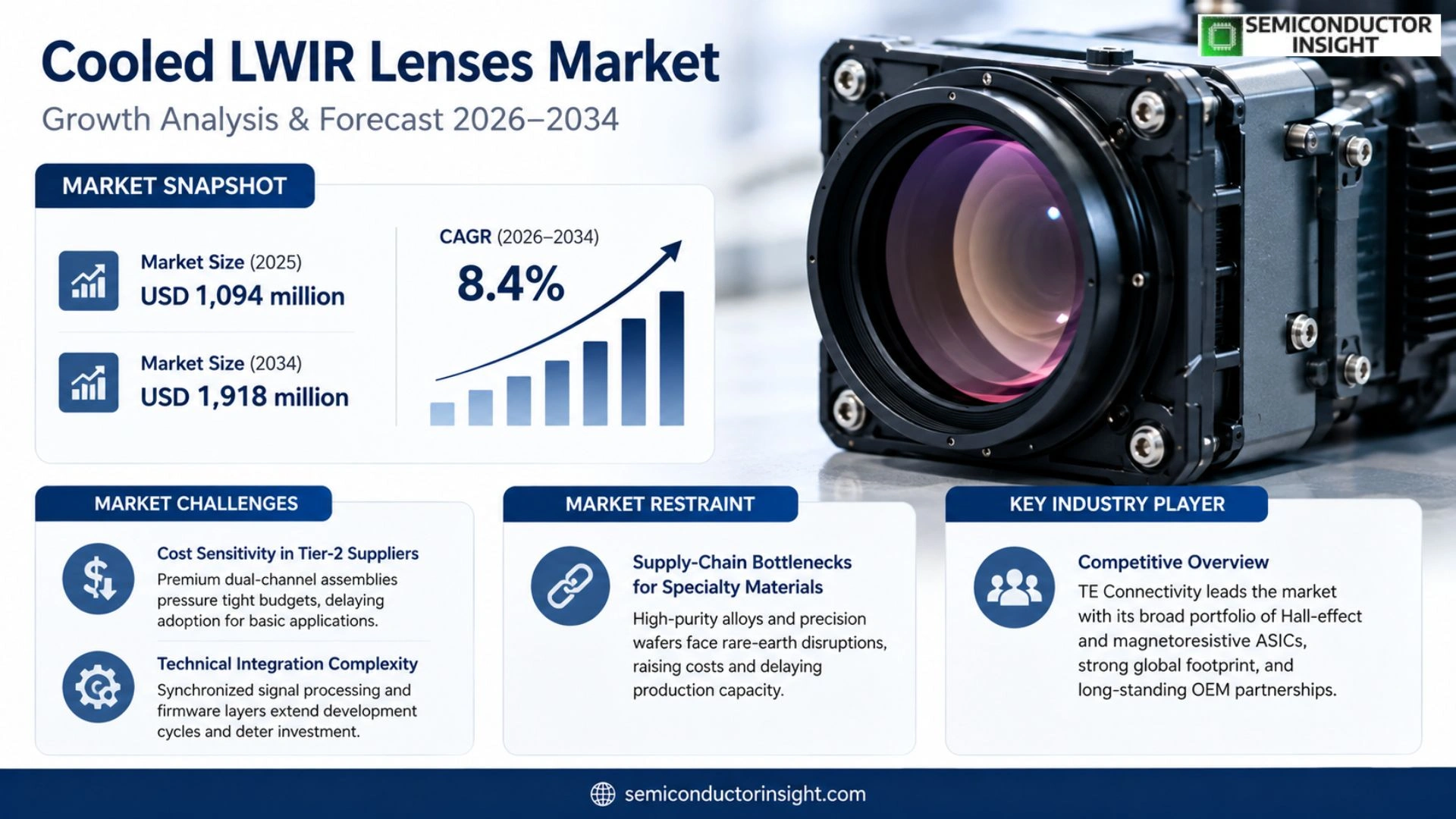
Cooled LWIR Lenses market size was valued at USD 1,094 million in 2025 and is projected to reach USD 1,918 million by 2034, exhibiting a CAGR of 8.4% during the forecast period.
Cooled LWIR Lenses are high‑end optical devices operating in the 8‑12 µm band that employ cryogenic coolers to boost detector sensitivity; they underpin high‑resolution thermal imaging systems for defense reconnaissance, aerospace monitoring, border security and industrial inspection.
The market expands because demand for all‑weather, high‑sensitivity infrared imaging grows across military, aerospace and precision‑inspection sectors. Recent trends feature lighter material constructions, higher transmittance optics and low‑power cooling modules integrated with AI analytics; leading firms such as Nanjing Cngeir Technology, Wuhan Guide and Hyperion Optics are accelerating product roadmaps to capture emerging opportunities.
MARKET DRIVERS
Thermal‑Imaging Precision Demands
Cooled LWIR Lenses market benefits from heightened expectations for resolution in security and aerospace surveillance. Operators now require image clarity that can differentiate between subtle temperature differentials, prompting OEMs to integrate tighter optical designs.
Industrial Process Monitoring
Manufacturers in steel, glass, and semiconductor fabrication are replacing legacy infrared sensors with cooled solutions because temperature‑controlled processes demand repeatable, low‑noise measurements. The shift reduces scrap rates and improves yield consistency.
➤ “Investments in cryogenic cooling modules have accelerated equipment upgrade cycles across defense contractors.”
Beyond pure performance, the integration of additive‑manufactured lens mounts shortens lead times, allowing end users to respond quickly to emerging compliance standards. This operational agility fuels further procurement activity.
MARKET CHALLENGES
High Capital Outlay
Acquiring cooled detector assemblies and associated optics remains a sizeable expense for midsize firms. The upfront cost often outweighs short‑term ROI calculations, delaying adoption in niche applications.
Other Challenges
Supply‑Chain Volatility
Fluctuations in rare‑earth material availability, combined with limited qualified vendors for low‑temperature dewars, create bottlenecks that can extend delivery windows well beyond forecasted dates.
MARKET RESTRAINTS
Regulatory Compliance Burden
Export controls on infrared‑sensitive components impose additional paperwork and licensing requirements, especially for defense‑related projects. Companies must allocate resources to navigate these frameworks, which can deter market entry.
Furthermore, certification processes for airborne platforms demand extensive testing cycles. The associated timeline and cost pressure smaller manufacturers, limiting the pool of viable suppliers.
MARKET OPPORTUNITIES
Emerging Defense Modernization Programs
Governments are allocating funds to replace legacy infrared arrays with cooled LWIR optics in next‑generation reconnaissance drones. This creates a pipeline of contracts for lens designers capable of meeting stringent weight and power constraints.
Parallel advancements in miniaturized cryocooler technology open avenues for portable scientific instruments. Researchers seeking high‑fidelity atmospheric measurements are a growing customer segment that values compact, low‑vibration solutions.
Lastly, strategic partnerships between lens manufacturers and semiconductor foundries are fostering integrated photonic platforms. The convergence of optics and electronics promises cost reductions that could democratize cooled LWIR capabilities across mid‑range markets.
Cooled LWIR Lenses Market Trends
High‑End Expansion Across Defense, Aerospace, and Industry
Cooled LWIR Lenses market is moving beyond its traditional defense stronghold and finding footholds in autonomous drones, border‑security networks, and precision‑temperature control lines on factories. Units sold in the most recent year topped forty‑two thousand, while production capacity hovered around forty‑eight thousand, yielding a utilization rate close to ninety percent. Such tight capacity leaves little room for price wars, allowing manufacturers to retain gross margins in the mid‑30 percent range. The upward pressure on demand stems from the need for all‑weather, low‑noise imaging that only cooled optics can deliver, especially as infrared sensor resolution climbs and end‑users require reliable night‑time surveillance. Companies that can keep up with the volume squeeze while preserving performance are positioned to negotiate better terms with downstream system integrators.
Other Trends
Supply‑Chain Pressures on Raw Materials and Cooling Sub‑Systems
Raw inputs for cooled lenses,high‑transmittance infrared glass such as ZnSe, germanium, and silicon, together with miniature cryogenic chillers,remain sourced from a limited pool of vendors. Recent years have seen spot price spikes for infrared crystal blanks, prompting several lens makers to invest in in‑house crystal growth or to sign long‑term supply agreements. The ripple effect reaches component pricing and, ultimately, the final lens price. Firms that secure a stable upstream flow can protect their margin cushions, whereas those dependent on spot purchases may see profitability erode when material costs climb. This dynamic encourages vertical integration and strategic partnerships as a way to shield the value chain.
Technology Convergence and Product Differentiation
Future competitiveness in Cooled LWIR Lenses market hinges on three technical fronts: weight reduction, higher optical transmittance, and energy‑efficient cooling. Lighter substrates enable integration on small‑form‑factor drones, while advances in crystal purity push transmission levels above ninety percent across the 8‑12 µm band. Parallel progress in low‑power Stirling chillers extends operational endurance for field‑deployed platforms. Moreover, manufacturers are embedding AI‑ready interfaces and multi‑band fusion capabilities directly into lens modules, turning a passive optical component into a data‑processing node. Players that deliver these combined attributes can command premium pricing and establish barriers that keep lower‑cost competitors at a distance, shaping the market’s long‑term profitability landscape.
COMPETITIVE LANDSCAPE
Key Industry Players
Cooled LWIR Lenses: Competitive Pressures in a High‑Performance Optics Segment
The market is anchored by a handful of large‑scale manufacturers that control the bulk of capacity and pricing power. Nanjing Cngeir Technology, for example, operates multiple clean‑room facilities in the Yangtze Delta and leverages vertically integrated supply of germanium and ZnSe crystals to sustain an average gross margin above 35 %. Its strategic focus on integrated cryogenic cooling modules allows it to offer turnkey lens assemblies to defense primes, which in turn reinforces its dominance in the military‑grade segment. The firm’s ability to keep utilization rates near 90 % while expanding into aerospace surveillance gives it a decisive advantage over smaller outfits that must outsource critical components and accept thinner margins.
Beyond the dominant players, a constellation of specialized firms is carving out niches through material expertise or application‑specific engineering. Companies such as Wuhan Guide Optics and Temmek Optics excel in custom aspherical designs for drone‑borne thermal cameras, while Shape Optics Technologies and Quanhom target the industrial inspection arena with ruggedized housings. Smaller entrants like Heguangruiyuan and WTDS Optics focus on low‑power Stirling‑cooler integration, positioning themselves as partners for AI‑driven multiband platforms. This diversification of capability creates a competitive environment where differentiated performance,lighter weight, higher transmittance, or reduced power draw,translates directly into pricing leverage and long‑term contracts.
List of Key Cooled LWIR Lenses Companies Profiled
- Nanjing Cngeir Technology Co., Ltd.
- Wuhan Guide Optics
- Temmek Optics Ltd.
- Shape Optics Technologies Pte Ltd
- Quanhom Optics
- Heguangruiyuan
- Ophir Optronics Solutions
- Hyperion Optics
- WTDS Optics
- Infiniti Electro‑Optics
- Delta Photonics
- TONGHAO Precision Optics
Segment Analysis:
| Segment Category | Sub-Segments | Key Insights |
| By Type |
|
Mercury Cadmium Telluride (MCT) Lens is the leading segment because it delivers superior photon‑capture efficiency and stable performance across the 8‑12 µm band.
|
| By Application |
|
Military dominates because cooled LWIR lenses are critical for high‑resolution night‑vision, target tracking, and missile guidance systems.
|
| By End User |
|
Defense manufacturers lead the end‑user segment as they embed cooled LWIR lenses into mission‑critical platforms.
|
| By Cooling Method |
|
Stirling Chiller (Integrated) is the preferred cooling method, offering compactness and high thermal efficiency.
|
| By Focal Length Range |
|
50mm‑100mm range emerges as the core segment, balancing resolution and system integration needs.
|
Regional Analysis: Cooled LWIR Lenses Market
North America
Recent acquisition programs favor modular cooled LWIR lenses that can be retrofitted onto legacy platforms, allowing armed forces to extend service life without full system replacement. This preference drives OEMs toward scalable designs that balance performance with upgradeability.
Manufacturers of semiconductors and aerospace components are embracing cooled optics to detect sub‑micron surface anomalies. The higher signal‑to‑noise ratio translates directly into lower scrap rates and tighter process control.
Federal agencies allocate multi‑year grants to university labs focused on cryogenic detector materials, creating a pipeline of proprietary lens coatings that improve transmission efficiency at long‑wave infrared frequencies.
Diversification of raw‑material sources and strategic stockpiling of vacuum‑sealed assemblies mitigate disruptions, ensuring that high‑specification lenses reach end‑users on schedule despite geopolitical fluctuations.
Europe
European nations, led by Germany, France, and the United Kingdom, are cultivating a niche in precision cooled LWIR lenses for scientific research and environmental monitoring. Collaborative initiatives such as the Horizon Europe program fund cross‑border projects that target atmospheric gas detection, where cooled optics provide the necessary spectral discrimination. Commercially, automotive OEMs experiment with long‑wave infrared sensors for driver‑assistance systems, prompting lens suppliers to adapt to automotive‑grade reliability standards. Regulatory pressures to lower emissions are indirectly fueling demand, as nations adopt infrared‑based leak detection in industrial complexes. Companies that can navigate the fragmented certification landscape across the EU will reap the benefits of a market that values both technical excellence and compliance agility.
Asia‑Pacific
Growth in the Asia‑Pacific Cooled LWIR Lenses Market is propelled by rapid militarization and burgeoning semiconductor fabrication capacity in China, Japan, and South Korea. Defense ministries are prioritizing cooled infrared suites for next‑generation unmanned aerial vehicles, while chip manufacturers seek tighter process windows offered by cooled imaging. Government incentives aimed at self‑sufficiency in critical components have led to the emergence of domestic lens manufacturers capable of competing on price without sacrificing quality. Market participants that can leverage local supply networks while adhering to international performance benchmarks will capture a sizable share of the region’s expanding demand.
South America
In South America, Brazil and Chile are the primary drivers of cooled LWIR lens interest, largely due to oil and gas exploration activities that require high‑resolution thermal imaging for pipeline integrity. Energy firms are integrating cooled optics into handheld and drone‑mounted systems to detect minute temperature differentials indicative of leaks. Additionally, academic institutions are partnering with niche optics firms to develop custom lenses for biodiversity monitoring, a sector receiving increased public funding. The region’s market depth remains modest, but firms that can provide ruggedized solutions tailored to tropical operating conditions are well positioned to become preferred suppliers.
Middle East & Africa
The Middle East & Africa region sees cooled LWIR lenses gaining traction in both defense and oil‑field surveillance. Nations with substantial sovereign wealth funds are allocating capital toward indigenous research centers that explore cryogenic detector technologies, aiming to reduce reliance on external sources. In the oil sector, enhanced security requirements and the need for precise flare monitoring push operators toward cooled infrared cameras equipped with custom lenses. African countries, meanwhile, are piloting cooled lens‑based systems for wildlife anti‑poaching patrols, where the ability to detect faint heat signatures at distance offers a tactical advantage. Providers that can navigate complex procurement processes and deliver solutions resilient to harsh desert climates will command a decisive edge.
Report Scope
This market research report provides a comprehensive analysis of the Cooled LWIR Lenses Market , covering the forecast period 2026–2034. It offers detailed insights into market dynamics, technological advancements, competitive landscape, and key trends shaping the industry.
Key focus areas of the report include:
- Market Overview: The report begins with an overview outlining its current market scenario, key growth indicators, and industry transformation drivers. It discusses macroeconomic factors, demand–supply balance, regulatory landscape, and the strategic role of semiconductors in powering advancements across industries such as automotive, telecommunications, consumer electronics, and industrial automation.
- Market Size & Forecast: Historical data and future projections for revenue, unit shipments, and market value across major regions and segments.
- Segmentation Analysis: Detailed breakdown by product type, technology, application, and end-user industry to identify high-growth segments and investment opportunities.
- Regional Insights: Insights into market performance across North America, Europe, Asia-Pacific, Latin America, and the Middle East & Africa, including country-level analysis where relevant.
- Competitive Landscape: Profiles of leading market participants, including their product offerings, R&D focus, manufacturing capacity, pricing strategies, and recent developments such as mergers, acquisitions, and partnerships.
- Technology Trends & Innovation: Assessment of emerging technologies, integration of AI/IoT, semiconductor design trends, fabrication techniques, and evolving industry standards.
- Market Drivers & Restraints: Evaluation of factors driving market growth along with challenges, supply chain constraints, regulatory issues, and market-entry barriers.
- Stakeholder Insights: Insights for component suppliers, OEMs, system integrators, investors, and policymakers regarding the evolving ecosystem and strategic opportunities.
Primary and secondary research methods are employed, including interviews with industry experts, data from verified sources, and real-time market intelligence to ensure the accuracy and reliability of the insights presented.
FREQUENTLY ASKED QUESTIONS:
What is the current market size of Cooled LWIR Lenses Market?
-> Cooled LWIR Lenses market is projected to reach USD 1,918 million by 2034, exhibiting a CAGR of 8.4% during the forecast period.
Which key companies operate in Cooled LWIR Lenses Market?
-> Key players include Nanjing Cngeir Technology Co.,Ltd., Wuhan Guide, Temmek Optics Ltd., Shape Optics technologies Pte Ltd, Quanhom, Heguangruiyuan, Ophir Optronics Solutions, Hyperion Optics, WTDS Optics, Infiniti Electro-Optics, Delta Photonics, TONGHAO, among others.
What are the key growth drivers?
-> Key growth drivers include rising demand for high‑resolution thermal imaging in defense, aerospace, border security, and high‑precision industrial inspection, together with expanding drone and nighttime surveillance applications and growth of industrial online inspection and precision temperature control markets.
Which region dominates the market?
-> Asia‑Pacific is the fastest‑growing region, while North America holds a strong market share.
What are the emerging trends?
-> Emerging trends include lighter‑weight lens designs, higher light transmittance, low‑power cryogenic cooling, AI‑enabled analysis, and multi‑band fusion integration to meet demanding military, aerospace and industrial intelligence requirements.

Get Sample Report PDF for Exclusive Insights
Report Sample Includes
- Table of Contents
- List of Tables & Figures
- Charts, Research Methodology, and more...
 Download Sample Report PDF



