Continuous-time sigma-delta ADC with inherent anti-aliasing Market Insights
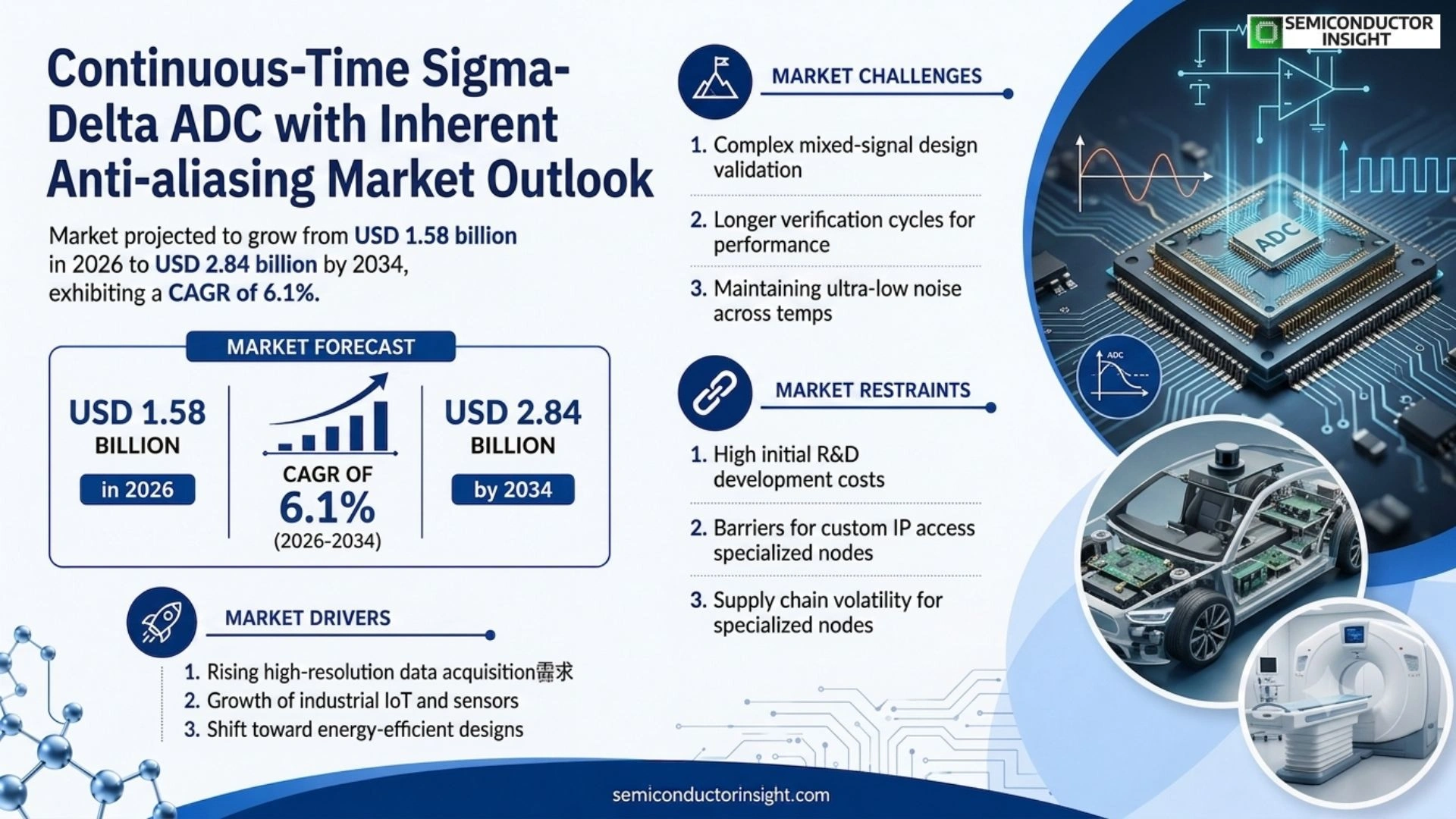
Global Continuous-time sigma‑delta ADC market size was valued at USD 1.52 billion in 2025. The market is projected to grow from USD 1.58 billion in 2026 to USD 2.84 billion by 2034, exhibiting a CAGR of 6.1% during the forecast period.
Continuous-time sigma‑delta analog‑to‑digital converters (ADCs) with inherent anti‑aliasing integrate a high‑order loop filter and a built‑in anti‑aliasing architecture, enabling superior signal‑to‑noise ratio and reduced external filtering requirements in high‑speed data acquisition systems.
The market is experiencing rapid growth because demand for high‑precision sensing in automotive ADAS, industrial IoT, and medical imaging is escalating. Furthermore, advancements in semiconductor processes are lowering power consumption while increasing bandwidth. Key players such as Texas Instruments, Analog Devices, Maxim Integrated and Infineon are expanding their portfolios through new product launches and strategic partnerships, further fueling expansion.
MARKET DRIVERS
Rising Demand for High‑Resolution Data Acquisition
Continuous-time sigma-delta ADC with inherent anti-aliasing Market is being propelled by the expansion of industrial IoT and advanced sensor networks that require sub‑microvolt resolution and low latency. Manufacturers are favoring architectures that integrate anti‑aliasing filters to reduce component count and improve reliability.
Shift Toward Energy‑Efficient Designs
Power‑constrained applications such as autonomous vehicles and portable medical devices benefit from Continuous‑time sigma‑delta conversion technique, which delivers high dynamic range while consuming less silicon area. This efficiency drives investment in next‑generation ADC solutions.
➤ “Embedding anti‑aliasing directly within the ADC architecture cuts bill‑of‑materials by up to 30 % and shortens time‑to‑market for critical systems.”
Regulatory pressure for stricter electromagnetic compatibility (EMC) standards further encourages adoption, as integrated anti‑aliasing helps meet compliance without additional external filtering stages.
MARKET CHALLENGES
Complexity of Design Validation
Design engineers must navigate intricate analog–digital interaction models when implementing continuous‑time sigma‑delta converters. Verification cycles can lengthen, especially for applications demanding ultra‑low noise performance across wide temperature ranges.
Other Challenges
Supply Chain Volatility
The semiconductor fab ecosystem experiences periodic capacity constraints, which can delay the availability of specialized process nodes required for high‑performance ADC cores.
MARKET RESTRAINTS
High Initial Development Costs
Entry into Continuous-time sigma-delta ADC with inherent anti-aliasing Market often demands substantial R&D spending for custom IP and verification infrastructure. Smaller firms may lack the capital to compete with established players, limiting market diversification.
MARKET OPPORTUNITIES
Emerging Applications in Edge AI
Edge AI processors increasingly rely on precise analog front‑ends to preprocess sensor data before digitization. The inherent anti‑aliasing feature of continuous‑time sigma‑delta ADCs aligns perfectly with the need for compact, low‑noise front‑ends, opening a growth corridor projected to expand as AI inference moves closer to data sources.
Continuous-time sigma-delta ADC with inherent anti-aliasing Market Trends
Rising Demand in High‑Precision Sensing
The adoption of continuous-time sigma-delta ADCs that embed anti‑aliasing functionality is accelerating across sectors that require high‑speed, high‑resolution data capture. Automotive advanced driver‑assistance systems (ADAS) are integrating these converters to improve radar and lidar signal fidelity while reducing board‑level component count. In parallel, industrial IoT deployments rely on the built‑in anti‑aliasing filter to simplify sensor front‑ends and enhance reliability in noisy factory environments. Medical imaging equipment benefits from the superior signal‑to‑noise ratio, enabling clearer diagnostic images without extensive external filtering. Collectively, these application trends are reshaping design architectures and driving incremental market expansion.
Other Trends
Integration of Anti‑Aliasing Architecture
Manufacturers are embedding the anti‑aliasing loop directly into the sigma‑delta modulator, which eliminates the need for separate analog filter stages. This integration reduces power consumption by up to 30 % and shortens time‑to‑market for new products. Semiconductor process refinements, such as advanced CMOS nodes, are delivering higher bandwidths while preserving low‑noise performance. The resulting devices support sampling rates that exceed several hundred megasamples per second, meeting the escalating data‑throughput requirements of modern sensor arrays. Design engineers cite the reduced bill‑of‑materials and simplified PCB layouts as decisive factors when selecting these converters for next‑generation platforms.
Strategic Portfolio Expansion by Key Players
Major suppliers, including Texas Instruments, Analog Devices, Maxim Integrated and Infineon, are broadening their product families through targeted launches that emphasize built‑in anti‑aliasing capabilities. Collaborative agreements with automotive OEMs and medical device manufacturers accelerate feature adoption and validate performance benchmarks. These companies also invest in software toolchains that streamline the implementation of continuous‑time sigma‑delta architectures, further lowering entry barriers for system designers. As a result, the market is witnessing a steady influx of differentiated solutions that address niche performance criteria while maintaining cost competitiveness.
COMPETITIVE LANDSCAPEKey Industry Players
Continuous‑Time Sigma‑Delta ADC Market Competitive Landscape
Continuous‑time sigma‑delta ADC segment is led by a handful of mature semiconductor giants that command the bulk of revenue and set the architectural roadmap. Texas Instruments (TI) and Analog Devices (ADI) together account for roughly 55 % of the global market, leveraging deep analog expertise, extensive product portfolios, and aggressive roadmap updates that target automotive ADAS, industrial IoT, and medical imaging. Their offerings combine high‑order loop filters with built‑in anti‑aliasing, delivering superior signal‑to‑noise ratios while reducing bill‑of‑materials. Infineon Technologies and NXP Semiconductors also hold significant positions, focusing on power‑optimized devices for automotive and energy‑efficient data acquisition. The market structure shows a clear split between high‑volume integrated converters for general‑purpose applications and bespoke ASIC solutions for niche, performance‑critical systems.
Beyond the top tier, a diverse set of niche players enriches the competitive fabric with differentiated technologies and specialty process nodes. Maxim Integrated (now part of ADI) continues to supply ultra‑low‑power converters for wearables, while ON Semiconductor emphasizes ruggedized parts for industrial environments. Microchip Technology and Renesas Electronics target cost‑sensitive mass‑market segments, offering compact packages and streamlined design kits. STMicroelectronics provides mixed‑signal families that integrate digital calibration, and Rohm Semiconductor focuses on high‑frequency converters for 5G front‑end modules. Smaller innovators such as Cypress (now under Infineon) and Toshiba bring legacy expertise in mixed‑signal silicon, fostering incremental innovation and sustaining a vibrant supply chain.
List of Key Continuous‑Time Sigma‑Delta ADC Companies Profiled
- Texas Instruments
- Analog Devices
- Maxim Integrated
- Infineon Technologies
- NXP Semiconductors
- ON Semiconductor
- Microchip Technology
- Renesas Electronics
- STMicroelectronics
- Cypress Semiconductor
- Toshiba
- Rohm Semiconductor
Segment Analysis:
| Segment Category | Sub-Segments | Key Insights |
| By Type |
|
Continuous‑time sigma‑delta ADCs
|
| By Application |
|
Automotive ADAS
|
| By End User |
|
OEMs in automotive
|
| By Technology |
|
Integrated anti‑aliasing architecture
|
| By Market Trend |
|
Increasing demand for higher bandwidth
|
Regional Analysis: Continuous-time sigma-delta ADC with inherent anti-aliasing Market
The surge in electric‑vehicle adoption and the rise of edge‑compute devices drive demand for high‑speed, low‑noise converters. Designers prioritize integrated anti‑aliasing to meet stringent signal‑integrity requirements while minimizing board footprint.
Safety‑critical standards such as ISO‑26262 influence product qualification, urging manufacturers to embed reliable filtering mechanisms directly within ADC architectures.
Leading automotive and industrial OEMs partner with silicon vendors, co‑developing converters that incorporate inherent anti‑aliasing to streamline system design and accelerate time‑to‑market.
Recent breakthroughs focus on mixed‑signal integration, leveraging advanced process nodes to deliver higher sampling rates and improved power efficiency within a single chip.
Europe
Europe maintains a solid foothold in Continuous-time sigma-delta ADC with inherent anti-aliasing Market through its strong automotive engineering base and extensive research networks. Collaborative programs across Germany, France, and the Nordics emphasize low‑power designs tailored for railway signaling and renewable‑energy converters. Regulatory harmonization, especially under the EU’s RoHS and REACH directives, drives manufacturers to adopt environmentally friendly processes while preserving performance. Regional distributors benefit from close proximity to key automotive suppliers, enabling rapid prototyping cycles and early feedback loops that shape product roadmaps. Although the market size trails North America, Europe’s focus on reliability and compliance sustains steady growth across the forecast period.
Asia-Pacific
Asia‑Pacific emerges as a fast‑growing hub for Continuous-time sigma-delta ADC with inherent anti-aliasing Market, propelled by massive consumer‑electronics production and expanding semiconductor fabs in China, South Korea, and Taiwan. The region’s cost‑competitiveness encourages high‑volume manufacturing of integrated converters for smartphones, wearables, and industrial IoT gateways. Government incentives for advanced manufacturing and strong push toward 5G rollout further accelerate adoption. While design expertise is still maturing, partnerships with multinational IP owners accelerate technology transfer, allowing local firms to quickly bring sophisticated anti‑aliasing solutions to market.
South America
South America’s contribution to Continuous-time sigma-delta ADC with inherent anti-aliasing Market is driven primarily by emerging renewable‑energy projects and modest growth in automotive electronics. Nations such as Brazil and Chile invest in localized assembly plants to reduce import dependency, fostering a small but agile supplier ecosystem. Market participants focus on robust, cost‑effective converters that can operate in diverse climatic conditions, aligning with regional infrastructure initiatives. Although overall demand remains modest, increasing awareness of signal‑quality requirements in power‑electronics applications signals a gradual upward trend.
Middle East & Africa
The Middle East & Africa region shows nascent interest in Continuous-time sigma-delta ADC with inherent anti-aliasing Market, largely linked to infrastructure modernization and smart‑grid deployments. Investments in data‑center expansion and oil‑field automation create niche opportunities for high‑precision converters. Local partnerships with global silicon vendors aim to establish regional design centers that can adapt anti‑aliasing technologies to harsh operating environments. While the market is still early‑stage, strategic government programs targeting digital transformation are expected to nurture incremental growth over the next decade.
Report Scope
This market research report provides a comprehensive analysis of the Continuous-time sigma-delta ADC with inherent anti-aliasing Market , covering the forecast period 2026–2034. It offers detailed insights into market dynamics, technological advancements, competitive landscape, and key trends shaping the industry.
Key focus areas of the report include:
- Market Overview: The report begins with an overview outlining its current market scenario, key growth indicators, and industry transformation drivers. It discusses macroeconomic factors, demand–supply balance, regulatory landscape, and the strategic role of semiconductors in powering advancements across industries such as automotive, telecommunications, consumer electronics, and industrial automation.
- Market Size & Forecast: Historical data and future projections for revenue, unit shipments, and market value across major regions and segments.
- Segmentation Analysis: Detailed breakdown by product type, technology, application, and end-user industry to identify high-growth segments and investment opportunities.
- Regional Insights: Insights into market performance across North America, Europe, Asia-Pacific, Latin America, and the Middle East & Africa, including country-level analysis where relevant.
- Competitive Landscape: Profiles of leading market participants, including their product offerings, R&D focus, manufacturing capacity, pricing strategies, and recent developments such as mergers, acquisitions, and partnerships.
- Technology Trends & Innovation: Assessment of emerging technologies, integration of AI/IoT, semiconductor design trends, fabrication techniques, and evolving industry standards.
- Market Drivers & Restraints: Evaluation of factors driving market growth along with challenges, supply chain constraints, regulatory issues, and market-entry barriers.
- Stakeholder Insights: Insights for component suppliers, OEMs, system integrators, investors, and policymakers regarding the evolving ecosystem and strategic opportunities.
Primary and secondary research methods are employed, including interviews with industry experts, data from verified sources, and real-time market intelligence to ensure the accuracy and reliability of the insights presented.
FREQUENTLY ASKED QUESTIONS:
What is the current market size of Continuous-time sigma-delta ADC with inherent anti-aliasing Market?
-> Continuous-time sigma‑delta ADC market is projected to grow from USD 1.58 billion in 2026 to USD 2.84 billion by 2034.
Which key companies operate in Continuous-time sigma-delta ADC with inherent anti-aliasing Market?
-> Key players include Texas Instruments, Analog Devices, Maxim Integrated, Infineon, among others.
What are the key growth drivers?
-> Key growth drivers include rising demand for high‑precision sensing in automotive ADAS, industrial IoT, and medical imaging, together with semiconductor process advances that lower power consumption and increase bandwidth.
Which region dominates the market?
-> The reference does not specify a dominant region for this market.
What are the emerging trends?
-> The reference does not highlight specific emerging trends for this market.
Get Sample Report PDF for Exclusive Insights
Report Sample Includes
- Table of Contents
- List of Tables & Figures
- Charts, Research Methodology, and more...