MARKET INSIGHTS
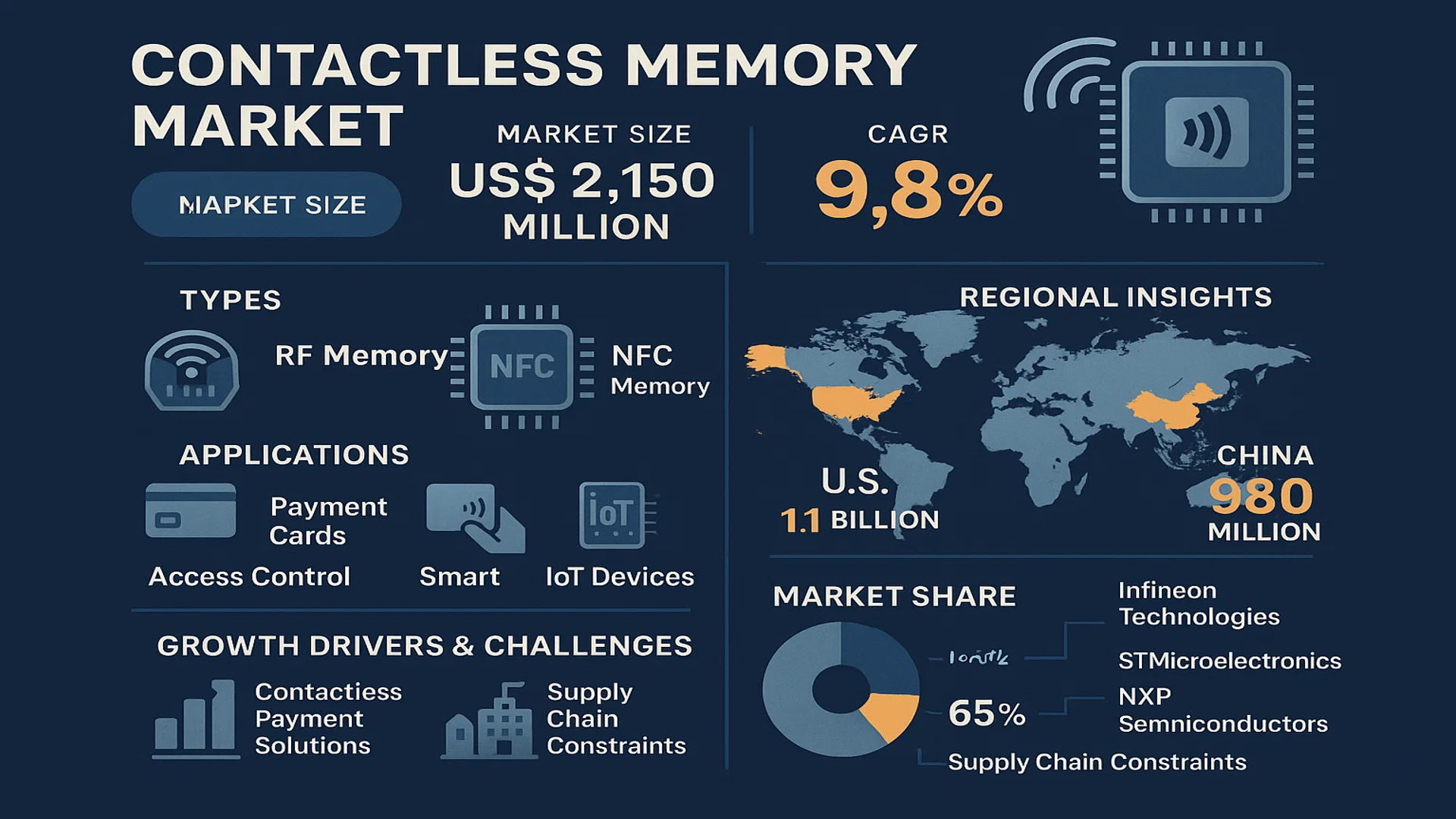
The global Contactless Memory Market size was valued at US$ 2,150 million in 2024 and is projected to reach US$ 4,230 million by 2032, at a CAGR of 9.8% during the forecast period 2025-2032.
Contactless memory refers to semiconductor chips that enable wireless data transmission through radio frequency (RF) or near-field communication (NFC) technology without physical contact. These chips are widely used in payment cards, access control systems, smart packaging, and IoT devices due to their convenience and enhanced security features. The market is segmented into RF memory and NFC memory solutions, with NFC dominating due to its growing adoption in mobile payments.
While the market shows strong growth potential, regional disparities exist. The U.S. market size is estimated at USD 1.1 billion in 2024, while China follows closely with USD 980 million. Key industry players including Infineon Technologies, STMicroelectronics, and NXP Semiconductors collectively hold approximately 65% market share. The rising demand for contactless payment solutions and smart infrastructure development are primary growth drivers, though supply chain constraints pose temporary challenges for manufacturers.
MARKET DYNAMICS
MARKET DRIVERS
Rise of IoT and Smart Devices Fuels Demand for Contactless Memory Solutions
The proliferation of Internet of Things (IoT) devices and smart technologies is significantly driving the contactless memory market. With over 15 billion connected IoT devices globally, there is an increasing need for secure, wireless data storage solutions that enable seamless communication between devices. Contactless memory chips, particularly those using NFC technology, are becoming essential components in smart home systems, wearable devices, and industrial automation due to their ability to transfer data without physical connections. The global IoT market is projected to grow at a compound annual growth rate of over 18% through 2027, creating substantial opportunities for contactless memory manufacturers.
Contactless Payment Adoption Accelerates Market Expansion
The rapid shift toward cashless transactions and digital payment systems worldwide is propelling the contactless memory market forward. Financial institutions and payment processors are increasingly adopting NFC-enabled cards and mobile payment solutions that require secure, high-performance contactless memory. Recent data shows that contactless payment transactions exceeded $10 trillion globally, with adoption rates growing nearly 30% year-over-year in major markets. This trend is prompting memory chip manufacturers to develop specialized solutions with enhanced security features and faster data transfer capabilities to meet banking and financial sector requirements.
➤ For instance, leading semiconductor companies have recently introduced memory chips with advanced encryption specifically designed for payment applications, meeting stringent financial security standards.
Furthermore, government initiatives promoting digital payments and the integration of contactless technology in public transportation systems are creating additional growth avenues for the market.
Automotive Industry Transition Toward Smart Technologies Creates New Applications
The automotive sector’s digital transformation is generating substantial demand for contactless memory solutions. Modern vehicles increasingly incorporate NFC and RF memory for keyless entry systems, digital dashboards, and over-the-air software updates. The trend toward connected and autonomous vehicles, which is projected to represent 25% of new car sales by 2030, requires reliable, high-speed contactless data storage and transfer capabilities. Memory chips that enable secure vehicle-to-infrastructure communication and driver authentication are becoming critical components in next-generation automotive designs.
MARKET RESTRAINTS
Security Vulnerabilities in Contactless Systems Pose Significant Challenges
While contactless memory technology offers convenience, it also faces persistent security concerns that restrain market growth. The wireless nature of data transmission makes NFC and RF memory chips potential targets for hacking, data interception, and unauthorized access. Recent research has identified vulnerabilities in some widely used contactless memory architectures that could expose sensitive user data. These security risks are particularly concerning for applications in financial services and personal identification, where data breaches could have severe consequences.
High Production Costs and Complex Manufacturing Limit Market Penetration
The sophisticated manufacturing processes required for contactless memory chips create significant barriers to market expansion. Producing high-quality NFC and RF memory solutions demands specialized fabrication facilities and advanced materials, resulting in production costs that are 30-40% higher than conventional memory chips. These elevated costs make it challenging for manufacturers to offer price-competitive solutions, particularly in cost-sensitive developing markets where adoption rates are already lower than in advanced economies.
Additionally, the complex supply chain for semiconductor components has led to periodic shortages, further constraining the market’s ability to meet growing demand.
Compatibility Issues Across Devices and Standards Hinder Adoption
The lack of universal standards for contactless memory implementations creates interoperability challenges that slow market growth. Different manufacturers often use proprietary protocols and frequencies, making it difficult for devices from various vendors to communicate seamlessly. This fragmentation is particularly evident in industrial applications where equipment from multiple suppliers needs to interact. Standardization efforts are underway, but progress has been slow, delaying wider adoption across certain sectors.
MARKET OPPORTUNITIES
Healthcare Digitalization Creates New Applications for Contactless Memory
The healthcare sector’s digital transformation presents significant opportunities for contactless memory solutions. NFC-enabled medical devices, patient ID bracelets, and medication tracking systems are gaining traction as hospitals modernize their infrastructure. Contactless memory can store and transfer critical patient data securely while maintaining compliance with strict healthcare privacy regulations. The global digital health market is projected to exceed $500 billion by 2027, creating substantial demand for specialized memory solutions tailored to medical applications.
Emerging Smart City Initiatives Drive Demand for Infrastructure Solutions
Urban development projects worldwide are incorporating contactless technology into public infrastructure, creating new markets for memory solutions. Smart parking systems, public transit payment terminals, and municipal IoT networks all require reliable contactless memory components. Governments are investing heavily in these initiatives, with global smart city spending expected to grow at nearly 20% annually through 2025. Memory chip manufacturers that can provide durable, high-capacity solutions for outdoor and industrial environments stand to benefit significantly from this trend.
➤ Several major cities have recently deployed contactless payment systems for public transportation using advanced NFC memory technology, demonstrating the potential for widespread adoption.
Additionally, the integration of contactless memory with emerging technologies like augmented reality and digital wallets opens up further avenues for innovation and market expansion.
Advancements in Memory Technology Enable New Consumer Applications
Recent breakthroughs in contactless memory density and power efficiency are creating opportunities in consumer electronics. Manufacturers are now able to develop smaller, more energy-efficient chips that can be incorporated into wearable devices, smart packaging, and interactive retail displays. The consumer electronics sector’s relentless demand for innovative features and enhanced user experiences continues to push the boundaries of what’s possible with contactless memory technology.
MARKET CHALLENGES
Global Semiconductor Shortages Disrupt Supply Chains
The contactless memory market faces ongoing challenges from semiconductor supply chain disruptions that began during the pandemic and continue to affect production capacities. Lead times for certain memory components have extended to six months or more, forcing manufacturers to delay product launches and scale back production targets. These shortages are particularly acute for specialty memory chips that require advanced fabrication processes, creating bottlenecks in the supply of high-performance contactless memory solutions.
Increasing Regulatory Scrutiny on Data Privacy Impacts Development Timelines
Growing global focus on data privacy and security is introducing new compliance challenges for contactless memory providers. Regulations such as GDPR in Europe and various data protection laws in other regions impose strict requirements on how personal information stored on memory chips must be handled. Meeting these standards often requires extensive product redesigns and additional certification processes, delaying time-to-market and increasing development costs for new memory solutions.
Other Challenges
Technical Limitations in Extreme Environments
Contactless memory performance can degrade in harsh industrial settings or extreme weather conditions, limiting applications in certain sectors. Developing more robust memory solutions that maintain reliability across wider temperature ranges and environmental conditions remains an ongoing engineering challenge.
Power Consumption Concerns
While improved, the energy requirements of active contactless memory solutions continue to pose challenges for battery-powered devices where energy efficiency is critical. Reducing power consumption while maintaining read/write speeds and data integrity is a key focus area for researchers and developers.
CONTACTLESS MEMORY MARKET TRENDS
Rising Demand for NFC-Enabled Solutions Driving Market Expansion
The global contactless memory market is experiencing significant growth, fueled by the widespread adoption of Near Field Communication (NFC) technology across multiple industries. With a projected CAGR of approximately 8.5% from 2024 to 2032, the market is poised to reach a valuation of $3.2 billion by the end of the forecast period. Key factors contributing to this growth include the increasing use of contactless payment systems, smart cards, and IoT-enabled devices. The integration of RF memory and NFC memory in applications ranging from industrial automation to personal electronics has accelerated market demand, particularly in regions like North America and Asia-Pacific.
Other Trends
Expansion of Smart Card Applications
Contactless memory chips are increasingly embedded in smart cards used for secure transactions, access control, and identity verification. This trend is bolstered by advancements in encryption technologies, ensuring data security without physical contact. The market for NFC-based smart cards is expected to grow at a 9.3% CAGR, driven by their adoption in financial services, government ID programs, and healthcare. Additionally, their role in contactless ticketing systems for public transport has further widened their application scope.
IoT and Industry 4.0 Integration
The rapid development of the Internet of Things (IoT) and Industry 4.0 initiatives has amplified the need for contactless memory solutions. These components facilitate seamless data transfer between connected devices, enhancing efficiency in industrial automation. With over 30 billion IoT devices expected to be in use globally by 2025, the demand for low-power, high-speed contactless memory is set to rise. Manufacturers are also leveraging hybrid memory solutions to optimize performance in sectors such as automotive telematics and smart home appliances.
COMPETITIVE LANDSCAPE
Key Industry Players
Technological Innovation Drives Intensified Competition in Contactless Memory Market
The global contactless memory market exhibits a semi-consolidated structure dominated by established semiconductor leaders, with the top five players accounting for a significant revenue share in 2024. NXP Semiconductors emerges as the market frontrunner, leveraging its extensive NFC product portfolio and strategic partnerships across payment systems, IoT devices, and industrial automation sectors. The company’s recent introduction of secure tamper-resistant memory solutions has further solidified its leadership position.
Infineon Technologies maintains strong market presence through its focus on high-security memory chips for automotive and industrial applications. Its acquisition of Cypress Semiconductor in 2020 enabled expanded capabilities in RF memory solutions, positioning the company as a key innovator in contactless vehicle access systems and smart manufacturing applications.
Meanwhile, STMicroelectronics has demonstrated remarkable growth by penetrating emerging markets with cost-optimized memory solutions. The company’s dual focus on performance optimization and energy efficiency has made its products particularly attractive for consumer electronics manufacturers developing next-generation wearables and smart home devices.
Notably, mid-size players like CardLogix Corporation are gaining traction through specialization in secure government ID solutions, while Westec differentiates itself with customized industrial memory modules. These companies are actively expanding their footprint through technology licensing agreements and regional distribution partnerships.
Market competition continues to intensify as participants prioritize three key strategies: (1) development of ultra-low-power memory architectures for IoT applications, (2) integration of advanced encryption standards for data security, and (3) miniaturization of components to support compact device designs. Recent developments indicate escalating R&D investments, with major players allocating 12-18% of revenues toward next-generation contactless memory technologies.
List of Key Contactless Memory Manufacturers Profiled
- NXP Semiconductors (Netherlands)
- Infineon Technologies (Germany)
- STMicroelectronics (Switzerland)
- CardLogix Corporation (U.S.)
- Westec (Singapore)
- Samsung Electronics (South Korea)
- Texas Instruments (U.S.)
- Renesas Electronics (Japan)
- Microchip Technology (U.S.)
Segment Analysis:
By Type
RF Memory Segment Drives Market Growth Due to Widespread Use in Industrial and IoT Applications
The global contactless memory market is segmented based on type into:
- RF Memory
- Subtypes: Low-frequency (LF), High-frequency (HF), and Ultra-high-frequency (UHF)
- NFC Memory
- Subtypes: NFC Forum Type 1-5 tags and others
By Application
Industrial Automation Trends Accelerate Adoption of Contactless Memory Solutions
The market is categorized by application into:
- Industrial Automation
- Home Appliances
- Personal Electronics
- Automotive Systems
- Healthcare Devices
By Technology
NFC Technology Gains Traction in Consumer Electronics and Payment Systems
The market is differentiated by technology platforms as:
- RFID Technology
- NFC Technology
- Hybrid Solutions
By End User
Enterprise Sector Shows Significant Demand for Secure Contactless Authentication
Key end user segments include:
- Consumer Electronics Manufacturers
- Industrial Equipment Providers
- Healthcare Device Companies
- Automotive OEMs
- Enterprise Security Solutions
Regional Analysis: Contactless Memory Market
Asia-Pacific
The Asia-Pacific region dominates the global contactless memory market, driven by rapid industrialization, government initiatives for digital transformation, and the widespread adoption of NFC-enabled devices. China leads, accounting for over 45% of regional demand due to its massive electronics manufacturing sector and emphasis on IoT integration. Japan and South Korea follow closely, with strong R&D investments in RF and NFC memory chips for applications like smart cards and wearables. India is emerging as a high-growth market, fueled by increasing smartphone penetration and initiatives like Digital India. However, cost sensitivity in the region creates challenges for premium solutions, with mid-range NFC memory chips being the most widely adopted.
North America
North America remains a technology leader in contactless memory, with the U.S. driving 80% of regional sales. The market thrives on advanced industry automation applications, particularly in logistics and retail, coupled with strong demand for secure NFC solutions in payment systems. High smartphone penetration (over 90%) and consumer preference for contactless transactions propel growth. Strict data security regulations, including PCI DSS compliance, also influence memory chip specifications. Canada is seeing increased adoption in smart city projects, though at a slower pace than the U.S. due to infrastructure limitations in rural areas.
Europe
European demand is characterized by stringent data protection standards (GDPR) and high adoption of contactless payment systems. Germany leads in industrial applications, while the U.K. and France show robust NFC memory adoption in banking and transport sectors. The EU’s focus on digital sovereignty boosts local semiconductor manufacturing, though the region remains dependent on global suppliers like Infineon and STMicroelectronics for advanced chips. Eastern Europe is gradually catching up, with Poland and Czech Republic emerging as manufacturing hubs for mid-range contactless memory solutions.
South America
Market growth here is slower but steady, primarily driven by Brazil’s banking sector and Argentina’s gradual shift to contactless payment infrastructure. Economic instability and currency fluctuations remain the primary barriers to widespread adoption of high-end solutions. Most demand concentrates in urban centers, with RF memory chips used in basic access control systems dominating over more advanced NFC applications. However, the region shows long-term potential as smartphones become more accessible and governments push cashless payment initiatives.
Middle East & Africa
The contactless memory market shows promising but uneven growth across this region. Gulf States like UAE and Saudi Arabia lead in NFC adoption, particularly for smart government services and high-end retail applications. Africa’s market remains nascent, though mobile payment systems like M-Pesa create demand for basic RF memory solutions in Kenya and South Africa. Infrastructure limitations and low banking penetration in many countries restrict market potential, yet the region presents opportunities for low-cost memory chips in transportation and identity management systems.
Report Scope
This market research report provides a comprehensive analysis of the global and regional Contactless Memory markets, covering the forecast period 2025–2032. It offers detailed insights into market dynamics, technological advancements, competitive landscape, and key trends shaping the industry.
Key focus areas of the report include:
- Market Size & Forecast: Historical data and future projections for revenue, unit shipments, and market value across major regions and segments. The Global Contactless Memory market was valued at US$ 2,150 million in 2024 and is projected to reach US$ 4,230 million by 2032, growing at a CAGR of 9.8%.
- Segmentation Analysis: Detailed breakdown by product type (RF Memory, NFC Memory), application (Industry Automation, Home Appliances, Personal Electronics), and end-user industry to identify high-growth segments.
- Regional Outlook: Insights into market performance across North America, Europe, Asia-Pacific, Latin America, and the Middle East & Africa. The U.S. market is estimated at USD 215 million in 2024, while China is projected to reach USD 298 million by 2032.
- Competitive Landscape: Profiles of leading market participants including Infineon Technologies, STMicroelectronics, NXP Semiconductors, their product portfolios, market shares (top 5 players held 68% revenue share in 2024), and strategic developments.
- Technology Trends & Innovation: Assessment of emerging NFC/RFID integration, IoT applications, and advancements in semiconductor fabrication for contactless solutions.
- Market Drivers & Restraints: Evaluation of factors including rising demand for contactless payments, smart device proliferation, along with challenges like security concerns and standardization issues.
- Stakeholder Analysis: Strategic insights for semiconductor manufacturers, OEMs, system integrators, and investors regarding market opportunities and competitive positioning.
The research methodology combines primary interviews with industry experts and analysis of verified market data from regulatory bodies, company filings, and trade associations to ensure accuracy.
FREQUENTLY ASKED QUESTIONS:
What is the current market size of Global Contactless Memory Market?
-> Contactless Memory Market size was valued at US$ 2,150 million in 2024 and is projected to reach US$ 4,230 million by 2032, at a CAGR of 9.8% during the forecast period 2025-2032.
Which key companies operate in Global Contactless Memory Market?
-> Key players include Infineon Technologies, STMicroelectronics, NXP Semiconductors, CardLogix Corporation, and Westec, with top 5 companies holding 68% market share in 2024.
What are the key growth drivers?
-> Growth is driven by rising adoption of contactless payment systems, IoT device proliferation, and demand for secure data transmission across industries.
Which region dominates the market?
-> Asia-Pacific is the fastest-growing market (projected 8.2% CAGR), while North America currently holds the largest revenue share (38% in 2024).
What are the emerging trends?
-> Emerging trends include integration with AI-powered systems, development of ultra-low power memory solutions, and advanced security features for contactless applications.

Get Sample Report PDF for Exclusive Insights
Report Sample Includes
- Table of Contents
- List of Tables & Figures
- Charts, Research Methodology, and more...