Consumer AI Processor Market Insights
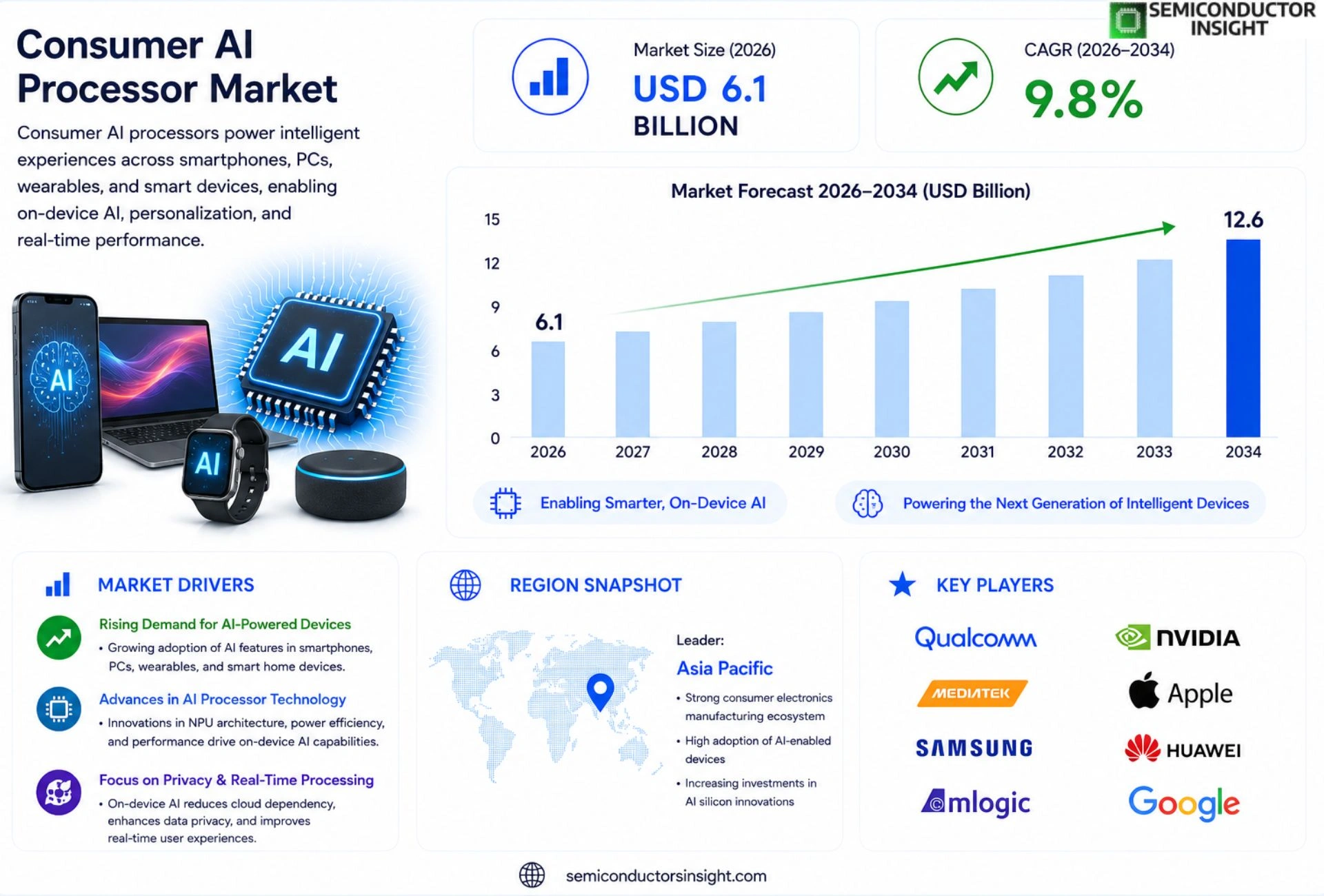
Global Consumer AI Processor market size was valued at USD 4.8 billion in 2025. The market is projected to grow from USD 6.1 billion in 2026 to USD 12.6 billion by 2034, exhibiting a CAGR of 9.8% during the forecast period.
Consumer AI processors are specialized semiconductor chips designed for on‑device artificial intelligence tasks in smartphones, wearables, smart home appliances, and AR/VR headsets. These processors enable low‑latency inference for voice assistants, image enhancement, predictive typing, and personalized recommendations while preserving user privacy.
The market is accelerating due to rising demand for edge‑AI capabilities, expanding adoption of advanced camera features, and increasing investment from leading OEMs such as Apple’s M‑series integration and Qualcomm’s Snapdragon AI platform collaborations with Samsung and Xiaomi. Furthermore, regulatory pressure for data sovereignty drives manufacturers toward on‑device processing solutions.
MARKET DRIVERS
Rising Adoption of Smart Devices
The proliferation of voice‑enabled assistants, immersive gaming consoles, and AI‑powered wearables is creating a strong demand for dedicated processing units. As consumers expect real‑time personalization, manufacturers are integrating more capable AI chips, which directly fuels growth in Consumer AI Processor Market.
Advancements in Edge Computing
Edge‑centric architectures reduce latency and protect user privacy, prompting chipset vendors to develop low‑power, high‑efficiency AI processors. These technological strides enable richer on‑device inference, reinforcing the market’s upward trajectory.
➤ “On‑device AI execution is now a baseline expectation for premium consumer electronics, accelerating platform migrations.”
Furthermore, strategic partnerships between semiconductor firms and device OEMs are shortening time‑to‑market for next‑generation AI solutions, ensuring a sustained pipeline of innovative products within Consumer AI Processor Market.
MARKET CHALLENGES
Cost Sensitivity
While AI capabilities are coveted, price‑conscious shoppers often prioritize overall device cost over incremental performance gains. This price elasticity can limit the premium pricing that many AI processor manufacturers seek.
Other Challenges
Supply Chain Constraints
Component shortages, especially for advanced lithography equipment, can delay production ramps, creating temporary mismatches between demand and supply in Consumer AI Processor Market.
Additionally, fragmented standards across operating systems and AI frameworks add integration complexity, requiring extra engineering effort that can increase development timelines.
MARKET RESTRAINTS
Regulatory and Privacy Concerns
Stringent data‑protection regulations in key regions compel manufacturers to implement robust on‑device processing, which can raise design complexity and cost, acting as a restraint on rapid market expansion.
Limited Consumer Awareness
Many end‑users remain unaware of the tangible benefits delivered by specialized AI processors, leading to slower adoption rates for products that rely on such hardware enhancements.
MARKET OPPORTUNITIES
Personalized Media & Gaming Experiences
The surge in demand for hyper‑realistic gaming and AI‑driven media recommendation engines provides a fertile ground for new processor designs that can handle complex neural networks without compromising battery life.
Growth of Health‑Focused Wearables
Wearable health monitors that perform real‑time biometrics analysis on‑device represent a high‑growth niche, allowing AI chip makers to capture value in a segment less affected by traditional computing constraints.
Consumer AI Processor Market Trends
Edge‑AI Adoption Accelerates
Consumer AI Processor Market is experiencing a decisive shift toward on‑device inference as manufacturers prioritize low‑latency responsiveness and data sovereignty. Smartphones now embed dedicated neural engines that handle voice‑assistant queries, real‑time image enhancement, and predictive typing without routing data to cloud servers. Wearables and smart‑home hubs follow the same trajectory, leveraging compact AI cores to deliver personalized health analytics and context‑aware automation. This momentum is reinforced by major OEMs integrating AI‑optimized silicon,such as Apple’s M‑series‑derived chips and Qualcomm’s Snapdragon AI platform,into flagship products, thereby expanding the addressable base of edge‑AI applications. Regulatory frameworks emphasizing user privacy further compel device makers to embed processing capabilities, creating a virtuous cycle of hardware investment and software innovation across Consumer AI Processor Market.
Other Trends
On‑Device Data Privacy
Privacy‑centric design has become a core differentiator for consumer‑grade AI processors. By executing neural network workloads locally, these chips minimize exposure of personal data to external networks, aligning with emerging data‑residency regulations in Europe and Asia. Manufacturers now embed secure enclaves and encrypted memory buffers within the silicon, ensuring that sensitive biometric or behavioral data remains isolated throughout the inference pipeline. This approach not only satisfies compliance requirements but also enhances user trust, driving higher adoption rates for features such as facial recognition unlocking and personalized recommendation engines. As privacy expectations rise, Consumer AI Processor Market sees increased demand for processors that combine high compute density with robust security primitives.
Integration with Advanced Camera Systems
Advanced imaging continues to be a catalyst for new AI processor capabilities. Modern smartphones employ multi‑sensor arrays, computational photography, and AI‑driven HDR pipelines that rely on real‑time pixel‑level analysis. Dedicated AI cores now handle noise reduction, super‑resolution upscaling, and scene classification directly on the image sensor, reducing latency and power consumption compared to cloud‑based processing. This trend extends to AR/VR headsets, where low‑latency depth estimation and object tracking are essential for immersive experiences. The convergence of high‑resolution optics and specialized AI accelerators solidifies a growth pathway for Consumer AI Processor Market, encouraging chip designers to focus on heterogeneous compute blocks that balance performance, efficiency, and integration flexibility.
COMPETITIVE LANDSCAPE
Key Industry Players
Intense Semiconductor Innovation and Strategic OEM Partnerships Define the Consumer AI Processor Competitive Arena
Consumer AI Processor market is characterized by fierce competition among a handful of dominant semiconductor giants who collectively command a substantial share of the industry valued at USD 4.8 billion in 2025. Qualcomm stands at the forefront with its Snapdragon AI platform, which powers a broad ecosystem of Android smartphones through deep collaborations with Samsung and Xiaomi, enabling advanced on-device inference capabilities across camera processing, voice recognition, and real-time translation. Apple reinforces its competitive position through its vertically integrated Neural Engine embedded within the M-series and A-series chip architectures, delivering industry-leading performance-per-watt ratios for edge-AI workloads across iPhones, iPads, and Mac devices. MediaTek has emerged as a strong challenger with its Dimensity series, aggressively targeting mid-range and premium Android OEMs across Asia-Pacific markets with cost-competitive AI processing solutions. NVIDIA, historically dominant in data center GPU computing, continues to extend its AI silicon expertise into the consumer edge segment, while Samsung’s Exynos platform integrates proprietary neural processing units to serve both internal flagship devices and select third-party handset manufacturers.
Beyond the market leaders, a growing cohort of specialized and regional players is reshaping niche segments of the consumer AI processor landscape. Google’s Tensor chip series, developed in collaboration with Samsung Foundry, is specifically optimized for computational photography and on-device large language model inference within the Pixel smartphone lineup. Arm Holdings provides the foundational CPU and NPU IP architectures that underpin processor designs from virtually every major fabless semiconductor company in this market, making it a silent but indispensable competitive force. HiSilicon, Huawei’s in-house semiconductor division, continues to develop its Kirin AI processors despite supply chain constraints, maintaining relevance in the Chinese consumer electronics ecosystem. Unisoc is progressively advancing its AI processing capabilities targeting entry-level and mid-tier devices across emerging markets. Meanwhile, companies such as Ambarella and Synaptics are carving out defensible positions in AI-enabled edge devices including wearables, smart home appliances, and AR/VR headsets, segments expected to contribute meaningfully to the market’s projected growth toward USD 12.6 billion by 2034 at a CAGR of 9.8%.
List of Key Consumer AI Processor Companies Profiled
- Qualcomm Technologies, Inc.
- Apple Inc.
- MediaTek Inc.
- NVIDIA Corporation
- Samsung Electronics Co., Ltd.
- Google LLC (Tensor SoC)
- Arm Holdings plc
- HiSilicon Technologies Co., Ltd. (Huawei)
- Unisoc Technologies Co., Ltd.
- Ambarella, Inc.
- Synaptics Incorporated
- Intel Corporation
- Rockchip Electronics Co., Ltd.
- Imagination Technologies Group
- Cadence Design Systems, Inc.
Segment Analysis:
| Segment Category | Sub-Segments | Key Insights |
| By Type |
|
Neural Processing Units drive the most compelling consumer experiences.
|
| By Application |
|
Smartphones represent the core deployment arena, shaping user interaction daily.
|
| By End User |
|
Individual Consumers drive demand for intuitive, private AI experiences.
|
| By Architecture |
|
Hybrid CPU‑GPU AI Solutions stand out for flexibility across workloads.
|
| By Integration Mode |
|
Integrated SoC AI Modules dominate device design choices.
|
Regional Analysis: North America
North America
The primary drivers for Consumer AI Processor Market in North America include increasing demand for smart home devices, the proliferation of 5G connectivity, and growing consumer awareness of AI-powered features.
Continuous advancements in AI processor technology, particularly in areas like neural processing units (NPUs) and edge computing, are enabling more sophisticated and on-device AI capabilities.
The North American Consumer AI Processor market is highly competitive, with established players and emerging startups vying for market share through innovation and strategic partnerships.
Future trends in the North American market include increased focus on privacy and security, the development of more energy-efficient AI processors, and the integration of AI with emerging technologies like extended reality (XR).
Europe
The European Consumer AI Processor market presents a significant opportunity for growth, fueled by a strong emphasis on innovation and a rapidly expanding smart device ecosystem. Several factors contribute to this positive outlook, including government initiatives supporting AI research, a large and tech-savvy consumer base, and increasing demand for intelligent devices across various sectors. The integration of AI processors in smartphones, wearables, and smart home appliances is gaining momentum, driven by consumer preferences for personalized and convenient experiences. European manufacturers are actively investing in developing energy-efficient and privacy-focused AI solutions, aligning with stringent data protection regulations. The market is characterized by a diverse range of players, including established semiconductor companies and innovative startups, all vying to capture a share of this burgeoning market. The focus is on providing seamless user experiences and addressing the specific needs of the European consumer market.
Asia-Pacific
The Asia-Pacific region is poised to become the largest and fastest-growing market for Consumer AI Processors globally. This rapid expansion is primarily driven by the massive consumer base in countries like China and India, coupled with increasing disposable incomes and a strong appetite for smart devices. The proliferation of 5G networks and the growing adoption of IoT devices are further accelerating market growth. Key applications driving demand include smartphones, smart home appliances, automotive systems, and industrial automation. Local manufacturers are playing a crucial role in catering to the specific needs of the regional market, with a focus on cost-effective and feature-rich AI solutions. The competitive landscape is dynamic, with both regional and global players intensifying their efforts to establish a strong presence. The future of the Asia-Pacific Consumer AI Processor market is characterized by rapid innovation, increasing digitalization, and a strong emphasis on affordability and accessibility.
South America
Consumer AI Processor Market in South America is experiencing steady growth, driven by increasing smartphone penetration and a growing awareness of smart home technologies. Economic development and rising disposable incomes are contributing to the adoption of AI-powered devices. Key applications include smartphones, wearables, and smart home assistants. While the market is currently smaller compared to North America and Asia-Pacific, it presents significant potential for expansion. Local players are adapting to the specific needs and price sensitivities of the South American consumer base. The focus is on providing affordable and reliable AI solutions that cater to the region’s diverse market dynamics. The growth of e-commerce and increasing internet access are further fueling the demand for smart devices and AI-powered functionalities.
Middle East & Africa
Consumer AI Processor Market in the Middle East and Africa is an emerging market with substantial growth potential. Increasing smartphone usage, rising disposable incomes, and government initiatives promoting technological advancements are driving market expansion. Key applications include smartphones, smart home devices, and connected vehicles. The region presents a unique opportunity for companies to introduce innovative AI solutions that cater to the specific needs of the local consumer base. Factors such as expanding internet infrastructure, increasing urbanization, and a growing digital economy are further fueling demand. The market is characterized by a mix of established and emerging players, with a focus on providing cost-effective and feature-rich AI solutions. The future of the Middle East and Africa Consumer AI Processor market is promising, with significant opportunities for growth in the coming years.
Report Scope
This market research report provides a comprehensive analysis of the Consumer AI Processor Market , covering the forecast period 2026–2034. It offers detailed insights into market dynamics, technological advancements, competitive landscape, and key trends shaping the industry.
Key focus areas of the report include:
- Market Overview: The report begins with an overview outlining its current market scenario, key growth indicators, and industry transformation drivers. It discusses macroeconomic factors, demand–supply balance, regulatory landscape, and the strategic role of semiconductors in powering advancements across industries such as automotive, telecommunications, consumer electronics, and industrial automation.
- Market Size & Forecast: Historical data and future projections for revenue, unit shipments, and market value across major regions and segments.
- Segmentation Analysis: Detailed breakdown by product type, technology, application, and end-user industry to identify high-growth segments and investment opportunities.
- Regional Insights: Insights into market performance across North America, Europe, Asia-Pacific, Latin America, and the Middle East & Africa, including country-level analysis where relevant.
- Competitive Landscape: Profiles of leading market participants, including their product offerings, R&D focus, manufacturing capacity, pricing strategies, and recent developments such as mergers, acquisitions, and partnerships.
- Technology Trends & Innovation: Assessment of emerging technologies, integration of AI/IoT, semiconductor design trends, fabrication techniques, and evolving industry standards.
- Market Drivers & Restraints: Evaluation of factors driving market growth along with challenges, supply chain constraints, regulatory issues, and market-entry barriers.
- Stakeholder Insights: Insights for component suppliers, OEMs, system integrators, investors, and policymakers regarding the evolving ecosystem and strategic opportunities.
Primary and secondary research methods are employed, including interviews with industry experts, data from verified sources, and real-time market intelligence to ensure the accuracy and reliability of the insights presented.
FREQUENTLY ASKED QUESTIONS:
What is the current market size of Consumer AI Processor Market?
-> Consumer AI Processor Market was valued at USD 4.8 billion in 2025 and is expected to reach USD 12.6 billion by 2034.
Which key companies operate in Consumer AI Processor Market?
-> Key players include Apple, Qualcomm, Samsung, MediaTek, and Xiaomi, among others.
What are the key growth drivers?
-> Key growth drivers include rising demand for edge‑AI capabilities, advanced camera and imaging features, privacy‑preserving on‑device processing, and regulatory pressure for data sovereignty.
Which region dominates the market?
-> Asia‑Pacific is the fastest‑growing region, while North America remains a dominant market.
What are the emerging trends?
-> Emerging trends include heterogeneous integration of AI accelerators, ultra‑low‑power AI cores, and AI‑optimized semiconductor process technologies (e.g., 3nm and below).

Get Sample Report PDF for Exclusive Insights
Report Sample Includes
- Table of Contents
- List of Tables & Figures
- Charts, Research Methodology, and more...
 Download Sample Report PDF