
MARKET INSIGHTS
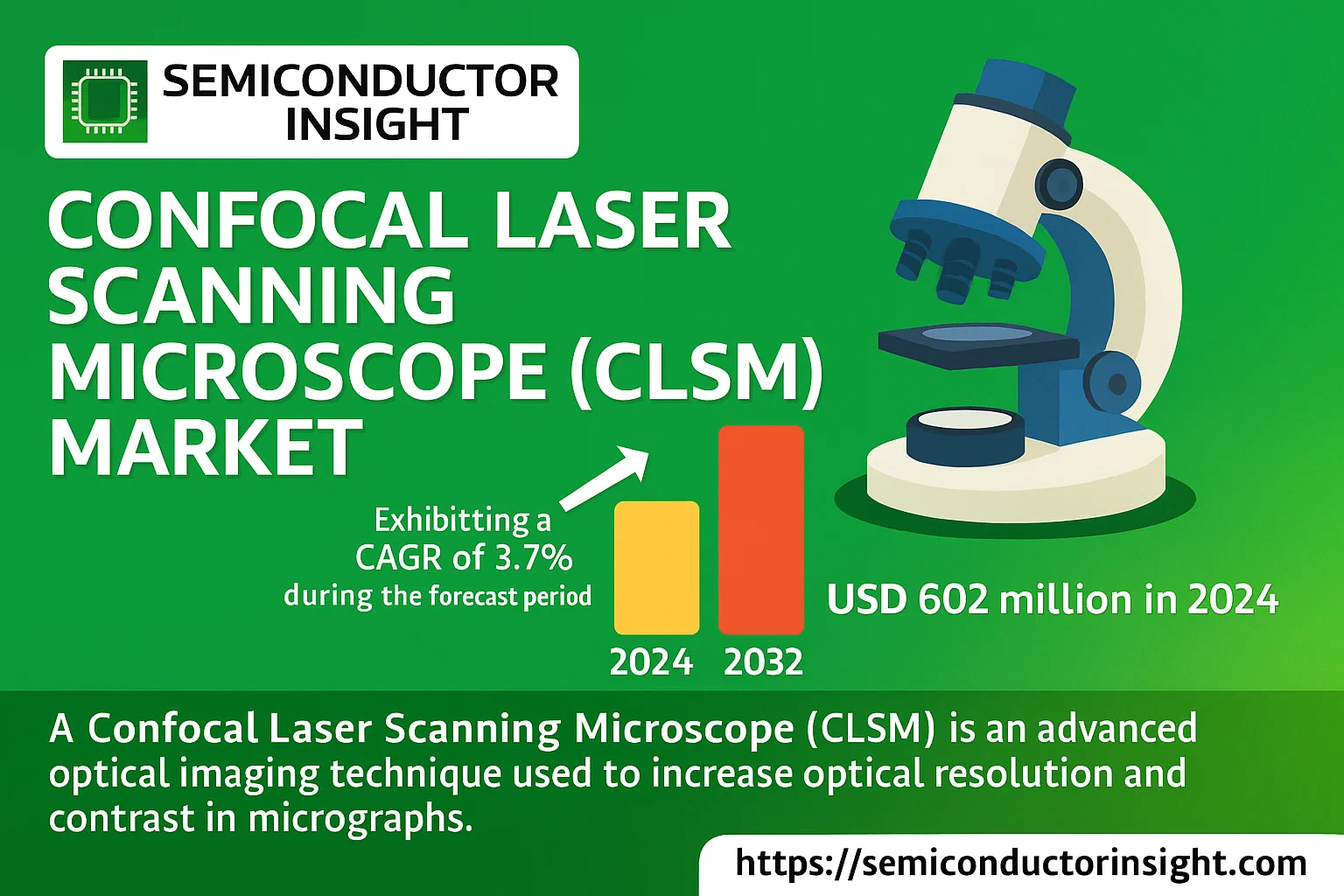
Global Confocal Laser Scanning Microscope (CLSM) Market was valued at USD 602 million in 2024 to USD 771 million by 2032, exhibiting a CAGR of 3.7% during the forecast period.
A Confocal Laser Scanning Microscope (CLSM) is an advanced optical imaging technique used to increase optical resolution and contrast in micrographs. This is achieved by using a spatial pinhole to block out-of-focus light during image formation, allowing for the capture of high-resolution, sharp images from selected depths within a specimen.
The market growth is primarily driven by increasing R&D investments in life sciences and material sciences, coupled with the rising demand for high-resolution imaging in applications such as cell biology and nanotechnology. However, the high cost of these sophisticated instruments can be a restraining factor. The market is characterized by a high level of consolidation, with key players like Carl Zeiss, Leica Microsystems (Danaher), and Olympus holding a dominant share. For instance, these top three companies collectively account for approximately 84% of the global market.
MARKET DRIVERS
Rising Demand in Life Sciences and Biomedical Research
The growth of the CLSM market is primarily driven by the expanding application of these microscopes in life sciences, particularly in cell biology, neuroscience, and immunology. The ability to generate high-resolution, three-dimensional images of specimens labeled with fluorescent tags is crucial for studying dynamic biological processes, drug interactions, and disease mechanisms. Increased funding for biomedical research globally is a significant contributor to this demand.
Technological Advancements and Product Innovations
Ongoing technological innovations are a major market driver. Manufacturers are continuously improving resolution, speed, and sensitivity while integrating advanced features like spectral imaging, multiphoton excitation, and super-resolution capabilities. The development of more user-friendly software for image acquisition and analysis is also making these powerful tools accessible to a broader range of researchers, thereby expanding the market.
➤ The global push for advancements in personalized medicine and regenerative therapies is creating a sustained need for detailed cellular analysis, which directly fuels the adoption of CLSM technology.
Furthermore, the application of CLSM is growing beyond traditional biology into materials science and nanotechnology, where it is used for analyzing surface structures, thin films, and semiconductor devices. This diversification of end-user industries provides additional momentum for market growth.
MARKET CHALLENGES
High Cost of Acquisition and Maintenance
A significant challenge facing the CLSM market is the high initial cost of the instruments and their operational expenses. Advanced confocal systems represent a major capital investment for academic institutions, research labs, and even industrial users. The need for specialized training for operators and the recurring costs of maintenance, service contracts, and consumables further limit market penetration, particularly in cost-sensitive settings and developing regions.
Other Challenges
Technical Complexity and Sample Preparation
The operation of CLSM requires a high level of technical expertise. Sample preparation is often intricate, involving specific fluorescent labeling and mounting techniques that can be time-consuming and prone to artifacts, potentially hindering throughput and adoption in high-volume screening applications.
Competition from Alternative Imaging Modalities
The market faces competition from other high-resolution imaging technologies, such as super-resolution microscopy, light-sheet fluorescence microscopy, and high-content screening systems. These alternatives sometimes offer advantages in speed, live-cell compatibility, or resolution, posing a challenge for traditional CLSM systems to maintain their market share.
MARKET RESTRAINTS
Budget Constraints in Academic and Public Research
Stringent budgetary limitations, especially within public funding bodies and academic institutions, act as a key restraint on market growth. Fluctuations in government research grants can delay or cancel equipment procurement plans, directly impacting sales cycles for high-end instruments like CLSM. This financial uncertainty makes long-term market forecasting challenging for manufacturers.
Limitations in Live-Cell Imaging
Despite advancements, conventional CLSM can still present challenges for prolonged live-cell imaging. Phototoxicity and photobleaching caused by the intense laser light required for imaging can damage living samples, limiting the duration over which biological processes can be observed. This inherent limitation restrains its application in certain dynamic, long-term biological studies.
MARKET OPPORTUNITIES
Expansion in Pharmaceutical and Biotechnology R&D
The pharmaceutical and biotechnology industries present substantial growth opportunities for the CLSM market. There is an increasing reliance on high-content imaging for drug discovery, toxicology studies, and the development of biologics. CLSM is essential for visualizing drug-target interactions, assessing compound efficacy, and ensuring quality control in biomanufacturing processes, driving demand from this sector.
Growth in Emerging Economies
Emerging economies in Asia-Pacific and Latin America are becoming significant areas of opportunity. Governments in these regions are increasing their investment in healthcare infrastructure and scientific research. As academic and industrial research capabilities expand, the demand for advanced microscopy equipment like CLSM is expected to rise, offering vendors new avenues for market penetration and growth.
Integration with Automated and AI-Driven Systems
The integration of CLSM with automation and artificial intelligence (AI) for image analysis represents a forward-looking opportunity. Automated imaging systems can increase throughput, while AI algorithms can rapidly analyze complex image data sets for pattern recognition and quantification. This synergy can open up new applications in diagnostics and large-scale screening programs.
Confocal Laser Scanning Microscope (CLSM) Market Trends
Steady Growth Fueled by Biomedical Research
The global Confocal Laser Scanning Microscope (CLSM) market demonstrates a pattern of stable, positive growth. Starting from a valuation of $602 million in 2024, the market is projected to expand to $771 million by 2032, achieving a compound annual growth rate (CAGR) of 3.7%. This sustained growth is primarily driven by the expanding applications of this high-resolution imaging technology in life sciences and biomedical research. The technique’s core advantage lies in its ability to increase optical resolution and contrast by using a spatial pinhole to eliminate out-of-focus light, making it indispensable for detailed cellular and subcellular analysis.
Other Trends
Dominance of Established Players and Regional Markets
The competitive landscape of the CLSM market is highly concentrated, with the top three manufacturers—Carl Zeiss, Leica, and Olympus—collectively holding approximately 84% of the global market share. This concentration underscores the high barriers to entry, including significant R&D investments and established patent portfolios. Geographically, North America is the largest market, accounting for about 36% of global share, followed by Europe at 26%. The prominence of these regions is linked to their advanced healthcare infrastructure, substantial funding for scientific research, and the presence of major market players.
Segmentation Insights and Application Areas
Market segmentation reveals key trends in technology adoption. The market is divided by type into Single-photon and Multiphoton CLSM, each catering to specific research needs requiring different depths of penetration and resolution. In terms of application, the Life Sciences segment holds the largest share, utilizing CLSM for applications in neurology, immunology, and cell biology. The Material Sciences segment is another significant area, employing the technology for the analysis of surfaces and thin films. The continued investment in R&D across these sectors is a primary factor ensuring the steady demand for confocal microscopy systems.
COMPETITIVE LANDSCAPE
Key Industry Players
Market Characterized by High Concentration and Technological Innovation
The global Confocal Laser Scanning Microscope (CLSM) market is dominated by a few major players, with the top three companies—Carl Zeiss, Leica Microsystems (a Danaher company), and Olympus—collectively occupying a significant portion of the market share, estimated at approximately 84%. These established giants leverage their extensive research and development capabilities, strong brand recognition, and global distribution networks to maintain their leadership. Their product portfolios are diverse, covering both single-photon and multiphoton CLSM systems tailored for applications in life sciences and material sciences. The competitive dynamics are heavily influenced by continuous technological advancements aimed at improving resolution, imaging speed, and ease of use.
Beyond the dominant leaders, a number of other significant players compete in specific niches or regions. Nikon, for instance, is a key competitor with a strong presence. Companies like Bruker, through its acquisition of optical microscopy assets, and Keyence, known for its automated and user-friendly systems, represent important competitors focusing on industrial and high-throughput applications. Other notable participants include JEOL Ltd., renowned for its electron microscopes which sometimes integrate confocal capabilities, and Hitachi High-Tech. The market also features specialized manufacturers like Thorlabs and Medimeas, which cater to research and customized solutions, alongside emerging players in the Asia-Pacific region who are increasingly gaining traction.
List of Key Confocal Laser Scanning Microscope (CLSM) Companies Profiled
- Carl Zeiss AG
- Leica Microsystems (Danaher)
- Evident Olympus
- Nikon Corporation
- Bruker Corporation
- JEOL Ltd.
- Keyence Corporation
- Hitachi High-Tech Corporation
- Thorlabs, Inc.
- Medimeas
- Zeiss Research Microscopy Solutions
- Intelligent Imaging Innovations (3i)
- Meiji Techno
- PicoQuant GmbH
- Nanonics Imaging Ltd.
Segment Analysis:
| Segment Category | Sub-Segments | Key Insights |
| By Type |
|
Single-photon CLSM represents the established standard in the market, favored for its high resolution and suitability for a wide array of standard fluorescence imaging applications. However, the Multiphoton CLSM segment is demonstrating significant momentum, driven by its superior capability for deep-tissue imaging with reduced photobleaching and phototoxicity. This makes it particularly valuable for advanced life sciences research, creating a distinct avenue for growth as research demands become more complex. |
| By Application |
|
Life Sciences is unequivocally the dominant application segment, serving as the primary driver of the CLSM market. The relentless progress in cellular biology, neuroscience, and drug discovery necessitates high-resolution 3D imaging, which is a core strength of confocal microscopy. While the Material Sciences application is a smaller niche, it holds critical importance for analyzing surface topography and material properties, indicating a specialized but stable demand base. |
| By End User |
|
Academic & Research Institutions form the largest end-user segment, as they are the primary hubs for foundational research requiring advanced imaging tools. The purchasing decisions here are heavily influenced by grant funding and the need for versatile, high-performance instruments. Pharmaceutical & Biotechnology Companies represent a highly valuable segment with a focus on applied research and quality control, often demanding robust systems with high throughput and reliability for drug development processes. |
| By System Configuration |
|
Inverted Microscopes are the leading configuration, particularly within the life sciences sector, due to their superior ergonomics for working with cell cultures and live-cell imaging chambers. The flexibility of Modular Systems is gaining significant traction, as they allow researchers to customize their setups with various laser lines, detectors, and accessories. This adaptability future-proofs investments and caters to highly specialized research requirements, making it a key differentiator for manufacturers. |
| By Level of Automation |
|
Semi-Automated Systems currently represent the sweet spot in the market, balancing usability with advanced functionality for most research labs. There is a clear and accelerating trend towards Fully Automated Systems, especially in high-throughput environments like pharmaceutical screening and core facilities. This shift is driven by the need for improved reproducibility, reduced operator time, and the ability to run complex, long-duration experiments unattended, which is a major factor in operational efficiency. |
Regional Analysis: Confocal Laser Scanning Microscope (CLSM) Market
North America
The region’s strength is anchored in its unparalleled R&D ecosystem. Heavy investment from both public agencies and private venture capital fuels cutting-edge research in neuroscience, cell biology, and nanotechnology, creating consistent, high-value demand for advanced CLSM systems capable of super-resolution and live-cell imaging, pushing manufacturers to innovate continuously.
A well-established regulatory framework for medical devices and pharmaceuticals, combined with generous federal and state-level funding for scientific research, provides a stable and predictable environment for market growth. This encourages long-term investment in expensive capital equipment like CLSMs by both academic and industrial research facilities.
The presence of global CLSM manufacturers’ headquarters and primary R&D centers in North America ensures direct access to the latest technological advancements and tailored customer support. This proximity facilitates close collaboration between end-users and developers, leading to products that are highly attuned to the specific needs of advanced research labs.
Beyond academia, industries such as pharmaceuticals, biotechnology, and semiconductors demonstrate a high rate of CLSM adoption for quality control, failure analysis, and fundamental research. The demand from these high-value industrial sectors, which prioritize precision and reliability, further cements North America’s leading position in the high-end segment of the CLSM market.
Europe
Europe represents a mature and highly sophisticated market for Confocal Laser Scanning Microscopes, characterized by a strong collaborative research landscape and significant public funding initiatives. Countries like Germany, the UK, and France are powerhouses in biomedical and materials research, supported by framework programs like Horizon Europe. The region boasts a high density of specialized research institutes and universities with a long history of optical innovation. A key dynamic is the emphasis on multi-disciplinary research, which drives demand for versatile CLSM systems that can be integrated with other analytical techniques. The presence of several renowned microscope manufacturers within Europe also contributes to a competitive and innovative market environment, ensuring a steady pipeline of advanced products tailored to the rigorous demands of European researchers.
Asia-Pacific
The Asia-Pacific region is the fastest-growing market for CLSMs, fueled by rapidly expanding investments in healthcare infrastructure, life sciences research, and academic institutions. China, Japan, and India are at the forefront of this growth, with governments actively promoting domestic R&D capabilities. Japan has a legacy of excellence in optical engineering and is home to major global players in microscope manufacturing. China’s market is expanding rapidly due to massive national-level funding for scientific equipment and a burgeoning biotechnology sector. The dynamic in this region is one of rapid adoption, with a focus on both high-end research systems and more cost-effective models suitable for a growing base of educational and industrial users, making it a critical region for future market expansion.
South America
The South American CLSM market is emerging, with growth primarily concentrated in a few key countries, notably Brazil and Argentina. Market dynamics are shaped by increasing government focus on strengthening scientific research infrastructure and growing partnerships with international research bodies. Funding limitations compared to more developed regions mean that market growth is often driven by specific, targeted national research programs and collaborations. The adoption is primarily within major public universities and government research institutes. The market is characterized by a demand for robust and cost-effective systems, with a slower adoption rate for the latest high-end technologies, presenting opportunities for manufacturers offering value-oriented solutions.
Middle East & Africa
The CLSM market in the Middle East and Africa is nascent but showing signs of growth, particularly in Gulf Cooperation Council (GCC) countries like Saudi Arabia and the UAE. The dynamic here is driven by ambitious national visions that prioritize economic diversification and the development of knowledge-based sectors, including healthcare and biotechnology. This has led to significant investments in establishing new research centers and universities equipped with modern technologies. In contrast, the broader African market remains limited, with adoption restricted to a handful of well-funded institutions and often dependent on international grants and collaborations. The region presents a long-term growth opportunity, though infrastructural and funding challenges remain significant barriers to widespread adoption.
Report Scope
This market research report provides a comprehensive analysis of the Confocal Laser Scanning Microscope (CLSM) Market , covering the forecast period 2025–2032. It offers detailed insights into market dynamics, technological advancements, competitive landscape, and key trends shaping the industry.
Key focus areas of the report include:
- Market Overview: The report begins with an overview outlining its current market scenario, key growth indicators, and industry transformation drivers. It discusses macroeconomic factors, demand–supply balance, regulatory landscape, and the strategic role of semiconductors in powering advancements across industries such as automotive, telecommunications, consumer electronics, and industrial automation.
- Market Size & Forecast: Historical data and future projections for revenue, unit shipments, and market value across major regions and segments.
- Segmentation Analysis: Detailed breakdown by product type, technology, application, and end-user industry to identify high-growth segments and investment opportunities.
- Regional Insights: Insights into market performance across North America, Europe, Asia-Pacific, Latin America, and the Middle East & Africa, including country-level analysis where relevant.
- Competitive Landscape: Profiles of leading market participants, including their product offerings, R&D focus, manufacturing capacity, pricing strategies, and recent developments such as mergers, acquisitions, and partnerships.
- Technology Trends & Innovation: Assessment of emerging technologies, integration of AI/IoT, semiconductor design trends, fabrication techniques, and evolving industry standards.
- Market Drivers & Restraints: Evaluation of factors driving market growth along with challenges, supply chain constraints, regulatory issues, and market-entry barriers.
- Stakeholder Insights: Insights for component suppliers, OEMs, system integrators, investors, and policymakers regarding the evolving ecosystem and strategic opportunities.
Primary and secondary research methods are employed, including interviews with industry experts, data from verified sources, and real-time market intelligence to ensure the accuracy and reliability of the insights presented.
FREQUENTLY ASKED QUESTIONS:
What is the current market size of Confocal Laser Scanning Microscope (CLSM) Market?
-> Confocal Laser Scanning Microscope (CLSM) Market was valued at USD 602 million in 2024 to USD 771 million by 2032, exhibiting a CAGR of 3.7% during the forecast period.
Which key companies operate in Confocal Laser Scanning Microscope (CLSM) Market?
-> Key players include Carl Zeiss, Leica, Olympus, and Nikon. The top 3 companies occupied about 84% of the market share in 2024.
What are the key growth drivers?
-> Key growth drivers include advancements in life sciences research, increasing demand for high-resolution imaging in material sciences, and ongoing technological innovations in optical imaging techniques.
Which region dominates the market?
-> North America is the largest Confocal Laser Scanning Microscope market with about 36% market share, while Europe is the follower, accounting for about 26% market share.
What are the emerging trends?
-> Emerging trends include the development of multiphoton CLSM systems, integration with advanced software for 3D reconstruction, and increasing application in nanotechnology and medical diagnostics.

Get Sample Report PDF for Exclusive Insights
Report Sample Includes
- Table of Contents
- List of Tables & Figures
- Charts, Research Methodology, and more...


