Cockpit-parking Integration Controller Market Insights
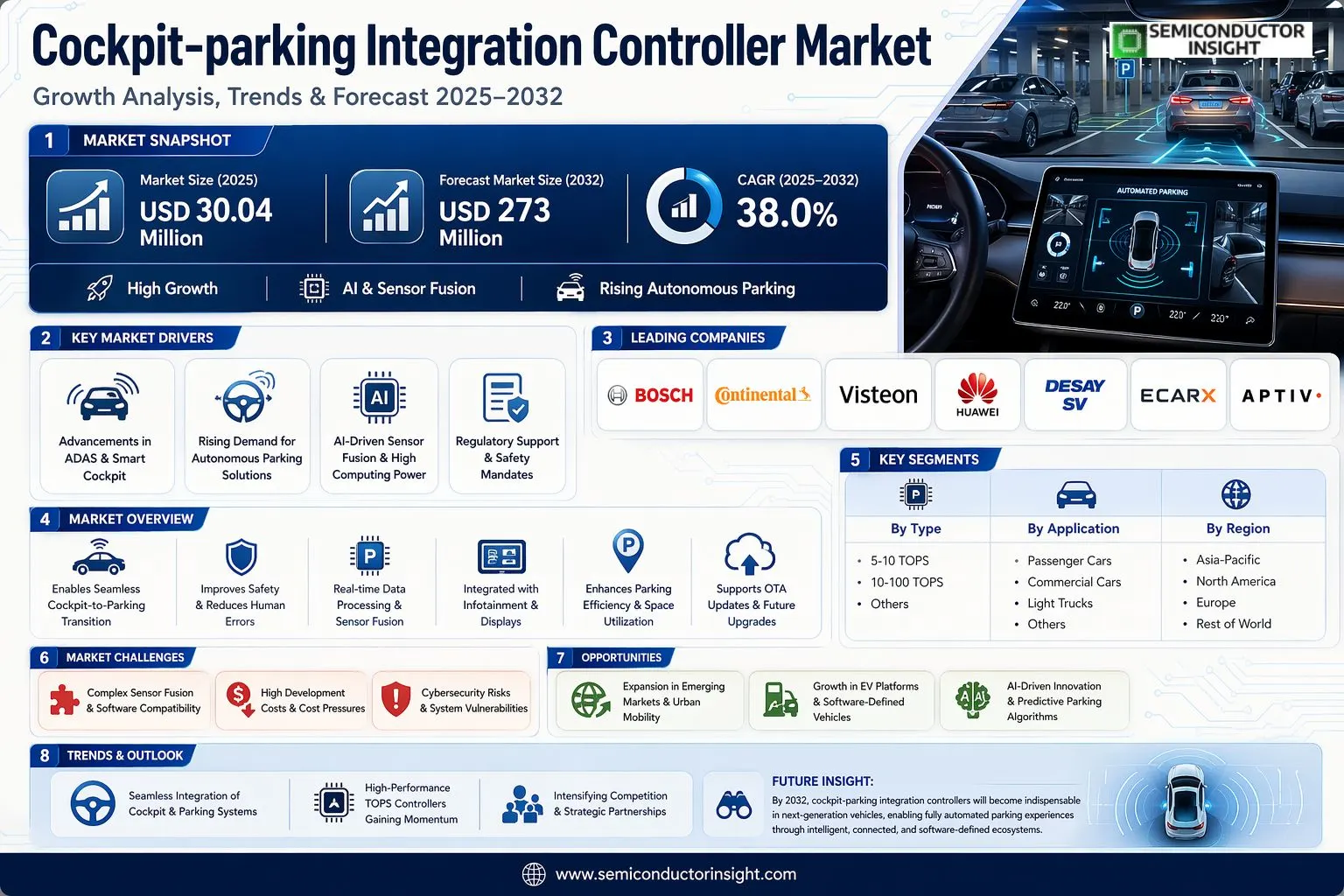
Global Cockpit-parking Integration Controller market size was valued at USD 30.04 million in 2025. The market is projected to reach USD 273 million by 2032, exhibiting a CAGR of 38.0% during the forecast period.
A cockpit-parking integration controller is an integrated intelligent control system that is capable of managing and controlling the process of moving and parking a vehicle in a car park lot in an automated manner. The controller works closely with the vehicle’s cockpit system, sensors, cameras, radar, automated parking system (APS), in-vehicle infotainment system, and a variety of other devices and technologies to achieve a seamless transition from the cockpit to the parking space, enhancing the driving experience and reducing human-operated complexity and errors.
The market is experiencing rapid growth due to several factors, including surging demand for software-defined vehicles, advancements in domain controllers, and increasing adoption of Level 2+ to Level 4 autonomous parking features. Additionally, the growing integration of AI-driven sensor fusion and high-performance computing platforms like 5-10 TOPS and above are contributing to market expansion. Initiatives by key players are fueling further development. For instance, Huawei has advanced its MDC platform for combined cockpit and parking intelligence, while Bosch and Continental continue to innovate in ADAS integration. Bosch, Continental, Visteon, HUAWEI, Desay SV, BDStar, ECARX, HARMAN, Aptiv, and Beijing Jingwei Hirain Technologies are some of the key players operating in the market with comprehensive portfolios.
MARKET DRIVERS
Advancements in ADAS and Smart Cockpit Technologies
Cockpit-parking Integration Controller Market is propelled by rapid advancements in advanced driver-assistance systems (ADAS) and smart cockpit architectures. Automotive manufacturers are increasingly integrating parking assistance features directly into cockpit displays for seamless user experiences, driving demand for sophisticated controllers that handle real-time data fusion from sensors and cameras. This integration enhances vehicle safety and convenience, with global ADAS adoption rates surpassing 40% in new passenger vehicles by 2023.
Rising Demand for Autonomous Parking Solutions
The shift toward Level 2+ and Level 3 autonomous driving capabilities is a key driver, as cockpit-parking integration controllers enable automated valet parking and remote parking maneuvers visualized on central infotainment screens. Electric vehicle (EV) platforms, which prioritize compact electronics, further accelerate this trend. Market projections indicate the segment will grow at a CAGR of 15% through 2030, fueled by consumer preferences for hands-free parking in urban environments.
➤ EV Integration Boost: Over 25 million EVs expected on roads by 2025, each requiring advanced cockpit-parking controllers for optimized space utilization.
Regulatory mandates for parking aids in Europe and Asia-Pacific, combined with OEM investments in software-defined vehicles, solidify the market’s growth trajectory, positioning cockpit-parking integration controllers as essential components in next-generation automobiles.
MARKET CHALLENGES
Complexity in Sensor Fusion and Software Compatibility
Cockpit-parking Integration Controller Market faces significant challenges in achieving seamless sensor fusion between ultrasonic, radar, and vision systems within the cockpit domain. Ensuring low-latency communication protocols like Automotive Ethernet adds layers of complexity, often leading to development delays and increased testing requirements. Interoperability across diverse ECU architectures remains a persistent hurdle for Tier-1 suppliers.
Other Challenges
Supply Chain Disruptions and Cost Pressures
Global semiconductor shortages have inflated component costs by up to 20%, straining profitability in Cockpit-parking Integration Controller Market. Additionally, cybersecurity vulnerabilities in connected parking systems demand robust OTA update mechanisms, complicating deployments.Heightened competition from aftermarket solutions and varying regional standards further challenge market penetration, requiring continuous R&D investments to maintain differentiation.
MARKET RESTRAINTS
High Development and Integration Costs
Premium pricing of cockpit-parking integration controllers restrains widespread adoption, particularly in mid-range vehicle segments where cost-sensitive OEMs prioritize essential features. Development expenses, including hardware-in-the-loop simulations and certification processes, can exceed $50 million per platform, limiting scalability for smaller manufacturers.Legacy vehicle architectures pose retrofit challenges, as upgrading to integrated controllers requires substantial rewiring and software overhauls. Stringent automotive-grade reliability standards, such as ISO 26262 ASIL-B compliance, further escalate barriers to entry in Cockpit-parking Integration Controller Market.Market fragmentation due to proprietary protocols among key players like Bosch and Continental hinders standardization efforts, slowing overall ecosystem maturity.
MARKET OPPORTUNITIES
Expansion in Emerging Markets and EV Platforms
Cockpit-parking Integration Controller Market presents substantial opportunities in Asia-Pacific and Latin America, where urbanization drives demand for smart parking solutions amid rising vehicle ownership. Projections show a 18% CAGR in these regions, supported by government incentives for ADAS-equipped vehicles.Partnerships between tech giants and automakers for domain controllers in software-defined vehicles open avenues for advanced features like AR-enhanced parking displays. The aftermarket segment, valued at $2 billion by 2028, offers retrofit kits for existing fleets.Innovations in AI-driven predictive parking algorithms will further unlock premiumization opportunities, enabling controllers to anticipate maneuvers and integrate with V2X communications for urban mobility ecosystems.
Cockpit-parking Integration Controller Market Trends
Seamless Fusion of Cockpit Systems and Automated Parking
Cockpit-parking Integration Controller Market is witnessing a primary trend toward the seamless integration of vehicle cockpit systems with automated parking functionalities. This intelligent control system coordinates sensors, cameras, radar, automated parking systems, and in-vehicle infotainment to enable smooth transitions from driving to parking, minimizing driver intervention and enhancing safety. As automotive manufacturers prioritize advanced driver assistance systems, demand for these controllers grows, driven by the need to reduce human error in complex parking maneuvers.
Other Trends
Expansion in Product Type Segments
Within Cockpit-parking Integration Controller Market, segments like 5-10 TOPS and 10-100 TOPS are gaining traction as vehicles require higher computational power for real-time processing of parking data. These controllers support diverse applications, enabling precise navigation in crowded lots. Manufacturers are refining these types to align with evolving vehicle architectures, fostering innovation in handling varied parking scenarios.
Intensifying Competition Among Key Players
Leading companies such as Bosch, Continental, Visteon, HUAWEI, Desay SV, BDStar, ECARX, HARMAN, Aptiv, and Beijing Jingwei Hirain Technologies dominate Cockpit-parking Integration Controller Market. The top five players command substantial revenue shares, propelled by ongoing developments in merger activities and product enhancements. This competitive landscape encourages technological advancements, with firms investing in surveys to address drivers like safety demands and challenges such as integration complexities. Regional dynamics highlight strong positions in North America, Europe, and Asia, particularly China, where key players tailor solutions for passenger and commercial cars. Overall, these trends underscore a maturing market focused on reliability and user-centric automation.
COMPETITIVE LANDSCAPE
Key Industry Players
Leading Manufacturers in Cockpit-parking Integration Controller Market
Cockpit-parking Integration Controller Market is dominated by a few established automotive technology giants, with Bosch and Continental leading the pack due to their extensive expertise in advanced driver assistance systems (ADAS) and vehicle electrification. These top players command a significant revenue share, with the global top five manufacturers accounting for approximately 50-60% of the market in 2025. The market structure is moderately concentrated, characterized by high barriers to entry stemming from the need for sophisticated integration of sensors, cameras, radar, and infotainment systems. Intense R&D investments drive innovation, particularly in high-performance computing segments like 5-10 TOPS and 10-100 TOPS controllers, fueling the projected CAGR of 38.0% from 2025 to 2032.
Beyond the leaders, niche players such as HUAWEI, Desay SV, and ECARX are carving out strong positions, especially in Asia-Pacific regions like China, where demand for automated parking solutions in passenger and commercial vehicles is surging. Companies like Visteon, HARMAN, and Aptiv focus on cockpit domain integration, offering scalable solutions that enhance seamless transitions from driving to parking. Emerging competitors including BDStar, Beijing Jingwei Hirain Technologies, ZF Friedrichshafen AG, and Joyson Electronic contribute through specialized sensor fusion and software-defined vehicle architectures, addressing regional preferences and segment-specific needs in North America and Europe.
List of Key Cockpit-parking Integration Controller Companies Profiled
- Bosch
- Continental
- Visteon
- HUAWEI
- Desay SV
- BDStar
- ECARX
- HARMAN
- Aptiv
- Beijing Jingwei Hirain Technologies
- ZF Friedrichshafen AG
- Joyson Electronic
Segment Analysis:
| Segment Category | Sub-Segments | Key Insights |
| By Type |
|
10-100 TOPS leads the segment as it offers superior computational power essential for handling complex sensor fusion and real-time processing during automated parking transitions.
|
| By Application |
|
Passenger Cars dominates applications due to widespread consumer demand for effortless parking in congested urban environments.
|
| By End User |
|
Automotive OEMs represent the foremost end users, leveraging the controller for factory-integrated advanced parking solutions.
|
| By Powertrain Type |
|
BEV Vehicles emerges as the frontrunner, aligning perfectly with electrification megatrends for optimized parking dynamics.
|
| By Autonomy Level |
|
L2/L2+ leads with mature deployment across mass-market vehicles for reliable assisted parking.
|
Regional Analysis: Cockpit-parking Integration Controller Market
Asia-Pacific
Asia-Pacific leads Cockpit-parking Integration Controller Market adoption through widespread integration in mid-range and premium vehicles. Urban drivers prioritize semi-autonomous parking features embedded in cockpit displays, driven by high vehicle densities and limited parking spaces. OEMs respond with user-centric designs, boosting market penetration across passenger cars.
Key innovation hubs in Shenzhen and Seoul drive Cockpit-parking Integration Controller advancements. Tech clusters foster sensor fusion and AI algorithms for precise parking maneuvers displayed on cockpit screens. Collaborative ecosystems between automakers and startups yield cutting-edge solutions tailored to regional needs.
Supportive regulations in China and Japan encourage Cockpit-parking Integration Controller deployment. Policies mandating advanced safety features in new vehicles propel integration into cockpits, harmonizing with smart city frameworks and promoting safer urban mobility.
Intense competition among Asian suppliers shapes Cockpit-parking Integration Controller Market. Local giants like Denso and Bosch Asia divisions innovate cost-effective modules, capturing OEM partnerships and expanding into export markets with reliable, cockpit-optimized controllers.
North America
North America exhibits strong growth in Cockpit-parking Integration Controller Market, propelled by tech-savvy consumers and premium vehicle segments. Automakers like Ford and GM embed advanced parking controllers into intuitive cockpit interfaces, catering to suburban lifestyles with expansive garages yet demanding convenience. Innovation stems from Silicon Valley collaborations, focusing on over-the-air updates for enhanced parking precision. Regulatory emphasis on pedestrian safety aligns with market trends, encouraging adoption in SUVs and trucks. Supply chain resilience post-pandemic supports steady expansion, positioning the region as a key player.
Europe
Europe’s Cockpit-parking Integration Controller Market thrives on stringent ADAS regulations and luxury brand leadership. Companies such as BMW and Volkswagen integrate sophisticated controllers into digital cockpits, prioritizing precision in narrow urban streets. Eco-friendly mandates boost demand for energy-efficient systems in electric models. Collaborative R&D across Germany and France yields ergonomic designs, enhancing driver confidence. The focus on sustainable mobility and connected ecosystems sustains competitive dynamics in this mature market.
South America
In South America, Cockpit-parking Integration Controller Market emerges amid rising urbanization and middle-class expansion. Brazilian and Argentine OEMs adapt affordable controllers for compact cars navigating chaotic city traffic. Local assembly plants incorporate cockpit integrations to meet growing safety demands. Infrastructure investments support gradual adoption, with partnerships bridging technology gaps. Consumer shift toward feature-rich vehicles drives potential, though economic volatility tempers pace.
Middle East & Africa
The Middle East & Africa region sees selective growth in Cockpit-parking Integration Controller Market, centered on luxury imports and Gulf urban projects. High-end SUVs from Mercedes feature advanced cockpit parking aids for vast yet gated environments. African megacities like Lagos spur demand for robust systems. Oil wealth funds diversification into automotive tech, fostering elite market segments with customized integrations.
Report Scope
This market research report provides a comprehensive analysis of the Cockpit-parking Integration Controller Market , covering the forecast period 2025–2032. It offers detailed insights into market dynamics, technological advancements, competitive landscape, and key trends shaping the industry.
Key focus areas of the report include:
- Market Overview: The report begins with an overview outlining its current market scenario, key growth indicators, and industry transformation drivers. It discusses macroeconomic factors, demand–supply balance, regulatory landscape, and the strategic role of Cockpit-parking Integration Controllers in powering advancements across industries such as automotive.
- Market Size & Forecast: Historical data and future projections for revenue, unit shipments, and market value across major regions and segments.
- Segmentation Analysis: Detailed breakdown by product type, technology, application, and end-user industry to identify high-growth segments and investment opportunities.
- Regional Insights: Insights into market performance across North America, Europe, Asia-Pacific, Latin America, and the Middle East & Africa, including country-level analysis where relevant.
- Competitive Landscape: Profiles of leading market participants, including their product offerings, R&D focus, manufacturing capacity, pricing strategies, and recent developments such as mergers, acquisitions, and partnerships.
- Technology Trends & Innovation: Assessment of emerging technologies, integration of AI/IoT, semiconductor design trends, fabrication techniques, and evolving industry standards.
- Market Drivers & Restraints: Evaluation of factors driving market growth along with challenges, supply chain constraints, regulatory issues, and market-entry barriers.
- Stakeholder Insights: Insights for component suppliers, OEMs, system integrators, investors, and policymakers regarding the evolving ecosystem and strategic opportunities.
Primary and secondary research methods are employed, including interviews with industry experts, data from verified sources, and real-time market intelligence to ensure the accuracy and reliability of the insights presented.
FREQUENTLY ASKED QUESTIONS:
What is the current market size of Cockpit-parking Integration Controller Market?
-> Global Cockpit-parking Integration Controller Market was valued at USD 30.04 million in 2025 and is expected to reach USD 273 million by 2032 at a CAGR of 38.0% during the forecast period.
Which key companies operate in Cockpit-parking Integration Controller Market?
-> Key players include Bosch, Continental, Visteon, HUAWEI, Desay SV, BDStar, ECARX, HARMAN, Aptiv, and Beijing Jingwei Hirain Technologies, among others.
What are the key growth drivers?
-> Key growth drivers include demand for automated parking systems, integration with cockpit and ADAS technologies, and advancements in vehicle sensors and infotainment.
Which region dominates the market?
-> Asia is the fastest-growing region, while North America remains a dominant market.
What are the emerging trends?
-> Emerging trends include high-computing TOPS controllers such as 5-10 TOPS and 10-100 TOPS segments, applications in passenger and commercial cars, and regional expansions in China.

Get Sample Report PDF for Exclusive Insights
Report Sample Includes
- Table of Contents
- List of Tables & Figures
- Charts, Research Methodology, and more...
 Download Sample Report PDF