MARKET INSIGHTS
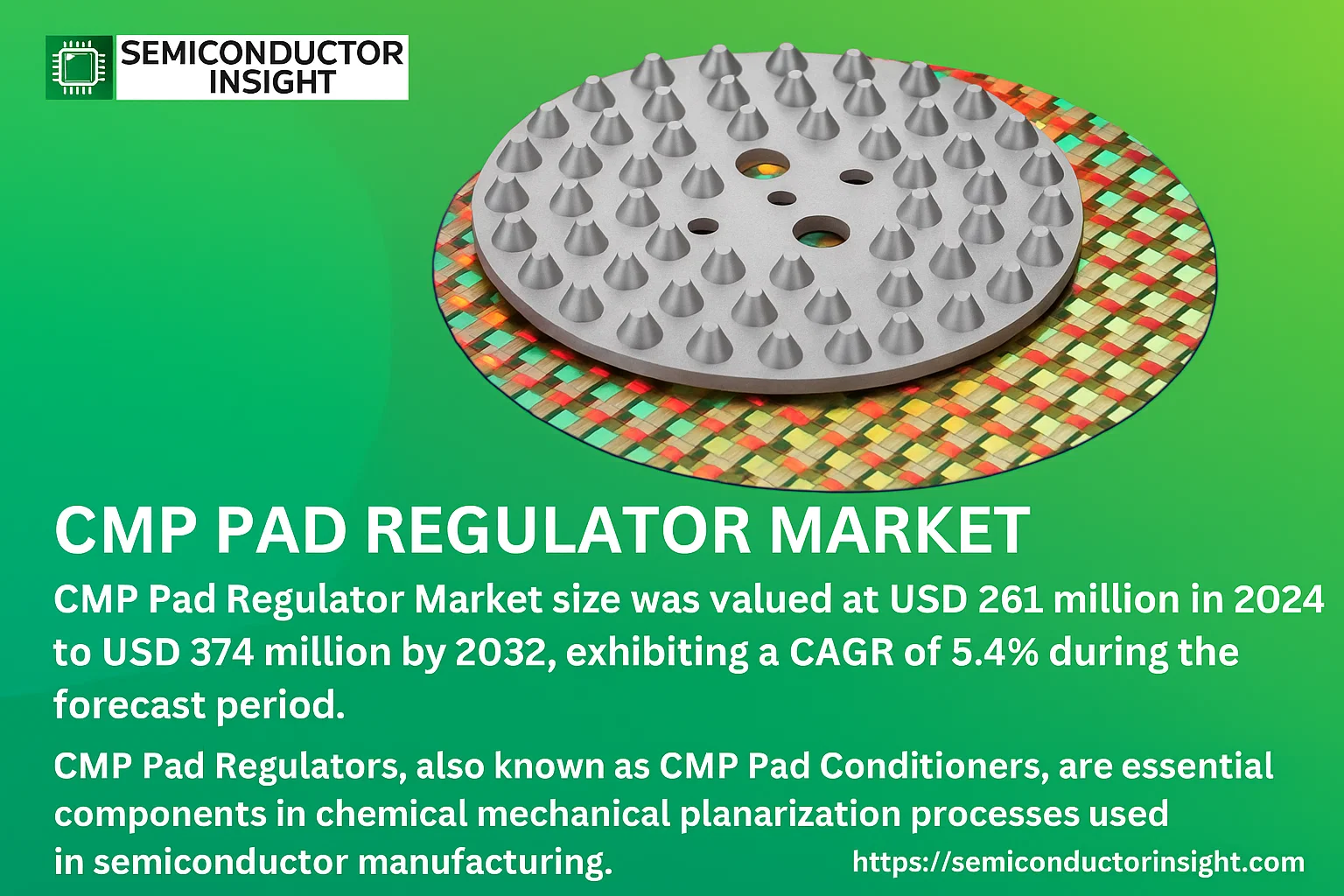
Global CMP Pad Regulator Market size was valued at USD 261 million in 2024 to USD 374 million by 2032, exhibiting a CAGR of 5.4% during the forecast period.
CMP Pad Regulators, also known as CMP Pad Conditioners, are essential components in chemical mechanical planarization processes used in semiconductor manufacturing. These devices condition polishing pads to restore pad planarity and surface roughness, ensuring consistent material removal rates and uniform wafer surfaces during the polishing operation.
The market is experiencing steady growth due to several factors, including increasing semiconductor production volumes, rising demand for advanced chip technologies, and growing adoption of smaller node processes. Additionally, the expansion of wafer fabrication facilities worldwide and continuous technological advancements in conditioning technologies are contributing to market expansion. Initiatives by key players in the market are also expected to fuel market growth. For instance, manufacturers are developing advanced diamond conditioning discs with optimized patterns and materials to extend pad life and improve process stability. 3M, Kinik Company, Saesol, Entegris, and Morgan Technical Ceramics are some of the key players that operate in the market with a wide range of portfolios.
MARKET DRIVERS
Rising Demand for Semiconductor Devices
Global surge in demand for high-performance computing, 5G infrastructure, and Internet of Things (IoT) devices is a primary driver for the CMP Pad Regulator Market. These regulators are critical components in the chemical mechanical planarization (CMP) process, which is essential for achieving the ultra-flat surfaces required for advanced semiconductor nodes. The continuous miniaturization of transistors below 7nm and 5nm processes necessitates highly precise CMP, directly increasing the need for advanced pad conditioning and regulation systems to maintain process stability and yield.
Technological Advancements in CMP Processes
Innovations in CMP pad regulator technology, such as the development of in-situ monitoring and real-time pressure control systems, are significantly enhancing process efficiency. These advancements allow for more uniform material removal rates and extended pad life, reducing operational costs for semiconductor manufacturers. The integration of Industry 4.0 principles, including data analytics and predictive maintenance, is further optimizing CMP operations and driving adoption of next-generation pad regulators.
Furthermore, stringent requirements for surface planarization in 3D NAND flash memory and DRAM production are propelling market growth. As memory chip densities increase, the role of the CMP pad regulator in preventing defects and ensuring layer uniformity becomes increasingly vital for meeting quality standards.
MARKET CHALLENGES
High Cost of Advanced Systems and Process Integration
The high capital investment required for advanced CMP pad regulator systems, which often include sophisticated sensors and control software, presents a significant barrier to entry, particularly for smaller fabrication facilities. Integrating these new systems into existing CMP tool sets without disrupting high-volume manufacturing lines is a complex and costly engineering challenge.
Other Challenges
Rapid Technological Obsolescence
The fast-paced evolution of semiconductor manufacturing technology means that CMP pad regulator systems can become outdated quickly. Manufacturers face the challenge of ensuring their equipment remains compatible with next-generation CMP processes and materials, requiring continuous R&D investment.
Maintenance and Downtime
Maintaining the precision components of pad regulators, such as diamond-coated conditioners and actuators, requires regular downtime. Unplanned maintenance can lead to significant production losses, making reliability a critical concern for fab operators.
MARKET RESTRAINTS
Cyclical Nature of the Semiconductor Industry
The CMP Pad Regulator Market is intrinsically tied to the capital expenditure cycles of the semiconductor industry. During periods of oversupply or economic downturns, semiconductor manufacturers delay or cancel investments in new equipment, directly restraining the demand for CMP pad regulators. This cyclicality creates significant volatility for suppliers in this market.
Supply Chain Constraints for Critical Components
Disruptions in the global supply chain for specialized materials and components, such as high-purity ceramics and precision sensors, can delay the production and delivery of CMP pad regulators. Geopolitical tensions and trade policies further exacerbate these constraints, potentially limiting market growth in certain regions.
MARKET OPPORTUNITIES
Expansion of Semiconductor Manufacturing Capacity
Major global initiatives, such as the CHIPS Acts in the United States and Europe, are fueling massive investments in new semiconductor fabrication plants. This creation of new, advanced manufacturing capacity represents a substantial opportunity for the CMP Pad Regulator Market, as each new fab requires a full suite of CMP tools equipped with the latest regulator technology.
Emergence of Advanced Packaging Applications
Beyond front-end wafer fabrication, CMP processes are increasingly critical in advanced packaging technologies like Fan-Out Wafer-Level Packaging (FOWLP) and 3D integration. These applications require precise planarization of redistribution layers and through-silicon vias (TSVs), opening new markets for CMP pad regulators tailored to packaging-specific requirements.
Demand for Sustainability and Cost Reduction
There is a growing focus on developing CMP pad regulators that extend consumable life and reduce chemical and water usage. Systems that offer superior pad conditioning efficiency and enable the use of thinner pads are highly sought after, as they directly lower the cost of ownership and environmental impact for semiconductor manufacturers.
CMP Pad Regulator Market Trends
Sustained Market Growth Driven by Semiconductor Demand
Global CMP Pad Regulator Market is on a trajectory of steady expansion, with its valuation projected to increase from USD 261 million in 2024 to USD 374 million by 2032, representing a compound annual growth rate (CAGR) of 5.4%. This consistent growth is fundamentally driven by the relentless demand for more advanced semiconductor devices. As semiconductor manufacturers push towards smaller process nodes, the role of Chemical Mechanical Planarization (CMP) becomes increasingly critical in achieving the necessary surface planarity on silicon wafers. The CMP pad regulator, or conditioner, is essential for maintaining the polishing pad’s surface texture and removing accumulated slurry by-products, directly impacting the yield and quality of semiconductor production. The sustained investment in semiconductor fabrication facilities, particularly for leading-edge nodes, underpins the positive market trend.
Other Trends
Regional Market Concentration and Dynamics
The market exhibits a strong geographical concentration, with the Asia-Pacific region dominating global consumption. China Taiwan is the largest single market, accounting for approximately 25% of the global share. This is closely followed by mainland China, Japan, and South Korea, each holding around 15% of the market. This regional prominence is a direct reflection of the concentration of semiconductor manufacturing capacity in these countries. The ongoing geopolitical and trade dynamics are influencing supply chain strategies, prompting some diversification, but the Asia-Pacific region is expected to maintain its leadership position due to its established infrastructure and continuous capital expenditure in the semiconductor industry.
Product and Application Segmentation Trends
A clear product trend is the dominance of CVD Diamond Pad Conditioners, which command about 60% of the market share. These conditioners are favored for their superior durability and consistent performance in demanding CMP processes compared to conventional alternatives. In terms of application, the market is segmented by wafer size, with the 300 mm wafer segment being the largest application. This is due to the widespread adoption of 300 mm wafers in high-volume manufacturing of advanced logic and memory chips. The 200 mm wafer segment also represents a significant market, supported by continued production of analog, power, and MEMS devices.
Consolidated Competitive Landscape
The competitive landscape is characterized by a high level of consolidation, with the top five manufacturers collectively holding approximately 85% of the global market share. Key players such as 3M, Kinik Company, Saesol, Entegris, and Morgan Technical Ceramics lead the industry. Competition is intense and revolves around technological innovation, product longevity, and the ability to provide conditioners that meet the exacting specifications required for next-generation semiconductor manufacturing. Companies are actively engaged in research and development to enhance diamond disc technology and conditioning algorithms to improve process efficiency and reduce the total cost of ownership for chipmakers.
COMPETITIVE LANDSCAPE
Key Industry Players
A Consolidated Market Dominated by a Handful of Global Specialists
Global CMP Pad Regulator Market is characterized by a high level of consolidation, with the top five manufacturers collectively holding approximately 85% of the market share in 2024. The market leader, 3M, along with other major players like Kinik Company and Entegris, leverages extensive R&D capabilities, established supply chains, and long-term relationships with semiconductor fabrication plants. This high concentration results in significant entry barriers for new competitors, rooted in the technical expertise required for producing high-precision diamond conditioners and the rigorous quality standards of the semiconductor industry. These leading companies compete primarily on product performance, reliability, consistency, and the ability to offer technical support for advanced node semiconductor manufacturing processes.
Beyond the dominant players, several other companies hold significant niches within specific geographic regions or product segments. Manufacturers such as Shinhan Diamond and Nippon Steel & Sumikin Materials have strong positions in the Asia-Pacific market, which is the largest regional market for CMP Pad Regulators. Furthermore, companies like CP TOOLS and Saesol focus on serving specific customer needs and applications, including conditioning for different pad materials or specialized CMP processes. These second-tier players often compete by offering cost-effective solutions, localized customer service, and specialized products tailored for less advanced technology nodes or specific end-user requirements, thereby securing a stable, albeit smaller, portion of the global market.
List of Key CMP Pad Regulator Companies Profiled
- 3M
- Kinik Company
- Saesol
- Entegris
- Morgan Technical Ceramics
- Nippon Steel & Sumikin Materials
- Shinhan Diamond
- CP TOOLS
- KCI Ltd.
- AB Technology, Inc.
- Abrasive Technology, Inc.
- Dynatex International
- Nanoquarz Wafer GmbH
- Asahi Diamond Industrial Co., Ltd.
Segment Analysis:
| Segment Category | Sub-Segments | Key Insights |
| By Type |
|
CVD Diamond Pad Conditioners represent the dominant segment primarily due to their superior durability and performance characteristics, which are critical for advanced semiconductor manufacturing nodes. These regulators maintain pad planarity and surface roughness more effectively over extended periods compared to conventional options, leading to higher process yields and reduced operational downtime. The market’s preference reflects the industry’s ongoing drive towards more demanding fabrication processes that require exceptional precision and consistency. CVD diamond technology’s ability to withstand the harsh chemical and mechanical environment of CMP operations solidifies its leading position. |
| By Application |
|
300 mm wafer processing is the leading application segment, driven by its dominance in high-volume manufacturing of advanced logic and memory chips. The larger wafer size offers significant economic advantages in terms of throughput and cost per die, making it the standard for leading-edge semiconductor fabs. The stringent planarization requirements for 300 mm wafers necessitate consistent and reliable pad conditioning to achieve the nanoscale topography control essential for multi-layer device structures. This trend is reinforced by continuous investments in new 300 mm fabrication facilities worldwide, ensuring sustained demand for high-performance CMP pad regulators tailored to this application. |
| By End User |
|
Foundries constitute the most significant end-user segment, as they are the primary hubs for contract semiconductor manufacturing and continually invest in cutting-edge process technologies. The intense competition among foundries to offer the most advanced nodes to their fabless customers creates a relentless demand for superior CMP consumables, including pad regulators, to maximize yield and tool utilization. These facilities operate at immense scale, where even minor improvements in process consistency and consumable lifetime translate into substantial operational cost savings and competitive advantage, fueling their leadership in driving market requirements and adoption. |
| By Diamond Grit Size |
|
Fine Grit conditioners are increasingly favored as the market advances, particularly for the final polishing steps in intricate device architectures. The shift towards finer grit sizes is driven by the need for ultra-smooth surfaces and minimal defectivity, which are paramount for high-performance logic chips and advanced memory stacks. Fine grit regulators provide a gentler, more controlled conditioning action that preserves the delicate features on the wafer while still effectively regenerating the pad surface. This trend aligns with the overall industry movement towards more precise and damage-free manufacturing processes. |
| By Conditioning Technology |
|
In-situ Conditioning represents the leading technology segment due to its fundamental integration within the CMP tool, enabling continuous pad maintenance during the polishing process. This approach maximizes tool utilization by eliminating the need for separate conditioning cycles, thereby boosting overall productivity and throughput in high-volume manufacturing environments. The real-time conditioning capability ensures consistent pad surface characteristics from wafer to wafer, which is critical for achieving uniform planarization results and high yield. The preference for in-situ systems underscores the industry’s focus on operational efficiency and process stability. |
Regional Analysis: CMP Pad Regulator Market
The region’s dominance is underpinned by its status as the world’s primary center for semiconductor manufacturing. High-volume production facilities for logic, memory, and foundry services create consistent, massive demand for CMP pad regulators to ensure precise planarization processes essential for multi-layer chip architectures.
A highly integrated local supply chain for semiconductor materials and equipment is a key advantage. Proximity to pad regulator manufacturers and raw material sources minimizes logistics delays and costs, enabling just-in-time delivery and fostering close collaboration between conditioner suppliers and fab operators for customized solutions.
Leading-edge research and development activities focused on next-generation nodes (e.g., sub-5nm processes) are concentrated here. This drives the need for advanced CMP pad regulators capable of delivering superior surface conditioning for new materials like cobalt and ruthenium, keeping the region at the forefront of innovation.
Strong governmental initiatives and significant investments in national semiconductor industries, particularly in China and South Korea, bolster market growth. These policies aim to achieve self-sufficiency and global leadership, directly supporting the expansion of supporting industries like CMP consumables manufacturing.
North America
North America remains a critical and technologically advanced market for CMP pad regulators, primarily driven by the United States. The region is a hub for leading semiconductor equipment OEMs and R&D centers that pioneer new CMP technologies. Demand is sustained by domestic fabrication plants, including advanced logic and memory fabs, as well as a strong focus on specialized semiconductors for aerospace, defense, and high-performance computing applications. The market benefits from stringent quality requirements and a culture of early adoption of innovative conditioning solutions to maximize process efficiency and device performance.
Europe
The European market for CMP pad regulators is characterized by a strong presence of research institutions and specialized semiconductor manufacturers, particularly for automotive and industrial applications. Countries like Germany, France, and Ireland host fabs that produce chips requiring high reliability. The market demand is driven by the region’s emphasis on quality and precision engineering, with a focus on developing regulators for specialized materials used in power electronics and sensors. Collaborative projects between academia and industry support continuous improvement in CMP processes.
South America
The CMP pad regulator market in South America is nascent but developing, with potential growth linked to broader regional economic diversification efforts. Limited local semiconductor manufacturing means most demand is currently met through imports. However, initiatives in countries like Brazil to develop a local electronics industry could create future opportunities. The market is primarily served by international suppliers, with demand stemming from maintenance and small-scale production facilities.
Middle East & Africa
This region represents an emerging market with minimal local semiconductor production. Demand for CMP pad regulators is currently very low and is almost entirely import-dependent, servicing niche electronics assembly or repair operations. Long-term growth potential may be linked to strategic investments in technology infrastructure and economic diversification plans in Gulf Cooperation Council countries, but it remains a minor contributor to the global market landscape.
Report Scope
This market research report provides a comprehensive analysis of the CMP Pad Regulator Market, covering the forecast period 2025–2032. It offers detailed insights into market dynamics, technological advancements, competitive landscape, and key trends shaping the industry.
Key focus areas of the report include:
- Market Overview: The report begins with an overview outlining its current market scenario, key growth indicators, and industry transformation drivers. It discusses macroeconomic factors, demand–supply balance, regulatory landscape, and the strategic role of semiconductors in powering advancements across industries such as automotive, telecommunications, consumer electronics, and industrial automation.
- Market Size & Forecast: Historical data and future projections for revenue, unit shipments, and market value across major regions and segments.
- Segmentation Analysis: Detailed breakdown by product type, technology, application, and end-user industry to identify high-growth segments and investment opportunities.
- Regional Insights: Insights into market performance across North America, Europe, Asia-Pacific, Latin America, and the Middle East & Africa, including country-level analysis where relevant.
- Competitive Landscape: Profiles of leading market participants, including their product offerings, R&D focus, manufacturing capacity, pricing strategies, and recent developments such as mergers, acquisitions, and partnerships.
- Technology Trends & Innovation: Assessment of emerging technologies, integration of AI/IoT, semiconductor design trends, fabrication techniques, and evolving industry standards.
- Market Drivers & Restraints: Evaluation of factors driving market growth along with challenges, supply chain constraints, regulatory issues, and market-entry barriers.
- Stakeholder Insights: Insights for component suppliers, OEMs, system integrators, investors, and policymakers regarding the evolving ecosystem and strategic opportunities.
Primary and secondary research methods are employed, including interviews with industry experts, data from verified sources, and real-time market intelligence to ensure the accuracy and reliability of the insights presented.
FREQUENTLY ASKED QUESTIONS:
What is the current market size of CMP Pad Regulator Market?
-> CMP Pad Regulator Market size was valued at USD 261 million in 2024 to USD 374 million by 2032, exhibiting a CAGR of 5.4% during the forecast period.
Which key companies operate in CMP Pad Regulator Market?
-> Key players include 3M, Kinik Company, Saesol, Entegris, Morgan Technical Ceramics, Nippon Steel & Sumikin Materials, Shinhan Diamond, and CP TOOLS, among others. The top five manufacturers hold a combined market share of about 85%.
What are the key growth drivers?
-> Key growth is driven by the essential role of CMP Pad Regulators in semiconductor manufacturing, specifically for maintaining polishing pad planarity and surface roughness, which is critical for advanced fabrication processes.
Which region dominates the market?
-> China Taiwan is the largest market, with a share of about 25%, followed by China, Japan, and South Korea.
What are the emerging trends?
-> Key market segments show the dominance of CVD Diamond Pad Conditioners, which hold about a 60% share, and the 300 mm wafer application is the largest.

Get Sample Report PDF for Exclusive Insights
Report Sample Includes
- Table of Contents
- List of Tables & Figures
- Charts, Research Methodology, and more...
 Download Sample Report PDF