
Market Insights
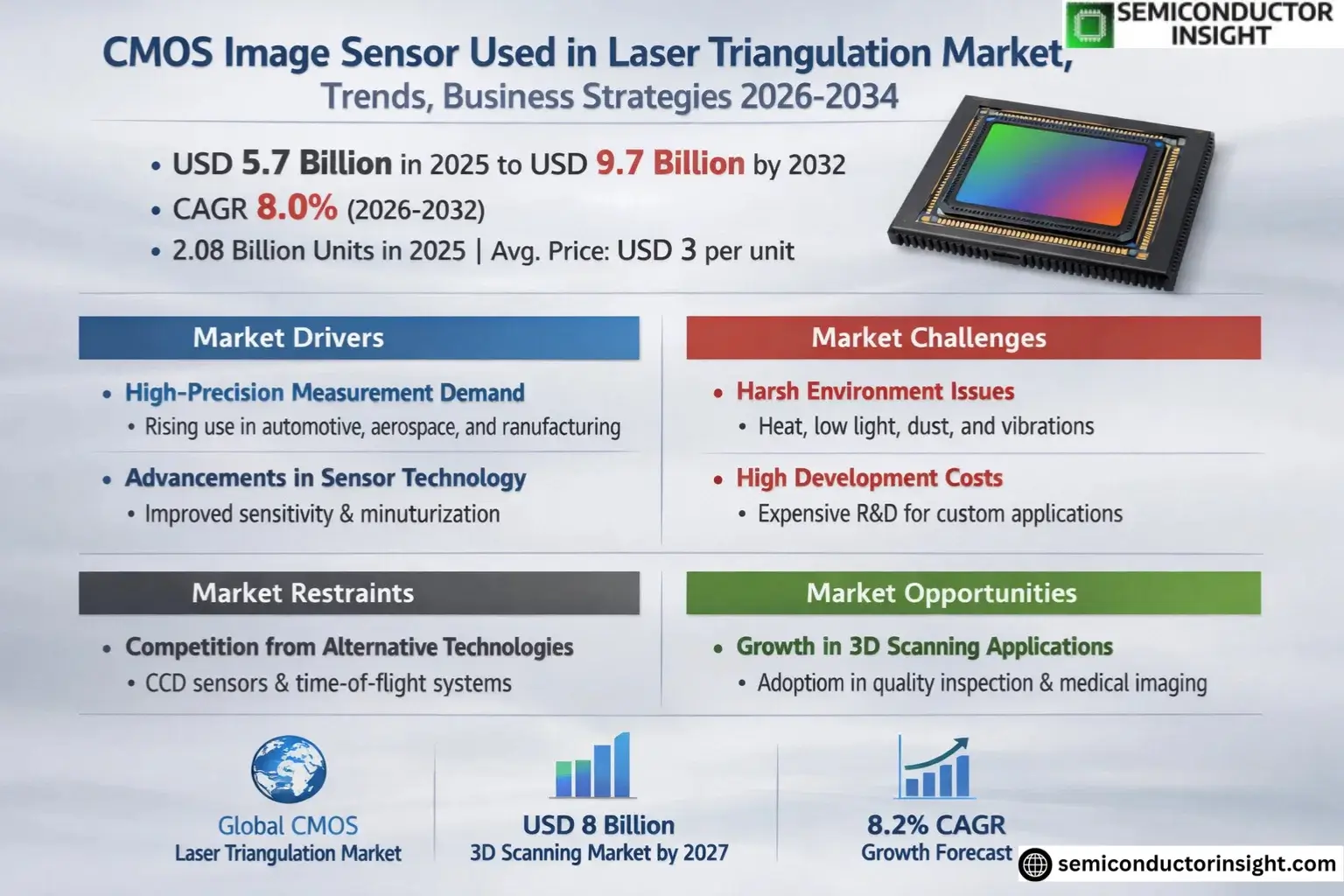
Global CMOS Image Sensor Used in Laser Triangulation Market was valued at USD 5.7 billion in 2025 and is projected to reach USD 9.7 billion by 2032, exhibiting a CAGR of 8.0% during the forecast period.
In 2025, global Camera Chip CMOS Image Sensor production reached approximately 2.08 billion units, with an average market price of around USD 3 per unit.
CMOS image sensors used in laser triangulation are specialized semiconductor devices that convert light into electrical signals for high-precision distance and profile measurements. These sensors offer key advantages such as high resolution, ultra-fast frame rates, and advanced HDR (High Dynamic Range) capabilities, making them ideal for applications requiring micrometer-level accuracy. Compared to other 3D sensing techniques, laser triangulation stands out for its ability to deliver both speed and precision simultaneously.
The market growth is driven by increasing demand across industrial automation, quality control systems, and robotics applications where precise dimensional measurement is critical. Major players like Sony, Samsung, and OmniVision continue to innovate with stacked sensor architectures and global shutter technologies to meet evolving industry requirements. The automotive sector’s growing adoption of advanced driver assistance systems (ADAS) also contributes significantly to market expansion.
MARKET DRIVERS
Growing Demand for High-Precision Measurement Systems
The increasing adoption of CMOS image sensors in laser triangulation systems is driven by the need for high-precision measurement across industries such as automotive, aerospace, and manufacturing. The CMOS image sensor’s ability to provide fast, accurate, and cost-effective distance measurements positions it as a critical component in modern metrology.
Advancements in Sensor Technology
Recent innovations in CMOS image sensor technology, including improved light sensitivity and reduced noise levels, have significantly enhanced their performance in laser triangation applications. The market for CMOS image sensors used in laser triangulation is projected to grow at 8.2% CAGR over the next five years.
The miniaturization of CMOS image sensors has further expanded their use in portable and handheld laser triangulation devices, creating new opportunities across multiple industries.
MARKET CHALLENGES
Technical Limitations in Challenging Environments
While CMOS image sensors excel in controlled environments, performance degradation in extreme conditions (high temperatures, low light) remains a challenge for laser triangulation applications. Dust, vibrations, and variable surface reflectivity can also impact measurement accuracy.
Other Challenges
High Development Costs
The customization of CMOS image sensors for specific laser triangulation applications requires significant R&D investment, creating barriers for smaller manufacturers.
MARKET RESTRAINTS
Competition from Alternative Technologies
The adoption of CMOS image sensors in laser triangulation faces competition from CCD sensors and time-of-flight technologies in certain applications. While CMOS offers advantages in speed and power efficiency, some high-end applications still prefer alternative solutions for their specific performance characteristics.
MARKET OPPORTUNITIES
Emerging Applications in 3D Scanning
The growing demand for 3D scanning solutions presents significant opportunities for CMOS image sensors in laser triangulation. Industries such as quality inspection, reverse engineering, and medical imaging are increasingly adopting these solutions. Global 3D scanning market, where laser triangulation plays a crucial role, is expected to reach USD 8 billion by 2027.
CMOS Image Sensor Used in Laser Triangulation Market Trends
High-Precision Industrial Applications Driving Demand
CMOS Image Sensor Used in Laser Triangulation Market is experiencing significant growth due to rising adoption in industrial metrology and quality control systems. These sensors enable micrometer-level accuracy for applications like automated inspection, robotics guidance, and 3D surface profiling. Manufacturers are prioritizing sensors with global shutter technology to capture fast-moving objects without motion distortion.
Other Trends
Advanced Shutter Technologies Gaining Traction
Global shutter CMOS sensors now account for over 40% of laser triangulation applications, replacing rolling shutter models in precision measurement systems. This shift is driven by the need for distortion-free imaging in high-speed industrial environments where object movement can affect measurement accuracy.
Integration with AI-Based Inspection Systems
The combination of high-resolution CMOS Image Sensors Used in Laser Triangulation with machine learning algorithms is enabling new smart inspection capabilities. These systems can detect microscopic defects in manufacturing lines with 99.5% accuracy rates, reducing inspection costs by 30-40% compared to manual methods. Leading semiconductor producers are investing heavily in these integrated solutions.
Miniaturization Challenges in Sensor Design
As portable measurement devices become prevalent, sensor manufacturers face pressure to reduce pixel sizes while maintaining light sensitivity. Backside-illuminated stacked CMOS architectures now dominate high-end applications, offering 15-20% better quantum efficiency than traditional front-illuminated designs.
Automotive Quality Control Applications Expanding
Automakers are increasingly adopting laser triangulation systems with specialized CMOS Image Sensors for body panel gap measurement and paint quality inspection. These sensors must operate reliably in challenging factory conditions, requiring enhanced temperature stability from -30°C to 85°C and protection against electromagnetic interference.
COMPETITIVE LANDSCAPE
Key Industry Players
High-Tech Precision Drives CMOS Image Sensor Innovation in Laser Triangulation
Sony Semiconductor Solutions dominates the CMOS image sensor market for laser triangulation applications, leveraging its advanced stacked sensor technology and global shutter capabilities. The company holds approximately 40% market share in high-precision industrial imaging segments. The market follows an oligopolistic structure with Sony, Samsung, and OmniVision collectively controlling over 65% of the laser triangulation sensor revenue. These leaders maintain competitive advantage through continuous R&D in high-speed readout technologies and micro-pixel architectures.
Emerging players like Smartsens Technology and GalaxyCore are gaining traction in cost-sensitive industrial applications with specialized sensors offering frame rates exceeding 1,000 fps. Niche specialists such as SOI (Silicon Optronics) deliver radiation-hardened sensors for extreme environment applications. The market also sees increasing competition from automotive sensor suppliers like ON Semiconductor and STMicroelectronics adapting their technologies for industrial metrology applications.
List of Key CMOS Image Sensor for Laser Triangulation Companies Profiled
- Sony Semiconductor Solutions
- Samsung Electronics
- OmniVision Technologies
- STMicroelectronics
- ON Semiconductor
- GalaxyCore
- Panasonic
- Smartsens Technology
- Canon
- SOI (Silicon Optronics)
- ams OSRAM
- Teledyne Technologies
- Hamamatsu Photonics
- Pyxalis
- Forza Silicon
Segment Analysis:
| Segment Category | Sub-Segments | Key Insights |
| By Type |
|
Resolution 2M-10M dominates the laser triangulation market due to:
|
| By Application |
|
Industrial Measurement represents the most sophisticated applications:
|
| By End User |
|
Manufacturing Industry shows strongest adoption trends:
|
| By Technology |
|
Stacked CMOS is gaining prominence due to:
|
| By Shutter Type |
|
Global Shutter is critical for precision applications:
|
Regional Analysis: CMOS Image Sensor in Laser Triangulation Market
Asia-Pacific’s integrated semiconductor supply chain enables rapid prototyping of specialized CMOS sensors for laser triangulation, with most critical components available within regional supplier networks.
Regional governments actively fund next-generation sensor research through technology parks and tax incentives, particularly for applications in automated quality inspection and 3D scanning.
The region shows strongest adoption across varied industries, from electronics assembly line monitoring to automotive weld inspection, driving demand for specialized sensor variants.
Cross-industry knowledge transfer from consumer electronics has accelerated development of low-power, high-sensitivity sensors suitable for laser triangulation in harsh industrial environments.
North America
North America maintains technological leadership in high-end CMOS image sensors for laser triangulation, particularly for defense and aerospace applications. The region benefits from strong university-corporate partnerships developing advanced time-of-flight capabilities alongside traditional triangulation methods. U.S. manufacturers focus on ruggedized sensors capable of operating in extreme conditions, with particular emphasis on reducing noise in high-temperature industrial settings. Strategic collaborations between sensor developers and laser manufacturers have created optimized system solutions for precision measurement applications.
Europe
European innovation in CMOS image sensors for laser triangulation centers on automotive and medical applications, with stringent quality requirements driving sensor performance. German and Swiss companies lead in developing sensors with exceptional linearity and thermal stability for metrology-grade equipment. The region shows strong adoption in automated optical inspection systems, where sensor reliability and long-term calibration stability are critical. Environmental regulations have also spurred development of energy-efficient sensor designs with minimal heat generation.
South America
The South American market is witnessing growing adoption of CMOS image sensors in agricultural machinery and mining equipment using laser triangulation for terrain mapping. Regional manufacturers prioritize cost-optimized solutions with adequate performance for less demanding industrial environments. Brazil has emerged as a hub for adapting Asian-developed sensors to local industrial requirements, particularly in food processing quality control applications.
Middle East & Africa
This region shows increasing demand for CMOS image sensors in oil & gas pipeline inspection and infrastructure monitoring applications. Harsh environment operation requirements have driven interest in specially packaged sensors with enhanced dust and moisture resistance. Dubai’s smart city initiatives are also creating opportunities for laser triangulation systems in security and traffic monitoring applications, though the market remains in early growth stages.
Report Scope
This market research report provides a comprehensive analysis of the CMOS Image Sensor Used in Laser Triangulation Market, covering the forecast period 2025–2032. It offers detailed insights into market dynamics, technological advancements, competitive landscape, and key trends shaping the industry.
Key focus areas of the report include:
- Market Overview: The report begins with an overview outlining its current market scenario, key growth indicators, and industry transformation drivers. It discusses macroeconomic factors, demand–supply balance, regulatory landscape, and the strategic role of semiconductors in powering advancements across industries such as automotive, telecommunications, consumer electronics, and industrial automation.
- Market Size & Forecast: Historical data and future projections for revenue, unit shipments, and market value across major regions and segments.
- Segmentation Analysis: Detailed breakdown by product type, technology, application, and end-user industry to identify high-growth segments and investment opportunities.
- Regional Insights: Insights into market performance across North America, Europe, Asia-Pacific, Latin America, and the Middle East & Africa, including country-level analysis where relevant.
- Competitive Landscape: Profiles of leading market participants, including their product offerings, R&D focus, manufacturing capacity, pricing strategies, and recent developments such as mergers, acquisitions, and partnerships.
- Technology Trends & Innovation: Assessment of emerging technologies, integration of AI/IoT, semiconductor design trends, fabrication techniques, and evolving industry standards.
- Market Drivers & Restraints: Evaluation of factors driving market growth along with challenges, supply chain constraints, regulatory issues, and market-entry barriers.
- Stakeholder Insights: Insights for component suppliers, OEMs, system integrators, investors, and policymakers regarding the evolving ecosystem and strategic opportunities.
Primary and secondary research methods are employed, including interviews with industry experts, data from verified sources, and real-time market intelligence to ensure the accuracy and reliability of the insights presented.
FREQUENTLY ASKED QUESTIONS:
What is the current market size of CMOS Image Sensor Used in Laser Triangulation Market?
-> CMOS Image Sensor Used in Laser Triangulation Market was valued at USD 5.7 billion in 2025 and is projected to reach USD 9.7 billion by 2032, exhibiting a CAGR of 8.0% during the forecast period.
What is the CAGR growth for this market?
-> The market is expected to grow at a CAGR of 8.0% during the forecast period (2025-2032).
Which key companies operate in CMOS Image Sensor Used in Laser Triangulation Market?
-> Key players include SONY, Samsung, OmniVision, STMicroelectronics, On Semi, GalaxyCore, Panasonic, and Smartsens Technology, among others.
What are the key application areas?
-> Major applications include Laser Pointing Devices and Cameras, with high demand in automotive, industrial detection, and medical imaging sectors.
What are the key technological characteristics of these sensors?
-> These sensors feature high resolution, extremely high frame rate, fast readout speed, HDR function, and are optimized for micrometer-level accuracy in 3D laser triangulation applications.

Get Sample Report PDF for Exclusive Insights
Report Sample Includes
- Table of Contents
- List of Tables & Figures
- Charts, Research Methodology, and more...


