Market Insights
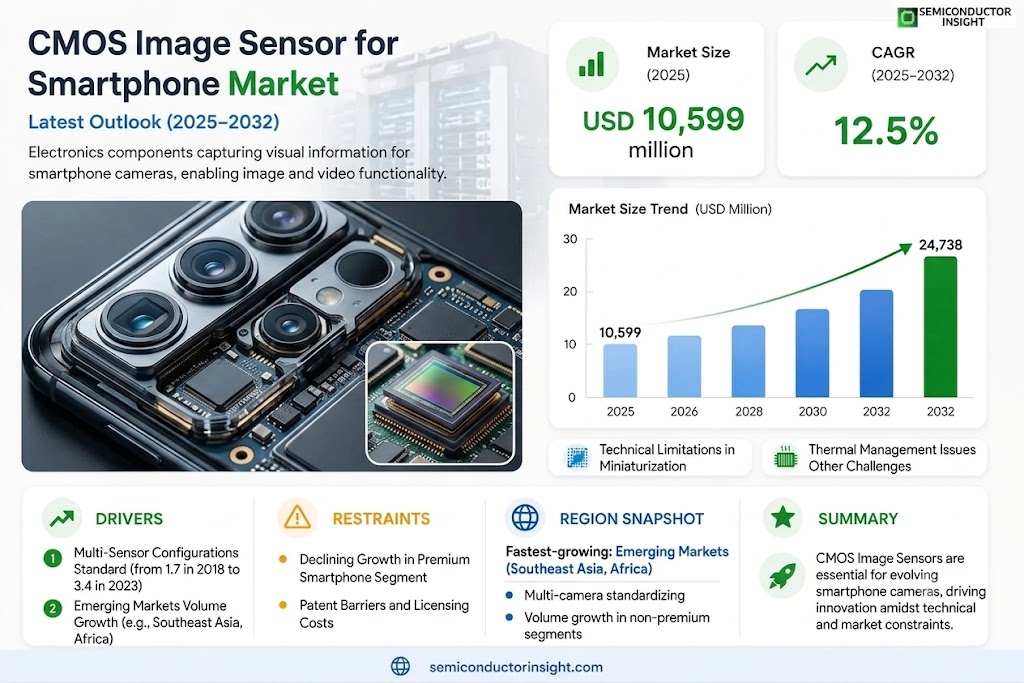
Global CMOS Image Sensor for Smartphone Market was valued at USD 10,599 million in 2025 and is projected to reach USD 24,738 million by 2032, exhibiting a CAGR of 12.5% during the forecast period. In 2025, global production reached approximately 5 billion units, with an average market price of around USD 2.3 per unit.
CMOS Image Sensor for Smartphone Market is a specialized image-capturing chip designed specifically for smartphone camera modules. It serves as the core component that converts optical signals into electrical signals, directly determining key imaging indicators such as resolution, low-light performance, and dynamic range. Optimized for smartphone constraints like limited space and strict power consumption requirements, these sensors enable advanced photography features in diverse shooting scenarios.
The market growth is driven by increasing demand for high-resolution smartphone cameras, multi-camera setups in devices, and advancements in computational photography. Leading manufacturers like Sony (holding over 40% market share), Samsung, and OmniVision continue to innovate with technologies such as stacked CMOS designs and improved pixel architectures to meet evolving consumer expectations for mobile photography.
MARKET DRIVERS
Increasing Demand for High-Quality Smartphone Cameras
CMOS Image Sensor for Smartphone Market is experiencing strong growth due to rising consumer expectations for advanced camera capabilities. With over 85% of smartphone users prioritizing camera quality when making purchases, manufacturers are investing heavily in sensor technology. The shift to 4K video recording and multi-lens setups is further accelerating adoption of high-performance CMOS sensors.
Technological Advancements in Sensor Design
Recent breakthroughs in pixel isolation technology and backside illumination (BSI) have significantly improved low-light performance while reducing sensor size. The development of 1μm and smaller pixel pitches allows for higher resolution sensors without increasing module footprint, a critical factor for smartphone OEMs.
The integration of AI-powered computational photography is creating new demand for sensors with specialized capabilities, including always-on HDR and advanced autofocus systems.
MARKET CHALLENGES
Technical Limitations in Miniaturization
While the CMOS Image Sensor for Smartphone Market continues to advance, there are significant challenges in achieving further miniaturization without sacrificing image quality. The physical limitations of photon capture in ultra-small pixels create noise and dynamic range issues that are increasingly difficult to overcome.
Other Challenges
Supply Chain Vulnerabilities
The concentrated production of CMOS image sensors in certain geographic regions creates supply chain risks, with any disruption potentially impacting global smartphone production timelines.
Thermal Management Issues
Higher resolution and faster readout speeds generate more heat, which can affect sensor performance and longevity in compact smartphone designs.
MARKET RESTRAINTS
Declining Growth in Premium Smartphone Segment
The saturation of premium smartphone markets in developed economies is slowing the adoption rate of cutting-edge CMOS image sensor technology. With replacement cycles extending beyond 30 months in key markets, sensor manufacturers face pressure to deliver premium features at mid-range price points.
Patent Barriers and Licensing Costs
Complex patent landscapes surrounding advanced CIS technologies create barriers to entry for new competitors and increase production costs. Leading manufacturers invest over USD 500 million annually in R&D to maintain technological leadership in this space.
MARKET OPPORTUNITIES
Emerging Markets Driving Volume Growth
Rapid smartphone adoption in developing economies presents significant opportunities for CMOS image sensor manufacturers. With over 300 million new smartphone users expected annually in regions like Southeast Asia and Africa, demand for cost-optimized camera solutions is growing dramatically.
Multi-Sensor Configurations Becoming Standard
The average number of cameras per smartphone has increased from 1.7 in 2018 to 3.4 in 2023, creating new opportunities for sensor differentiation. Specialty sensors for ultra-wide, macro and depth-sensing applications are experiencing above-market growth rates of 18-22% annually.
CMOS Image Sensor for Smartphone Market Trends
Advancements in High-Resolution Imaging
CMOS Image Sensor for Smartphone Market continues to be driven by demand for higher resolution capabilities. Manufacturers are pushing beyond 100MP sensors while maintaining pixel sizes below 0.7µm. This trend is particularly prominent in flagship smartphones, where backside-illuminated (BSI) and stacked sensor architectures enable superior low-light performance without increasing module thickness.
Other Trends
Multi-Camera System Integration
Smartphone OEMs are adopting multi-camera configurations that combine different sensor types – ultra-wide, telephoto, and depth sensors alongside primary sensors. This requires CMOS image sensor manufacturers to optimize specific sensor designs for distinct camera functions within space-constrained smartphone designs.
AI-Enhanced Sensor Functionality
Integration of AI processing directly into CMOS image sensors is emerging as a key differentiator. Features like real-time scene recognition, advanced HDR processing, and computational photography enhancements are moving from post-processing to the sensor level. This reduces processing load on smartphone SoCs while improving power efficiency.
Power Efficiency Innovations
As smartphone camera usage increases, power consumption becomes critical. New pixel architectures and readout circuits are being developed to reduce active power by 15-20% while maintaining performance. This includes innovations in analog memory integration and adaptive power management within the sensor itself.
Other Trends
Expansion of High-Dynamic-Range Capabilities
Smartphone CMOS image sensors are achieving HDR performance exceeding 120dB, matching some automotive applications. This is enabled through multi-exposure techniques combined with advanced pixel designs that can capture wider light ranges in a single shot.
COMPETITIVE LANDSCAPE
Key Industry Players
CMOS Image Sensor Market Dominated by Established Semiconductor Giants and Emerging Chinese Challengers
Global CMOS Image Sensor for Smartphone Market is highly concentrated, with Sony Semiconductor Solutions maintaining a commanding 42% market share in 2025 through its technological leadership in stacked sensor designs. Samsung Electronics follows closely as the second-largest supplier, leveraging its vertical integration advantages in mobile device production. OmniVision Technologies, now owned by Chinese conglomerate Will Semiconductor, has strengthened its position through aggressive R&D investment in small-pixel and multi-camera solutions.
Emerging Chinese players like GalaxyCore and Smartsens Technology are gaining traction in mid-range smartphone segments with cost-competitive offerings, while maintaining technological parity through collaborations with foundries like SMIC. Traditional semiconductor firms such as STMicroelectronics and ON Semiconductor continue to maintain specialized positions in automotive and industrial segments, while diversifying into smartphone applications with high-dynamic-range sensors.
List of Key CMOS Image Sensor for Smartphone Companies Profiled
- Sony Semiconductor Solutions
- Samsung Electronics
- OmniVision Technologies
- STMicroelectronics
- ON Semiconductor
- GalaxyCore Inc.
- Panasonic Corporation
- Smartsens Technology
- Canon
- SOI Technologies
- SK Hynix
- HiMax Technology
- PixArt Imaging
- Himax Technologies
- Silicon Optronics
Segment Analysis:
| Segment Category | Sub-Segments | Key Insights |
| By Type |
|
Stacked CMOS is emerging as the dominant technology due to:
|
| By Application |
|
Primary rear cameras drive the most innovation with:
|
| By End User |
|
Flagship smartphones remain the key innovation driver with:
|
| By Resolution Tier |
|
Above 32MP sensors are gaining prominence due to:
|
| By Technology |
|
Rolling Shutter remains the mainstream choice because:
|
Regional Analysis: CMOS Image Sensor for Smartphone Market
Asia-Pacific
China’s vertically integrated smartphone supply chain enables CMOS sensor manufacturers to optimize production costs while meeting tight OEM delivery schedules. Clustering of component suppliers reduces time-to-market for new sensor technologies.
South Korean tech giants drive innovation in smartphone CMOS sensors, integrating cutting-edge pixel technologies with advanced image signal processors. Local R&D focus on computational photography enhances sensor value propositions.
Japanese firms supply critical materials and equipment for CMOS sensor manufacturing. Expertise in semiconductor-grade silicon and optical components supports regional quality standards in smartphone imaging solutions.
Growing smartphone adoption in Indonesia, Vietnam, and Thailand creates new opportunities for mid-range CMOS sensors. Local assembly plants increasingly require cost-effective imaging solutions with competitive performance characteristics.
North America
North America represents a premium market for high-performance CMOS image sensors in smartphones. U.S.-based smartphone brands prioritize advanced imaging capabilities, driving demand for sensors with superior dynamic range and AI processing features. The region’s strong intellectual property framework supports continuous innovation in CMOS sensor designs. Major technology companies collaborate closely with Asian manufacturers to develop custom sensor solutions. Enterprise and security applications further complement smartphone sensor demand across the region.
Europe
European smartphone brands and camera module integrators emphasize high-quality imaging standards in their CMOS sensor specifications. The region shows strong demand for sensors with excellent color accuracy and thermal performance. German automotive suppliers leverage smartphone CMOS technologies for adjacent applications. European privacy regulations influence sensor designs with enhanced security features for mobile devices.
Middle East & Africa
The MEA market shows diverging trends with premium smartphones driving high-end CMOS sensor demand in GCC countries, while feature phone conversions to entry-level smartphones boost basic sensor requirements across Africa. Local assembly initiatives in Egypt and South Africa may reshape regional supply chains for mobile imaging components in coming years.
South America
Brazil and Mexico emerge as important growth markets for mid-range smartphones with capable camera systems. Regional consumers demonstrate strong preference for devices with versatile imaging capabilities, encouraging OEMs to equip handsets with multiple CMOS sensors of varying specifications. Local tariff structures influence final assembly locations for camera modules.
Report Scope
This market research report provides a comprehensive analysis of the CMOS Image Sensor for Smartphone Market , covering the forecast period 2025–2032. It offers detailed insights into market dynamics, technological advancements, competitive landscape, and key trends shaping the industry.
Key focus areas of the report include:
- Market Overview: The report begins with an overview outlining its current market scenario, key growth indicators, and industry transformation drivers. It discusses macroeconomic factors, demand–supply balance, regulatory landscape, and the strategic role of semiconductors in powering advancements across industries such as automotive, telecommunications, consumer electronics, and industrial automation.
- Market Size & Forecast: Historical data and future projections for revenue, unit shipments, and market value across major regions and segments.
- Segmentation Analysis: Detailed breakdown by product type, technology, application, and end-user industry to identify high-growth segments and investment opportunities.
- Regional Insights: Insights into market performance across North America, Europe, Asia-Pacific, Latin America, and the Middle East & Africa, including country-level analysis where relevant.
- Competitive Landscape: Profiles of leading market participants, including their product offerings, R&D focus, manufacturing capacity, pricing strategies, and recent developments such as mergers, acquisitions, and partnerships.
- Technology Trends & Innovation: Assessment of emerging technologies, integration of AI/IoT, semiconductor design trends, fabrication techniques, and evolving industry standards.
- Market Drivers & Restraints: Evaluation of factors driving market growth along with challenges, supply chain constraints, regulatory issues, and market-entry barriers.
- Stakeholder Insights: Insights for component suppliers, OEMs, system integrators, investors, and policymakers regarding the evolving ecosystem and strategic opportunities.
Primary and secondary research methods are employed, including interviews with industry experts, data from verified sources, and real-time market intelligence to ensure the accuracy and reliability of the insights presented.
FREQUENTLY ASKED QUESTIONS:
What is the current market size of CMOS Image Sensor for Smartphone Market?
-> CMOS Image Sensor for Smartphone Market was valued at USD 10,599 million in 2025 and is projected to reach USD 24,738 million by 2032, exhibiting a CAGR of 12.5% during the forecast period.
What is the production volume of CMOS Image Sensors for smartphones?
-> Global production reached approximately 5 billion units in 2025, with an average market price of around USD 2.3 per unit.
Which key companies operate in the CMOS Image Sensor for Smartphone Market?
-> Key players include Sony, Samsung, OmniVision, STMicroelectronics, On Semi, GalaxyCore, Panasonic, Smartsens Technology, Canon, and SOI, among others.
What are the key segments by resolution in this market?
-> The market is segmented by resolution into Below 8MP, 8MP-32MP, and Above 32MP, with multiple segments catering to different smartphone tiers.
Which region dominates the CMOS Image Sensor for Smartphone Market?
-> Asia dominates the market, with China being the largest consumer, followed by Japan and South Korea as key production hubs.

Get Sample Report PDF for Exclusive Insights
Report Sample Includes
- Table of Contents
- List of Tables & Figures
- Charts, Research Methodology, and more...
 Download Sample Report PDF