
MARKET INSIGHTS
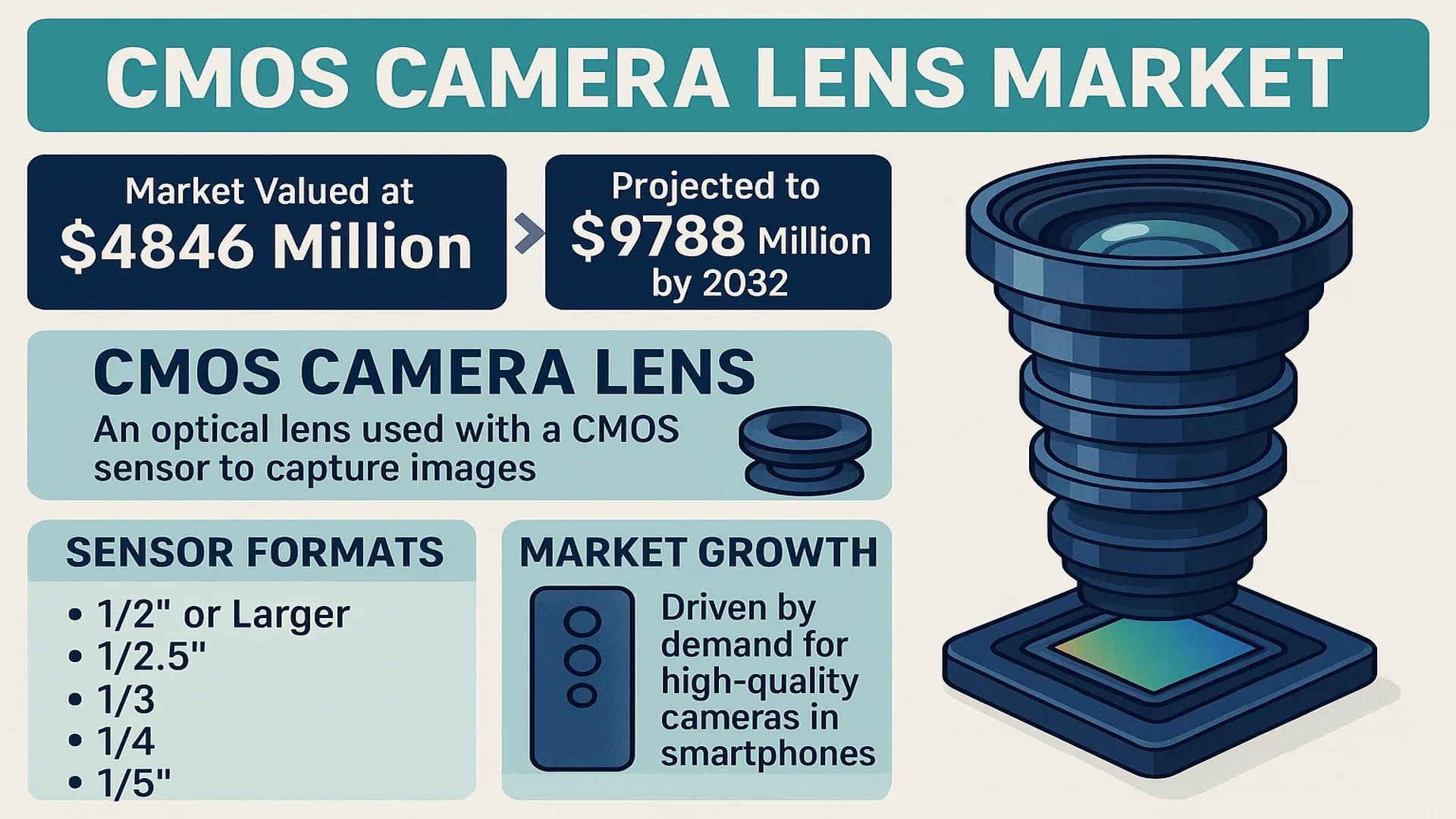
The global CMOS Camera Lens Market was valued at 4846 million in 2024 and is projected to reach US$ 9788 million by 2032, at a CAGR of 10.8% during the forecast period.
A CMOS camera lens is an optical lens or assembly of lenses used in conjunction with a Complementary Metal-Oxide-Semiconductor (CMOS) sensor to capture images. These lenses are fundamental components in modern imaging systems, focusing light onto the sensor to create a digital image. They are engineered for various sensor formats, including 1/2″ or larger, 1/2.5″, 1/3″, 1/4″, and 1/5″, each catering to specific size, resolution, and application requirements.
The market’s robust growth is primarily fueled by the insatiable demand for high-quality cameras in smartphones, where multi-lens setups have become standard. Furthermore, the expansion is driven by increasing adoption in automotive applications for advanced driver-assistance systems (ADAS), the proliferation of security and surveillance infrastructure, and growing use in medical and industrial imaging. While the market is highly consolidated, with the top five manufacturers holding approximately 80% of the market share, innovation in areas like periscope zoom lenses and larger apertures continues to intensify competition and propel the industry forward.
MARKET DYNAMICS
MARKET DRIVERS
Proliferation of Smartphones with Advanced Camera Systems to Drive Market Expansion
The global CMOS camera lens market is significantly propelled by the exponential growth in smartphone adoption and the continuous enhancement of mobile camera technologies. With over 1.5 billion smartphones shipped annually, manufacturers are increasingly integrating multi-lens setups, including wide-angle, telephoto, and macro lenses, to differentiate their products and meet consumer demand for superior imaging capabilities. High-resolution sensors, such as 108 MP and beyond, are becoming standard in flagship devices, necessitating precision-engineered lenses to maximize optical performance. This trend is further accelerated by the rising popularity of social media platforms and content creation, where high-quality visuals are paramount. Additionally, advancements in computational photography, which rely on sophisticated lens systems to work in tandem with software algorithms, are pushing the boundaries of what mobile cameras can achieve, thereby fueling demand for innovative CMOS camera lenses.
Growth in Automotive and Surveillance Applications to Boost Market Momentum
Beyond consumer electronics, the automotive and surveillance sectors are emerging as powerful drivers for the CMOS camera lens market. The automotive industry is rapidly adopting advanced driver-assistance systems (ADAS) and autonomous driving technologies, which rely heavily on multiple camera modules for functions like lane departure warning, adaptive cruise control, and pedestrian detection. It is estimated that modern vehicles incorporate an average of 8 to 12 cameras, a number projected to increase as fully autonomous vehicles become more prevalent. Similarly, the global surveillance market is expanding due to heightened security concerns and smart city initiatives, with demand for high-resolution, low-light capable cameras rising steadily. These applications require robust, reliable lenses that can perform under varying environmental conditions, creating sustained demand across these verticals.
Technological Innovations and Miniaturization Trends to Accelerate Adoption
Continuous innovation in lens design and manufacturing processes is another critical driver shaping the CMOS camera lens market. Breakthroughs in materials science, such as the use of glass-plastic hybrid lenses and molded glass elements, allow for better aberration correction and more compact form factors without compromising optical quality. Furthermore, the integration of autofocus mechanisms, optical image stabilization, and variable aperture systems into tiny lens assemblies has become a focal point for R&D efforts. These advancements are crucial for applications in medical imaging, where endoscopes and diagnostic equipment require extremely small yet high-performance lenses, and in industrial automation, where machine vision systems depend on precision optics for quality control and robotics. The relentless push toward miniaturization, coupled with rising performance standards, ensures ongoing investment and growth in this sector.
MARKET RESTRAINTS
High Manufacturing Complexity and Cost Pressures to Limit Market Penetration
Despite strong growth prospects, the CMOS camera lens market faces significant restraints due to the high complexity and cost associated with manufacturing precision optics. Producing high-quality lenses involves stringent tolerances, specialized equipment, and skilled labor, leading to elevated production costs. This is particularly challenging for applications requiring exotic materials or custom optical designs, such as those used in aerospace or medical devices. Moreover, intense competition among smartphone manufacturers exerts downward pressure on component pricing, squeezing profit margins for lens suppliers. As a result, companies must balance innovation with cost-efficiency, which can slow the adoption of cutting-edge technologies in price-sensitive market segments.
Supply Chain Vulnerabilities and Material Shortages to Hinder Production Scalability
Global supply chain disruptions pose another considerable restraint for the CMOS camera lens market. The industry relies on a complex network of suppliers for raw materials, such as specialized glass, polymers, and rare-earth elements, as well as for manufacturing equipment. Recent geopolitical tensions and logistical challenges have led to shortages and increased lead times, impacting production schedules and ability to meet demand. For instance, fluctuations in the availability of key components like sensor modules and lens barrels can cascade through the supply chain, causing delays in end-product assembly. These vulnerabilities highlight the need for greater supply chain resilience but currently act as a brake on market growth.
Technical Limitations in Extreme Environments to Constrain Application Scope
Technical challenges related to performance under extreme conditions also restrain market expansion. While CMOS camera lenses excel in many environments, they can struggle in applications involving high temperatures, intense vibration, or exposure to corrosive elements. For example, automotive and industrial applications often require lenses that maintain clarity and reliability across a wide temperature range, which demands additional engineering and material costs. Similarly, in medical sterilization processes or outdoor surveillance, lenses must withstand harsh conditions without degradation. Overcoming these limitations requires innovative solutions but adds complexity and expense, potentially limiting adoption in certain high-stakes applications.
MARKET CHALLENGES
Intense Market Competition and Rapid Technological Obsolescence to Challenge Sustainability
The CMOS camera lens market is characterized by fierce competition and rapid technological evolution, presenting significant challenges for industry participants. With leading players continuously introducing innovations, product lifecycles are shortening, and companies must invest heavily in R&D to stay relevant. This environment pressures smaller manufacturers, who may lack the resources to keep pace, leading to market consolidation. Additionally, the need to constantly upgrade manufacturing capabilities to support new lens designs and higher resolutions increases operational costs, challenging profitability and long-term sustainability.
Other Challenges
Stringent Quality and Compliance Requirements
Meeting rigorous quality standards and regulatory compliance across diverse regions and applications is another major challenge. Automotive and medical sectors, in particular, impose strict certifications and performance benchmarks that lenses must satisfy. Navigating these requirements demands significant time and financial investment, potentially delaying product launches and increasing time-to-market.
Intellectual Property and Patent Disputes
The market is also fraught with intellectual property disputes, as companies vie to protect proprietary technologies related to lens designs, coatings, and manufacturing processes. Litigation can drain resources and hinder innovation, creating an additional layer of complexity for businesses operating in this space.
MARKET OPPORTUNITIES
Expansion into Emerging Applications such as AR/VR and IoT to Unlock New Growth Avenues
The CMOS camera lens market stands to benefit enormously from emerging applications in augmented reality (AR), virtual reality (VR), and the Internet of Things (IoT). AR and VR devices require compact, high-performance lenses to deliver immersive experiences, driving demand for specialized optics. Similarly, IoT ecosystems increasingly incorporate cameras for smart home security, industrial monitoring, and healthcare diagnostics, creating new opportunities for lens manufacturers. These applications often prioritize miniaturization, low power consumption, and cost-effectiveness, aligning well with ongoing trends in the CMOS lens industry.
Advancements in AI and Machine Vision to Fuel Demand for Precision Optics
Artificial intelligence (AI) and machine vision are revolutionizing various industries, from manufacturing to retail, and CMOS camera lenses are critical enablers of these technologies. AI-powered systems rely on high-quality visual data for tasks like object recognition, quality inspection, and autonomous navigation, necessitating lenses with exceptional clarity and consistency. As AI adoption grows, so does the need for optics that can support advanced imaging algorithms. This synergy between hardware and software opens lucrative opportunities for lens makers to develop products tailored to AI-driven applications.
Strategic Collaborations and Geographic Expansion to Enhance Market Presence
Finally, strategic partnerships and expansion into untapped geographic markets present significant growth opportunities. Collaborations between lens manufacturers, sensor developers, and end-product integrators can accelerate innovation and create holistic solutions that address evolving customer needs. Meanwhile, emerging economies in Asia, Latin America, and Africa offer substantial growth potential due to rising disposable incomes, urbanization, and increasing adoption of smart devices. By leveraging these opportunities, companies can diversify their revenue streams and strengthen their global footprint.
CMOS CAMERA LENS MARKET TRENDS
Proliferation of High-Resolution Smartphone Cameras Driving Market Expansion
The relentless consumer demand for superior mobile photography continues to be the primary catalyst for the CMOS camera lens market. This trend is characterized by the integration of multiple, increasingly sophisticated lenses within a single smartphone device. While flagship models have long featured advanced camera systems, this technology is rapidly cascading into mid-range and even budget segments, significantly broadening the total addressable market. The shift towards higher megapixel counts is a key metric of this progression; lenses supporting 64MP and 108MP sensors have moved from being premium novelties to mainstream features. This evolution necessitates more complex optical designs, including the widespread adoption of multi-element constructions, often incorporating six or seven plastic (PMMA) or glass elements to correct for aberrations and achieve sharper images. Furthermore, the race to minimize the physical footprint of these high-performance modules, known as the periscope zoom form factor, has spurred innovation in prism and folded optics, creating a distinct and valuable sub-segment within the market.
Other Trends
Integration of Advanced Computational Photography and AI
The functionality of CMOS camera lenses is increasingly being augmented by sophisticated software and artificial intelligence, creating a synergistic trend that elevates the importance of the optical hardware. While the lens captures the raw light data, AI-driven computational photography algorithms are now essential for producing the final image. This includes features like night mode, portrait mode bokeh effects, and enhanced HDR processing. However, these algorithms require high-quality, consistent optical input to perform effectively, which in turn drives demand for lenses with superior light transmission, minimal distortion, and precise manufacturing tolerances. The development of lenses specifically optimized for these computational tasks, rather than just traditional photography, represents a significant shift in design philosophy. This trend is further amplified by the growing use of cameras for machine vision and augmented reality applications, where lens performance directly impacts the accuracy of the underlying AI models.
Rising Demand from Non-Consumer Applications in Automotive and Industrial Sectors
Beyond the consumer electronics sphere, the CMOS camera lens market is experiencing robust growth driven by its critical role in automotive and industrial automation. The automotive industry, in particular, represents a high-growth vertical due to the rapid adoption of Advanced Driver-Assistance Systems (ADAS) and the development of autonomous vehicles. These systems rely heavily on a suite of cameras for functions like lane departure warning, traffic sign recognition, blind spot detection, and emergency braking. These applications impose a unique set of requirements on camera lenses, including exceptional reliability over a wide temperature range (-40°C to 105°C), high resistance to vibration and shock, and consistent performance in challenging lighting conditions. Similarly, the industrial sector utilizes machine vision cameras for quality control, robotic guidance, and logistics, where lenses must provide extreme sharpness and minimal geometric distortion for accurate measurement and inspection. The specifications for these lenses often exceed those of consumer products, creating a specialized and high-value market segment with distinct supply chains and technological demands.
COMPETITIVE LANDSCAPE
Key Industry Players
Innovation and Strategic Expansion Define Market Leadership
The global CMOS Camera Lens market is characterized by a highly consolidated competitive structure, dominated by a handful of major players who collectively command a significant portion of the market share. This consolidation is primarily driven by the substantial capital investment required for research, development, and advanced manufacturing capabilities. Largan Precision Co., Ltd. (Taiwan) and Sunny Optical Technology (Group) Company Limited (China) are the undisputed leaders, leveraging their massive scale, extensive patent portfolios, and deep-rooted relationships with global smartphone OEMs to maintain their dominance.
While the top five manufacturers hold approximately 80% of the global market, the landscape also includes a tier of strong, specialized competitors. Companies like GeniuS Electronic Optical (GSEO) (Taiwan) and Kantatsu Co., Ltd. (Japan) have carved out significant niches by focusing on high-precision optics for specific applications, such as automotive and medical imaging. Their growth is fueled by continuous innovation in multi-lens assemblies and miniaturization technologies, which are critical for next-generation devices.
Furthermore, these leading companies are aggressively pursuing growth through strategic initiatives. This includes geographical expansion into emerging manufacturing hubs in Southeast Asia and significant investments in R&D to develop lenses for higher megapixel sensors and advanced features like periscope zoom and under-display camera technology. Such moves are essential to secure long-term contracts and solidify their market positions.
Meanwhile, established electronics giants like Sony Corporation (Japan) and Samsung Electro-Mechanics (South Korea) are strengthening their market presence through vertical integration. By producing both the CMOS image sensors and the accompanying lenses, they can offer optimized, end-to-end imaging solutions, creating a formidable competitive advantage and ensuring their continued influence in the market.
List of Key CMOS Camera Lens Companies Profiled
- Largan Precision Co., Ltd. (Taiwan)
- Sunny Optical Technology (Group) Company Limited (China)
- GeniuS Electronic Optical (GSEO) (Taiwan)
- Kantatsu Co., Ltd. (Japan)
- Sekonix Co., Ltd. (South Korea)
- Sony Corporation (Japan)
- Samsung Electro-Mechanics (South Korea)
- Canon Inc. (Japan)
- Nikon Corporation (Japan)
Segment Analysis:
By Type
1/3″ Format Lenses Segment Dominates the Market Due to Widespread Adoption in Smartphone Cameras
The market is segmented based on type into:
- 1/2″ or Larger Format Lenses
- 1/2.5″ Format Lenses
- 1/3″ Format Lenses
- 1/4″ Format Lenses
- 1/5″ Format Lenses
By Application
Consumer Camera Segment Leads Due to Massive Demand from Smartphone and Automotive Industries
The market is segmented based on application into:
- Consumer Camera
- Medical Camera
- Industrial Camera
By Pixel Resolution
32 MEGA Pixels Segment Holds Significant Market Share Driven by High-Resolution Imaging Requirements
The market is segmented based on pixel resolution into:
- Below 8 MEGA Pixels
- 8-16 MEGA Pixels
- 16-32 MEGA Pixels
- 32 MEGA Pixels and Above
By End-User
Smartphone Manufacturers Represent the Largest End-User Segment Fueled by Continuous Camera Innovation
The market is segmented based on end-user into:
- Smartphone Manufacturers
- Automotive OEMs
- Medical Device Companies
- Industrial Equipment Manufacturers
- Surveillance and Security System Providers
Regional Analysis: CMOS Camera Lens Market
Asia-Pacific
The Asia-Pacific region dominates the global CMOS Camera Lens market, accounting for over 65% of the total market share by volume as of 2024. This leadership is primarily driven by the massive consumer electronics manufacturing base, particularly in China, South Korea, and Japan. The region is home to key lens manufacturers like Sunny Optical, Largan Precision, and Sekonix, which collectively hold a significant portion of the global supply. The relentless innovation in smartphone camera technology, with a push towards higher megapixel counts and periscope zoom lenses, fuels continuous demand. Furthermore, the rapid expansion of automotive production, especially in China and India, is increasing the adoption of CMOS lenses for Advanced Driver-Assistance Systems (ADAS). While cost-competitive manufacturing remains a core strength, there is a growing emphasis on research and development to produce more advanced optical solutions for next-generation applications.
North America
North America is a significant market characterized by high-value, technologically advanced CMOS camera lens applications. The region, led by the United States, is a hub for innovation in medical imaging, industrial automation, and defense sectors. Stringent quality standards and a strong focus on R&D drive demand for high-precision lenses used in specialized equipment. The presence of major technology firms and a robust automotive sector, particularly in electric and autonomous vehicle development, further supports market growth. While the volume of consumer-grade lens production is lower than in Asia, the region excels in the high-performance segment, with companies investing heavily in developing lenses for machine vision, scientific research, and medical diagnostics.
Europe
Europe maintains a strong position in the CMOS Camera Lens market, underpinned by its advanced automotive industry and a well-established industrial manufacturing base. The region’s focus is on high-quality, precision lenses for automotive cameras, industrial machine vision systems, and medical equipment. Strict regulatory frameworks, especially in the automotive sector regarding safety and ADAS features, act as a key market driver. European companies and research institutions are also at the forefront of developing specialized lenses for scientific and medical applications, demanding extreme clarity and reliability. While not a mass-volume production hub, Europe’s market is defined by its technological sophistication and adherence to high performance and durability standards.
South America
The South American CMOS Camera Lens market is emerging, with growth primarily fueled by the expanding consumer electronics sector and increasing smartphone penetration. Countries like Brazil and Argentina are seeing rising demand for mobile devices, which in turn drives the need for camera lenses. The automotive industry also presents opportunities as regional manufacturers incorporate more camera-based features into vehicles. However, market growth is tempered by economic volatility and a reliance on imported components, which can lead to supply chain inconsistencies and price sensitivity. The adoption of higher-end lens technology is gradual, with the market currently focused on cost-effective solutions for mainstream consumer applications.
Middle East & Africa
The market in the Middle East and Africa is in a nascent stage of development. Growth is primarily driven by increasing smartphone adoption and infrastructure development projects that utilize surveillance and security systems. The United Arab Emirates and Saudi Arabia are key markets within the region, investing in smart city initiatives that incorporate extensive camera networks. However, the overall market size remains relatively small compared to other regions. Progress is often constrained by economic factors and a less developed local manufacturing ecosystem, leading to a heavy dependence on imports. Despite these challenges, long-term growth potential exists as digitalization efforts and urban development continue to advance.
Report Scope
This market research report provides a comprehensive analysis of the global CMOS Camera Lens market, covering the forecast period 2025–2032. It offers detailed insights into market dynamics, technological advancements, competitive landscape, and key trends shaping the industry.
Key focus areas of the report include:
- Market Size & Forecast: Historical data and future projections for revenue, unit shipments, and market value across major regions and segments.
- Segmentation Analysis: Detailed breakdown by product type, technology, application, and end-user industry to identify high-growth segments and investment opportunities.
- Regional Outlook: Insights into market performance across North America, Europe, Asia-Pacific, Latin America, and the Middle East & Africa, including country-level analysis where relevant.
- Competitive Landscape: Profiles of leading market participants, including their product offerings, R&D focus, manufacturing capacity, pricing strategies, and recent developments such as mergers, acquisitions, and partnerships.
- Technology Trends & Innovation: Assessment of emerging technologies, integration of AI/IoT, semiconductor design trends, fabrication techniques, and evolving industry standards.
- Market Drivers & Restraints: Evaluation of factors driving market growth along with challenges, supply chain constraints, regulatory issues, and market-entry barriers.
- Stakeholder Analysis: Insights for component suppliers, OEMs, system integrators, investors, and policymakers regarding the evolving ecosystem and strategic opportunities.
Primary and secondary research methods are employed, including interviews with industry experts, data from verified sources, and real-time market intelligence to ensure the accuracy and reliability of the insights presented.
FREQUENTLY ASKED QUESTIONS:
What is the current market size of Global CMOS Camera Lens Market?
-> CMOS Camera Lens Market was valued at 4846 million in 2024 and is projected to reach US$ 9788 million by 2032, at a CAGR of 10.8% during the forecast period.
Which key companies operate in Global CMOS Camera Lens Market?
-> Key players include Sunny Optical, Largan Precision, GeniuS Electronic Optical (GSEO), Sekonix, Kantatsu, Canon, Sony, and Nikon, among others.
What are the key growth drivers?
-> Key growth drivers include rising smartphone adoption, increasing demand for high-resolution imaging in automotive and medical applications, and advancements in multi-camera setups.
Which region dominates the market?
-> Asia-Pacific is the dominant market, accounting for over 70% of global production and consumption, with China being the largest manufacturing hub.
What are the emerging trends?
-> Emerging trends include periscope zoom lenses, under-display camera technology, wafer-level optics, and integration of AI for computational photography.

Get Sample Report PDF for Exclusive Insights
Report Sample Includes
- Table of Contents
- List of Tables & Figures
- Charts, Research Methodology, and more...
 Download Sample Report PDF



