
MARKET INSIGHTS
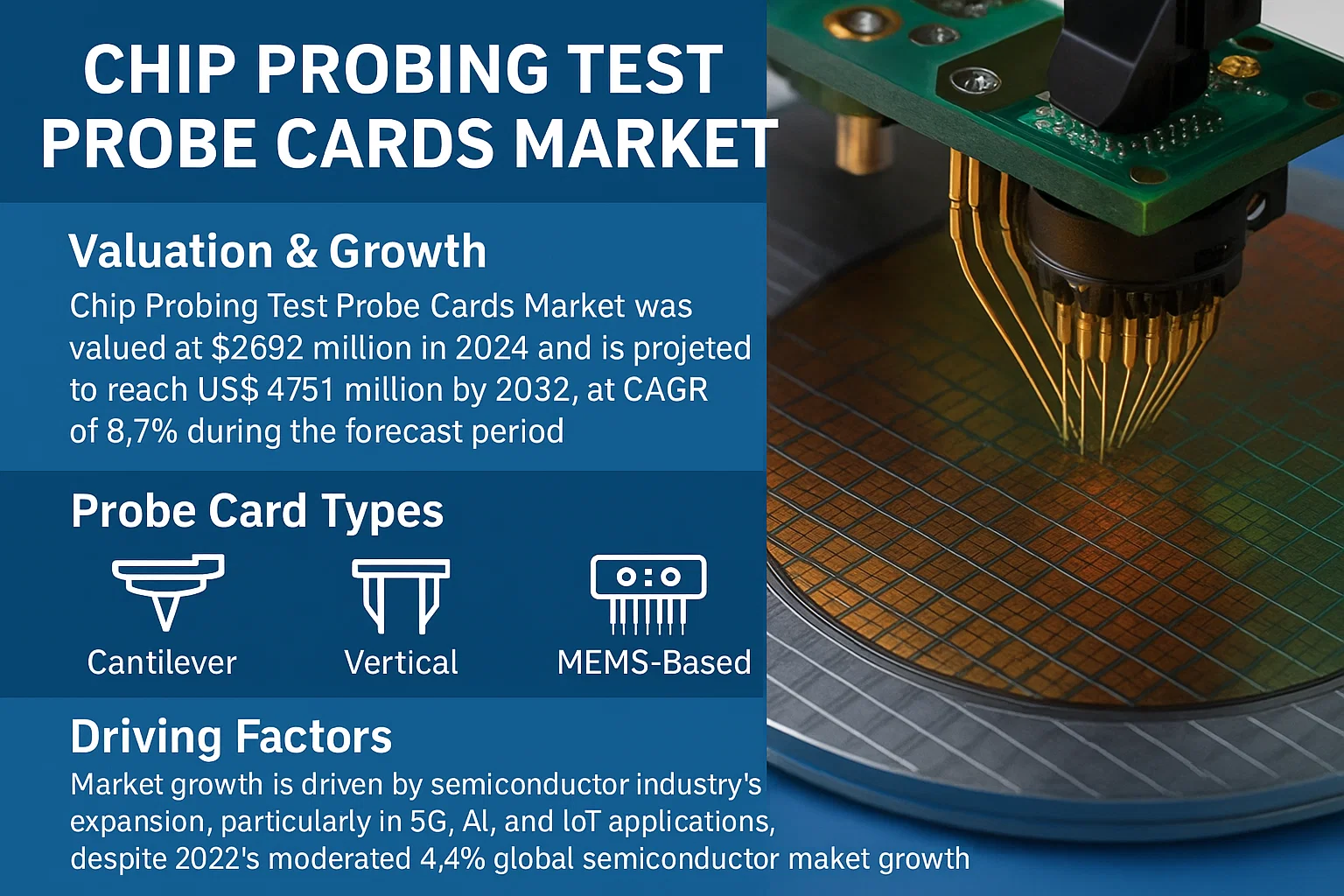
The global Chip Probing Test Probe Cards Market was valued at 2692 million in 2024 and is projected to reach US$ 4751 million by 2032, at a CAGR of 8.7% during the forecast period.
Chip probing test probe cards are high-precision devices used for wafer-level testing of integrated circuits (ICs) during semiconductor manufacturing. These cards establish electrical connections between test equipment and microscopic chip contacts, verifying functionality before packaging. The market offers three primary probe card types: cantilever, vertical, and MEMS-based, each optimized for different IC architectures and testing requirements.
Market growth is driven by the semiconductor industry’s expansion, particularly in 5G, AI, and IoT applications, despite 2022’s moderated 4.4% global semiconductor market growth to USD 580 billion. While the Asia Pacific region saw a 2% decline in semiconductor sales in 2022, the Americas and Europe demonstrated strong growth at 17% and 12.6% respectively. Key players like FormFactor and Technoprobe S.p.A. continue to innovate probe card technologies to meet the increasing complexity of advanced nodes below 7nm, with MEMS probe cards gaining traction for their superior durability and fine-pitch capabilities.
MARKET DYNAMICS
MARKET DRIVERS
Expanding Semiconductor Industry and Advanced Packaging Technologies Fueling Probe Card Demand
The global semiconductor industry continues its strong growth trajectory, creating parallel demand for testing solutions like probe cards. With semiconductor revenues projected to reach $580 billion in 2024, manufacturers are investing heavily in wafer testing equipment to ensure quality standards. The growing complexity of chip architectures, including 3D IC packaging and heterogeneous integration, requires more sophisticated probe card solutions. Leading foundries are allocating 15-20% of their capital expenditures to testing equipment, creating sustained demand for high-precision probe cards. The shift toward smaller node processes (5nm and below) and advanced packaging solutions like chiplets further emphasizes the critical role of probe cards in the semiconductor manufacturing value chain.
Rise of AI and High-Performance Computing Driving Technological Advancements
Artificial intelligence and high-performance computing applications are pushing the boundaries of semiconductor performance, requiring equally advanced testing solutions. AI chips with thousands of cores and specialized architectures demand probe cards capable of handling ultra-high pin counts (exceeding 100,000 pins in some cases) and fine-pitch probing. The global AI chip market, expected to grow at 38% CAGR through 2030, is driving innovations in probe card technology to support these complex designs. MEMS probe cards in particular are gaining traction due to their ability to meet the stringent requirements of AI processor testing, including high signal integrity and thermal stability during wafer probing operations.
Additionally, the increasing adoption of autonomous vehicles and 5G technologies requires reliable semiconductor components that can only be ensured through rigorous wafer testing. Automotive semiconductor content per vehicle is projected to exceed $1,000 by 2025, with safety-critical applications mandating zero-defect manufacturing processes that begin with comprehensive wafer testing.
MARKET RESTRAINTS
High Development Costs and Technical Complexities Limit Market Penetration
While the probe card market shows strong growth potential, several technical and economic factors constrain expansion. Developing advanced probe cards for cutting-edge semiconductor nodes requires significant R&D investments, often exceeding $5-10 million per design for leading-edge applications. The transition to smaller geometries below 7nm presents substantial technical hurdles, including maintaining probe tip planarity at sub-micron levels and managing thermal expansion mismatches during testing. These challenges force probe card manufacturers to balance performance requirements against escalating development costs, potentially limiting access to smaller semiconductor fabs and packaging houses.
Supply Chain Volatility Impacts Material Availability and Pricing
The semiconductor industry’s ongoing supply chain challenges equally affect the probe card market. Specialty materials required for probe tip manufacturing, such as tungsten-rhenium alloys and high-performance ceramics, face periodic shortages that disrupt production schedules. Lead times for certain probe card components have extended beyond six months in some cases, forcing manufacturers to maintain higher inventory levels. Meanwhile, geopolitical tensions impacting rare earth material supplies could create additional pricing pressures, potentially increasing probe card costs by 15-20% for certain configurations. These factors combine to create headwinds for market expansion, particularly for cost-sensitive applications.
MARKET OPPORTUNITIES
Emerging Memory Technologies and Heterogeneous Integration Create New Testing Paradigms
The proliferation of novel memory architectures presents significant growth opportunities for probe card manufacturers. Emerging technologies like 3D NAND, MRAM, and ReRAM each require specialized probing solutions to address their unique testing requirements. The memory market alone accounts for over 30% of probe card demand, with 3D NAND stacking driving increased probe card complexity. Similarly, the rise of chiplet-based designs and heterogeneous integration creates demand for innovative probe solutions capable of testing multiple die configurations within a single wafer. Advanced probe card designs incorporating mixed-signal testing capabilities and built-in self-test features are well-positioned to capitalize on these industry trends.
Automation and Smart Manufacturing Revolutionizing Probe Card Usage
The integration of Industry 4.0 technologies into semiconductor manufacturing opens new avenues for probe card innovation. Smart probe cards incorporating embedded sensors and IoT connectivity enable real-time monitoring of probe performance and predictive maintenance capabilities. This transition toward data-driven testing can reduce probe card downtime by up to 30% while improving yield management. Additionally, the automation of probe card handling and cleaning processes through robotic systems enhances testing throughput, addressing one of the key pain points in high-volume semiconductor manufacturing. As fabs continue their digital transformation journeys, probe card manufacturers that embrace these technological shifts will gain competitive advantages.
MARKET CHALLENGES
Increasing Design Complexity and Shorter Product Lifecycles Strain Development Resources
The rapid pace of semiconductor innovation creates significant challenges for probe card manufacturers. Product lifecycles for advanced chips continue to shorten, often requiring probe card redesigns within 12-18 months to accommodate new architectures. This compressed development timeline, combined with the increasing complexity of multi-die packages, strains engineering resources and testing capacity. Probe card makers must balance the need for quick turnaround times with maintaining rigorous quality standards, as defective probe cards can potentially scrap entire wafer batches. The industry’s transition toward more specialized, application-specific probe card solutions further exacerbates these development challenges.
Technical Hurdles in High-Frequency and High-Power Testing Applications
High-frequency RF chips and power semiconductors present unique testing difficulties that push the limits of current probe card technologies. Millimeter-wave applications above 100GHz require probe cards with exceptional signal integrity features and specialized probe tip geometries. Similarly, wide-bandgap semiconductors like GaN and SiC used in electric vehicles and power applications demand probe solutions capable of handling high voltages and currents during wafer testing. Developing probe cards for these extreme conditions while maintaining acceptable probe life and reliability remains an ongoing technical challenge for the industry. These specialized applications often require custom probe card solutions that can significantly increase development costs and time-to-market.
CHIP PROBING TEST PROBE CARDS MARKET TRENDS
Miniaturization of Semiconductor Devices Drives Demand for Advanced Probe Cards
The relentless push toward semiconductor miniaturization is significantly boosting the demand for high-precision chip probing test probe cards. As semiconductor nodes shrink below 7nm and 5nm, traditional probe card technologies struggle to maintain testing accuracy. This has led to rapid adoption of MEMS-based probe cards, which offer superior precision, durability, and signal integrity at smaller geometries. The global market is projected to reach US$ 4.75 billion by 2032, growing at a CAGR of 8.7% from 2024-2032, fueled by these technological requirements. While logic and analog segments continue strong growth, memory applications face temporary declines due to inventory corrections in 2022-2023.
Other Trends
Automotive Semiconductor Testing Expansion
The automotive sector’s growing semiconductor content per vehicle, particularly for ADAS, infotainment, and powertrain electrification, has created new demand verticals for probe card manufacturers. Electric vehicles now incorporate nearly 3,000 chips per vehicle compared to 500 in conventional cars, necessitating robust wafer-level testing solutions. This sector’s stringent reliability requirements are accelerating adoption of high-temperature probe cards capable of automotive-grade validation (-40°C to 150°C operational ranges).
Shift Toward 300mm Wafer Testing Infrastructure
Foundries and IDMs are aggressively transitioning to 300mm wafer production to improve economies of scale, with over 75% of advanced logic nodes now processed on larger wafers. This migration demands compatible probe card solutions featuring larger contact arrays and multi-DUT capabilities. However, Asia Pacific, which dominates semiconductor manufacturing, saw a temporary 2% market contraction in 2022 due to inventory corrections, though regional demand is rebounding strongly with new fab constructions across China, Taiwan, and South Korea.
Heterogeneous Integration & Advanced Packaging
The rise of 3D-IC designs and chiplets requires probe cards capable of testing interconnected die assemblies prior to packaging. This has spurred development of multi-layer probe technologies that can simultaneously access TSV (through-silicon via) interconnects and microbumps. While the technology adds complexity, it addresses critical yield management needs in cutting-edge packaging approaches like CoWoS and HBM stacks that now represent over 15% of advanced packaging revenue.
COMPETITIVE LANDSCAPE
Key Industry Players
Market Leaders Expand Technological Capabilities to Address Semiconductor Industry Demands
The global chip probing test probe cards market features a dynamic competitive environment with established players holding dominant positions while emerging companies gain traction through specialized solutions. FormFactor leads the market with an estimated 18.2% revenue share in 2024, owing to its comprehensive MEMS probe card solutions and strategic partnerships with major semiconductor manufacturers. The company’s recent $50 million investment in advanced probe card R&D further strengthens its technological edge.
Technoprobe S.p.A. and Micronics Japan (MJC) collectively account for approximately 22% of global sales, benefiting from their strong presence in Asian semiconductor hubs. These companies continue introducing innovative vertical probe card designs with enhanced pitch capabilities below 40μm, addressing the testing requirements of next-generation chips.
Meanwhile, established players like Japan Electronic Materials (JEM) and MPI Corporation are expanding their market share through acquisitions and collaborative development programs. MPI’s 2023 acquisition of a Korean probe card manufacturer enhanced its 3D NAND memory testing capabilities – a strategic move that increased their Asia-Pacific market penetration by 14%.
Emerging competitors such as Suzhou Dougute and Will Technology are gaining momentum through cost-effective cantilever probe solutions, particularly for automotive chip testing applications. These China-based manufacturers now hold nearly 8% combined market share, having doubled their production capacity since 2022 to meet domestic semiconductor industry demands.
List of Key Chip Probing Test Probe Card Companies Profiled
- FormFactor, Inc. (U.S.)
- Japan Electronic Materials Corporation (Japan)
- Wentworth Laboratories, Inc. (U.S.)
- Technoprobe S.p.A. (Italy)
- Micronics Japan Co., Ltd. (Japan)
- ACCUPROBE (Taiwan)
- MPI Corporation (Taiwan)
- SV Probe Pte Ltd. (Singapore)
- Microfriend Inc. (Japan)
- Korea Instrument Co., Ltd. (South Korea)
- Star Technologies, Inc. (U.S.)
- Will Technology Co., Ltd. (South Korea)
- FICT LIMITED (Japan)
- TOHO ELECTRONICS INC. (Japan)
- Synergie Cad Probe (France)
- GGB Industries (PICOPROBE) (U.S.)
- Feinmetall GmbH (Germany)
- TSE Co., Ltd. (South Korea)
- Suzhou Dougute Precision Technology Co., Ltd. (China)
- MaxOne (South Korea)
Segment Analysis:
By Type
MEMS Probe Card Segment Leads the Market Due to Superior Performance in High-Density and Advanced Node Testing
The market is segmented based on type into:
- Cantilever Probe Card
- Vertical Probe Card
- MEMS Probe Card
By Application
Consumer Electronics Segment Dominates Owing to Massive Demand for Smartphones, PCs, and Wearables
The market is segmented based on application into:
- Consumer Electronics
- Medical Device
- Automotive
- Others
By Wafer Size
300mm Wafer Segment Holds the Largest Share Driven by High-Volume Semiconductor Manufacturing
The market is segmented based on wafer size into:
- 200mm Wafer
- 300mm Wafer
- Others
By Technology Node
Advanced Nodes (<10nm) Segment is the Fastest Growing Due to Proliferation of AI, 5G, and HPC Chips
The market is segmented based on technology node into:
- >28nm
- 20-28nm
- 10-20nm
- <10nm
Regional Analysis: Chip Probing Test Probe Cards Market
Asia-Pacific
The Asia-Pacific region dominates the global Chip Probing Test Probe Cards market, accounting for the largest revenue share due to its thriving semiconductor industry. Countries like China, Japan, and South Korea lead the market with significant investments in semiconductor manufacturing and testing infrastructure. China’s aggressive expansion in semiconductor self-sufficiency, backed by government initiatives like the National Integrated Circuit Industry Investment Fund, fuels demand for high-performance probe cards. Japan remains a key player with companies like Japan Electronic Materials (JEM) and Micronics Japan (MJC) driving innovation in MEMS and vertical probe cards. South Korea’s strong presence is attributed to semiconductor giants like Samsung and SK Hynix, which continuously demand advanced probe testing solutions for memory and logic chips. While cost-effective solutions remain prevalent, the shift toward miniaturization and high-density testing is accelerating adoption of advanced probe card technologies.
North America
The Chip Probing Test Probe Cards market in North America, led by the U.S., is characterized by technological advancements and high R&D investments. The U.S. accounted for approximately 42% of the region’s market revenue in 2024, driven by companies like FormFactor and MPI Corporation, which specialize in high-precision vertical and MEMS probe cards. The demand is further bolstered by the increasing complexity of semiconductor designs, especially in AI, 5G, and automotive applications. Government support through initiatives like the CHIPS and Science Act, which allocates $52 billion for domestic semiconductor manufacturing, strengthens the supply chain and testing infrastructure. Canada and Mexico, though smaller markets, are witnessing gradual growth due to expanding electronics manufacturing and outsourcing activities.
Europe
Europe’s market benefits from strong automotive and industrial semiconductor demand, particularly in Germany and France, where Technoprobe S.p.A. and Feinmetall play pivotal roles in supplying advanced probe solutions. The region emphasizes high-reliability testing for automotive-grade chips, driving demand for durable and precise probe cards. While growth remains steady, the market faces challenges due to high production costs and reliance on imported semiconductor components. However, the European Commission’s European Chips Act aims to bolster local semiconductor production, which is expected to create long-term opportunities for probe card manufacturers.
South America
South America’s market is in the nascent stage, primarily driven by Brazil and Argentina, where electronics assembly and automotive manufacturing are expanding. The lack of local semiconductor fabrication plants limits the demand for probe cards, but increasing investments in consumer electronics assembly present opportunities for testing solutions. Economic volatility and limited technological infrastructure hinder faster adoption, though the gradual shift toward localized component sourcing could improve market prospects in the long term.
Middle East & Africa
The Middle East & Africa region shows emerging potential, with countries like Israel and the UAE investing in semiconductor R&D and testing facilities. While the market size remains small compared to global leaders, the focus on smart city projects and telecommunications infrastructure is driving demand for semiconductor testing. Limited domestic manufacturing capabilities and reliance on imports restrain growth, but partnerships with global semiconductor firms could unlock future opportunities.
Report Scope
This market research report provides a comprehensive analysis of the global Chip Probing Test Probe Cards market, covering the forecast period 2024–2032. It offers detailed insights into market dynamics, technological advancements, competitive landscape, and key trends shaping the semiconductor testing industry.
Key focus areas of the report include:
- Market Size & Forecast: Historical data and future projections for revenue and unit shipments, with the global market valued at USD 2,692 million in 2024 and projected to reach USD 4,751 million by 2032 at a CAGR of 8.7%.
- Segmentation Analysis: Detailed breakdown by product type (Cantilever, Vertical, MEMS Probe Cards), application (Consumer Electronics, Medical Devices, Automotive), and end-user industries.
- Regional Outlook: Insights into market performance across North America, Europe, Asia-Pacific (dominant with 55% market share), Latin America, and Middle East & Africa, including country-level semiconductor industry analysis.
- Competitive Landscape: Profiles of 20+ key players including FormFactor (market leader with 18% share), Technoprobe, Micronics Japan, and MPI Corporation, covering their product portfolios and strategic developments.
- Technology Trends: Assessment of advanced probe card technologies, wafer-level testing innovations, and integration with AI-driven test systems.
- Market Dynamics: Analysis of drivers (semiconductor industry growth, 5G expansion) and challenges (supply chain constraints, testing complexity for advanced nodes).
- Stakeholder Insights: Strategic guidance for foundries, IDMs, OSATs, and test equipment manufacturers navigating the probe card ecosystem.
The research methodology combines primary interviews with industry experts and analysis of verified market data from semiconductor associations and financial reports of listed companies.
FREQUENTLY ASKED QUESTIONS:
What is the current market size of Global Chip Probing Test Probe Cards Market?
-> Chip Probing Test Probe Cards Market was valued at 2692 million in 2024 and is projected to reach US$ 4751 million by 2032, at a CAGR of 8.7% during the forecast period.
Which key companies operate in Global Chip Probing Test Probe Cards Market?
-> Key players include FormFactor, Japan Electronic Materials, Technoprobe, Micronics Japan, MPI Corporation, and SV Probe, with FormFactor holding 18% market share.
What are the key growth drivers?
-> Key growth drivers include increasing semiconductor complexity (3nm/2nm nodes), 5G adoption (projected 7 billion 5G subscriptions by 2027), and automotive semiconductor demand (projected 14% CAGR).
Which region dominates the market?
-> Asia-Pacific dominates with 55% market share, led by semiconductor hubs in Taiwan, South Korea, and China.
What are the emerging trends?
-> Emerging trends include MEMS probe card adoption (growing at 12% CAGR), AI-driven testing systems, and advanced materials for high-frequency testing.

Get Sample Report PDF for Exclusive Insights
Report Sample Includes
- Table of Contents
- List of Tables & Figures
- Charts, Research Methodology, and more...
 Download Sample Report PDF


