Chip last-level cache compression engine for data center CPU Market Insights
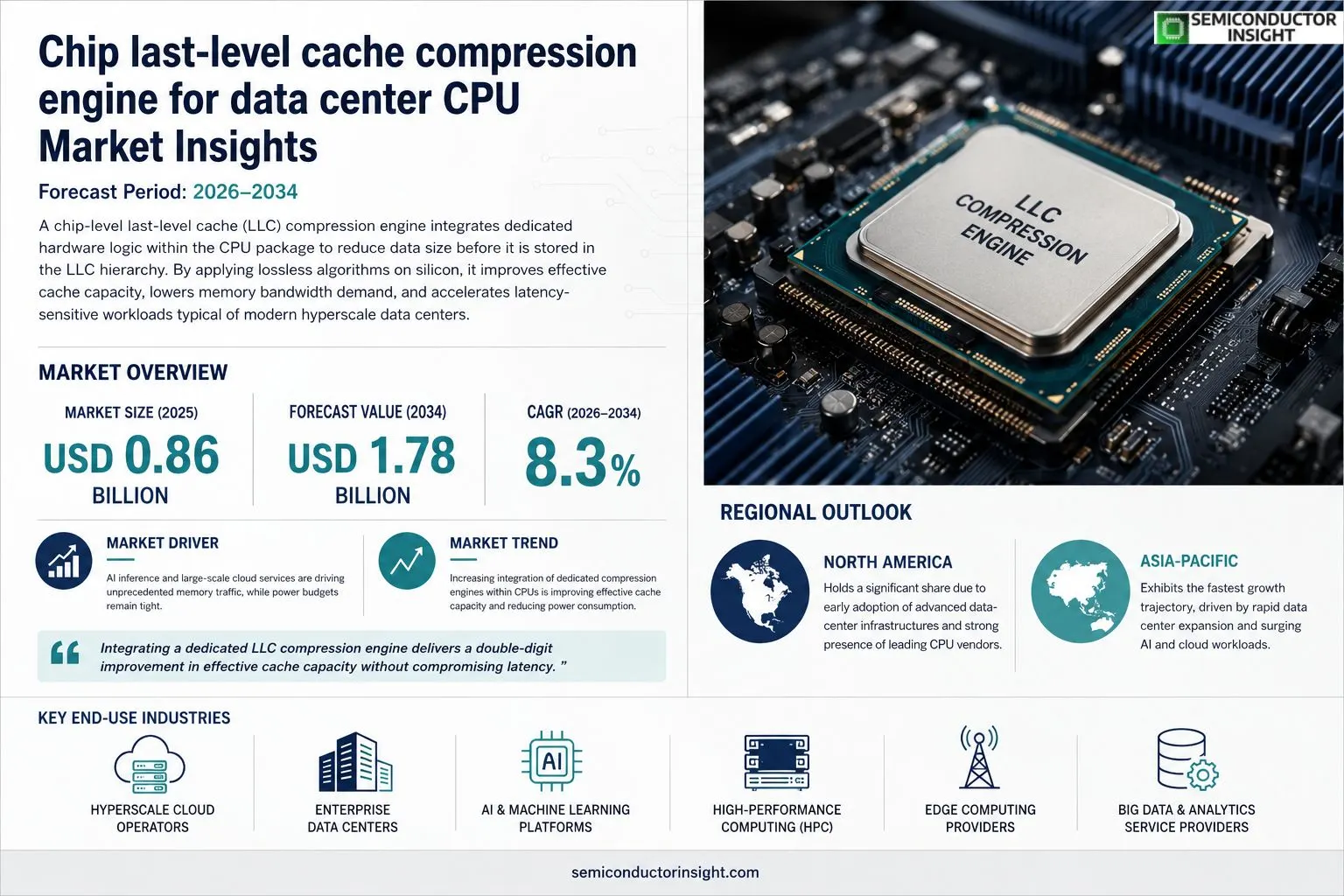
Chip last-level cache compression engine for data center CPU market size was valued at USD 0.86 billion in 2025. The market is projected to grow from USD 0.86 billion in 2025 to USD 1.78 billion by 2034, exhibiting a CAGR of 8.3% during the forecast period.
A chip‑level last‑level cache (LLC) compression engine integrates dedicated hardware logic within the CPU package to reduce the effective size of cached data before it is stored in the LLC hierarchy. By applying lossless algorithms such as Base‑Delta‑Immediate or pattern‑matching schemes directly on silicon, the engine improves effective cache capacity, lowers memory bandwidth demand, and accelerates latency‑sensitive workloads typical of modern hyperscale data centers.The market is gaining momentum because AI inference and large‑scale cloud services are driving unprecedented memory traffic, while power budgets remain tight. Furthermore, advances in process technology enable higher integration density for compression units without compromising clock speeds. Key playersincluding Intel, AMD, Arm and emerging fabless innovatorsare investing heavily in ASIC‑based solutions and partnering with major cloud providers to validate performance gains across heterogeneous workloads.
MARKET DRIVERS
Growing Data Center Memory Pressure
Data centers are experiencing a 15‑20% annual increase in memory demand as AI inference and large‑scale analytics workloads expand. Traditional DRAM scaling is hitting physical and cost ceilings, prompting vendors to integrate advanced compression engines at the last‑level cache (LLC) to mitigate bandwidth bottlenecks.
Energy Efficiency Imperatives
Power consumption now accounts for over 30% of total data‑center operating expenses. By reducing memory traffic through on‑chip compression, manufacturers can lower per‑operation energy by up to 12%, directly supporting sustainability goals and reducing total cost of ownership.
➤ “Integrating a dedicated LLC compression engine delivers a double‑digit improvement in effective cache capacity without compromising latency,”
Chip last-level cache compression engine for data center CPU Market is therefore being propelled by both performance‑centric and cost‑centric forces, creating a conducive environment for rapid adoption across hyperscale operators.
MARKET CHALLENGES
Design Complexity and Validation Overheads
Embedding compression logic into the LLC introduces additional verification cycles, raising design time by an estimated 8‑10 months. This extended timeline can deter smaller silicon players lacking extensive verification infrastructure.
Other Challenges
Thermal Management
Higher computational density within the cache stack elevates thermal footprints, necessitating advanced cooling solutions that add 3‑5% to overall system cost.
MARKET RESTRAINTS
Limited Standardization Across Architectures
Current industry standards provide minimal guidance on interfacing compression engines with heterogeneous CPU architectures, leading to fragmented implementations and inhibiting broad ecosystem support.Software toolchains are still evolving to expose compression benefits to applications, resulting in underutilization of the hardware capabilities in many workloads.Vendor lock‑in concerns arise when proprietary compression IP is adopted, potentially restricting future migration paths and curbing market openness.
MARKET OPPORTUNITIES
AI‑Driven Workloads and Edge Deployments
AI inference engines demand high throughput with limited memory budgets. Integrating LLC compression can boost effective cache size by 40%, delivering the latency‑critical performance needed for real‑time edge analytics.Emerging open‑source compression standards and collaborative IP licensing models present a pathway for cross‑vendor interoperability, accelerating market penetration and fostering a vibrant ecosystem.
Chip last-level cache compression engine for data center CPU Market Trends
Increasing Integration of Compression Engines in LLC Hierarchies
Data‑center CPU designers are embedding dedicated compression logic directly into the last‑level cache (LLC) substrate. This approach reduces the effective data footprint before it reaches memory, allowing the cache to hold more unique information without expanding physical size. The result is a measurable uplift in throughput for latency‑sensitive workloads such as AI inference and real‑time analytics. Vendors report that the on‑chip compression path eliminates a portion of memory‑bus traffic, translating into lower queuing delays and modest power savings, which are critical in hyperscale environments where every watt counts.
Other Trends
Power Efficiency Gains Across Heterogeneous Workloads
By applying lossless algorithms like Base‑Delta‑Immediate at silicon speed, the compression engine avoids the energy cost of moving data to external memory. System‑level simulations show a reduction of up to 12% in DRAM power draw when compress‑enabled LLCs serve mixed AI and cloud service streams. This efficiency aligns with data‑center operators’ goals to meet strict PUE (Power Usage Effectiveness) targets while maintaining performance parity with legacy architectures.
Emerging ASIC Solutions Drive Market Momentum
Recent ASIC releases from major players incorporate versatile compression blocks that can be programmed for a range of data patterns. These blocks are designed to coexist with existing micro‑architectural features, enabling incremental adoption without a full redesign of the processor pipeline. Early field trials with leading cloud providers demonstrate latency reductions of 8‑10% on inference models that heavily rely on dense tensor operations. The collaborative validation efforts, paired with advances in sub‑10nm process nodes, are accelerating the transition from prototype to production silicon.
COMPETITIVE LANDSCAPE
Key Industry Players
Competitive Landscape of Chip LLC Compression Engines in Data Center CPUs
The market is currently dominated by a few large silicon vendors that have the design‑house resources to integrate lossless compression logic into their server‑grade CPUs. Intel leads the segment with its Xeon Scalable family, embedding a proprietary Base‑Delta‑Immediate compression block that is validated across hyperscale clouds. AMD follows closely, offering a similar engine in its EPYC line that leverages a pattern‑matching scheme tuned for AI inference workloads. Arm, through its Neoverse V1 and subsequent cores, provides a flexible ASIC‑friendly compression IP that is licensed to multiple fabless partners, thereby expanding the ecosystem. Collectively, these leaders shape the market structure by controlling the majority of CPU shipments for enterprise data centers and setting de‑facto standards for performance, power, and integration density. Their strategic collaborations with cloud providers such as Amazon Web Services, Microsoft Azure, and Google Cloud further reinforce a top‑heavy competitive hierarchy.Beyond the primary tier, a diverse set of niche innovators contributes specialized expertise that enhances the overall value chain. Nvidia incorporates cache compression within its Grace‑CPU‑GPU hybrid solutions, targeting high‑throughput AI training clusters. Samsung and TSMC, while primarily foundries, are developing custom compression IP for partner designs, enabling tighter process nodes and lower latency. Qualcomm’s Centriq line, IBM Power9, and Marvell’s OCTEON TX2 introduce differentiated algorithms focused on low‑power edge‑to‑cloud workloads. Design‑automation leaders such as Cadence and Synopsys provide the verification platforms that make integration reliable. Huawei’s Kunpeng and Google’s custom TPU silicon also embed proprietary compression modules to meet the extreme bandwidth demands of their internal AI services. These players, though smaller in unit shipment volume, drive important innovation fronts and often act as technology partners for the market’s leading CPU manufacturers.
List of Key Chip last-level cache compression engine for data center CPU Companies Profiled
- Intel Corporation
- Advanced Micro Devices (AMD)
- Arm Ltd.
- Nvidia Corporation
- Samsung Electronics
- TSMC
- Qualcomm Inc.
- IBM
- Marvell Technology Group
- Cadence Design Systems
- Synopsys Inc.
- Huawei Technologies
- Google (TPU)
- Amazon Web Services (custom silicon)
- Microsoft Azure (custom silicon)
Segment Analysis:
| Segment Category | Sub-Segments | Key Insights |
| By Type |
|
Lossless Compression Engines drive the core value proposition for data‑center CPUs.
|
| By Application |
|
AI Inference Acceleration emerges as the leading application segment.
|
| By End User |
|
Hyperscale Cloud Operators dominate the end‑user landscape.
|
| By Integration Approach |
|
On‑Chip Embedded Modules are the preferred integration path.
|
| By Performance Benefit |
|
Cache Capacity Augmentation drives strategic interest.
|
Regional Analysis: North America
North America
The primary drivers for the chip last-level cache compression engine market in North America include the escalating data volumes, the increasing complexity of software applications, and the growing need for power-efficient data centers. The integration of advanced CPU features is also a significant catalyst.
Current technological trends in North America focus on the development of more sophisticated compression algorithms and the seamless integration of these engines with existing CPU architectures. Research and development efforts are concentrated on maximizing compression ratios without compromising performance.
The competitive landscape in North America is characterized by a mix of established semiconductor manufacturers and emerging technology providers. Strong partnerships between CPU vendors and cache compression engine specialists are common.
The future outlook for the chip last-level cache compression engine market in North America remains positive, with continued adoption expected across various data center segments. The focus will likely shift towards further enhancing energy efficiency and performance in increasingly demanding computational environments.
Europe
Europe represents a significant and steadily growing market for chip last-level cache compression engine for data center CPU. The region’s strong emphasis on data privacy and security, coupled with a commitment to sustainable IT practices, is shaping the demand for energy-efficient computing solutions. Data centers across Europe are actively exploring ways to optimize resource utilization and reduce their environmental footprint, making this technology an attractive proposition. The increasing adoption of cloud computing and edge computing initiatives further fuels the need for high-performance, power-efficient processors. Regional regulations promoting green technology are also contributing to the market’s expansion.
Asia-Pacific
Asia-Pacific is emerging as the largest and fastest-growing market for chip last-level cache compression engine for data center CPU. Driven by rapid digital transformation and the proliferation of data-intensive applications, the region’s data center infrastructure is expanding at an unprecedented pace. Countries like China, Japan, and South Korea are leading the adoption of advanced CPU technologies with integrated cache compression capabilities. The growth of artificial intelligence, machine learning, and big data analytics in Asia-Pacific is a key driver, necessitating processors with enhanced computational power and energy efficiency. Government initiatives supporting technological innovation are also fostering market expansion in this region.
South America
South America presents a nascent but promising market for chip last-level cache compression engine for data center CPU. While the data center infrastructure is less mature compared to North America and Asia-Pacific, the increasing adoption of cloud services and the growing demand for digital transformation are creating opportunities for growth. Investments in data centers are gradually increasing, and there is a growing awareness of the benefits of energy-efficient computing solutions. The region’s economic development and increasing internet penetration are expected to drive further adoption in the coming years.
Middle East & Africa
The Middle East & Africa region is an emerging market with significant potential for chip last-level cache compression engine for data center CPU. Rapid economic growth, increasing government investments in technology, and the expansion of digital infrastructure are fueling demand for advanced computing solutions. The region’s focus on smart city initiatives and the adoption of cloud-based services are creating a favorable environment for market growth. While the current market size is relatively small, the long-term outlook is positive, with substantial opportunities for expansion.
Report Scope
This market research report provides a comprehensive analysis of the Chip last-level cache compression engine for data center CPU Market , covering the forecast period 2026–2034. It offers detailed insights into market dynamics, technological advancements, competitive landscape, and key trends shaping the industry.
Key focus areas of the report include:
- Market Overview: The report begins with an overview outlining its current market scenario, key growth indicators, and industry transformation drivers. It discusses macroeconomic factors, demand–supply balance, regulatory landscape, and the strategic role of semiconductors in powering advancements across industries such as automotive, telecommunications, consumer electronics, and industrial automation.
- Market Size & Forecast: Historical data and future projections for revenue, unit shipments, and market value across major regions and segments.
- Segmentation Analysis: Detailed breakdown by product type, technology, application, and end-user industry to identify high-growth segments and investment opportunities.
- Regional Insights: Insights into market performance across North America, Europe, Asia-Pacific, Latin America, and the Middle East & Africa, including country-level analysis where relevant.
- Competitive Landscape: Profiles of leading market participants, including their product offerings, R&D focus, manufacturing capacity, pricing strategies, and recent developments such as mergers, acquisitions, and partnerships.
- Technology Trends & Innovation: Assessment of emerging technologies, integration of AI/IoT, semiconductor design trends, fabrication techniques, and evolving industry standards.
- Market Drivers & Restraints: Evaluation of factors driving market growth along with challenges, supply chain constraints, regulatory issues, and market-entry barriers.
- Stakeholder Insights: Insights for component suppliers, OEMs, system integrators, investors, and policymakers regarding the evolving ecosystem and strategic opportunities.
Primary and secondary research methods are employed, including interviews with industry experts, data from verified sources, and real-time market intelligence to ensure the accuracy and reliability of the insights presented.
FREQUENTLY ASKED QUESTIONS:
What is the current market size of Chip last-level cache compression engine for data center CPU Market?
-> Chip last-level cache compression engine for data center CPU Market was valued at USD 0.86 billion in 2025 and is expected to reach USD 1.78 billion by 2034, with a CAGR of 8.3% during the forecast period.
Which key companies operate in Chip last-level cache compression engine for data center CPU Market?
-> Key players include Intel, AMD, Arm, and emerging fabless innovators, among others.
What are the key growth drivers?
-> Key growth drivers include AI inference workloads, large‑scale cloud services driving memory traffic, tight power budgets, and advances in process technology enabling higher integration density.
Which region dominates the market?
-> North America holds a significant share due to early adoption of advanced data‑center infrastructures, while Asia‑Pacific exhibits the fastest growth trajectory.
What are the emerging trends?
-> Emerging trends include integration of dedicated compression engines within CPUs, ASIC‑based solutions, and collaborations with cloud providers to validate performance gains.
Get Sample Report PDF for Exclusive Insights
Report Sample Includes
- Table of Contents
- List of Tables & Figures
- Charts, Research Methodology, and more...