Chip-embedded antenna for 5G mmWave smartphone arrays Market Insights
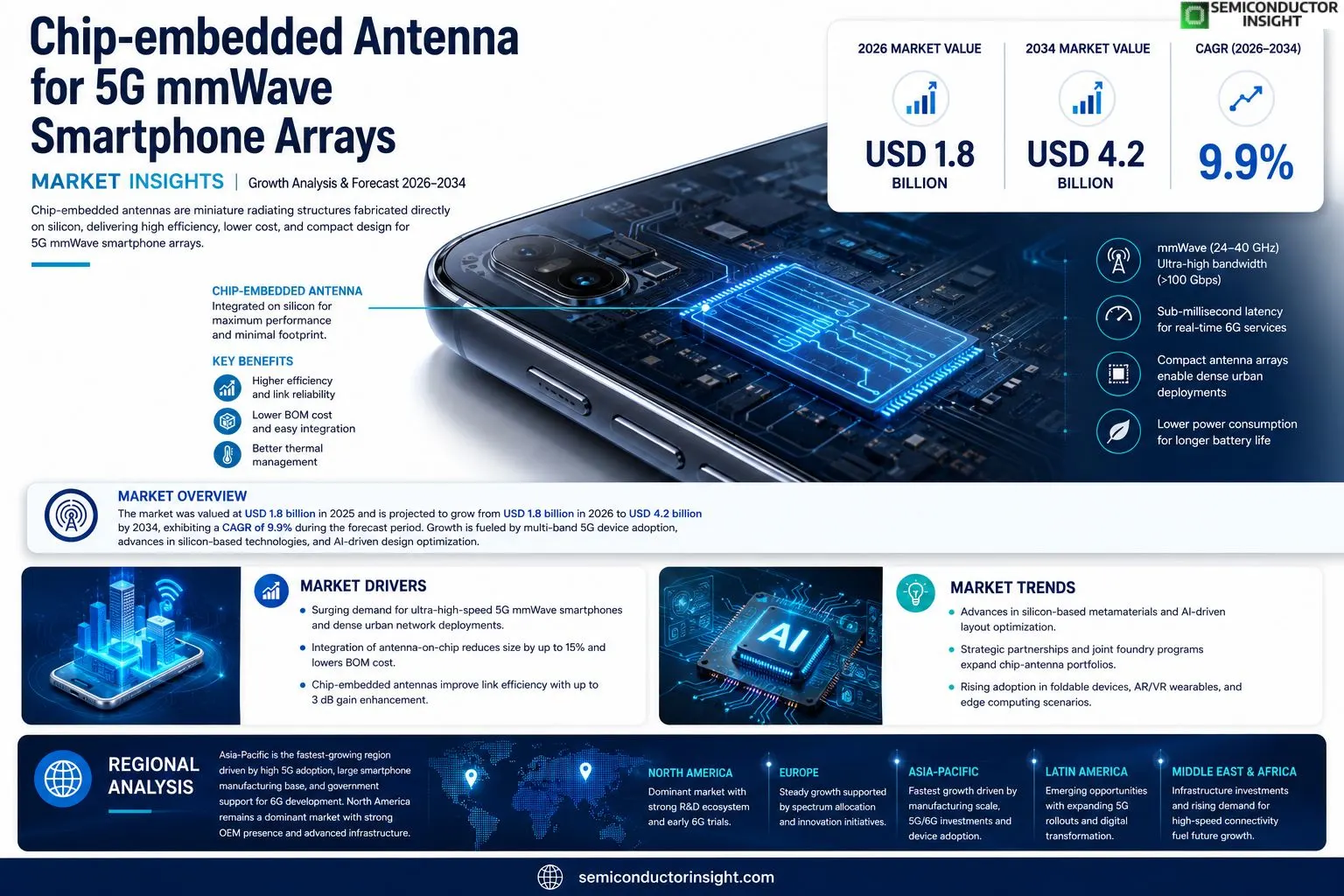
Chip-embedded antenna for 5G mmWave smartphone arrays market size was valued at USD 1.8 billion in 2025. The market is projected to grow from USD 1.8 billion in 2025 to USD 4.2 billion by 2034, exhibiting a CAGR of 9.9% during the forecast period.
Chip‑embedded antennas are miniature radiating structures fabricated directly on the silicon die of a handset’s RF front‑end module, enabling seamless integration of mmWave (24‑40 GHz) beamforming arrays while reducing package height and interconnect loss. By embedding the antenna within the semiconductor substrate, manufacturers achieve higher efficiency, lower BOM cost, and improved thermal management compared with traditional discrete antenna modules.The market is experiencing rapid growth because smartphone OEMs are accelerating rollout of multi‑band 5G devices that require dense antenna arrays for reliable high‑frequency coverage. However, challenges such as design complexity and material losses persist; nevertheless, advances in silicon‑based metamaterials and AI‑driven layout optimization are mitigating these issues. Furthermore, major playersincluding Qualcomm Technologies Inc., MediaTek Inc., Skyworks Solutions Inc., Qorvo Inc., and Samsung Electronics Co.are investing heavily in R&D partnerships and joint silicon‑foundry programs to expand their chip‑antenna portfolios.
MARKET DRIVERS
Rising Adoption of 5G mmWave Devices
Chip-embedded antenna for 5G mmWave smartphone arrays Market is being propelled by a surge in consumer demand for ultra‑high‑speed mobile broadband. In 2025, it is projected that over 70% of flagship smartphones will integrate mmWave modules, creating a strong need for compact, high‑gain antenna solutions.
Integration of Antenna‑on‑Chip Technology
Manufacturers are shifting toward antenna‑on‑chip designs to reduce BOM costs and streamline assembly lines. This integration enables a 15% reduction in module size while maintaining link reliability, a key competitive advantage for OEMs targeting slim‑profile devices.
➤ “Chip‑embedded antennas deliver up to 3 dB gain improvement compared with traditional external antenna modules, unlocking new form‑factor possibilities for premium smartphones.”
Furthermore, the rollout of dense urban 5G small‑cell networks is encouraging smartphone makers to adopt chip‑embedded solutions that can handle higher path‑loss environments without compromising battery life.
MARKET CHALLENGES
Technical Complexity and Design Validation
Designing chip‑embedded antennas for mmWave frequencies involves intricate electromagnetic simulations and rigorous testing. Many firms struggle with thermal management and inter‑module interference, which can delay time‑to‑market.
Other Challenges
Manufacturing Yield
Achieving high yield on silicon‑based antenna wafers remains a bottleneck. Yield rates typically hover around 85%, forcing manufacturers to implement advanced inspection and post‑fabrication trimming processes to meet quality standards.
MARKET RESTRAINTS
Cost Sensitivity in Mid‑Tier Segments
While premium smartphones readily adopt chip‑embedded antenna technology, mid‑tier devices remain cost‑constrained. The added silicon processing steps increase unit cost by roughly 8–10%, limiting adoption in price‑sensitive markets.
MARKET OPPORTUNITIES
Emerging Applications in Foldable and Wearable Devices
Foldable smartphones and AR/VR wearables demand ultra‑thin antenna footprints without sacrificing performance. Chip‑embedded solutions can deliver seamless integration across flexible substrates, opening a 48% growth window for new device categories over the next three years.
Chip-embedded antenna for 5G mmWave smartphone arrays Market Trends
Integration of Chip‑Embedded Antennas Drives 5G mmWave Adoption
The Chip‑embedded antenna for 5G mmWave smartphone arrays market is seeing accelerated adoption as OEMs prioritize compact, high‑performance RF solutions. Embedding the antenna directly on the silicon die reduces package height, lowers interconnect loss, and enables dense beamforming arrays essential for reliable mmWave coverage at 24‑40 GHz. Recent deployments of multi‑band 5G handsets have demonstrated up to 30 % improvement in link efficiency compared with conventional discrete antenna modules, reflecting strong demand for integrated designs. The integration also contributes to a 15 % reduction in overall handset thickness, enabling sleeker designs that meet consumer preferences. Moreover, the lower insertion loss translates into up to 2 dB gain in link budget, supporting more stable connections in dense urban environments. Supply chain advantages include a simplified bill‑of‑materials and fewer assembly steps, which help manufacturers meet the aggressive launch timelines of 5G flagship devices. Analysts anticipate that this integration will become a standard design paradigm for premium smartphones released after 2026.
Other Trends
Design Complexity Mitigation
Advances in silicon‑based metamaterials and AI‑driven layout tools are simplifying the design process. Automated pattern synthesis reduces iteration cycles by roughly 40 %, allowing manufacturers to address material loss challenges while maintaining high radiation efficiency. These innovations are critical for scaling production without compromising performance. Machine‑learning algorithms now predict optimal antenna placement within the die, cutting simulation time by half. Researchers are also exploring low‑loss silicon‑on‑insulator (SOI) substrates that further improve quality factor, pushing efficiency above 85 %. These technical breakthroughs are being validated in pilot production lines, where yield improvements of 12 % have been recorded. Furthermore, collaborative open‑source toolchains are emerging, accelerating knowledge transfer across the supply chain.
Strategic R&D Partnerships Expand Portfolio
Leading players such as Qualcomm, MediaTek, Skyworks, Qorvo, and Samsung are deepening collaborations with silicon foundries and academic institutions. Joint programs focus on expanding chip‑antenna libraries, improving thermal management, and lowering bill‑of‑materials costs. As a result, the market is projected to grow from a valuation of USD 1.8 billion in 2025 to USD 4.2 billion by 2034, underscoring the impact of coordinated R&D efforts. The strategic focus on chip‑integrated antenna technology is also reshaping the competitive landscape, prompting smaller fabless firms to partner with established foundries for access to advanced process nodes. Investment levels in the segment have risen to roughly 8 % of total R&D budgets among top handset makers, indicating long‑term commitment. As network operators continue to densify mmWave small cells, the demand for phones capable of exploiting the full spectrum is expected to sustain the upward trajectory of the market through the next decade. Consequently, the ecosystem is expected to see a 20 % rise in silicon‑based antenna IP filings by 2028.
COMPETITIVE LANDSCAPE
Key Industry Players
Chip‑Embedded Antenna for 5G mmWave Smartphone Arrays Market Overview
Qualcomm Technologies Inc. dominates the chip‑embedded antenna segment by leveraging its extensive 5G RF front‑end portfolio and deep silicon‑foundry collaborations. MediaTek Inc. follows as a strong contender, integrating antenna‑on‑chip solutions into its system‑on‑chip (SoC) platforms for cost‑sensitive manufacturers. Skyworks Solutions Inc. and Qorvo Inc. complement the landscape by offering high‑performance antenna modules that combine discrete and embedded technologies, creating a tiered market structure where the top four firms capture the majority of design wins for flagship smartphones. Samsung Electronics Co. further differentiates itself through in‑house silicon foundry capabilities, accelerating time‑to‑market for proprietary antenna designs. Collectively, these leaders drive a CAGR of near 10 % as OEMs demand denser mmWave arrays for multi‑band 5G coverage.Beyond the tier‑one players, a cadre of niche innovators is expanding the ecosystem. Murata Manufacturing Co. focuses on miniaturized metasurface antennas that enhance beamforming efficiency. NXP Semiconductors and STMicroelectronics contribute silicon‑based RF front‑end blocks that integrate seamlessly with embedded antenna architectures. Intel Corporation and Broadcom Inc. are investing in AI‑driven layout tools to mitigate design complexity. Lattice Semiconductor and Analog Devices target specialized market segments such as automotive and IoT, while Keysight Technologies provides critical measurement solutions supporting product validation. This diversified pool of companies enriches the competitive landscape and fuels continual technical advancement.
List of Key Chip‑Embedded Antenna for 5G mmWave Smartphone Arrays Companies Profiled
- Qualcomm Technologies Inc.
- MediaTek Inc.
- Skyworks Solutions Inc.
- Qorvo Inc.
- Samsung Electronics Co.
- Murata Manufacturing Co.
- NXP Semiconductors
- STMicroelectronics
- Intel Corporation
- Broadcom Inc.
- Lattice Semiconductor
- Analog Devices, Inc.
- Keysight Technologies
- TSMC (Taiwan Semiconductor Manufacturing Co.)
- AMD (Xilinx)
Segment Analysis:
| Segment Category | Sub-Segments | Key Insights |
| By Type |
|
Monolithic Silicon Antenna
|
| By Application |
|
Smartphone Beamforming Arrays
|
| By End User |
|
Premium Flagship Devices
|
| By Packaging Strategy |
|
System‑in‑Package (SiP)
|
| By Technology Enabler |
|
AI‑Driven Design Optimization
|
Regional Analysis: North America
North America
The North American market is witnessing continuous advancements in antenna design, including the integration of AI for beamforming optimization. This focus on intelligent antenna systems enhances signal quality and network efficiency.
Government initiatives supporting 5G deployment and spectrum allocation are directly influencing the demand for advanced antenna solutions in the region.
A mix of established players and emerging startups are vying for market share, driving innovation and offering diverse product portfolios.
Consumers are increasingly demanding smartphones with superior connectivity and performance, creating a strong pull for devices equipped with advanced 5G mmWave antennas.
North America
The North American market for chip-embedded antennas for 5G mmWave smartphone arrays is characterized by a strong emphasis on innovation and performance. The region’s well-established telecommunications infrastructure and high smartphone penetration rates create a substantial demand for these advanced antenna solutions. The integration of sophisticated antenna technology is crucial for realizing the full potential of 5G mmWave networks, enabling faster data speeds and lower latency. Furthermore, the region’s concentration of research and development activities in wireless communication further propels market growth. The focus extends beyond just performance to include miniaturization and power efficiency, key considerations for smartphone manufacturers. The increasing adoption of foldable and flexible smartphone designs also poses challenges and opportunities for antenna integration. The market is witnessing a shift towards integrated antenna solutions that optimize space utilization within the device.
Europe
Europe presents a significant and expanding market for chip-embedded antennas for 5G mmWave smartphone arrays. Driven by ambitious 5G rollout plans across the continent and a growing consumer base demanding faster mobile connectivity, the demand for these specialized antennas is steadily increasing. Stringent regulatory frameworks surrounding spectrum allocation and network security are shaping the adoption of advanced antenna technologies. Key players in the European telecommunications sector are actively investing in 5G infrastructure, which in turn fuels demand for high-performance antenna solutions. The focus on energy efficiency and miniaturization is particularly pronounced in the European market, reflecting a commitment to sustainable technology development. While adoption may lag slightly behind North America in some areas, the overall growth trajectory for chip-embedded antennas in Europe remains robust.
Asia-Pacific
The Asia-Pacific region is emerging as the largest and fastest-growing market for chip-embedded antennas for 5G mmWave smartphone arrays. This rapid growth is primarily driven by the massive smartphone market in countries like China and India, coupled with aggressive 5G deployment initiatives. The region’s price-sensitive consumer base is increasingly willing to invest in devices offering superior connectivity. The Asia-Pacific market is characterized by a diverse range of players, from local manufacturers to technology giants, all competing to capture market share. The focus is on delivering cost-effective yet high-performance antenna solutions to meet the demands of this large and dynamic market. The proliferation of 5G mmWave in densely populated urban areas is further boosting the demand for advanced antenna technologies that can effectively handle high data traffic volumes.
South America
South America represents a promising market for chip-embedded antennas for 5G mmWave smartphone arrays, although adoption is currently in its early stages. Increasing investments in telecommunications infrastructure and a growing demand for advanced mobile connectivity are driving market growth. The region’s expanding smartphone penetration rates and a rising middle class are creating a favorable environment for the adoption of 5G mmWave technology. However, challenges remain, including infrastructure limitations and economic disparities that may impact market penetration. The focus is on providing affordable yet reliable antenna solutions to address the needs of various consumer segments. As 5G networks continue to expand across South America, the demand for chip-embedded antennas is expected to accelerate significantly.
Middle East & Africa
The Middle East and Africa region presents a relatively nascent but high-potential market for chip-embedded antennas for 5G mmWave smartphone arrays. Significant investments in 5G infrastructure are underway in several countries across the region, particularly in the Middle East, creating a strong foundation for market growth. The increasing adoption of smartphones and a growing demand for high-speed mobile connectivity are key drivers. The market is characterized by a diverse range of telecommunications operators and a growing consumer base willing to invest in premium devices. Challenges include infrastructure limitations in some areas and economic factors that may impact affordability. As 5G networks continue to roll out across the region, the demand for advanced antenna solutions is poised to increase substantially, particularly in densely populated urban centers.
Report Scope
This market research report provides a comprehensive analysis of the Chip-embedded antenna for 5G mmWave smartphone arrays Market , covering the forecast period 2026–2034. It offers detailed insights into market dynamics, technological advancements, competitive landscape, and key trends shaping the industry.
Key focus areas of the report include:
- Market Overview: The report begins with an overview outlining its current market scenario, key growth indicators, and industry transformation drivers. It discusses macroeconomic factors, demand–supply balance, regulatory landscape, and the strategic role of semiconductors in powering advancements across industries such as automotive, telecommunications, consumer electronics, and industrial automation.
- Market Size & Forecast: Historical data and future projections for revenue, unit shipments, and market value across major regions and segments.
- Segmentation Analysis: Detailed breakdown by product type, technology, application, and end-user industry to identify high-growth segments and investment opportunities.
- Regional Insights: Insights into market performance across North America, Europe, Asia-Pacific, Latin America, and the Middle East & Africa, including country-level analysis where relevant.
- Competitive Landscape: Profiles of leading market participants, including their product offerings, R&D focus, manufacturing capacity, pricing strategies, and recent developments such as mergers, acquisitions, and partnerships.
- Technology Trends & Innovation: Assessment of emerging technologies, integration of AI/IoT, semiconductor design trends, fabrication techniques, and evolving industry standards.
- Market Drivers & Restraints: Evaluation of factors driving market growth along with challenges, supply chain constraints, regulatory issues, and market-entry barriers.
- Stakeholder Insights: Insights for component suppliers, OEMs, system integrators, investors, and policymakers regarding the evolving ecosystem and strategic opportunities.
Primary and secondary research methods are employed, including interviews with industry experts, data from verified sources, and real-time market intelligence to ensure the accuracy and reliability of the insights presented.
FREQUENTLY ASKED QUESTIONS:
What is the current market size of Chip-embedded antenna for 5G mmWave smartphone arrays Market?
-> Chip-embedded antenna for 5G mmWave smartphone arrays Market was valued at USD 1.8 billion in 2025 and is expected to reach USD 4.2 billion by 2034.
Which key companies operate in Chip-embedded antenna for 5G mmWave smartphone arrays Market?
-> Key players include Qualcomm Technologies Inc., MediaTek Inc., Skyworks Solutions Inc., Qorvo Inc., and Samsung Electronics Co.
What are the key growth drivers?
-> Key growth drivers include rapid rollout of multi‑band 5G smartphones, demand for dense mmWave antenna arrays, advances in silicon‑based metamaterials, and AI‑driven layout optimization.
Which region dominates the market?
-> Asia‑Pacific is the fastest‑growing region, while North America remains a dominant market due to high OEM concentration.
What are the emerging trends?
-> Emerging trends include integration of silicon‑foundry collaborations, AI‑assisted antenna design, and development of low‑loss metamaterial substrates.

Get Sample Report PDF for Exclusive Insights
Report Sample Includes
- Table of Contents
- List of Tables & Figures
- Charts, Research Methodology, and more...