
Key Statistics
Key Takeaways
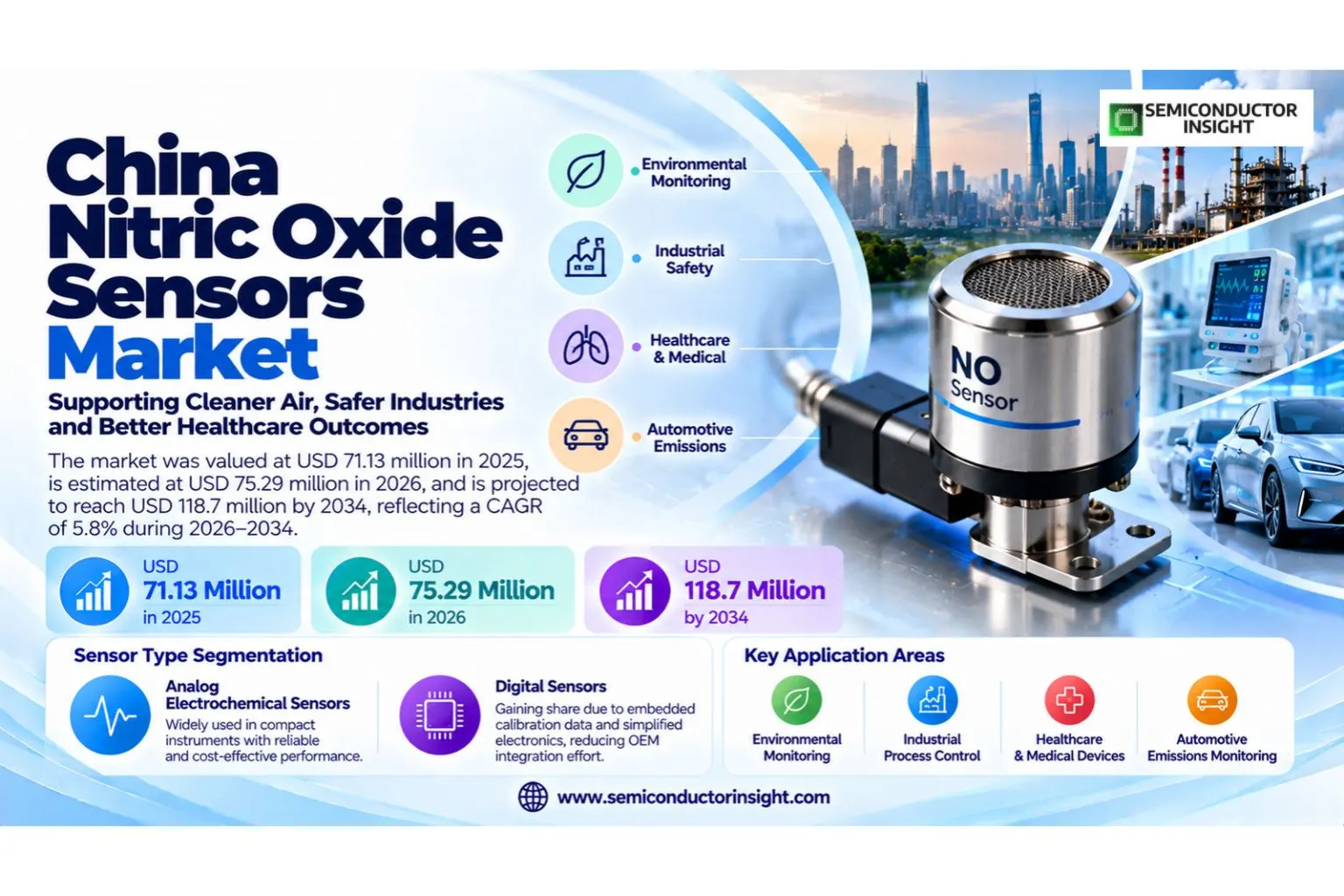
- The market is valued at USD 71.13 million in 2025 and is projected to reach USD 118.7 million by 2034, representing a 5.8% CAGR over 2026–2034.
- Digital Sensor is a major product segment, while adjacent technology variants are expanding as performance, integration and cost requirements evolve.
- Chemical Industry is a leading application area, supported by rising deployment across Pharmaceutical & Medical, Laboratory.
- East China is the largest market in 2025, reflecting the current concentration of demand, manufacturing capacity and ecosystem maturity.
China Nitric Oxide Sensors Market Overview
China Nitric Oxide Sensors detect NO concentrations in industrial, environmental, automotive, laboratory and medical settings. The most common commercial devices are electrochemical sensors that convert nitric-oxide reactions at a working electrode into a current proportional to gas concentration, with different cell formats optimized for ppm safety monitoring or ppb air-quality measurement.
China’s market benefits from large chemical and manufacturing industries, tightening emissions monitoring, urban air-quality networks and a growing domestic instrumentation sector. Product differentiation centers on sensitivity, cross-gas rejection, humidity and temperature stability, response time, calibration support and the ability to integrate sensors into compact connected instruments. Suppliers that connect technical improvements to measurable gains in throughput, energy use, form factor, lifecycle cost or engineering productivity are better positioned to win long-duration programs and repeat business.
Segment Analysis: By Type
Analog electrochemical outputs remain widely used in compact instruments, while digital variants gain share because embedded calibration data and simplified electronics reduce OEM integration effort. This segmentation increasingly reflects distinct cost-performance tradeoffs, so customers compare not only specifications but also integration effort, reliability evidence and expected product lifecycle before selecting a platform.
| Type | Market relevance |
|---|---|
| Digital Sensor | Integrated calibration and simpler system interfaces. |
| Analog Sensor | Lowest-cost and broadly established output format. |
Segment Analysis: By Application
Industrial safety and emissions monitoring provide broad recurring demand, while medical nitric-oxide monitoring is a smaller high-specification segment requiring tight calibration and response performance. Application requirements differ materially in duty cycle, environmental conditions and qualification burden, which makes customer-specific engineering support an important part of supplier competitiveness.
| Application | Market relevance |
|---|---|
| Chemical Industry | Process and worker safety. |
| Pharmaceutical & Medical | Medical gas and therapeutic NO monitoring. |
| Laboratory | Research and analytical measurement. |
| Automotive & Emissions | Combustion and exhaust measurement. |
| Environmental Monitoring | Ambient air-quality monitoring. |
Segment Analysis: By Sensing Technology
Electrochemical sensing dominates portable and fixed instruments because it offers compact size, selectivity and low power. Optical systems serve higher-end analyzers, while semiconductor and MEMS approaches target miniaturized future designs. Technology choice depends on concentration range, selectivity, response time, environmental stability and the acceptable balance between sensor cost and instrument complexity.
| Sensing Technology | Market relevance |
|---|---|
| Electrochemical | Commercial workhorse for ppm and ppb detection. |
| Optical / Spectroscopic | Higher-cost precision analytical systems. |
| Semiconductor / MEMS | Miniaturization and integration opportunity. |
Segment Analysis: By Deployment
Fixed installations lead industrial and emissions monitoring, portable instruments support field and personal safety, and OEM embedded sensors are gaining share as analyzers become more integrated. Deployment architecture influences maintenance, calibration, power consumption and data connectivity, so buyers often optimize around total operating requirements rather than sensor price alone.
| Deployment | Market relevance |
|---|---|
| Portable | Handheld and wearable use. |
| Fixed | Continuous facility and air monitoring. |
| OEM Embedded | Built directly into analyzers and medical devices. |
Regional Analysis
East China is the largest regional market because it combines dense chemical manufacturing, electronics production, research institutions and major urban air-quality monitoring networks, while North and South China provide substantial environmental, automotive and industrial demand. Regional leadership also reflects the density of qualified suppliers, engineering support, local manufacturing investment and the speed at which new China Nitric Oxide Sensors designs can move from evaluation into repeat production.
| Region | 2025 Position | Growth Outlook | Demand Profile |
|---|---|---|---|
| East China | Largest | Strong | Chemical, electronics and urban monitoring led |
| North China | Large environmental market | Strong | Air quality, energy and industrial led |
| South China | Fast-growing | Strong | Electronics, manufacturing and automotive led |
| Central & Western China | Developing | Moderate-strong | Industrial and environmental led |
| Medical & National Programs | High-value niche | Moderate | Medical gas and laboratory led |
Detailed Regional Blocks
Why is East China important to this market?
East China leads because provinces and municipalities such as Jiangsu, Zhejiang and Shanghai contain large chemical, pharmaceutical, electronics and research ecosystems. Dense cities also support sophisticated air-quality monitoring and environmental instrumentation demand. In East China, procurement decisions also depend on service coverage, qualification resources, logistics and long-term availability, which can materially affect adoption even when underlying technology performance is similar.
| Country / Subregion | Role | Market Context |
|---|---|---|
| Shanghai | Instrumentation and research hub | Laboratories, hospitals and environmental monitoring support high-value sensors. |
| Jiangsu | Chemical and manufacturing base | Industrial safety and emissions create recurring demand. |
| Zhejiang | Manufacturing and electronics | OEM instrument production supports embedded sensors. |
- Alphasense offers ppb-capable four-electrode NO sensors for fixed air-quality networks, illustrating the performance tier relevant to dense urban monitoring.
- Industrial sites typically require ppm-range sensors with fast response and long service life rather than ultra-low detection limits.
- Local instrument makers increasingly value digital sensor variants that simplify calibration transfer and field servicing.
Why is North China important to this market?
North China has substantial demand from air-quality monitoring, power generation, heavy industry and research, particularly around Beijing, Tianjin and Hebei. Seasonal pollution and emissions-control programs create strong measurement requirements. In North China, procurement decisions also depend on service coverage, qualification resources, logistics and long-term availability, which can materially affect adoption even when underlying technology performance is similar.
| Country / Subregion | Role | Market Context |
|---|---|---|
| Beijing | Air-quality and research hub | Government monitoring and laboratories drive sensitive NO measurement. |
| Tianjin | Industrial and port economy | Industrial safety and emissions create demand. |
| Hebei | Heavy industry base | Combustion and process monitoring support sensor use. |
- ppb-level electrochemical sensors are suitable for distributed air-quality networks when paired with low-noise electronics and calibration.
- Combustion monitoring requires broader concentration ranges than urban ambient sensing.
- Fixed installations value humidity stability because outdoor and industrial environments can be challenging.
Why is South China important to this market?
South China is growing through Guangdong’s electronics, automotive and instrument manufacturing base. OEM integration creates demand for compact sensors that can be embedded into portable and connected analyzers. In South China, procurement decisions also depend on service coverage, qualification resources, logistics and long-term availability, which can materially affect adoption even when underlying technology performance is similar.
| Country / Subregion | Role | Market Context |
|---|---|---|
| Guangdong | Electronics manufacturing hub | OEM instrument and automotive supply chains support sensor integration. |
| Shenzhen | Connected-device ecosystem | Portable and digital monitoring devices support compact sensors. |
| Guangxi | Industrial niche | Chemical and environmental monitoring create selected demand. |
- Miniature D- and H-series NO sensors demonstrate how electrochemical cells can fit wearable and handheld devices.
- Automotive and industrial analyzers favor sensors with fast response and stable calibration.
- Electronics manufacturing supports local development of digital front ends and connected monitoring systems.
Why is Central & Western China important to this market?
Central and Western China demand is expanding through chemicals, energy, mining and environmental monitoring. The market is more dispersed, so rugged fixed sensors and portable safety instruments are particularly relevant. In Central & Western China, procurement decisions also depend on service coverage, qualification resources, logistics and long-term availability, which can materially affect adoption even when underlying technology performance is similar.
| Country / Subregion | Role | Market Context |
|---|---|---|
| Sichuan | Industrial and research market | Chemical and laboratory demand support sensors. |
| Hubei | Manufacturing and automotive | Industrial monitoring creates recurring use. |
| Shaanxi | Energy and research | Combustion and scientific applications create niche demand. |
- Portable electrochemical instruments are useful where fixed monitoring networks are sparse.
- Industrial safety customers prioritize simple maintenance and predictable sensor replacement intervals.
- Local service and calibration support materially affect supplier selection outside major coastal clusters.
Why is Medical & National Programs important to this market?
Medical nitric-oxide sensing is a smaller but technically demanding national market because therapeutic NO systems require precise monitoring of delivered gas and related species. Hospitals and device manufacturers value calibrated sensors with documented response and quality controls. In Medical & National Programs, procurement decisions also depend on service coverage, qualification resources, logistics and long-term availability, which can materially affect adoption even when underlying technology performance is similar.
| Country / Subregion | Role | Market Context |
|---|---|---|
| National hospital networks | Medical gas monitoring | Therapeutic and diagnostic applications require reliable sensors. |
| Medical-device OEMs | Embedded sensor demand | Digital integration and calibration are important. |
| Research institutes | Analytical use | NO biology and combustion studies support specialized sensors. |
- Honeywell’s iNO M is a medical nitric-oxide sensor using four-electrode electrochemical technology.
- Medical NO sensing emphasizes controlled response and documented sensor performance rather than lowest component cost.
- Clinical and research demand is concentrated in large hospitals and specialist device programs.
Competitive Landscape
Competition includes international electrochemical sensor suppliers such as Alphasense and Honeywell alongside Chinese gas-sensor and instrument companies. International brands compete on calibration stability and documented performance, while local suppliers benefit from cost, regional service and integration with domestic monitoring systems.
| Company | Position | Relevant capability |
|---|---|---|
| Alphasense | Key participant | Broad NO portfolio from ppb-level air-quality cells to 5,000ppm industrial sensors. |
| Honeywell / City Technology | Key participant | Industrial and medical electrochemical NO sensors with established OEM qualification. |
| Membrapor | Key participant | Competes through product breadth, integration capability, qualification and customer support. |
| Winsen Electronics | Key participant | Domestic gas-sensor supplier serving industrial and environmental monitoring. |
| Hanwei Electronics | Key participant | Competes through product breadth, integration capability, qualification and customer support. |
| Cubic Sensor and Instrument | Key participant | Competes through product breadth, integration capability, qualification and customer support. |
| Dalian Actech | Key participant | Competes through product breadth, integration capability, qualification and customer support. |
Production Capacity Analysis
Sensor manufacturing combines electrode chemistry, electrolyte filling, membrane control, clean assembly, aging and calibration. Output can scale more easily than semiconductor wafer fabs, but consistent electrochemistry and lot-to-lot calibration remain critical. Scaling output without degrading consistency requires disciplined process control, robust incoming-material specifications and final test coverage that detects drift before product reaches high-value customer systems.
China has a large domestic gas-sensor and instrument manufacturing base, while premium medical and low-noise air-quality segments continue to use international suppliers. Effective capacity includes calibration and field-support infrastructure. As demand expands, second-source planning and regional service capability become increasingly important because customers want supply continuity without repeating lengthy qualification work for every production change.
Market Dynamics
The market spans very different detection regimes, from ppb urban air-quality monitoring to thousands of ppm in industrial emissions. Suppliers cannot optimize one sensor for every use case, so portfolios are segmented by package size, concentration range and electrode architecture. This is changing competitive behavior because vendors increasingly sell a complete performance and integration proposition rather than a single component or software feature in isolation.
Digitalization is increasing value around the sensing element. OEMs increasingly want stored calibration data, temperature compensation and smart analogue front ends so instruments can be serviced quickly without lengthy recalibration after sensor replacement. Buyers are consequently evaluating total ownership cost, qualification effort and roadmap stability over the life of a program rather than relying on a single benchmark or initial purchase price.
Market Drivers
| Factor | Analyst Interpretation |
|---|---|
| Environmental monitoring | Urban air-quality networks and emissions regulation sustain NO measurement demand. |
| Industrial safety | Chemical, combustion and manufacturing sites require toxic-gas monitoring. |
| Medical NO therapy | Medical devices need dedicated sensors for delivered nitric oxide. |
| Connected instruments | Digital sensors simplify integration into networked monitoring systems. |
Market Restraints
| Factor | Analyst Interpretation |
|---|---|
| Cross-sensitivity | Electrochemical sensors can respond to interfering gases and require filtering or compensation. |
| Calibration drift | Sensor sensitivity changes over time and environmental conditions. |
| Replacement cycles | Electrochemical cells have finite operating lives and must be maintained. |
| Application fragmentation | Different concentration ranges and environments require multiple sensor designs. |
Market Opportunities
| Factor | Analyst Interpretation |
|---|---|
| ppb air-quality sensors | Four-electrode low-noise designs can support denser ambient monitoring networks. |
| Digital smart sensors | Stored calibration and digital output can reduce OEM integration effort. |
| Miniature wearable sensors | Smaller cells can expand personal and industrial safety devices. |
| Domestic OEM localization | Chinese instrument makers can source more integrated local sensor modules. |
Supply Chain Analysis
The supply chain combines specialty electrodes, electrolytes, membranes, precision plastic packaging, analogue front-end electronics and instrument calibration. Reliable performance depends on chemistry and manufacturing consistency rather than only mechanical assembly. Traceability and coordination between upstream material or component suppliers, integrators and final OEMs are critical because failures found late in the chain can be far more expensive than the underlying part itself.
| Supply Chain Stage | Role in the Market |
|---|---|
| Electrode and electrolyte materials | Catalytic electrodes and electrolytes determine selectivity and sensitivity. |
| Sensor-cell assembly | Membranes, electrodes and packages are assembled under controlled conditions. |
| Calibration and electronics | Sensors are aged, calibrated and paired with analogue or digital front ends. |
| Instrument integration | Cells enter fixed monitors, handheld instruments, medical devices and analyzers. |
Recent Developments
| Date | Development | Source |
|---|---|---|
| July 2026 | Honeywell updated its iNO M medical nitric-oxide sensor documentation for healthcare applications using four-electrode electrochemical sensing. | Honeywell |
| 2026 | Alphasense continues a broad NO portfolio spanning 0–20ppm ppb-level air-quality sensors through 0–5,000ppm industrial sensors. | Alphasense |
| 2026 | Alphasense's NO-B4 remains positioned for ppb-capable fixed air-quality monitoring with four-electrode architecture and low-noise performance. | Alphasense |
Report Scope & Segmentation
| Scope Item | Coverage |
|---|---|
| Base Year | 2025 |
| Estimated Year | 2026 |
| Forecast Period | 2026–2034 |
| 2025 Market Size | USD 71.13 million |
| 2026 Estimated Size | USD 75.29 million |
| 2034 Forecast Size | USD 118.7 million |
| CAGR (2026–2034) | 5.8% |
| Largest Market in 2025 | East China |
| Category | Sensors / Gas Sensors / Nitric Oxide Detection / China |
| By Type | Digital Sensor, Analog Sensor |
| By Application | Chemical Industry, Pharmaceutical & Medical, Laboratory, Automotive & Emissions, Environmental Monitoring |
| By Sensing Technology | Electrochemical, Optical / Spectroscopic, Semiconductor / MEMS |
| By Deployment | Portable, Fixed, OEM Embedded |
Frequently Asked Questions
What is the 2025 market size of the China Nitric Oxide Sensors market?
The market is valued at USD 71.13 million in 2025.
What is the projected 2034 market size of the China Nitric Oxide Sensors market?
The market is projected to reach USD 118.7 million by 2034.
What is the CAGR of the China Nitric Oxide Sensors market from 2026 to 2034?
The market is expected to expand at a CAGR of 5.8% during 2026–2034.
Which region leads the China Nitric Oxide Sensors market?
East China is the largest market in 2025 based on the current demand, manufacturing and deployment structure.
Which type segment is important in the China Nitric Oxide Sensors market?
Digital Sensor is a major segment, while adjacent product variants are gaining share as performance and integration requirements evolve.
What is the main application for China Nitric Oxide Sensors products?
Chemical Industry is a leading application, with additional growth coming from Pharmaceutical & Medical, Laboratory.
What drives growth in the China Nitric Oxide Sensors market?
Urban air-quality networks and emissions regulation sustain NO measurement demand.
What is a key restraint for the China Nitric Oxide Sensors market?
Electrochemical sensors can respond to interfering gases and require filtering or compensation.
Which companies participate in the China Nitric Oxide Sensors market?
Key participants include Alphasense, Honeywell / City Technology, Membrapor, Winsen Electronics, Hanwei Electronics, alongside other specialized suppliers and system companies.
What technology trend is shaping the China Nitric Oxide Sensors market?
Four-electrode low-noise designs can support denser ambient monitoring networks.
Research Sources & Evidence Base
View research sources used for this overview.
- Alphasense — Nitric Oxide Sensors: Current NO sensor portfolio, concentration ranges and electrochemical architecture. Source
- Alphasense — NO-B4: ppb-capable four-electrode NO sensor for air-quality monitoring. Source
- Honeywell — I Series M Medical Gas Sensors: Current medical nitric-oxide sensor documentation. Source
Get Sample Report PDF for Exclusive Insights
Report Sample Includes
- Table of Contents
- List of Tables & Figures
- Charts, Research Methodology, and more...
 Download Sample Report PDF


