China AI Training GPU Market Insights
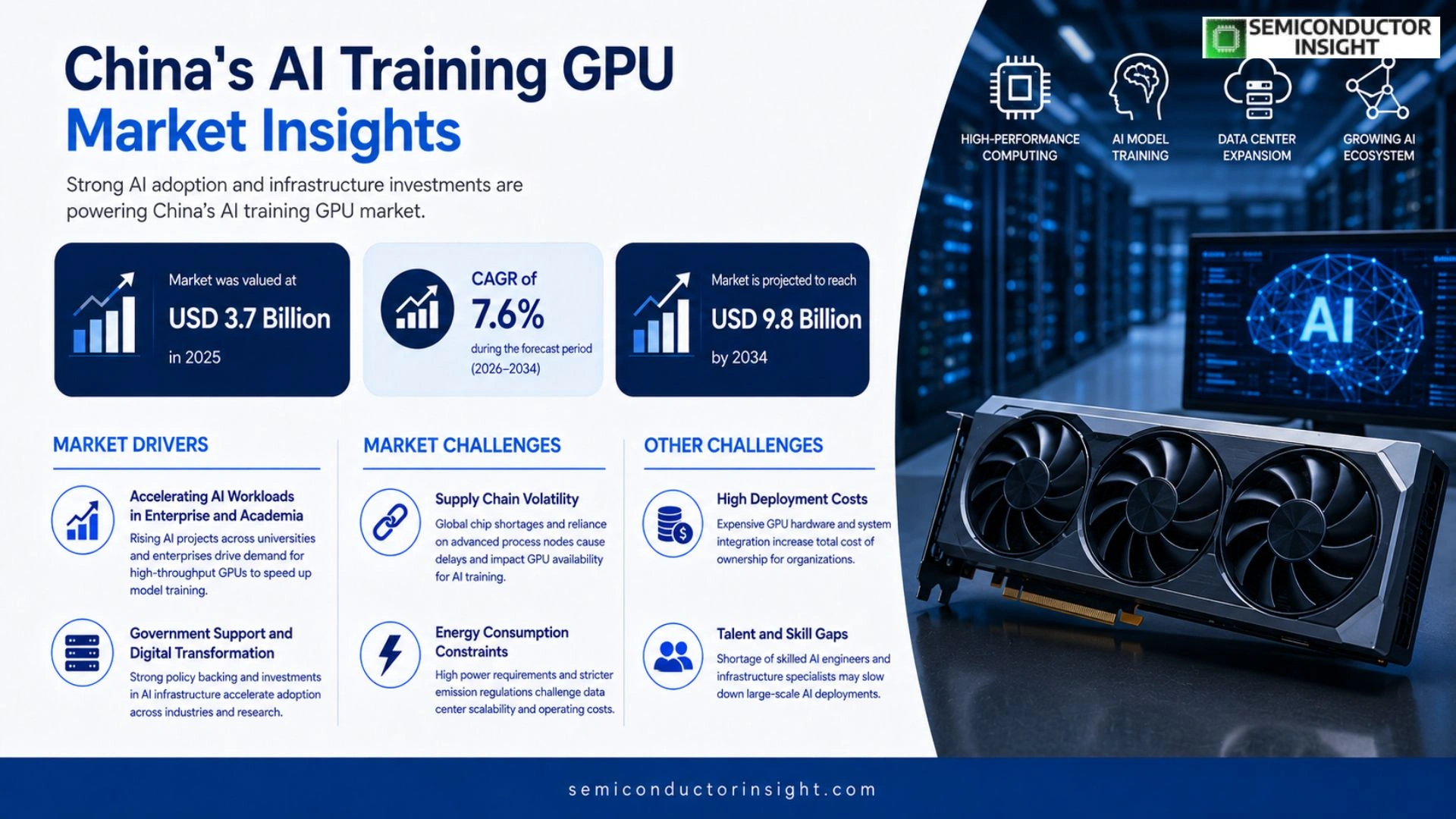
China’s AI training GPU market was valued at USD 3.7 billion in 2025. The market will increase from USD 4.1 billion in 2026 to USD 9.8 billion by 2034, showing a CAGR of roughly 7.6% over the period.
AI training GPUs are high‑performance graphics processors designed specifically for deep‑learning workloads such as large language model pre‑training and computer‑vision inference acceleration. These devices combine massive parallel cores, high‑bandwidth memory (HBM2e) and specialized tensor operations that reduce time‑to‑train complex neural networks.
The expansion is fueled by strong governmental backing under the New Generation Artificial Intelligence Development Plan, which earmarks billions of yuan for domestic compute infrastructure.
Cloud providers including Alibaba Cloud and Baidu Cloud are scaling out fleets of NVIDIA H100 and AMD MI250X accelerators to meet rising demand from enterprises building generative‑AI services.
Key players such as NVIDIA, Huawei and Alibaba continue deepening partnerships with Chinese research institutes, accelerating the rollout of locally produced GPUs that lessen reliance on imported silicon.
MARKET DRIVERS
Accelerating AI Workloads in Enterprise and Academia
The surge in deep‑learning projects across Chinese universities and state‑backed enterprises has created a relentless demand for high‑throughput graphics processors. Organizations are migrating from traditional CPUs to purpose‑built GPUs to shorten model‑training cycles, a shift that directly fuels China AI Training GPU Market.
Policy Incentives and Strategic Funding
Recent national programmes allocate billions of yuan to AI infrastructure, explicitly earmarking resources for next‑generation compute platforms. This financial backing reduces capital barriers for firms seeking to upgrade their training clusters, encouraging broader adoption of advanced GPU solutions.
➤ “The alignment of research grants with hardware procurement creates a virtuous loop, where faster training leads to more breakthroughs, which in turn justifies further investment.”
In parallel, the emergence of domestic GPU manufacturers offering competitive performance‑per‑dollar ratios has begun to erode reliance on imported components, adding a cost‑efficiency advantage that resonates with budget‑conscious Chinese operators.
MARKET CHALLENGES
Supply Chain Volatility
Global semiconductor shortages continue to ripple through the Chinese market, causing lead‑time extensions for the latest training GPUs. Even with local fabs scaling capacity, the reliance on specialised process nodes abroad introduces periodic bottlene‑cks that can stall project timelines.
Other Challenges
Energy Consumption Constraints
Data centers powering AI training workloads confront rising electricity costs and stricter emissions regulations. Operators must balance the pursuit of raw performance with the need for sustainable power management, a tension that can limit rapid fleet expansion.
MARKET RESTRAINTS
Regulatory Oversight on AI Deployments
China’s evolving AI governance framework introduces compliance checkpoints that can delay procurement cycles for training hardware. Firms must demonstrate alignment with ethical guidelines and data‑security standards before scaling GPU clusters, a process that adds administrative overhead.
MARKET OPPORTUNITIES
Specialized Software‑Hardware Co‑Design
Collaboration between GPU vendors and AI framework developers is unlocking performance gains that are not achievable through hardware alone. Tailored libraries and compiler optimisations specific to Chinese language models present a fertile ground for firms to differentiate their offerings within China AI Training GPU Market.
China AI Training GPU Market Trends
Accelerating Adoption of High‑End Tensor GPUs
China AI Training GPU Market is witnessing a rapid upscale in capacity as enterprises move from prototype to production‑grade models. Valued at roughly USD 3.7 billion in 2025, the segment is projected to climb toward USD 9.8 billion by 2034, reflecting sustained investment across cloud, automotive and healthcare verticals. Central to this trajectory is the New Generation Artificial Intelligence Development Plan, which earmarks billions for domestic compute infrastructure. Cloud operators such as Alibaba Cloud and Baidu Cloud have already expanded their fleets with NVIDIA H100 and AMD MI250X accelerators, securing the hardware needed to train large language models and vision transformers. The convergence of policy support, scale‑up in data‑center footprints, and the pressing need to shorten model‑training cycles creates a feedback loop that pushes spending deeper into the high‑performance GPU tier.
Other Trends
Domestic Chip Initiatives
Home‑grown players are reshaping supply dynamics within China AI Training GPU Market. Huawei’s Ascend series and Alibaba’s proprietary accelerator chips now appear alongside imported solutions, offering comparable throughput while reducing exposure to external trade constraints. Strategic collaborations with leading research institutes accelerate firmware optimisation for the unique characteristics of Chinese data workloads. These alliances not only diversify the hardware ecosystem but also generate a competitive pricing environment that forces global vendors to revisit margin structures. The shift toward locally produced silicon is further reinforced by tax incentives and fast‑track certification pathways, encouraging startups to enter the accelerator space and broaden the portfolio of specialised tensors for AI training.
Emergence of Generative AI Workloads
Generative AI has become the most compelling use case driving demand for compute‑intensive training cycles. Companies developing chat‑based assistants, image synthesis platforms, and code‑generation tools require GPUs that can sustain petaflop‑level tensor operations for weeks at a time. This pressure translates into higher average utilisation rates for data‑center fleets and stimulates a market preference for GPUs with larger HBM2e memory pools and advanced sparsity support. For hardware vendors, the implication is clear: product roadmaps must prioritise memory bandwidth scaling and energy‑efficiency innovations to remain attractive. Service providers, meanwhile, face the strategic choice of either expanding on‑premise capacity or partnering with hyperscale hyperscalers that can absorb the bursty training demands. The ripple effect reshapes pricing models, elevates the importance of after‑sales support, and accelerates the convergence of AI‑specific hardware with broader cloud service offerings.
COMPETITIVE LANDSCAPE
Key Industry Players
China AI Training GPU Market – Competitive Overview
The dominant position in China’s AI training GPU segment remains with NVIDIA, whose H100 architecture commands the majority of high‑end deployments across cloud hyperscalers and research institutions. The company’s sustained lead derives from a mature software ecosystem, extensive developer support, and a supply chain that, despite export controls, continues to meet domestic demand through localized assembly. Huawei, leveraging its Ascend series, has carved a parallel niche by aligning closely with government‑backed AI programs and offering integrated hardware‑software stacks that reduce reliance on foreign silicon. Alibaba Cloud and Baidu Cloud, while primarily service providers, have become de‑ facto accelerators for the market; they purchase large volumes of NVIDIA and AMD units, then augment them with proprietary management layers that create a hybrid competitive edge. Collectively, these players shape a tiered structure where global OEMs supply the core silicon, and Chinese cloud giants and telecom‑grade firms adapt the technology to local workloads and policy requirements.
Beyond the headline names, several domestic and regional firms are gaining traction in specialised segments. AMD’s MI250X finds adoption in cost‑sensitive training clusters, thanks to competitive pricing and strong memory bandwidth. Cambricon Technologies supplies custom AI‑focused GPUs to edge AI firms, capitalising on its deep integration with Chinese chip design policies. Horizon Robotics and Bitmain have pivoted from inference‑only solutions toward mixed‑precision training chips, targeting niche applications such as autonomous driving and cryptocurrency‑backed AI services. Intel’s China‑focused line, built on the Xe‑HPC architecture, is entering pilot programmes with state universities, while SMIC’s advanced packaging capabilities are beginning to support local fabless designers. Companies like Inspur, Sugon, and Great Wall continue to bundle GPU hardware with high‑density server solutions, reinforcing the ecosystem’s ability to scale rapidly across data centre tiers.
List of Key AI Training GPU Companies Profiled
- NVIDIA
- Huawei
- Alibaba Cloud
- AMD
- Cambricon Technologies
- Horizon Robotics
- Bitmain
- Intel China
- SMIC
- Inspur
- Sugon
- Great Wall
Segment Analysis:
| Segment Category | Sub-Segments | Key Insights |
| By Type |
|
High‑End Tensor GPUs
|
| By Application |
|
Large Language Model Training
|
| By End User |
|
Cloud Service Providers
|
| By Deployment Model |
|
On‑Premises Data Centers
|
| By Industry Vertical |
|
Healthcare & Life Sciences
|
Regional Analysis: China AI Training GPU Market
Asia‑Pacific
Recent policy drafts emphasize funding for domestic GPU R&D, tax incentives for fabs that adopt advanced nodes, and streamlined export licences for AI‑related components. These measures lower capital costs for manufacturers and embed China’s AI training hardware agenda within broader economic plans, prompting firms to prioritize regional investments over distant alternatives.
The proximity of silicon foundries in Taiwan and memory producers in South Korea creates a tightly knit supply network that can react swiftly to demand spikes from Chinese data centres. This geographical clustering shortens lead times and cushions the market against global component shortages, reinforcing the region’s leadership.
Universities such as Tsinghua and Shanghai Jiao Tong churn out graduates versed in both hardware design and deep‑learning workloads. The resulting talent pool enables startups to prototype custom accelerators that complement mainstream GPUs, fostering a vibrant innovation niche that sustains long‑term demand.
Beyond traditional data‑centre training, sectors like autonomous driving, real‑time video analytics, and generative content creation are scaling GPU consumption. These sectors, largely concentrated in the Asia‑Pacific, are prompting vendors to introduce specialized memory hierarchies and interconnects tailored to Chinese workloads.
North America
North America remains a pivotal reference market for architectural benchmarks, yet its influence on China AI Training GPU Market is largely indirect. U.S. chip designers continue to set performance standards, while American cloud providers serve as testing grounds for large‑scale models that Chinese firms later adapt. Geopolitical frictions have prompted Chinese customers to diversify sourcing, but the strategic insights derived from North American deployments still inform procurement strategies and product roadmaps across the Pacific rim.
Europe
European AI research consortia contribute sophisticated algorithmic frameworks that stress‑test GPU capabilities. While the continent does not host mass production of the silicon in question, its regulatory stance on data privacy pushes Chinese vendors to embed compliance features at the hardware level. This regulatory push creates niche opportunities for specialized GPU variants that balance performance with stringent data‑handling requirements, subtly shaping the product mix destined for Chinese training workloads.
South America
South America’s AI adoption is nascent, yet the region’s burgeoning cloud infrastructure offers a low‑cost testing arena for early‑stage GPU deployments. Brazilian and Argentine startups are beginning to experiment with training generative models, providing a peripheral market that can absorb overflow capacity from larger suppliers. Though modest in volume, this activity validates scaling strategies and helps Chinese manufacturers refine pricing tiers for emerging economies.
Middle East & Africa
Investment in smart‑city initiatives and oil‑field analytics drives incremental GPU demand across the Middle East & Africa. Partnerships between Chinese hardware exporters and regional telecom operators facilitate the rollout of edge‑focused inference nodes, which in turn generate feedback loops for training hardware requirements. While the absolute market size stays limited, the strategic importance of establishing footholds in these fast‑growing digital economies cannot be ignored by firms targeting China AI Training GPU market’s broader ecosystem.
Report Scope
This market research report provides a comprehensive analysis of the China AI Training GPU Market , covering the forecast period 2026–2034. It offers detailed insights into market dynamics, technological advancements, competitive landscape, and key trends shaping the industry.
Key focus areas of the report include:
- Market Overview: The report begins with an overview outlining its current market scenario, key growth indicators, and industry transformation drivers. It discusses macroeconomic factors, demand–supply balance, regulatory landscape, and the strategic role of semiconductors in powering advancements across industries such as automotive, telecommunications, consumer electronics, and industrial automation.
- Market Size & Forecast: Historical data and future projections for revenue, unit shipments, and market value across major regions and segments.
- Segmentation Analysis: Detailed breakdown by product type, technology, application, and end-user industry to identify high-growth segments and investment opportunities.
- Regional Insights: Insights into market performance across North America, Europe, Asia-Pacific, Latin America, and the Middle East & Africa, including country-level analysis where relevant.
- Competitive Landscape: Profiles of leading market participants, including their product offerings, R&D focus, manufacturing capacity, pricing strategies, and recent developments such as mergers, acquisitions, and partnerships.
- Technology Trends & Innovation: Assessment of emerging technologies, integration of AI/IoT, semiconductor design trends, fabrication techniques, and evolving industry standards.
- Market Drivers & Restraints: Evaluation of factors driving market growth along with challenges, supply chain constraints, regulatory issues, and market-entry barriers.
- Stakeholder Insights: Insights for component suppliers, OEMs, system integrators, investors, and policymakers regarding the evolving ecosystem and strategic opportunities.
Primary and secondary research methods are employed, including interviews with industry experts, data from verified sources, and real-time market intelligence to ensure the accuracy and reliability of the insights presented.
FREQUENTLY ASKED QUESTIONS:
What is the current market size of China AI Training GPU Market?
-> China AI Training GPU Market was valued at USD 3.7 billion in 2025 and is expected to reach USD 9.8 billion by 2034. The market is projected to grow from USD 4.1 billion in 2026, reflecting a CAGR of approximately 7.6% over the forecast period.
Which key companies operate in China AI Training GPU Market?
-> Key players include NVIDIA, Huawei, and Alibaba, which are actively expanding GPU production capacities, forming research collaborations, and deploying accelerators for domestic AI workloads.
What are the key growth drivers?
-> Key growth drivers include strong governmental backing under the New Generation Artificial Intelligence Development Plan, large-scale funding for domestic compute infrastructure, and rapid cloud‑provider adoption of NVIDIA H100 and AMD MI250X accelerators to support generative‑AI services.
Which region dominates the market?
-> Asia‑Pacific dominates China AI Training GPU market, with China accounting for the majority of regional demand due to its extensive AI research ecosystem and industrial applications.
What are the emerging trends?
-> Emerging trends include development of locally‑produced GPUs to reduce reliance on imported silicon, deeper partnerships between chipset manufacturers and Chinese research institutes, and the integration of high‑bandwidth memory (HBM2e) for accelerated large‑model training.
Get Sample Report PDF for Exclusive Insights
Report Sample Includes
- Table of Contents
- List of Tables & Figures
- Charts, Research Methodology, and more...
 Download Sample Report PDF