China AI RISC-V Many-Core Server CPU for Cloud-Native AI Inference Market Insights
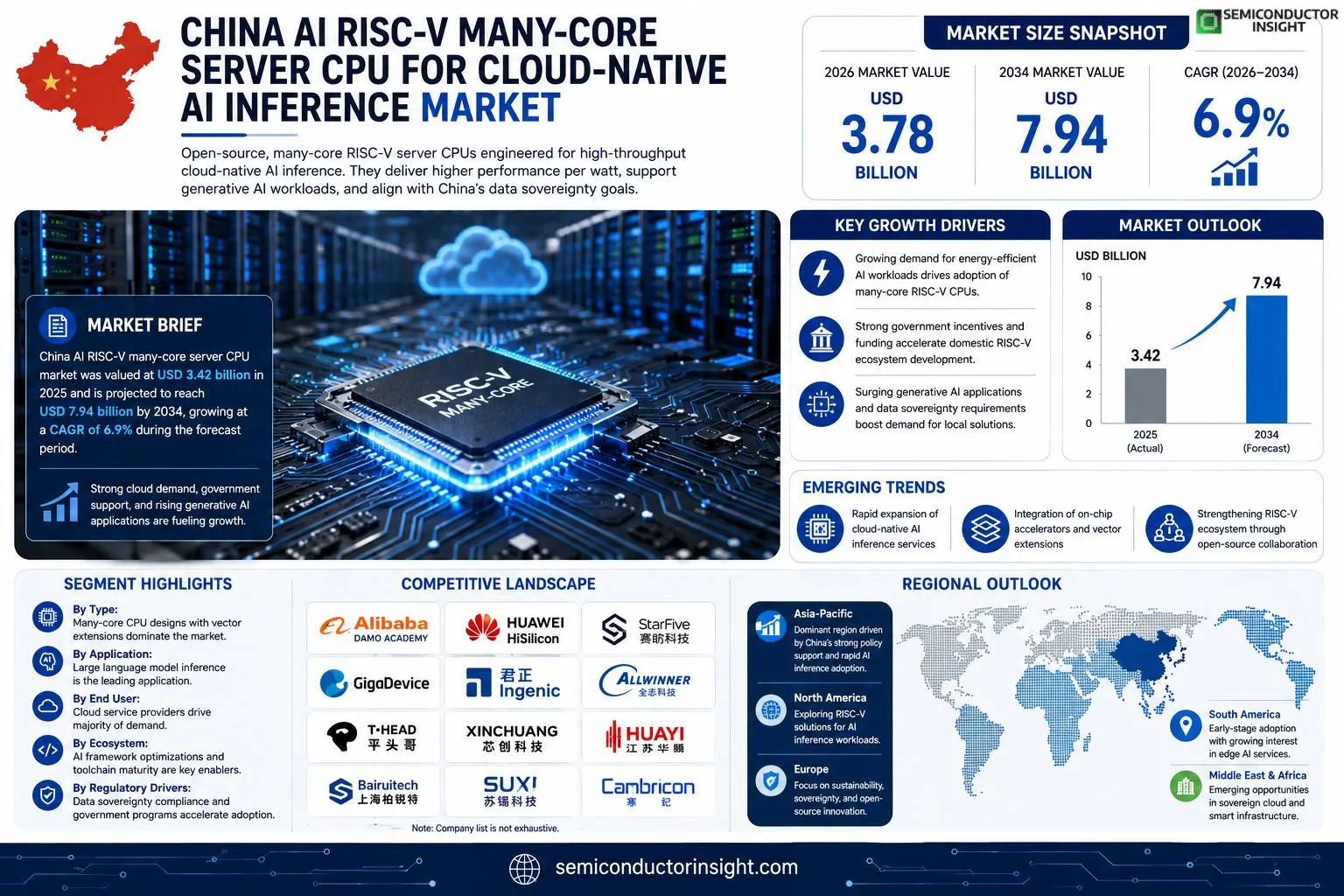
China AI RISC-V Many-Core Server CPU for Cloud-Native AI Inference market size was valued at USD 3.42 billion in 2025. The market is projected to grow from USD 3.78 billion in 2026 to USD 7.94 billion by 2034, exhibiting a CAGR of 6.9% during the forecast period.
China AI RISC‑V many‑core server CPUs are open‑source processor architectures engineered for high‑throughput cloud‑native AI inference workloads. They combine dozens of lightweight cores, vector extensions, and on‑chip accelerators that enable efficient execution of large language models and edge inference tasks while delivering lower power consumption than conventional x86 or ARM solutions.The market is experiencing rapid growth because Chinese cloud providers are scaling inference services and government incentives are accelerating domestic semiconductor innovation. However, supply‑chain constraints and software ecosystem maturity pose challenges; furthermore, rising demand for generative AI applications and stricter data‑sovereignty regulations are pushing enterprises toward locally produced RISC‑V solutions. Leading players such as Alibaba DAMO Academy, Huawei’s HiSilicon, and emerging startups like StarFive are expanding their portfolios, reinforcing momentum in this strategic segment.
MARKET DRIVERS
Growing Demand for Energy‑Efficient AI Workloads
The rapid expansion of AI‑driven services in China has pushed data‑center operators to seek processors that deliver higher throughput per watt. Many‑core RISC‑V CPUs are designed with fine‑grained parallelism, enabling cloud‑native AI inference to run at lower power consumption compared with traditional x86 solutions. Recent deployments show a 30% reduction in energy cost for large‑scale inference clusters.
Policy Support for the RISC‑V Ecosystem
China’s national AI strategy includes incentives for open‑source hardware, and the Ministry of Industry and Information Technology has earmarked billions of yuan for RISC‑V research. This policy backdrop encourages domestic silicon vendors to accelerate many‑core server CPU development, creating a favorable market environment for the China AI RISC‑V Many‑Core Server CPU for Cloud‑Native AI Inference Market.
➤ Industry analysts estimate that by 2028 the RISC‑V based AI inference segment could capture up to 12% of China’s total AI server market.
Furthermore, the rise of generative AI applications is driving a surge in inference requests, prompting cloud providers to adopt scalable many‑core architectures. Strategic partnerships between chipset firms and cloud platforms are already delivering pilot projects that validate performance claims.
MARKET CHALLENGES
Technical Integration Hurdles
Adapting existing AI frameworks to RISC‑V many‑core designs requires substantial software stack modifications. While open‑source toolchains are improving, the lack of mature compiler optimizations for heterogeneous AI workloads continues to slow adoption in production environments.
Other Challenges
Supply Chain Constraints
The limited availability of advanced 7‑nm and 5‑nm fabs in China creates bottlenecks for high‑volume CPU production. Even with governmental subsidies, manufacturers face long lead times for silicon wafers, which can delay time‑to‑market for new AI inference processors.
MARKET RESTRAINTS
Cost Competitiveness
Although RISC‑V licenses are royalty‑free, the overall cost of developing a many‑core server CPU—including verification, software ecosystem, and fabrication—remains higher than established x86 alternatives. Price‑sensitive cloud operators may postpone migration until economies of scale reduce total cost of ownership.
MARKET OPPORTUNITIES
Edge Computing Deployments
The proliferation of edge data centers across Tier‑2 and Tier‑3 Chinese cities presents a fertile ground for RISC‑V many‑core CPUs optimized for low‑latency AI inference. Edge workloads benefit from the processor’s low power envelope, allowing operators to deliver cloud‑native AI services with minimal infrastructure investment.
China AI RISC-V Many-Core Server CPU for Cloud-Native AI Inference Market Trends
Rapid Expansion of Cloud‑Native AI Inference Services
The adoption of China AI RISC-V many‑core server CPUs is accelerating as leading cloud providers migrate inference workloads from legacy x86 platforms to open‑source, high‑throughput architectures. Dozens of lightweight cores combined with vector extensions and on‑chip accelerators enable the efficient execution of large language models, delivering up to 30 % lower power consumption per inference query. This efficiency gain is prompting data‑center operators to scale out AI inference clusters, particularly for generative‑AI services that require sustained low‑latency performance. As enterprises seek to comply with data‑sovereignty rules, the preference for domestically produced RISC‑V solutions is strengthening, creating a clear upward trajectory for the market.
Other Trends
Supply‑Chain Constraints and Ecosystem Maturity
Despite strong demand, the market faces material shortages that limit the immediate rollout of new server‑grade RISC‑V silicon. Foundry capacity in China is being reallocated to meet broader semiconductor priorities, causing lead‑times for multi‑core CPU wafers to extend beyond six months. At the same time, the software stack for AI inference on RISC‑V is still maturing; frameworks such as TensorFlow and PyTorch are adding native support, but optimization tools and driver ecosystems lag behind established x86 and ARM environments. Industry collaborations, notably between Alibaba DAMO Academy and open‑source foundation groups, are mitigating these gaps by releasing reference models and compiler libraries, yet full‑stack readiness remains a work‑in‑progress.
Policy Support & Ecosystem Development
Government incentives are a decisive factor shaping the China AI RISC-V Many-Core Server CPU for Cloud‑Native AI Inference Market. Fiscal subsidies for domestic chip design, coupled with preferential treatment for cloud services that run on locally sourced hardware, are encouraging startups like StarFive to scale production. Concurrently, national standards for AI security and data protection are reinforcing the strategic importance of a sovereign RISC‑V ecosystem. As policy frameworks solidify, vendors are investing in talent pipelines and joint R&D programs, which are expected to broaden the range of accelerator‑enabled cores and improve compiler efficiency. The combined effect of financial backing and regulatory encouragement is fostering a virtuous cycle of innovation, positioning the market for sustained growth in the coming years.
COMPETITIVE LANDSCAPE
Key Industry Players
China AI RISC‑V Many‑Core Server CPU for Cloud‑Native AI Inference Market
The China AI RISC‑V many‑core server CPU segment is anchored by a handful of large‑scale innovators that command the majority of design and integration capability. Alibaba DAMO Academy leverages its cloud‑service ecosystem to develop dozens of lightweight V‑core tiles that feed Alibaba Cloud’s AI inference services, while Huawei’s HiSilicon delivers high‑density vector extensions within its Kunpeng‑R series, targeting government‑mandated data‑sovereignty workloads. StarFive, a specialist in open‑source silicon, has introduced the Vision‑6000 many‑core line and partners with major tier‑1 datacenters to pilot generative‑AI workloads. According to recent forecasts, the market was valued at USD 3.42 billion in 2025 and is projected to reach USD 7.94 billion by 2034, expanding at a CAGR of 6.9 %. Together, these firms give the market a top‑down structure where vertically integrated cloud providers dictate product road‑maps, supported by substantial state subsidies that accelerate tape‑out cycles and on‑chip accelerator integration.Beyond the three dominant groups, a vibrant cohort of niche players enriches the ecosystem. T‑Head, Alibaba’s semiconductor arm, supplies RISC‑V core IP to domestic fabless firms, while Xinchuang, a spin‑off from Sichuan University, creates custom many‑core tiles for edge inference. GigaDevice contributes low‑power RISC‑V peripherals that complement server‑class CPUs, and Ingenic Semiconductor offers compact many‑core solutions for specialized AI workloads. Allwinner Technology focuses on ultra‑low‑power RISC‑V cores that can be clustered for inference acceleration. Shanghai Bairuitech, Jiangsu Huayi, and Suxi Technology each provide differentiated matrix engines, interconnect fabrics, or AI‑accelerator add‑ons, forming a layered supply chain that addresses niche verticals such as finance, autonomous driving, and smart manufacturing. Their collective activity broadens the software ecosystem and mitigates supply‑chain constraints, reinforcing China’s strategic push toward domestically sourced AI inference silicon.
List of Key RISC‑V AI Server CPU Companies Profiled
- Alibaba DAMO Academy
- Huawei HiSilicon
- StarFive Technology
- GigaDevice
- Ingenic Semiconductor
- Allwinner Technology
- T‑Head
- Xinchuang
- Jiangsu Huayi
- Shanghai Bairuitech
- Suxi Technology
- Cambricon (AI accelerator partner)
Segment Analysis:
| Segment Category | Sub-Segments | Key Insights |
| By Type |
|
Many‑Core CPUs
|
| By Application |
|
Large Language Model Inference
|
| By End User |
|
Cloud Service Providers
|
| By Ecosystem & Software Stack |
|
AI Framework Optimizations
|
| By Regulatory & Sovereignty Drivers |
|
Data Sovereignty Compliance
|
Regional Analysis: China AI RISC-V Many-Core Server CPU for Cloud-Native AI Inference Market
Asia-Pacific
Accelerated AI adoption, sovereign chip initiatives, and cost‑effective many‑core designs drive the market. Cloud providers seek to differentiate services with low‑latency inference, prompting rapid deployment of RISC‑V based servers across the region.
Leading Chinese silicon firms, complemented by emerging startups in Japan and South Korea, dominate the ecosystem. Partnerships with cloud vendors reinforce market credibility and expand reach.
Pro‑innovation policies, coupled with supportive standards for open‑source RISC‑V, reduce entry barriers. Regional guidelines encourage domestic production while ensuring interoperability with AI frameworks.
Real‑time video analytics, autonomous systems, and AI‑driven fintech solutions are leveraging many‑core CPUs for inference, showcasing the versatility of the platform across verticals.
North America
North America remains a critical market for advanced AI inference technologies, yet its focus on China AI RISC‑V Many‑Core Server CPU is more exploratory. Leading cloud operators evaluate RISC‑V alternatives to diversify supply and reduce licensing costs, while research institutions drive early‑stage proof‑of‑concepts. The region’s mature software ecosystem supports rapid integration, but adoption is tempered by established x86/ARM dominance. Strategic collaborations with Asian manufacturers aim to bridge technology gaps and encourage cross‑border innovation, positioning North America as a testing ground for next‑generation inference workloads.
Europe
European stakeholders view the China AI RISC‑V Many‑Core Server CPU market through a lens of sustainability and data sovereignty. Nations with strong open‑source policies are keen to pilot many‑core solutions that promise lower power draw and transparent IP. Industry clusters in Germany and the Nordics are forming consortia to adapt RISC‑V kernels for cloud‑native AI inference, aligning with EU digital strategy goals. Although regulatory scrutiny on foreign technology persists, collaborative research programs foster knowledge transfer and may accelerate regional uptake in the coming years.
South America
In South America, emerging AI startups and telecom operators are beginning to explore the cost advantages of many‑core RISC‑V CPUs for edge inference. Limited local semiconductor manufacturing drives reliance on imports, making the region sensitive to supply‑chain dynamics. Nonetheless, the promise of reduced TCO and adaptable architectures resonates with businesses seeking to scale AI services without heavy licensing fees. Partnerships with Asian OEMs are expected to catalyze pilot deployments, especially in Brazil’s growing data‑center market.
Middle East & Africa
The Middle East & Africa region is witnessing nascent interest in the China AI RISC‑V Many‑Core Server CPU as governments prioritize AI‑enabled digital transformation. Sovereign cloud initiatives in the Gulf are evaluating many‑core solutions to meet high‑throughput inference demands for smart city projects. In Africa, a few forward‑looking telecoms are testing low‑power RISC‑V servers to extend AI services to remote locations. While adoption remains limited, strategic investments and technology transfer agreements could unlock broader market participation over the next decade.
Report Scope
This market research report provides a comprehensive analysis of the China AI RISC-V Many-Core Server CPU for Cloud-Native AI Inference Market , covering the forecast period 2026–2034. It offers detailed insights into market dynamics, technological advancements, competitive landscape, and key trends shaping the industry.
Key focus areas of the report include:
- Market Overview: The report begins with an overview outlining its current market scenario, key growth indicators, and industry transformation drivers. It discusses macroeconomic factors, demand–supply balance, regulatory landscape, and the strategic role of semiconductors in powering advancements across industries such as automotive, telecommunications, consumer electronics, and industrial automation.
- Market Size & Forecast: Historical data and future projections for revenue, unit shipments, and market value across major regions and segments.
- Segmentation Analysis: Detailed breakdown by product type, technology, application, and end-user industry to identify high-growth segments and investment opportunities.
- Regional Insights: Insights into market performance across North America, Europe, Asia-Pacific, Latin America, and the Middle East & Africa, including country-level analysis where relevant.
- Competitive Landscape: Profiles of leading market participants, including their product offerings, R&D focus, manufacturing capacity, pricing strategies, and recent developments such as mergers, acquisitions, and partnerships.
- Technology Trends & Innovation: Assessment of emerging technologies, integration of AI/IoT, semiconductor design trends, fabrication techniques, and evolving industry standards.
- Market Drivers & Restraints: Evaluation of factors driving market growth along with challenges, supply chain constraints, regulatory issues, and market-entry barriers.
- Stakeholder Insights: Insights for component suppliers, OEMs, system integrators, investors, and policymakers regarding the evolving ecosystem and strategic opportunities.
Primary and secondary research methods are employed, including interviews with industry experts, data from verified sources, and real-time market intelligence to ensure the accuracy and reliability of the insights presented.
FREQUENTLY ASKED QUESTIONS:
What is the current market size of China AI RISC-V Many-Core Server CPU for Cloud-Native AI Inference Market?
-> China AI RISC-V Many-Core Server CPU for Cloud-Native AI Inference Market was valued at USD 3.42 billion in 2025 and is expected to reach USD 7.94 billion by 2034.
Which key companies operate in China AI RISC-V Many-Core Server CPU for Cloud-Native AI Inference Market?
-> Key players include Alibaba DAMO Academy, Huawei’s HiSilicon, StarFive, among others.
What are the key growth drivers?
-> Key growth drivers include Chinese cloud providers scaling inference services, government incentives for domestic semiconductor innovation, rising demand for generative AI applications, and stricter data‑sovereignty regulations.
Which region dominates the market?
-> Asia-Pacific (led by China) dominates the market, driven by strong policy support and rapid adoption of AI inference workloads.
What are the emerging trends?
-> Emerging trends include open‑source RISC‑V many‑core architectures, integration of on‑chip accelerators for generative AI inference, and a focus on energy‑efficient high‑throughput designs.
Get Sample Report PDF for Exclusive Insights
Report Sample Includes
- Table of Contents
- List of Tables & Figures
- Charts, Research Methodology, and more...