MARKET INSIGHTS
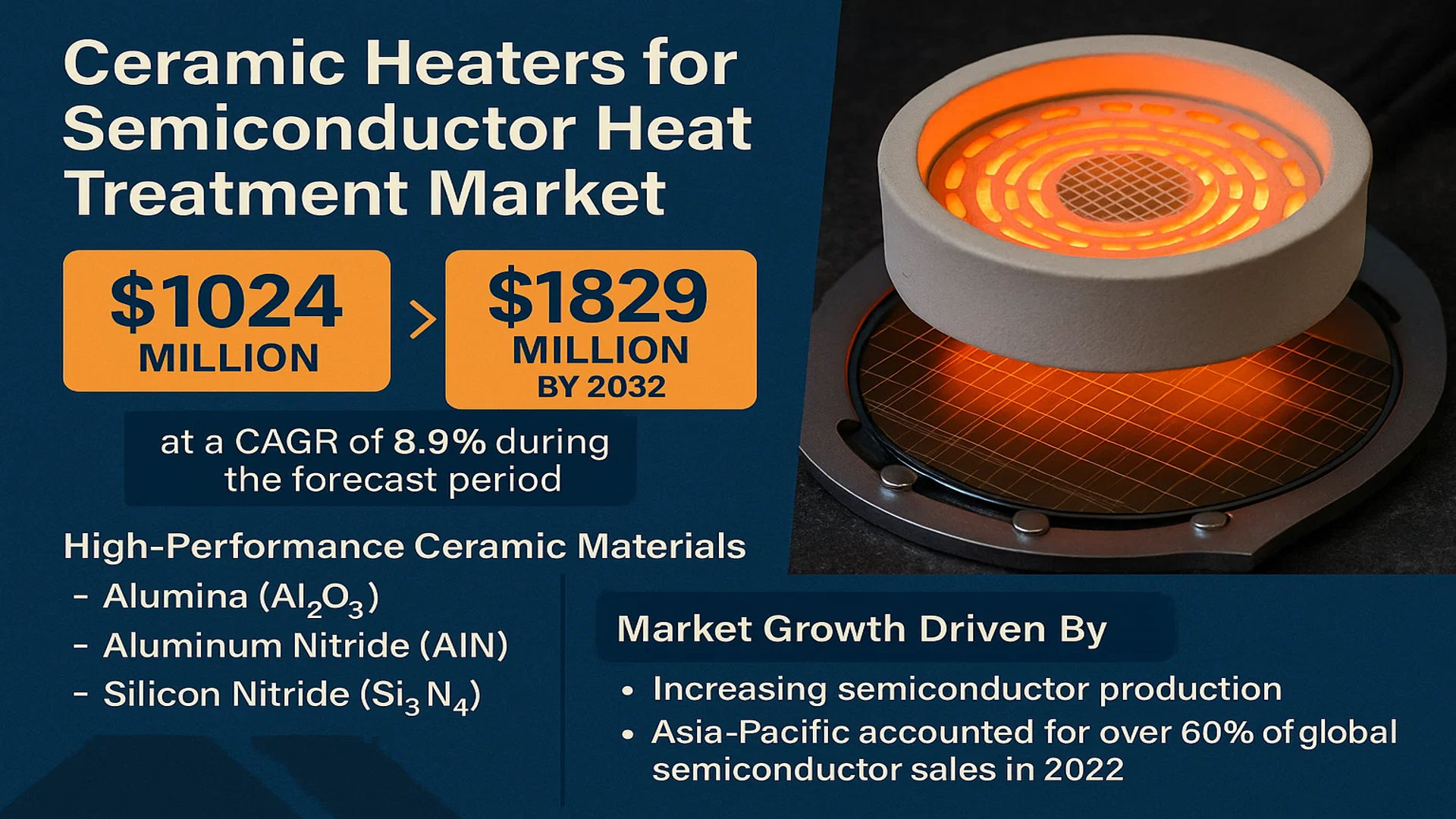
The global Ceramic Heaters for Semiconductor Heat Treatment Market was valued at 1024 million in 2024 and is projected to reach US$ 1829 million by 2032, at a CAGR of 8.9% during the forecast period.
Ceramic heaters for semiconductor heat treatment are advanced heating components designed to deliver precise temperature control and uniformity across semiconductor wafers during manufacturing processes. These heaters utilize high-performance ceramic materials such as Alumina (Al2O3), Aluminum Nitride (AlN), and Silicon Nitride (Si3N4) to ensure thermal stability and durability in harsh semiconductor fabrication environments.
The market growth is driven by increasing semiconductor production, particularly in Asia-Pacific, which accounted for over 60% of global semiconductor sales in 2022. While the overall semiconductor market grew by 4.4% in 2022 to reach USD 580 billion, certain segments like analog chips (20.8% growth) and sensors (16.3% growth) saw strong demand. This semiconductor industry expansion, coupled with the transition to smaller process nodes requiring more precise heat treatment, is accelerating adoption of advanced ceramic heater solutions. Key players like Sumitomo Electric and NGK Insulators are investing in R&D to develop heaters with improved thermal uniformity and longevity.
MARKET DYNAMICS
MARKET DRIVERS
Rising Semiconductor Industry Demand to Accelerate Ceramic Heater Adoption
The global semiconductor industry continues to expand with increasing applications across electronics, automotive, and industrial sectors, creating robust demand for ceramic heaters in wafer processing. With semiconductor revenues projected to reach $720 billion by 2030, manufacturers require precise thermal solutions like ceramic heaters that offer superior temperature uniformity (±1°C) compared to metal alternatives. These components have become integral in deposition, annealing, and etching processes where thermal stability directly impacts chip yields. The transition to smaller node sizes below 5nm further intensifies the need for ceramic heater precision, as nanometer-scale manufacturing tolerances become critical.
Expansion of Silicon Carbide and Gallium Nitride Production Fuels Growth
Wide bandgap semiconductor manufacturing for electric vehicles and power electronics requires extreme processing temperatures up to 1,800°C, where ceramic heaters demonstrate clear advantages over conventional options. Aluminum nitride (AlN) heaters in particular show 40% better thermal conductivity than alumina models in high-temperature applications. With SiC device production growing at 35% annually and GaN adoption increasing in RF applications, manufacturers are rapidly scaling capacity. This results in direct demand growth for specialized ceramic heating solutions capable of maintaining stability in harsh process environments, creating a $280 million incremental opportunity by 2027.
Government Semiconductor Investments Create Installation Opportunities
National semiconductor self-sufficiency initiatives worldwide are driving multi-billion dollar fab construction projects requiring thousands of ceramic heater units per facility. The U.S. CHIPS Act alone allocated $52 billion for domestic semiconductor manufacturing, while the European Chips Act commits €43 billion in public and private funding. Each new 300mm wafer fab typically installs 150-200 ceramic heater units across various process tools, with installation rates increasing 12% year-over-year since 2022. This equipment expansion cycle presents sustained demand for ceramic heater manufacturers through 2030.
MARKET RESTRAINTS
Technical Limitations in Ultra-high Temperature Applications Constrain Adoption
While ceramic heaters excel in most semiconductor processes, certain advanced applications requiring temperatures above 2,000°C face material limitations. Silicon carbide susceptors begin decomposition at 1,800°C in reducing atmospheres, while alumina experiences reduced mechanical strength above 1,750°C. These constraints affect emerging processes like ultra-high temperature epitaxy for next-generation power devices, where alternative heating solutions must be developed. Current research focuses on modified ceramics with refractory metal reinforcements, but commercialization timelines remain challenging.
Other Restraints
Supply Chain Vulnerabilities
The specialized nature of technical ceramics creates supply bottlenecks, with certain grades of aluminum nitride experiencing 6-8 month lead times. Over 85% of high-purity alumina powder originates from just three global suppliers, creating single-point failure risks that affect heater production schedules.
Energy Efficiency Demands
Increasing focus on fab sustainability pressures heater manufacturers to reduce power consumption. While ceramics already offer 15-20% better thermal efficiency than metal counterparts, next-generation designs must achieve another 30% improvement to meet 2030 carbon neutrality targets at major semiconductor manufacturers.
MARKET OPPORTUNITIES
Advanced Packaging Revolution Creates New Application Verticals
The shift toward 3D IC architectures and heterogeneous integration drives demand for specialized thermal processing equipment. Ceramic heater adoption in advanced packaging is growing at 28% CAGR as chiplet-based designs require precise thermal management during wafer-level bonding and interposer formation. New heater configurations with multi-zone temperature control enable sub-1μm alignment accuracy during thermocompression bonding processes critical for HBM and chiplet integration.
Material Innovations Offer Performance Breakthroughs
Emerging ceramic matrix composites combining AlN with graphene or carbon nanotubes demonstrate 50% higher thermal conductivity than conventional formulations. These advanced materials could enable faster process ramp rates and better temperature uniformity for next-generation nodes. Several leading equipment manufacturers have already initiated qualification programs for these enhanced materials, anticipating commercialization within 2-3 years.
MARKET CHALLENGES
Precision Manufacturing Requirements Limit Production Scaling
Ceramic heater fabrication demands micron-level dimensional accuracy for optimal thermal performance, constraining production capacity expansion. The complex machining and sintering processes require specialized equipment with limited global availability, creating bottlenecks during industry upturns. Current manufacturing yields for high-precision AlN heaters average just 65-70% for leading suppliers, increasing unit costs and extending lead times during periods of strong demand.
Other Challenges
Technical Support Requirements
The increasing complexity of ceramic heater designs demands greater application engineering support throughout the product lifecycle. Customers now expect 24/7 technical assistance and rapid failure analysis capabilities, requiring manufacturers to expand their service infrastructure significantly.
Intellectual Property Protection
With heater designs becoming more differentiated, manufacturers face growing challenges protecting proprietary technology in global markets where patent enforcement remains inconsistent. Several companies have reported unauthorized replication of critical thermal designs within 6-12 months of product launches.
CERAMIC HEATERS FOR SEMICONDUCTOR HEAT TREATMENT MARKET TRENDS
Growing Semiconductor Industry Demand to Drive Ceramic Heater Market Expansion
The ceramic heaters for semiconductor heat treatment market is experiencing robust growth, propelled by the increasing demand for high-performance thermal solutions in semiconductor manufacturing. The global semiconductor industry, valued at US$580 billion in 2022, continues to expand despite fluctuations in consumer demand, with key segments such as analog and logic chips growing at double-digit rates. This expansion necessitates advanced heat treatment solutions, with ceramic heaters emerging as a critical component due to their superior temperature uniformity, durability, and thermal stability. Manufacturers are investing in alumina (Al2O3), silicon nitride (Si3N4), and aluminum nitride (AlN)-based heaters, catering to diverse semiconductor fabrication processes, including plasma etching, chemical vapor deposition (CVD), and annealing. Furthermore, the rising adoption of the Internet of Things (IoT) and 5G technologies is amplifying demand for semiconductors, indirectly boosting the ceramic heater market.
Other Trends
Advancements in Material Science
Innovations in ceramic materials are significantly enhancing the efficiency of semiconductor heat treatment processes. Aluminum nitride (AlN) heaters, known for their high thermal conductivity and electrical insulation properties, are increasingly preferred for high-power applications. Meanwhile, silicon nitride (Si3N4) is gaining traction due to its resistance to thermal shock and chemical corrosion, making it ideal for harsh semiconductor fabrication environments. Recent developments include hybrid ceramic heaters that combine multiple materials to optimize performance, ensuring precise temperature control within a range of ±1°C uniformity. As semiconductor nodes shrink to 3nm and below, the demand for ultra-precise heating solutions is accelerating, further driving R&D in ceramic heater technologies.
Shift Toward Miniaturization and High-Performance Chips
The semiconductor industry’s shift toward miniaturization and advanced chip architectures is reshaping the ceramic heater market. With leading foundries like TSMC and Samsung investing heavily in sub-5nm fabrication, heat treatment processes require unparalleled precision. Ceramic heaters with multi-zone temperature control are being developed to accommodate complex wafer geometries and ensure uniform thermal distribution. Additionally, the growing adoption of gallium nitride (GaN) and silicon carbide (SiC) semiconductors for power electronics is creating new opportunities for specialized heat treatment solutions. As these materials operate at higher temperatures, ceramic heaters capable of maintaining stability above 1000°C are becoming indispensable. This trend is further reinforced by government initiatives supporting semiconductor self-sufficiency, particularly in the U.S. and Europe, where strategic investments in domestic chip manufacturing are rising.
COMPETITIVE LANDSCAPE
Key Industry Players
Innovation-Driven Competition Intensifies in Semiconductor Heat Treatment Solutions
The global ceramic heaters for semiconductor heat treatment market features a dynamic competitive environment with established multinational corporations competing alongside specialized regional manufacturers. Sumitomo Electric and NGK Insulators currently dominate market share, leveraging their decades of expertise in advanced ceramic technologies and strong relationships with leading semiconductor foundries.
CoorsTek has emerged as a formidable challenger, particularly in North America and Europe, where its high-purity aluminum nitride (AlN) heaters are gaining traction for advanced node semiconductor manufacturing. Meanwhile, Asian players like BOBOO Hitech and Semixicon are rapidly expanding their market presence through aggressive pricing strategies and localized customer support networks.
The market is witnessing increased competition in product differentiation, with companies investing heavily in R&D to develop heaters with superior temperature uniformity (>±0.5°C across 300mm wafers) and longer operational lifespans. Recent industry consolidation activities, including CoorsTek’s acquisition of several ceramic component manufacturers, suggest the competitive landscape may become more concentrated in coming years.
Emerging competitors such as Oasis Materials and Cactus Materials are focusing on niche applications like gallium nitride (GaN) and silicon carbide (SiC) power device manufacturing, creating specialized solutions that challenge traditional market leaders in these high-growth segments.
List of Key Ceramic Heater Manufacturers Profiled
- Sumitomo Electric (Japan)
- NGK Insulators (Japan)
- Mico Ceramics (Germany)
- BACH Resistor Ceramics (Germany)
- BOBOO Hitech (China)
- Semixicon (South Korea)
- CoorsTek (U.S.)
- Oasis Materials (U.S.)
- Cactus Materials (U.S.)
Segment Analysis:
By Type
Aluminum Nitride (AlN) Segment Dominates the Market Due to Superior Thermal Conductivity and High Resistance
The market is segmented based on type into:
- Alumina (Al2O3)
- Aluminum Nitride (AlN)
- Silicon Nitride (Si3N4)
- Others
By Application
Plasma Process Segment Leads Due to Widespread Use in Semiconductor Fabrication
The market is segmented based on application into:
- Plasma Process
- Thermal Treatment
- Wet Chemical Process
By End User
Foundries Dominate Market Demand Due to High Volume Semiconductor Production
The market is segmented based on end user into:
- Foundries
- IDMs (Integrated Device Manufacturers)
- Research Institutes
- Others
By Temperature Range
High Temperature Heaters (Above 1000°C) Drive Market Growth for Advanced Applications
The market is segmented based on temperature range into:
- Low Temperature (Below 500°C)
- Medium Temperature (500-1000°C)
- High Temperature (Above 1000°C)
Regional Analysis: Ceramic Heaters for Semiconductor Heat Treatment Market
Asia-Pacific
The Asia-Pacific region dominates the ceramic heaters for semiconductor heat treatment market, driven by robust semiconductor manufacturing hubs in China, Japan, South Korea, and Taiwan. China alone accounts for over 35% of global semiconductor production capacity, necessitating high-performance ceramic heaters for advanced chip fabrication. In 2023, regional semiconductor sales reached $336 billion, reflecting continued demand despite macroeconomic headwinds. Local manufacturers like BOBOO Hitech and Sumitomo Electric are investing in aluminum nitride (AlN) heaters to support the transition to more demanding 5nm and 3nm node processes. While cost competitiveness remains crucial, buyers increasingly prioritize thermal uniformity and longevity – with leading foundries specifying ±1°C temperature stability across 300mm wafers.
North America
North America’s ceramic heater market benefits from substantial R&D investments and reshoring initiatives in semiconductor manufacturing. The U.S. CHIPS Act’s $52 billion allocation is accelerating fab construction, with companies like Intel and TSMC Arizona requiring advanced thermal solutions. American manufacturers such as CoorsTek and Oasis Materials lead in developing ultra-pure aluminum oxide formulations that meet stringent contamination standards for logic and memory production. The region shows particular strength in plasma process applications, where ceramic heaters must withstand aggressive chemistries. However, higher costs compared to Asian suppliers and longer qualification cycles present ongoing challenges for market expansion.
Europe
Europe maintains a strong position in specialty semiconductor applications through its focus on compound semiconductors and power electronics. German firms like BACH Resistor Ceramics supply silicon nitride (Si3N4) heaters for silicon carbide (SiC) wafer processing, benefiting from the region’s leadership in automotive and industrial power devices. The EU Chips Act’s €43 billion investment aims to double Europe’s semiconductor market share by 2030, creating opportunities for localized ceramic heater production. Environmental regulations favor compositions with reduced rare earth content, spurring innovation in alternative material systems. Nevertheless, the region’s smaller manufacturing base limits volume demand compared to Asia-Pacific.
South America
South America represents a developing market for semiconductor ceramic heaters, primarily serving the region’s growing electronics assembly and packaging sector. Brazil’s semiconductor equipment market grew 18% year-over-year in 2023 as companies seek to reduce import dependency. However, lack of front-end wafer fabrication limits adoption to lower-temperature applications like packaging and testing. Most ceramic heaters are imported from Asian suppliers, though local players like Semikron have begun offering basic alumina-based solutions. Economic instability and limited technical expertise continue to hinder more sophisticated heat treatment adoption across the region.
Middle East & Africa
The MEA region is emerging as an unlikely contender in semiconductor manufacturing, with Abu Dhabi’s GLOBALFOUNDries expansion and Saudi Arabia’s planned $2 billion wafer fab signaling growing ambitions. Ceramic heater demand currently focuses on maintenance and replacement for existing equipment rather than new installations. Israeli startups are pioneering novel heater designs for extreme environment applications, but broader market development awaits more stable infrastructure investments. The lack of local material suppliers and high import duties on precision ceramics remain significant barriers to regional market growth in the immediate term.
Report Scope
This market research report provides a comprehensive analysis of the Global Ceramic Heaters for Semiconductor Heat Treatment Market, covering the forecast period 2025–2032. It offers detailed insights into market dynamics, technological advancements, competitive landscape, and key trends shaping the industry.
Key focus areas of the report include:
- Market Size & Forecast: Historical data and future projections for revenue, unit shipments, and market value across major regions and segments. The market was valued at USD 1,024 million in 2024 and is projected to reach USD 1,829 million by 2032, growing at a CAGR of 8.9%.
- Segmentation Analysis: Detailed breakdown by product type (Alumina, Silicon Nitride, Aluminum Nitride, Others), application (Plasma Process, Thermal Treatment, Wet Chemical Process), and end-user industry.
- Regional Outlook: Insights into market performance across North America, Europe, Asia-Pacific, Latin America, and the Middle East & Africa, including country-level analysis where relevant. Asia-Pacific dominates with over 42% market share in 2024.
- Competitive Landscape: Profiles of leading market participants including Sumitomo Electric, NGK Insulators, CoorsTek, and Mico Ceramics, their product portfolios, manufacturing capabilities, and recent strategic developments.
- Technology Trends & Innovation: Assessment of advanced ceramic materials, precision heating technologies, and integration with semiconductor fabrication processes.
- Market Drivers & Restraints: Evaluation of semiconductor industry growth, demand for miniaturization, and challenges in material costs and supply chain disruptions.
- Stakeholder Analysis: Insights for semiconductor equipment manufacturers, material suppliers, foundries, and investors regarding growth opportunities and strategic positioning.
Primary and secondary research methods are employed, including interviews with industry experts, data from semiconductor industry associations, and analysis of financial reports from key players to ensure the accuracy and reliability of the insights presented.
FREQUENTLY ASKED QUESTIONS:
What is the current market size of Global Ceramic Heaters for Semiconductor Heat Treatment Market?
->Ceramic Heaters for Semiconductor Heat Treatment Market was valued at 1024 million in 2024 and is projected to reach US$ 1829 million by 2032, at a CAGR of 8.9% during the forecast period.
Which key companies operate in this market?
-> Key players include Sumitomo Electric, NGK Insulators, CoorsTek, Mico Ceramics, BOBOO Hitech, and Semixicon, among others.
What are the key growth drivers?
-> Key growth drivers include increasing semiconductor manufacturing, demand for advanced packaging technologies, and adoption of AI/IoT in semiconductor fabrication.
Which region dominates the market?
-> Asia-Pacific dominates with over 42% market share, driven by semiconductor manufacturing hubs in China, Taiwan, South Korea, and Japan.
What are the emerging trends?
-> Emerging trends include development of ultra-high purity ceramic materials, integration of smart temperature control systems, and adoption of aluminum nitride heaters for advanced nodes.

Get Sample Report PDF for Exclusive Insights
Report Sample Includes
- Table of Contents
- List of Tables & Figures
- Charts, Research Methodology, and more...
 Download Sample Report PDF