Market Insights
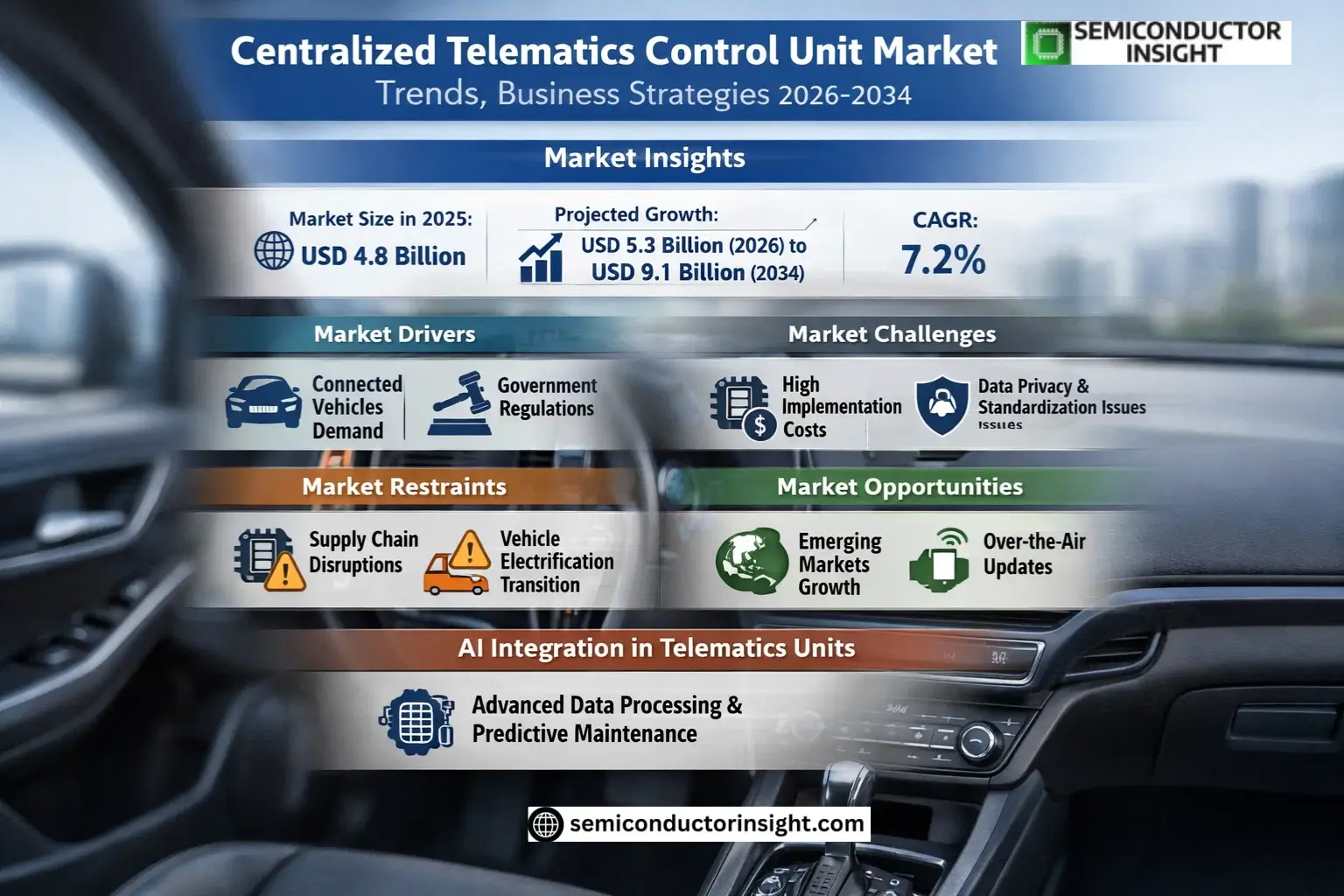
Global Centralized Telematics Control Unit Market size was valued at USD 4.8 billion in 2025. The market is projected to grow from USD 5.3 billion in 2026 to USD 9.1 billion by 2034, exhibiting a CAGR of 7.2% during the forecast period.
A Centralized Telematics Control Unit (TCU) is a critical component in modern connected vehicles, serving as the hub for data processing and communication between onboard systems and external networks. These units integrate multiple functions including GPS tracking, vehicle diagnostics, wireless connectivity, and remote control capabilities into a single centralized module. By consolidating these features, TCUs enable real-time monitoring of vehicle performance, predictive maintenance alerts, and over-the-air software updates.
The automotive industry’s rapid shift toward connected and autonomous vehicles is driving significant demand for advanced telematics solutions. Major manufacturers are increasingly embedding sophisticated TCUs in both passenger and commercial vehicles to comply with emerging regulatory requirements and meet consumer expectations for smart mobility features. Recent technological advancements in 5G connectivity and edge computing are further enhancing the capabilities of these systems, enabling faster data transmission and more complex onboard processing.
MARKET DRIVERS
Increasing Demand for Connected Vehicles
USD Centralized Telematics Control Unit Market is experiencing significant growth due to rising consumer preference for connected vehicle technologies. Automakers are integrating advanced telematics systems to provide real-time vehicle diagnostics, predictive maintenance alerts, and enhanced driver assistance features. This trend is particularly strong in North America and Europe, where over 65% of new vehicles now come equipped with telematics capabilities.
Government Regulations and Safety Mandates
Stringent government regulations regarding vehicle tracking, emergency call systems (eCall), and driver safety are accelerating market adoption. The EU’s eCall mandate, requiring all new vehicles to have telematics capabilities, has created a standardized market for Centralized Telematics Control Units. Similar regulations are being implemented in emerging markets, further driving demand.
Additionally, fleet management companies are adopting Centralized Telematics Control Units at an unprecedented rate to optimize logistics operations and reduce operational costs.
MARKET CHALLENGES
High Implementation Costs
The sophisticated technology behind Centralized Telematics Control Units comes with significant development and implementation costs. These systems require potent processing capabilities, multiple connectivity options, and robust security measures, making them expensive to develop and integrate into vehicle architectures.
Other Challenges
Data Privacy and Security Concerns
As Centralized Telematics Control Units collect and transmit sensitive vehicle and driver data, manufacturers face growing concerns about data protection. Implementing secure data transmission protocols and storage solutions adds complexity and cost to the systems.
Standardization Issues
The lack of global standardization for telematics protocols creates interoperability challenges across different regions and vehicle manufacturers, potentially limiting market growth.
MARKET RESTRAINTS
Supply Chain Disruptions
The semiconductor shortage has significantly impacted production timelines for Centralized Telematics Control Units. These devices require specialized chips that are also in high demand from other industries, creating bottlenecks in the supply chain. Manufacturers are facing extended lead times and increased component costs that may restrain market growth in the short term.
Vehicle Electrification Transition
The automotive industry’s rapid shift toward electric vehicles is causing manufacturers to prioritize battery and powertrain development over telematics system upgrades. While necessary long-term, this focus may temporarily slow investment in next-generation Centralized Telematics Control Units.
MARKET OPPORTUNITIES
Emerging Markets Expansion
Developing economies in Asia and Latin America represent significant growth opportunities for the Centralized Telematics Control Unit Market. Increasing vehicle production in these regions, combined with growing awareness of telematics benefits, is creating new revenue streams. China and India are expected to account for over 40% of market growth in the next five years.
Over-the-Air Updates
The ability to provide software updates and new features via over-the-air (OTA) technology presents a substantial opportunity for Centralized Telematics Control Unit providers. This capability reduces dealership visits and allows for continuous feature enhancements, improving customer satisfaction and creating recurring revenue models.
Centralized Telematics Control Unit Market Trends
Adoption of AI-Driven Data Processing in Telematics Units
Centralized Telematics Control Unit Market is witnessing accelerated integration of artificial intelligence for advanced data processing. Leading manufacturers are embedding machine learning algorithms to enhance real-time vehicle status monitoring, fault diagnosis accuracy, and predictive maintenance capabilities. This technological evolution enables more efficient processing of data streams from multiple vehicle systems while reducing latency in command execution.
Other Trends
Expansion in Commercial Vehicle Segment
Growing demand for fleet management solutions is driving increased adoption of Centralized Telematics Control Units in commercial vehicles. Logistics companies are implementing these systems to optimize routing, monitor driver behavior, and improve fuel efficiency. The units’ ability to consolidate data from various vehicle subsystems supports comprehensive fleet analytics.
Standardization of Connectivity Protocols
Industry players are collaborating to establish unified communication standards for Centralized Telematics Control Units. This trend addresses compatibility challenges across different vehicle manufacturers and aftermarket systems. Standardized protocols facilitate seamless integration with emerging Vehicle-to-Everything (V2X) technologies and next-generation 5G networks.
Enhanced Cybersecurity Measures
As Centralized Telematics Control Units handle increasingly sensitive vehicle data, manufacturers are implementing multi-layered security architectures. These include hardware-based encryption, secure boot mechanisms, and continuous vulnerability monitoring to protect against potential cyber threats targeting connected vehicles.
Modular Design Approaches
Vendors are transitioning toward modular Centralized Telematics Control Unit architectures that allow customizable feature sets. This approach enables automakers to select specific capabilities based on vehicle segments and regional requirements while maintaining a common hardware platform for cost efficiency.
COMPETITIVE LANDSCAPE
Key Industry Players
Global Leaders and Innovators Driving the Centralized TCU Market
Centralized Telematics Control Unit Market is dominated by automotive electronics giants such as Bosch, Continental, and Denso, which collectively hold over 40% of the global market share. These leaders offer comprehensive TCU solutions with advanced connectivity features, benefiting from their established relationships with major automakers and extensive R&D capabilities. LG and Harman (Samsung subsidiary) have emerged as strong competitors in the infotainment-integrated TCU segment.
Specialist players like Peiker and Novero focus on high-performance telematics solutions for premium automotive segments, while Asian manufacturers such as Huawei and Murata are gaining traction with cost-competitive offerings. The market also sees significant participation from semiconductor companies like Infineon and Renesas providing key components for TCU architectures. Recent years have witnessed strategic acquisitions, with Marelli and Ficosa expanding their TCU portfolios through targeted mergers.
List of Key Centralized Telematics Control Unit Companies Profiled
- Bosch GmbH
- Continental AG
- Denso Corporation
- LG Electronics
- Harman International (Samsung)
- Huawei Technologies
- Visteon Corporation
- Peiker Group
- Novero GmbH
- Marelli Corporation
- Ficosa International
- Infineon Technologies
- Murata Manufacturing
- Renesas Electronics
Segment Analysis:
| Segment Category | Sub-Segments | Key Insights |
| By Type |
|
Enhanced Units are dominating the market due to their advanced data processing capabilities.
|
| By Application |
|
Automotive Applications lead the market demand, particularly in connected vehicle solutions.
|
| By End User |
|
OEMs represent the largest demand segment with direct integration into vehicles.
|
| By Connectivity |
|
5G-Compatible Units are emerging as growth drivers for future applications.
|
| By Vehicle Type |
|
Passenger Vehicles account for majority of installations currently.
|
Regional Analysis: Centralized Telematics Control Unit Market
The U.S. leads in adopting next-gen telematics solutions, with 80% of new vehicles incorporating centralized TCU capabilities. Canadian markets show strong growth in fleet management applications, particularly in commercial vehicle segments.
Stringent vehicle safety regulations and mandatory emergency call systems (eCall) in the U.S. drive centralized TCU installations. Canada’s evolving telematics standards create favorable conditions for market expansion across vehicle classes.
Well-established 4G LTE networks across urban and suburban areas enable seamless connectivity. Ongoing 5G network rollouts promise enhanced capabilities for centralized telematics applications and real-time data processing.
The region hosts intense competition among telematics providers, with OEMs increasingly developing in-house centralized TCU solutions. Strategic partnerships between automakers and technology firms characterize the competitive landscape.
Europe
Europe represents the second-largest market for Centralized Telematics Control Units, driven by EU mandates for connected vehicle technologies. The region shows strong adoption in Germany, France, and the UK, with growing penetration in Eastern European markets. Automotive manufacturers prioritize integration of centralized TCUs to comply with eCall regulations and meet consumer demand for advanced connectivity features. European markets demonstrate particularly strong growth in electric vehicle segments where telematics integration is standard. Localized data privacy laws influence TCU architecture and cloud service deployment models across the region.
Asia-Pacific
Asia-Pacific emerges as the fastest-growing Centralized Telematics Control Unit Market, with China and Japan leading adoption rates. Rapid vehicle electrification and smart city initiatives drive demand across major urban centers. Local OEMs increasingly incorporate centralized TCUs as competitive differentiators in domestic and export markets. While premium segments dominate current installations, market expansion focuses on cost-effective solutions for mass-market vehicles. Government support for V2X communication infrastructure development creates long-term growth opportunities throughout the region.
South America
South American markets show steady growth in Centralized Telematics Control Unit adoption, primarily concentrated in Brazil and Argentina. Commercial vehicle fleets represent the largest application segment, driven by logistics optimization needs. Regulatory developments regarding vehicle tracking and security systems are gradually increasing OEM-level installations. Infrastructure limitations in rural areas and pricing sensitivity present challenges to widespread adoption across all vehicle segments in the region.
Middle East & Africa
The MEA region demonstrates evolving demand for Centralized Telematics Control Units, with strongest growth in GCC countries. Luxury vehicle segments and commercial fleets lead adoption, supported by government smart mobility initiatives. Market development faces challenges from fragmented regulatory environments and varying infrastructure quality across countries. However, increasing investment in connected vehicle technologies and expanding dealer networks show promising signs for future market expansion.
Report Scope
This market research report provides a comprehensive analysis of the Centralized Telematics Control Unit Market , covering the forecast period 2025–2034. It offers detailed insights into market dynamics, technological advancements, competitive landscape, and key trends shaping the industry.
Key focus areas of the report include:
- Market Overview: The report begins with an overview outlining its current market scenario, key growth indicators, and industry transformation drivers. It discusses macroeconomic factors, demand–supply balance, regulatory landscape, and the strategic role of telematics control units in powering advancements across industries such as automotive, industrial automation, smart home, and IoT.
- Market Size & Forecast: Historical data and future projections for revenue, unit shipments, and market value across major regions and segments.
- Segmentation Analysis: Detailed breakdown by product type (Basic, Enhanced, Customized), application, and end-user industry to identify high-growth segments and investment opportunities.
- Regional Insights: Insights into market performance across North America, Europe, Asia, South America, and Middle East & Africa, including country-level analysis where relevant.
- Competitive Landscape: Profiles of leading market participants, including their product offerings, R&D focus, pricing strategies, and recent developments.
- Technology Trends & Innovation: Assessment of emerging technologies, AI integration, and evolving industry standards in telematics units.
- Market Drivers & Restraints: Evaluation of factors driving market growth along with challenges and regulatory issues.
- Stakeholder Insights: Insights for component suppliers, OEMs, system integrators, and investors regarding strategic opportunities.
Primary and secondary research methods are employed, including interviews with industry experts, data from verified sources, and real-time market intelligence to ensure the accuracy and reliability of the insights presented.
FREQUENTLY ASKED QUESTIONS:
What is the current market size of Centralized Telematics Control Unit Market?
-> Centralized Telematics Control Unit Market size was valued at USD 4.8 billion in 2025. The market is projected to grow from USD 5.3 billion in 2026 to USD 9.1 billion by 2034, exhibiting a CAGR of 7.2% during the forecast period.
Which key companies operate in Centralized Telematics Control Unit Market?
-> Key players include LG, Samsung, Denso, Bosch, Continental, Huawei, Visteon, Peiker, Novero, Marelli, Ficosa, Infineon, Murata, and Renesas.
What are the key growth drivers?
-> Key growth drivers include adoption in passenger and commercial vehicles, development of intelligent connected vehicles, AI and big data integration, and demand for vehicle status monitoring and remote control.
Which region dominates the market?
-> Asia is expected to show significant growth, particularly in China, Japan, and South Korea, while North America maintains a strong market position.
What are the emerging trends?
-> Emerging trends include intelligent development with AI algorithms, enhanced fault diagnosis capabilities, and centralized processing for unified control strategies.
Get Sample Report PDF for Exclusive Insights
Report Sample Includes
- Table of Contents
- List of Tables & Figures
- Charts, Research Methodology, and more...
 Download Sample Report PDF