Key Statistics
Key Takeaways
- Plastic core carrier tape is the dominant material class because dimensional stability, pocket precision, impact resistance and ESD-control options make it suitable for semiconductor and high-speed surface-mount assembly.
- Active components lead application demand, including integrated circuits, transistors and diodes, while consumer electronics remains the largest end-user industry through the enormous volume of tape-and-reel packaged components entering smartphones, appliances and personal devices.
- Asia Pacific accounts for more than 60% of global production and consumption, with China alone contributing more than 50% of worldwide output through its large electronics and semiconductor assembly base.
- Miniaturization is raising pocket-precision requirements. 3M carrier tape offerings now target pocket tolerances down to ±0.02 mm and pocket-hole dimensions below 0.01 mm for ultra-thin advanced packages and known-good-die transport.
- High-speed sealing is becoming a productivity lever. Sumitomo Bakelite started mass production of CSL-Z7304 in April 2026 for ultra-small electronic components and short sealing cycles, including 4 mm carrier-tape applications.
Carrier Tape Market Overview
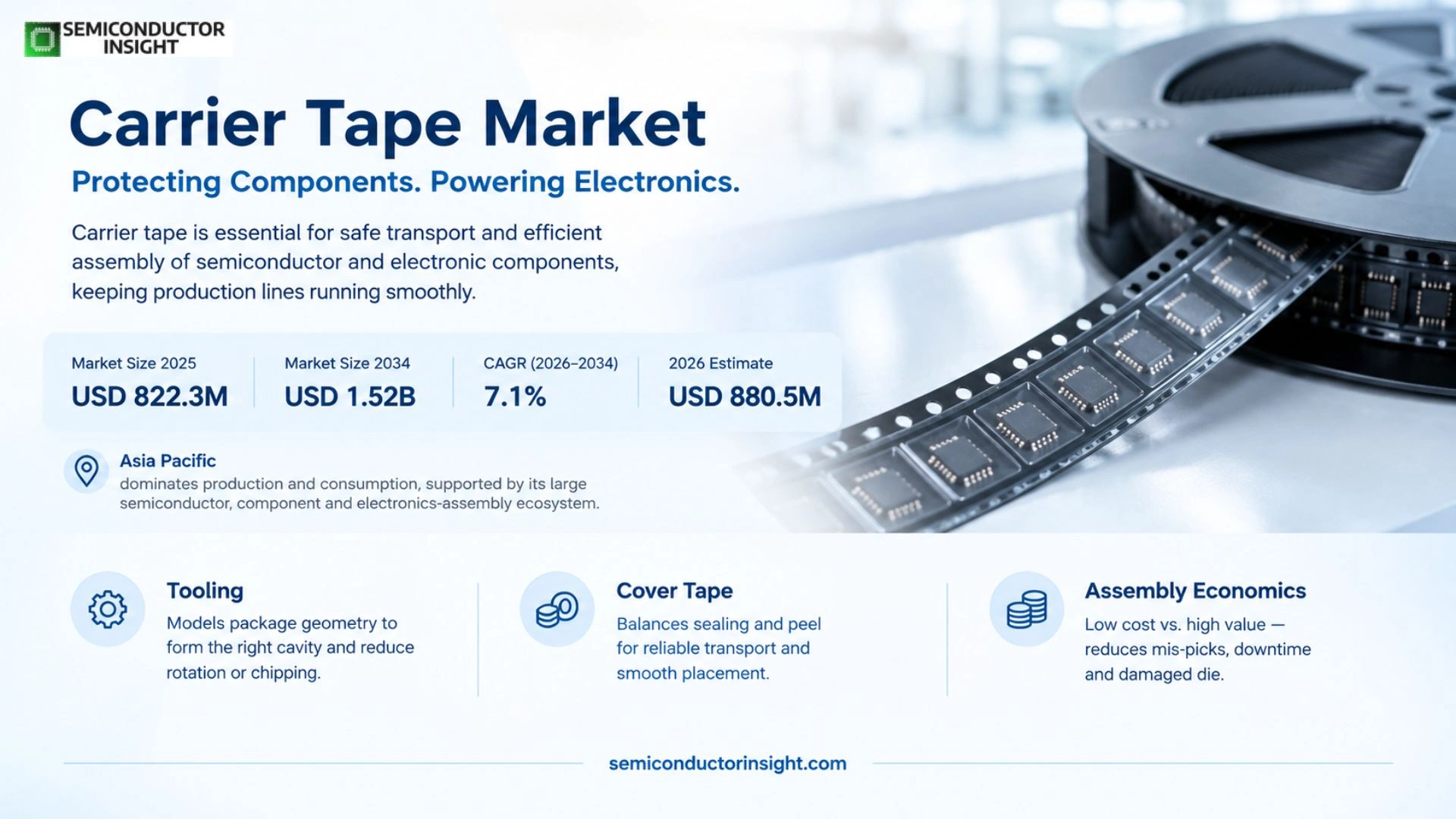
Carrier Tape market is valued at USD 822.3 million in 2025 and is projected to reach USD 1.52 billion by 2034, representing a 7.1% CAGR during 2026–2034. The 2026 estimated market size is USD 880.5 million. Asia Pacific remains the dominant production and consumption region, supported by its large semiconductor, component and electronics-assembly ecosystem.
Carrier tape is a precision transport medium for surface-mount components, semiconductor packages and bare or partially packaged devices. Molded pockets maintain component orientation and spacing while sprocket holes index the tape through automated handling equipment. A cover tape seals the components inside the pockets until pick-and-place or backend assembly removes them at controlled peel force.
Performance depends on dimensional accuracy, static behavior, pocket geometry, optical clarity, stiffness and compatibility with the cover-tape sealing system. Modern semiconductor packaging introduces thinner dies, WLCSP, fan-out, chiplets and multi-die stacks that are more sensitive to tilt, migration and edge damage. The tape therefore becomes part of yield management rather than a simple logistics consumable.
Automation raises the cost of inconsistency. A tape that stretches, warps or peels irregularly can stop high-speed assembly lines and generate mis-picks. Suppliers compete through tooling precision, resin selection, ESD performance, vision-system compatibility and custom pocket engineering. Traceability is also becoming more important, with technologies such as pre-applied 2D barcodes supporting component tracking without marking delicate die surfaces directly.
Segment Analysis: By Type
By material, the market is segmented into Plastic Core Carrier Tape and Paper Core Carrier Tape. Plastic tape leads because semiconductor and fine-pitch electronic components require tighter cavity tolerances, stronger mechanical protection and better ESD-control options than paper-based formats can provide.
| Material | Technical profile | Market position |
|---|---|---|
| Plastic Core Carrier Tape | Thermoformed or precision-formed plastic carrier tape commonly uses polystyrene, polycarbonate, PET-related constructions and conductive or static-dissipative compounds. Plastic supports deeper pockets, thin-wall geometry, optical inspection and high dimensional accuracy over long reels. | Largest material segment. Advanced ICs, WLCSP, optoelectronics and miniature passive components increasingly require pocket precision, antistatic behavior and mechanical strength that favor engineered plastic structures. |
| Paper Core Carrier Tape | Paper carrier tape is widely used for smaller, lower-profile passive components where punched cavities and lower material cost are sufficient. It is lightweight and can provide favorable sustainability characteristics depending on coating and end-of-life handling. | A mature segment concentrated in resistors, capacitors and other passive-device formats. Growth is steadier than plastic because miniaturized and fragile semiconductor packages increasingly move toward molded polymer pockets. |
Width and end-user segmentation
Carrier-tape width is standardized around component dimensions and placement equipment, with common widths including 8 mm, 12 mm, 16 mm, 24 mm, 32 mm and 44 mm. Consumer electronics represents the largest end-user industry by volume, while automotive and industrial applications place greater emphasis on traceability, ESD control and long-term quality consistency.
| Axis | Segments | Commercial implication |
|---|---|---|
| By Width | 8 mm · 12 mm · 16 mm · 24 mm · 32 mm · 44 mm · Others | 8 mm and 12 mm widths serve high-volume miniature devices, while wider tapes are required for larger semiconductor packages, connectors, power devices and irregular components. A supplier with broad tooling capability can serve more component families from one manufacturing network. |
| By End-User Industry | Consumer Electronics · Automotive Electronics · Industrial Electronics · Medical Devices · Aerospace & Defense · Others | Consumer electronics drives volume; automotive and medical markets reward stronger qualification and traceability; aerospace and defense create lower-volume, high-reliability opportunities for customized tape-and-reel handling. |
Segment Analysis: By Application
By application, Active Components lead demand, followed by passive components, optoelectronics, power discrete devices and other packaged electronics. Integrated circuits use high-precision pockets to protect leads, solder balls and thin package edges, while passive components create enormous reel volumes through high-speed SMT assembly.
| Application | Demand characteristics |
|---|---|
| Active Components | The largest application includes integrated circuits, transistors and diodes. Advanced packages can be thin, mechanically delicate and electrostatically sensitive, requiring accurate pocket geometry and controlled surface resistivity. Semiconductor backend operations also increasingly use carrier tape for known-good die and WLCSP transport between test, packaging and final assembly steps. |
| Passive Components | Resistors, capacitors, inductors and small filters are placed at extremely high speed in electronics factories. Paper and plastic carrier tapes compete depending on component size and fragility. Feed consistency, sprocket-hole accuracy and cover-tape peel behavior directly influence pick-and-place uptime. |
| Optoelectronics | LEDs, photodiodes and optical sensors can be sensitive to surface damage and contamination. Transparent or low-particle tape materials support automated inspection and reliable orientation while ESD-safe constructions reduce risk to sensitive devices. |
| Power Discrete Devices | MOSFETs, IGBTs, SiC devices and other power components often use larger packages and wider carrier tapes. Automotive and industrial qualification requirements increase the importance of pocket strength, clean handling and lot-level traceability. |
| Others | Connectors, crystals, MEMS, sensors and specialty components require custom pockets matched to unusual shapes or mechanical features. Suppliers with rapid tooling and simulation capability can capture higher-margin niche programs. |
Regional Analysis
Asia Pacific leads the Carrier Tape market with more than 60% of global production and consumption. China alone contributes more than 50% of worldwide output, while Japan, South Korea and Taiwan supply high-precision tape, semiconductor packaging and advanced electronics manufacturing. North America is a mature high-value market, and Europe emphasizes automotive, industrial and sustainability requirements.
How do regional carrier-tape requirements differ?
Regional demand follows electronics assembly and semiconductor backend activity. Asia Pacific leads on scale and tooling breadth. North America uses advanced tape for high-value semiconductors, aerospace, medical and automotive products. Europe combines strict quality with sustainability pressure. South America and the Middle East & Africa remain smaller and more dependent on imported tape, but local electronics assembly creates incremental demand.
| Region | Market position | Growth outlook | Demand profile | What decides supplier selection |
|---|---|---|---|---|
| Asia Pacific | >60% production and consumption | High | Semiconductor & electronics assembly | Scale, cost, tooling speed and ESD precision |
| North America | Mature high-value market | Moderate to high | Semiconductor, aerospace & medical | Precision, traceability and custom engineering |
| Europe | Specialized quality market | Moderate | Automotive & industrial | Reliability, sustainability and compliance |
| South America | Emerging | Selective | Consumer & automotive assembly | Price, imported supply and logistics |
| Middle East & Africa | Nascent | Selective | Electronics assembly & servicing | Availability and cost-effective standard products |
Competitive Landscape
Key participants include 3M, Advantek, Shin-Etsu Polymer, Nissho Corporation, Zhejiang Jiemei Electronic Technology, NIPPO, YAC GARTER, U-PAK, C-Pak, ePAK International, ROTHE, Sumitomo Bakelite, Tek Pak, Oji F-Tex, Jiangyin Winpack, SEKISUI SEIKEI, Asahi Kasei, Kanazu Giken, Taiwan Carrier Tape Enterprise and LaserTek. Competition is semi-consolidated, with global materials companies competing alongside regional specialists.
3M differentiates through precision carrier-tape tooling, polycarbonate materials and advanced traceability. Its semiconductor tape-and-reel portfolio includes raised-platform pockets for thin packages, ultra-precision pocket geometry and pre-applied 2D barcodes that support bare-die and advanced-packaging flows. These features move carrier tape from a commodity consumable toward a yield and traceability tool.
Shin-Etsu Polymer combines precision molding with semiconductor-container and carrier-tape products. Its FY2025 results described strong demand in large electronic components and recovery in smaller component applications. This gives the company exposure across multiple semiconductor logistics products and a customer base that values long-term process stability.
Sumitomo Bakelite competes through carrier-tape sheet materials and cover tapes. The 2026 CSL-Z7304 launch targets higher sealing productivity for ultra-small components. Chinese and Taiwanese suppliers compete strongly on scale, tooling speed and proximity to EMS customers, while Japanese and U.S. companies emphasize materials science and process precision.
Competitive tier structure
| Tier | Companies | Basis of competition |
|---|---|---|
| Global materials & precision leaders | 3M; Shin-Etsu Polymer; Sumitomo Bakelite; Nissho | Advanced polymers, precision tooling, ESD control, cover-tape systems and global technical support |
| Asian volume leaders | Zhejiang Jiemei; NIPPO; YAC GARTER; U-PAK; Taiwan Carrier Tape | High-volume production, local EMS relationships, broad width/tooling portfolios and competitive cost |
| Specialty / regional suppliers | Advantek; C-Pak; ePAK; ROTHE; Tek Pak; LaserTek; SEKISUI SEIKEI | Custom pockets, regional logistics, niche materials and application-specific tape-and-reel solutions |
Key companies profiled in the report scope
- 3M
- Advantek
- Shin-Etsu Polymer
- Nissho Corporation
- Zhejiang Jiemei Electronic Technology
- NIPPO CO., LTD.
- YAC GARTER
- U-PAK
- C-Pak
- ePAK International
- ROTHE
- Sumitomo Bakelite
- Tek Pak
- Oji F-Tex Co., Ltd.
- Jiangyin Winpack
- SEKISUI SEIKEI
- Asahi Kasei
- Kanazu Giken
- Taiwan Carrier Tape Enterprise Co., Ltd.
- LaserTek
Carrier Tape Production Capacity & Process Analysis
Capacity depends on polymer-sheet extrusion, thermoforming or embossing, precision tooling, punching, slitting, clean handling and quality inspection. A line can produce long reels at high speed, but usable output is limited by cavity accuracy, sprocket registration, web flatness and customer-specific tooling. Advanced semiconductor tape therefore has a lower effective capacity than simple passive-component tape even on similar production equipment.
Tooling is a major capacity variable because each component package may require a dedicated pocket design. Suppliers with rapid mold, die and forming-tool capability can convert new component designs into production faster. Ultra-thin semiconductor packages add raised platforms, small hole radii and tighter tolerances that reduce process windows and increase inspection requirements.
Cover-tape sealing performance also affects effective throughput. Shorter sealing times can increase tape-and-reel line speed if peel strength remains stable. Sumitomo Bakelite’s 2026 CSL-Z7304 targets this productivity constraint, illustrating how materials innovation can increase packaging-line output without changing the carrier tape itself.
Market Dynamics
Growth is driven by semiconductor and electronics output, component miniaturization, automated SMT assembly, advanced packaging and traceability. Restraints include polymer-price volatility, environmental pressure, precision-tooling cost and supply concentration. Opportunities center on recyclable materials, ultra-precision pockets, embedded traceability and local capacity near new packaging hubs.
MARKET DRIVERS
Drivers Impact Analysis*
| Factor | Forecast impact* | Geographic relevance | Impact timeline |
|---|---|---|---|
| Semiconductor and electronics volume | High | Asia Pacific, North America | Persistent |
| Component miniaturization | High | Global advanced packaging | Medium to long term |
| SMT automation | High | Global electronics assembly | Persistent |
| Advanced packaging and known-good die | Medium to high | Semiconductor backend hubs | Medium term |
*Directional analytical rating; it is not a measured contribution to the headline CAGR.
Electronics output creates recurring consumables demand
Every reel of packaged components requires a transport medium. As smartphones, vehicles, industrial systems and data centers consume more electronic components, carrier-tape demand rises with component shipments rather than with final-device count alone. This creates a broad and diversified demand base.
Miniaturization raises value per meter of tape
Smaller components do not simply reduce material use. They require tighter pocket tolerances, better antistatic control and lower risk of sticking or rotation. Suppliers can therefore capture premium pricing through precision rather than volume alone.
Automation makes tape consistency economically critical
High-speed pick-and-place equipment depends on predictable sprocket spacing, pocket geometry and cover-tape peel. A small tape defect can stop an expensive assembly line, so customers value repeatability and supplier quality systems.
Advanced packaging creates new transport steps
Chiplets, WLCSP, fan-out and stacked-die packaging create more movement of delicate components between test, assembly and final integration. Carrier tape with barcode traceability and precision cavities can support known-good-die logistics and reduce handling damage.
MARKET RESTRAINTS
Restraints Impact Analysis*
| Factor | Forecast impact* | Geographic relevance | Impact timeline |
|---|---|---|---|
| Polymer price volatility | Medium to high | Global | Short to medium term |
| Sustainability pressure | Medium | Europe, North America, Asia | Persistent |
| Precision tooling cost | Medium | Advanced packages | Persistent |
| Regional supply concentration | Medium | Global electronics chains | Persistent |
*Directional analytical rating; it is not a measured contribution to the headline CAGR.
Raw-material prices can compress margins
Polystyrene, polycarbonate, PET-related materials and conductive compounds move with petrochemical and specialty-material markets. High-volume customers negotiate aggressively, and suppliers may not pass through cost increases immediately.
Disposable packaging faces environmental scrutiny
Carrier tape is consumed in very large volumes and is difficult to reuse once pockets and cover tapes have been opened. Suppliers need recyclable materials, downgauging and take-back concepts without sacrificing ESD or mechanical performance.
Miniaturized packages raise capital requirements
Ultra-small components require high-precision tooling, optical inspection and tighter environmental control. Suppliers without advanced forming and metrology capability can be excluded from the most profitable programs.
Concentrated manufacturing creates disruption risk
A large share of carrier-tape production is located in Asia. Logistics disruptions can interrupt electronics assembly elsewhere, encouraging customers to dual-source or hold more safety inventory.
MARKET OPPORTUNITIES
Develop recyclable and lower-material constructions
Sustainability targets create room for recyclable polymers, thinner webs and simplified material stacks. The winning products must maintain antistatic performance, dimensional stability and clean peel behavior so environmental gains do not reduce placement yield.
Expand ultra-precision semiconductor tape
WLCSP, chiplets and ultra-thin packages need tighter pocket geometry and low-particle handling. 3M’s precision products show how sub-0.1 mm pocket features and tight tolerances can support premium semiconductor transport.
Add traceability to tape-and-reel logistics
Barcodes, QR codes and machine-readable identifiers can connect each pocket or reel to lot and test data. This is valuable in advanced packaging, automotive and medical electronics where traceability helps isolate defects quickly.
Localize near packaging and test clusters
New semiconductor backend capacity in the U.S., Southeast Asia and other regions creates demand for local carrier-tape supply. Regional production can reduce freight, shorten custom-tooling lead times and improve resilience.
Carrier Tape Value Chain Analysis
Material formulation establishes performance limits
Conductive additives, polymer stiffness and optical properties influence ESD behavior, pocket shape and vision-system compatibility. Sheet consistency must remain stable across long reels because dimensional drift can affect automated feeders.
Tooling converts component geometry into a transport pocket
Suppliers model package edges, leads, bumps and center of gravity before forming the cavity. Raised platforms, small opening radii and custom wall angles can reduce rotation and chipping in thin packages.
Cover tape controls sealing and peel
A good cover tape must seal reliably during transport but peel smoothly at placement. Excessive peel force can jerk small components out of position, while weak sealing risks contamination or loss. High-speed sealing therefore requires a carefully balanced adhesive system.
Assembly economics determine customer value
Carrier tape is low cost compared with the components it protects and the equipment it feeds. Customers will pay for a design that reduces mis-picks, downtime and damaged die because those savings outweigh modest differences in tape price.
Recent Developments in the Carrier Tape Market
Sumitomo Bakelite starts mass production of CSL-Z7304 cover tape
The new cover tape is designed for ultra-small electronic components and short sealing cycles, with strength and peel performance suitable for 4 mm carrier-tape applications and higher-speed packaging lines.
Shin-Etsu Polymer reports firm carrier-tape demand
FY2025 results show carrier-tape-related products remained strong for large electronic components while small-component demand recovered, supporting continued activity in its Precision Molding Products business.
3M expands precision carrier-tape options for advanced packages
Current semiconductor carrier products include raised-platform pockets, ultra-precision forming and 2D barcode variants aimed at WLCSP, bare die and advanced packaging transport.
Shin-Etsu Polymer identifies carrier tape as a steady base business
The company’s annual review highlights steady demand for large electronic-component carrier tape and continued product activity across semiconductor-related precision molding.
REPORT SCOPE & SEGMENTATION
| Attribute | Details |
|---|---|
| Study Period | 2020–2034 |
| Base Year | 2025 |
| Estimated Year | 2026 |
| Forecast Period | 2026–2034 |
| Historical Period | 2020–2025 |
| Market Size 2025 | USD 822.3 million |
| Market Size 2034 | USD 1.52 billion |
| Growth Rate | CAGR of 7.1% from 2026–2034 |
| Unit | Value (USD Million/Billion) and tape/reel volume where applicable |
| Segmentation | By Material, By Application, By Width, By End-User Industry, By Region |
| By Material | Plastic Core Carrier Tape · Paper Core Carrier Tape |
| By Application | Active Components · Passive Components · Optoelectronics · Power Discrete Devices · Others |
| By Width | 8 mm · 12 mm · 16 mm · 24 mm · 32 mm · 44 mm · Others |
| By End-User Industry | Consumer Electronics · Automotive Electronics · Industrial Electronics · Medical Devices · Aerospace and Defense · Others |
| By Region | Each region analysed by material, application, width, end-user industry and country marketNorth AmericaUnited States, Canada, MexicoEuropeGermany, France, United Kingdom, Italy and other European marketsAsia PacificChina, Japan, South Korea, Taiwan, Malaysia, Vietnam and other Asian marketsSouth AmericaBrazil, Argentina and other South American marketsMiddle East & AfricaUAE, Saudi Arabia, South Africa and other MEA markets |
| Key Companies Profiled | 3M · Advantek · Shin-Etsu Polymer · Nissho Corporation · Zhejiang Jiemei Electronic Technology · NIPPO CO., LTD. · YAC GARTER · U-PAK · C-Pak · ePAK International · ROTHE · Sumitomo Bakelite · Tek Pak · Oji F-Tex Co., Ltd. · Jiangyin Winpack · SEKISUI SEIKEI · Asahi Kasei · Kanazu Giken · Taiwan Carrier Tape Enterprise Co., Ltd. · LaserTek |
| Customization Scope | Free report customization equivalent to up to four analyst working days with purchase. Addition or alteration to country, regional and segment scope. |
Frequently Asked Questions
What is the 2025 size of the Carrier Tape market?
The market is valued at USD 822.3 million in 2025 and is projected to reach USD 1.52 billion by 2034. The 2026 estimate is USD 880.5 million and the 2026–2034 CAGR is 7.1%, supported by electronics output, miniaturization and continued automation in semiconductor and SMT assembly.
Which carrier-tape material leads the market?
Plastic core carrier tape leads because semiconductor and miniature electronic components require precise molded cavities, stronger mechanical protection and ESD-control options. Paper carrier tape remains important for high-volume passive devices where cost and simple punched-pocket geometry are sufficient.
Which application is the largest?
Active components lead demand, including integrated circuits, transistors and diodes. These devices require reliable orientation, ESD protection and mechanical protection through storage, transportation and high-speed placement. Passive components also generate very large reel volumes in consumer and industrial electronics.
Which region leads the market?
Asia Pacific accounts for more than 60% of global production and consumption, with China contributing more than 50% of worldwide output. Japan, South Korea and Taiwan add high-precision semiconductor and electronics packaging capability.
What is the estimated market size in 2026?
The 2026 estimated market size is USD 880.5 million. Growth is supported by higher semiconductor and component shipments, increasing use of tape-and-reel automation and more demanding carrier requirements for thin and miniaturized packages.
Why is pocket precision becoming more important?
WLCSP, chiplets and thin semiconductor packages can tilt, rotate or crack if pocket dimensions are poorly controlled. Modern carrier products use tight tolerances, raised platforms and very small opening radii to reduce migration and protect delicate components during backend handling.
What are the main market restraints?
The main restraints are polymer-price volatility, environmental pressure on disposable packaging, investment required for ultra-precision forming and regional supply concentration. High-performance tape also requires strong process control, which can limit entry by low-cost suppliers.
How is traceability changing carrier tape?
Machine-readable barcodes and reel identifiers can connect component position to test and lot data. This is valuable for known-good-die handling, advanced packaging, automotive and medical electronics where rapid defect containment and supply-chain traceability reduce risk.
What opportunity exists in sustainable carrier tape?
Electronics customers increasingly want lower material use and better recyclability. Suppliers can develop thinner constructions, recyclable polymers and simpler material stacks, provided the new designs preserve ESD protection, dimensional accuracy and cover-tape peel performance.
What does the report cover?
The report covers plastic and paper carrier tape; active, passive, optoelectronic and power-device applications; standard width classes; consumer, automotive, industrial, medical and aerospace end users; five global regions; production analysis; and the full profiled company set.
Research Sources & Evidence Base
View primary and authoritative evidence used in this overview
- 3M. Semiconductor Tape & Reel Packaging Solutions – Official information on carrier tape, cover tape, thin-package transport, WLCSP and 2D barcode traceability.
- 3M. Polycarbonate Carrier Tape 3000R Series – Official specifications covering pocket tolerance, raised-platform geometry and thin semiconductor-package transport.
- Sumitomo Bakelite. High-Speed Sealing Cover Tape CSL-Z7304 – April 2026 production announcement for ultra-small components and short sealing times.
- Sumitomo Bakelite. Carrier Tape Materials – Official cover-tape material and electrical-property information for semiconductor and electronic-component packaging.
- Shin-Etsu Polymer. FY2025 Financial Results – Primary evidence on FY2025 carrier-tape-related product demand across large and small electronic components.
- Shin-Etsu Polymer. Annual Review 2025 – Primary company evidence on carrier-tape business conditions and strategic positioning.

Get Sample Report PDF for Exclusive Insights
Report Sample Includes
- Table of Contents
- List of Tables & Figures
- Charts, Research Methodology, and more...