Carrier Power Amplifier Market Insights
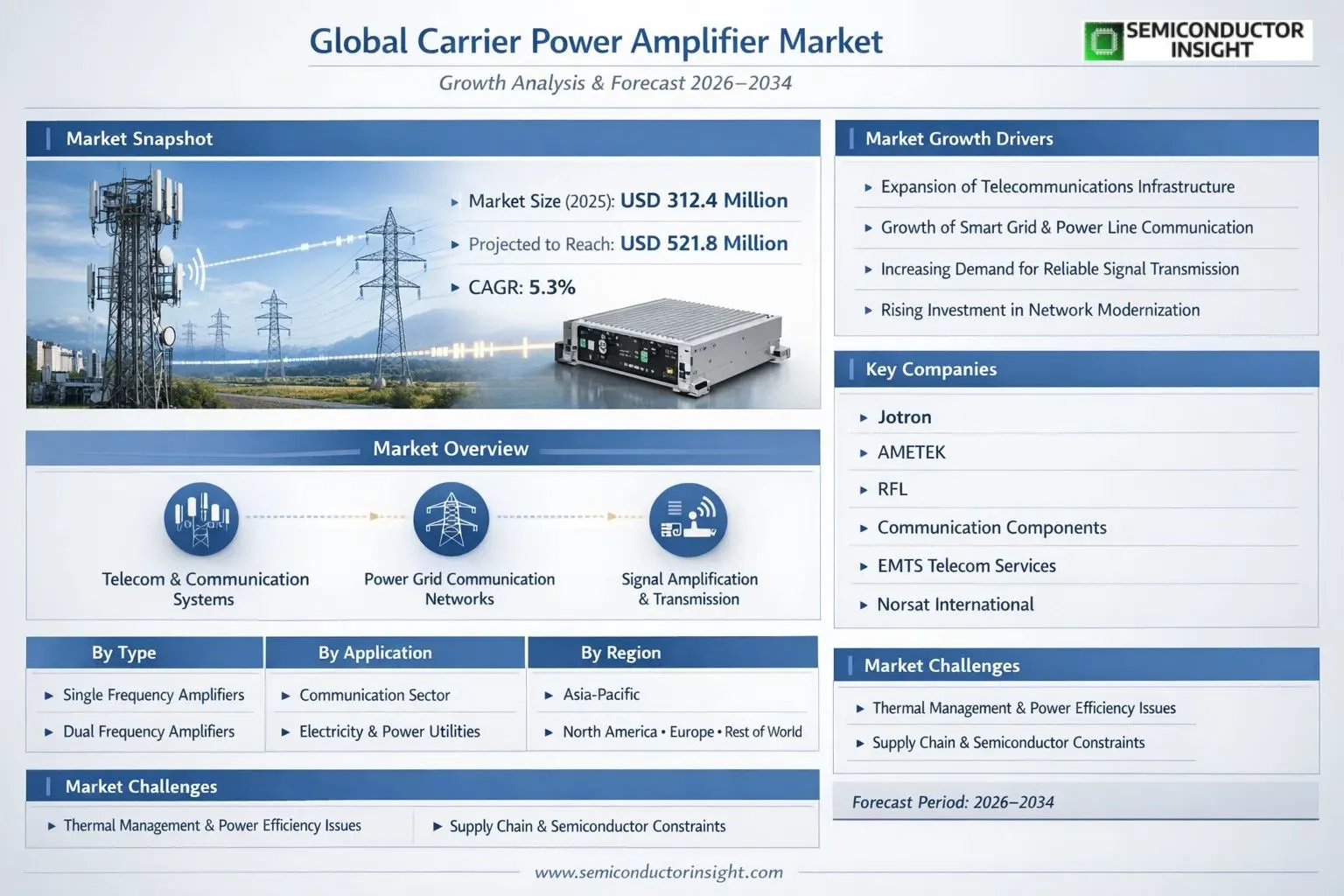
Global Carrier Power Amplifier market size was valued at USD 312.4 million in 2025. The market is projected to grow from USD 328.6 million in 2026 to USD 521.8 million by 2034, exhibiting a CAGR of 5.3% during the forecast period.
The carrier power amplifier is a device used to compensate for line transmission attenuation and characteristic changes to ensure effective transmission of communication signals. The main function is to amplify carrier signals, adjust line attenuation changes, and maintain signal integrity across extended distances. It can realize the transmission of multiple communication signals on the same line through frequency division, making it an essential component in both telecommunications infrastructure and power utility networks. Key product types in this market include Single Frequency and Dual Frequency amplifiers, serving applications across communication and electricity sectors.
The market is witnessing steady growth driven by escalating demand for reliable carrier communication systems in power grids, expanding telecommunications infrastructure, and the ongoing modernization of utility networks globally. The Communication segment continues to dominate application-wise, while the Electricity segment is gaining traction as smart grid deployments accelerate across North America, Europe, and Asia. Key manufacturers operating in the global Carrier Power Amplifier market include Jotron, Communication Components, EMTS Telecom Services, AMETEK, and RFL, among others, collectively accounting for a significant share of global revenue in 2025.
MARKET DRIVERS
Surging Demand from 5G Infrastructure Deployment
The global rollout of fifth-generation (5G) wireless networks represents one of the most significant catalysts propelling growth in Carrier Power Amplifier Market. Telecom operators across North America, Europe, and Asia-Pacific are aggressively investing in upgrading their base station infrastructure to support the massive bandwidth and low-latency requirements of 5G technology. Carrier power amplifiers are a critical component in radio access networks (RAN), enabling efficient signal transmission across macro cells, small cells, and distributed antenna systems. As network densification accelerates, the volume of power amplifiers required per square kilometer of coverage is rising substantially, directly expanding market demand.
Growth in Satellite Communication and Defense Applications
Beyond terrestrial wireless, Carrier Power Amplifier Market is benefiting from robust expansion in satellite communications and defense electronics. The proliferation of low Earth orbit (LEO) satellite constellations for broadband connectivity has created a parallel demand for high-efficiency, wideband power amplifiers capable of operating across diverse frequency bands. In the defense sector, phased array radar systems, electronic warfare platforms, and secure military communications all rely on advanced carrier power amplifier technologies. Government defense budgets across major economies continue to prioritize modernization of communication infrastructure, sustaining a steady stream of high-value contracts for amplifier manufacturers.
➤ The transition to Gallium Nitride (GaN) semiconductor technology is fundamentally reshaping Carrier Power Amplifier Market, delivering superior power density, thermal efficiency, and operational bandwidth compared to legacy Gallium Arsenide (GaAs) solutions , making GaN-based carrier power amplifiers the preferred choice for next-generation telecom and defense applications.
The increasing adoption of Massive MIMO (Multiple Input Multiple Output) antenna architectures in 5G base stations is further amplifying demand within Carrier Power Amplifier Market. Massive MIMO systems require dozens to hundreds of individual antenna elements, each necessitating its own power amplifier, exponentially increasing the unit volumes required per base station compared to legacy 4G LTE deployments. This architectural shift is compelling manufacturers to develop highly integrated, energy-efficient amplifier modules that can be produced at scale without compromising on RF performance or linearity.
MARKET CHALLENGES
Thermal Management and Power Efficiency Constraints
One of the foremost technical challenges confronting Carrier Power Amplifier Market is the management of heat dissipation in high-power amplifier designs. As carrier frequencies shift toward millimeter-wave (mmWave) bands for 5G and beyond, power amplifiers operate under increasingly demanding thermal conditions. Inefficiencies in power conversion generate excess heat that, if not adequately managed, degrades amplifier performance, reduces mean time between failures (MTBF), and increases total cost of ownership for network operators. Designing compact, high-power-density amplifier modules that meet stringent thermal thresholds without compromising on output power or linearity remains a persistent engineering challenge for the industry.
Other Challenges
Supply Chain Disruptions and Semiconductor Sourcing
Carrier Power Amplifier Market is exposed to vulnerabilities in the global semiconductor supply chain. Specialized compound semiconductors such as GaN-on-SiC and GaAs, which are essential for high-frequency carrier power amplifiers, are produced by a limited number of wafer fabrication facilities worldwide. Geopolitical tensions, export restrictions, and episodic supply-demand imbalances can create significant lead time extensions and component cost inflation, challenging manufacturers’ ability to fulfill large-scale telecom infrastructure contracts on schedule.
Stringent Linearity and Spectral Efficiency Requirements
Modern cellular and satellite communication standards impose increasingly rigorous specifications on amplifier linearity, adjacent channel leakage ratio (ACLR), and error vector magnitude (EVM). Meeting these requirements, particularly in wideband and multi-carrier operating configurations, necessitates sophisticated digital pre-distortion (DPD) algorithms and advanced circuit design methodologies. The engineering complexity and associated development costs required to satisfy these specifications can extend product development cycles and create barriers to market entry for smaller participants in Carrier Power Amplifier Market.
MARKET RESTRAINTS
High Capital Expenditure and R&D Investment Requirements
The development and commercialization of advanced carrier power amplifiers demand substantial upfront capital investment in semiconductor process technology, RF characterization infrastructure, and application-specific integrated circuit (ASIC) design capabilities. Smaller and mid-tier manufacturers often face significant financial constraints in keeping pace with the rapid technological evolution driven by 5G and next-generation communication standards. The high cost of GaN wafer fabrication, combined with the complexity of multi-band amplifier architectures, elevates barriers to entry and may restrain the pace of innovation across certain segments of Carrier Power Amplifier Market.
Regulatory and Spectrum Allocation Complexities
Regulatory frameworks governing RF spectrum allocation, electromagnetic compatibility (EMC), and radio frequency emissions vary considerably across geographies, creating compliance complexity for carrier power amplifier manufacturers serving global markets. Amplifiers designed for one regulatory jurisdiction may require significant re-engineering to meet the certification requirements of another, adding cost and time to market entry strategies. Furthermore, delays in spectrum licensing and auction processes in certain emerging markets can defer the rollout of 5G infrastructure projects, indirectly suppressing near-term demand within Carrier Power Amplifier Market in those regions.
Additionally, the increasing consolidation among global telecom operators is creating a more concentrated buyer base with heightened pricing leverage over amplifier suppliers. As major network equipment vendors negotiate large-scale procurement agreements, margin pressure on carrier power amplifier manufacturers intensifies. This dynamic is particularly acute in mature markets where infrastructure upgrade cycles are more predictable, limiting opportunities for suppliers to command premium pricing on established product lines and constraining overall revenue growth potential.
MARKET OPPORTUNITIES
Open RAN Architecture as a Catalyst for Amplifier Innovation
The global momentum behind Open Radio Access Network (Open RAN) initiatives presents a compelling growth opportunity for participants in Carrier Power Amplifier Market. Open RAN disaggregates hardware and software components of traditional base stations, enabling network operators to source radio units, distributed units, and centralized units from different vendors. This architectural openness is accelerating demand for interoperable, standards-compliant carrier power amplifier modules that can be integrated into diverse multi-vendor radio unit designs, expanding the addressable customer base for amplifier manufacturers beyond the traditional closed-ecosystem OEM relationships.
Emerging Markets Infrastructure Buildout and Rural Connectivity Initiatives
Rapid telecommunications infrastructure development across emerging economies in Southeast Asia, Sub-Saharan Africa, Latin America, and the Middle East represents a substantial untapped opportunity for Carrier Power Amplifier Market. Government-backed universal service obligations and rural broadband connectivity programs are driving the deployment of new base stations and repeater infrastructure in underserved areas. These deployments require cost-effective, energy-efficient carrier power amplifiers optimized for tropical and high-temperature operating environments, creating demand for purpose-engineered product variants and establishing long-term supply relationships with regional network operators.
The convergence of artificial intelligence and machine learning with RF system design is opening a new frontier of innovation within Carrier Power Amplifier Market. AI-driven digital pre-distortion, adaptive bias control, and intelligent load modulation techniques are enabling next-generation amplifiers to dynamically optimize their operating parameters in real time, significantly improving efficiency across varying traffic load conditions. Manufacturers investing in the integration of AI-assisted signal processing capabilities into their carrier power amplifier product portfolios are well-positioned to differentiate on performance and energy efficiency , two attributes that are increasingly decisive in competitive network equipment procurement decisions globally.
MAIN TITLE HERE () Trends
Rising Demand for Reliable Signal Transmission Drives Carrier Power Amplifier Market Growth
Carrier Power Amplifier Market is witnessing sustained momentum as industries across telecommunications, power utilities, and infrastructure sectors increasingly rely on stable, long-distance signal transmission. Carrier power amplifiers, designed to compensate for line transmission attenuation and maintain signal integrity across extended communication lines, have become indispensable components in modern communication networks. As network operators prioritize signal reliability and operational efficiency, demand for advanced carrier power amplifier solutions continues to strengthen across both developed and emerging economies.
The communication segment remains the dominant application area within Carrier Power Amplifier Market, driven by the ongoing expansion of wireline and carrier-based communication infrastructure. Simultaneously, the electricity sector is emerging as a significant end-user, leveraging carrier power amplifiers for power line communication systems that support grid monitoring and remote control operations. The dual-use functionality of these devices , enabling multiple communication signals to be transmitted simultaneously over the same line through frequency division , continues to be a key value proposition for network operators seeking cost-effective infrastructure solutions.
Other Trends
Shift Toward Dual Frequency Configurations
Within Carrier Power Amplifier Market, there is a notable shift in product preference from single frequency to dual frequency configurations. Dual frequency carrier power amplifiers offer enhanced flexibility in managing diverse signal types across a single transmission medium, making them particularly attractive for utilities and telecom operators managing complex, multi-signal environments. This trend is expected to influence product development strategies among leading manufacturers such as Jotron, AMETEK, RFL, Communication Components, and EMTS Telecom Services, who are actively advancing their product portfolios to address evolving end-user requirements.
Regional Expansion in Asia-Pacific
Asia-Pacific, led by China, Japan, South Korea, and Southeast Asia, represents one of the most dynamic regions in the global Carrier Power Amplifier Market. Rapid urbanization, large-scale telecommunications infrastructure deployment, and expanding smart grid initiatives are collectively driving strong regional demand. China, in particular, is a major growth contributor, supported by ongoing investments in both communication networks and electricity grid modernization programs. India and Southeast Asian economies are also emerging as high-potential markets as their communication and utility sectors continue to develop.
Competitive Landscape and Innovation Trends
The global Carrier Power Amplifier Market is moderately consolidated, with the top five manufacturers collectively holding a substantial share of global revenues as of 2025. Key players are focused on product innovation, strategic partnerships, and geographic expansion to strengthen their market positions. There is a growing emphasis on developing amplifiers with improved energy efficiency, wider frequency ranges, and enhanced durability to meet the demands of both legacy infrastructure upgrades and new network deployments. North America and Europe continue to be significant markets, supported by ongoing infrastructure modernization investments, while emerging markets in the Middle East, Africa, and South America offer incremental growth opportunities for market participants over the coming years.
COMPETITIVE LANDSCAPE
Key Industry Players
Carrier Power Amplifier Market: Competitive Dynamics, Strategic Positioning, and Leading Manufacturer Profiles
The global Carrier Power Amplifier market is characterized by a moderately consolidated competitive landscape, with a handful of established players commanding a significant portion of total industry revenue. The top five manufacturers collectively accounted for an estimated majority share of the global market in 2025, underscoring the dominant influence of specialized firms with deep expertise in carrier signal amplification technologies. Market leaders such as Jotron and AMETEK have leveraged decades of engineering experience, robust R&D investment, and expansive distribution networks to maintain competitive advantages. These companies offer carrier power amplifier solutions spanning both single frequency and dual frequency product types, catering to critical end-use sectors including telecommunications, electricity transmission infrastructure, and broader communication applications. The competitive intensity in this market is further shaped by the technical complexity of designing amplifiers that can compensate for line transmission attenuation and characteristic changes while enabling multi-signal transmission over a single line through frequency division , a capability that demands high precision manufacturing and continuous innovation.
Beyond the leading incumbents, a number of niche yet significant players such as Communication Components, EMTS Telecom Services, and RFL contribute meaningfully to the global supply landscape. These companies have carved out specialized positions by focusing on specific regional markets or application segments, particularly in North America, Europe, and Asia-Pacific, where demand for reliable carrier communication infrastructure remains robust. Competitive strategies across the industry include product portfolio diversification, strategic mergers and acquisitions, technological upgrades to support evolving grid communication requirements, and expanding after-sales service capabilities. Emerging players from China and Southeast Asia are increasingly entering the arena, intensifying price-based competition and prompting established manufacturers to differentiate through quality, reliability, and compliance with international communication standards. As the market continues to expand through 2034, competitive dynamics are expected to evolve further with advancements in digital carrier systems and smart grid integration driving new product development cycles.
List of Key Carrier Power Amplifier Companies Profiled
- Jotron
- Communication Components
- EMTS Telecom Services
- AMETEK
- RFL
- Comlab
- Norsat International
- Richardson Electronics
- Ophir RF
- AR RF/Microwave Instrumentation
- Empower RF Systems
- Advantech Wireless
- Teledyne Microwave Solutions
- General Dynamics Mission Systems
- CPI (Communications & Power Industries)
Segment Analysis:
| Segment Category | Sub-Segments | Key Insights |
| By Type |
|
Single Frequency amplifiers represent the leading segment in Carrier Power Amplifier Market, driven by their widespread use in legacy communication infrastructure and point-to-point transmission networks.
|
| By Application |
|
Communication stands as the dominant application segment, underpinned by the critical role carrier power amplifiers play in maintaining signal integrity across long-distance and high-frequency transmission lines.
|
| By End User |
|
Telecommunication Service Providers represent the leading end-user segment, as they constitute the primary consumers of carrier power amplifiers for managing and sustaining expansive carrier communication networks.
|
| By Frequency Band |
|
Mid Frequency Band amplifiers lead this segment, offering an optimal balance between signal reach and transmission capacity that suits the majority of carrier communication deployments across both telecom and power sectors.
|
| By Installation Type |
|
Rack-Mounted carrier power amplifiers dominate the installation type segment, reflecting the preference of large-scale telecom operators and utility companies for centralized, high-density equipment configurations within dedicated communication facilities.
|
Regional Analysis: Carrier Power Amplifier Market
Asia-Pacific
China commands an unparalleled position within the Asia-Pacific carrier power amplifier market, owing to its aggressive national broadband strategy and the world’s most extensive 5G base station deployment program. State-backed telecom operators continue to prioritize network densification across tier-one and tier-two cities, creating consistent demand for high-performance amplifier solutions. Domestic chipmakers and system integrators further strengthen China’s self-sufficiency in this segment.
India presents one of the most dynamic growth opportunities within the regional carrier power amplifier landscape. The country’s ongoing spectrum auctions, combined with ambitious digital connectivity programs targeting rural and underserved populations, are stimulating robust demand for amplifier technologies across both macro and small cell deployments. The entry of new telecom players and competitive pricing strategies continue to accelerate infrastructure investment at a substantial pace.
Japan and South Korea represent the technological vanguard of the Asia-Pacific carrier power amplifier market. Both nations have transitioned early to advanced network generations and continue to pioneer developments in amplifier efficiency, thermal management, and miniaturization. Strong collaboration between network operators, equipment vendors, and academic institutions fosters a healthy innovation pipeline that sets benchmarks for the broader regional market.
Southeast Asian nations including Indonesia, Vietnam, Thailand, and the Philippines, along with Australia and New Zealand in Oceania, are increasingly becoming important contributors to regional carrier power amplifier demand. Expanding middle-class populations, rising mobile penetration, and government-led broadband initiatives are driving network operators to invest in modernized radio access infrastructure, creating a favorable environment for amplifier solution providers targeting these emerging sub-markets.
North America
North America represents one of the most technologically mature and commercially significant regions within the global carrier power amplifier market. The United States, in particular, serves as a key innovation hub, with major network operators making substantial investments in advanced wireless infrastructure to support the proliferation of high-bandwidth applications and connected device ecosystems. The region’s strong regulatory framework, characterized by proactive spectrum management by federal authorities, supports systematic network upgrades and the deployment of new radio access technologies. Canada contributes meaningfully through its own network modernization programs targeting both urban centers and remote communities. The presence of globally recognized semiconductor designers, system integrators, and telecom equipment manufacturers within the region ensures a robust and competitive supply environment. Enterprise private network deployments and the growing adoption of fixed wireless access solutions further diversify demand for carrier power amplifiers across North America.
Europe
Europe occupies a prominent position in Carrier Power Amplifier Market, underpinned by a mature telecommunications ecosystem, harmonized regulatory standards, and a strong commitment to digital infrastructure investment across member states. Leading economies including Germany, the United Kingdom, France, and the Nordic countries are actively advancing network modernization programs that drive sustained demand for amplifier technologies. The European market is also shaped by stringent energy efficiency regulations, which incentivize telecom operators and equipment vendors to adopt power amplifier solutions with superior linearity and reduced energy consumption profiles. The region’s emphasis on sustainable telecommunications practices aligns well with innovations in amplifier design, including the adoption of energy-efficient semiconductor materials and advanced digital pre-distortion techniques. Cross-border infrastructure collaboration facilitated by European Union connectivity mandates further supports regional market development through the forecast period.
South America
South America presents a steadily developing market for carrier power amplifiers, with Brazil and Mexico leading regional demand through ongoing network expansion programs and increasing mobile broadband penetration. The region’s large and youthful population base, combined with growing consumer appetite for digital services, is encouraging telecom operators to invest in network capacity enhancements. However, economic variability and currency fluctuations in several South American economies continue to create investment uncertainty, moderating the pace of infrastructure deployment in some markets. Despite these challenges, multilateral development financing and public-private partnership models are helping accelerate connectivity programs in underserved regions. The gradual transition toward advanced wireless network standards is expected to generate meaningful long-term opportunities for carrier power amplifier vendors operating across the South American landscape.
Middle East & Africa
The Middle East and Africa region occupies an emerging but increasingly strategic position within the global carrier power amplifier market. Gulf Cooperation Council nations, particularly Saudi Arabia and the United Arab Emirates, are pursuing ambitious smart city and digital economy agendas that demand robust and high-performance telecommunications infrastructure. These nations are investing heavily in next-generation network deployments as part of broader national transformation programs, creating premium demand for advanced amplifier solutions. Across Africa, mobile connectivity expansion remains a central development priority, with network operators extending coverage into previously unserved territories through a combination of macro cell and innovative low-power network architectures. While infrastructure financing and logistical challenges persist across parts of the African continent, the long-term demographic and economic trajectory of the region positions it as a significant future contributor to global carrier power amplifier market growth.
Report Scope
This market research report provides a comprehensive analysis of Carrier Power Amplifier Market, covering the forecast period 2026–2034. It offers detailed insights into market dynamics, technological advancements, competitive landscape, and key trends shaping the industry.
Key focus areas of the report include:
- Market Overview: The report begins with an overview outlining its current market scenario, key growth indicators, and industry transformation drivers. It discusses macroeconomic factors, demand–supply balance, regulatory landscape, and the strategic role of carrier power amplifiers in powering advancements across industries such as telecommunications, communication infrastructure, electricity transmission, and industrial automation.
- Market Size & Forecast: Historical data and future projections for revenue, unit shipments, and market value across major regions and segments.
- Segmentation Analysis: Detailed breakdown by product type, technology, application, and end-user industry to identify high-growth segments and investment opportunities.
- Regional Insights: Insights into market performance across North America, Europe, Asia-Pacific, Latin America, and the Middle East & Africa, including country-level analysis where relevant.
- Competitive Landscape: Profiles of leading market participants, including their product offerings, R&D focus, manufacturing capacity, pricing strategies, and recent developments such as mergers, acquisitions, and partnerships.
- Technology Trends & Innovation: Assessment of emerging technologies, integration of AI/IoT, semiconductor design trends, fabrication techniques, and evolving industry standards.
- Market Drivers & Restraints: Evaluation of factors driving market growth along with challenges, supply chain constraints, regulatory issues, and market-entry barriers.
- Stakeholder Insights: Insights for component suppliers, OEMs, system integrators, investors, and policymakers regarding the evolving ecosystem and strategic opportunities.
Primary and secondary research methods are employed, including interviews with industry experts, data from verified sources, and real-time market intelligence to ensure the accuracy and reliability of the insights presented.
FREQUENTLY ASKED QUESTIONS:
What is the current market size of Carrier Power Amplifier Market?
-> Global Carrier Power Amplifier Market was valued at USD 312.4 million in 2025. and is expected to reach USD 521.8 million by 2034, growing at a CAGR of 5.3% during the forecast period 2026–2034.
Which key companies operate in Carrier Power Amplifier Market?
-> Key players include Jotron, Communication Components, EMTS Telecom Services, AMETEK, and RFL, among others. In 2025, the global top five players held a share of approximately % in terms of revenue.
What are the key growth drivers?
-> Key growth drivers include expanding telecommunication networks, growing demand for reliable communication signal transmission, increasing deployment of carrier-based communication systems, and the need to compensate for line transmission attenuation and characteristic changes across communication and electricity sectors.
Which region dominates the market?
-> North America represents a significant market, with the U.S. market size estimated at USD million in 2025. Asia is also a key growth region, with China projected to reach USD million during the forecast period.
What are the emerging trends?
-> Emerging trends include frequency division multiplexing advancements enabling transmission of multiple communication signals on the same line, growing adoption of Single Frequency and Dual Frequency carrier power amplifiers, and increasing applications across Communication, Electricity, and other end-use sectors. The Single Frequency segment is projected to reach USD million by 2034, with a CAGR of % over the next six years.

Get Sample Report PDF for Exclusive Insights
Report Sample Includes
- Table of Contents
- List of Tables & Figures
- Charts, Research Methodology, and more...
 Download Sample Report PDF