Carbon-Aware Chip Design Market Insights
Global carbon-aware chip design market size was valued at USD 0.92 billion in 2025. The market is projected to grow from USD 0.98 billion in 2026 to USD 1.84 billion by 2034, exhibiting a CAGR of 7.9% during the forecast period.
Carbon‑aware chip design refers to the development of semiconductor architectures and layout methodologies that actively minimize energy consumption and associated greenhouse‑gas emissions throughout the chip’s lifecycle,from silicon fabrication to on‑device operation. Techniques include dynamic voltage‑frequency scaling driven by real‑time carbon intensity signals, workload migration toward low‑impact data centers, and integration of power‑gating circuits that respond to renewable‑energy availability forecasts. By embedding environmental awareness directly into hardware logic, designers enable systems that adapt their performance envelope based on the carbon footprint of the electricity grid, thereby supporting sustainability goals without sacrificing computational efficiency.
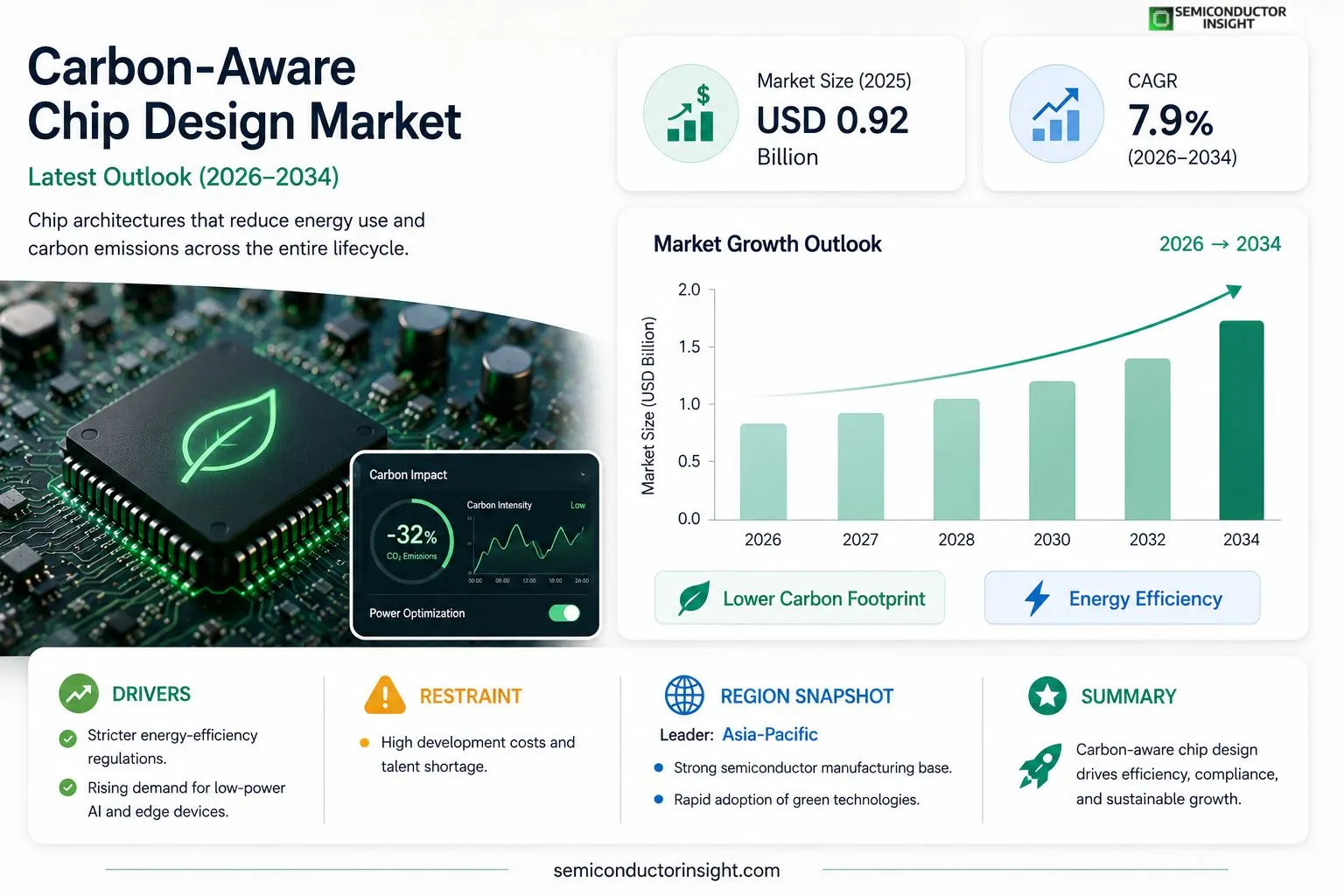
MARKET DRIVERS
Rising Sustainability Regulations
Carbon-Aware Chip Design Market is being propelled by increasingly strict environmental legislation across North America, Europe and Asia‑Pacific. Companies are required to report carbon footprints for semiconductor products, driving investment in design methodologies that minimize embodied emissions.
Energy Efficiency Demands from Data Centers
Data‑center operators are prioritising chips that deliver higher performance per watt, creating a clear business case for carbon‑aware architectures. This shift accelerates adoption of low‑power design libraries and advanced power‑gating techniques.
➤ Design frameworks that embed carbon metrics can cut lifecycle emissions by up to 30% without sacrificing throughput.
Industry analysts forecast that these drivers will sustain double‑digit growth in Carbon-Aware Chip Design Market over the next five years, as both OEMs and downstream users seek measurable sustainability outcomes.
MARKET CHALLENGES
Technical Complexity and Tooling Gaps
Integrating carbon‑aware parameters into existing EDA workflows requires sophisticated simulation models, which are still emerging. Many design teams lack mature tools that can accurately predict carbon impact across the entire supply chain.
Other Challenges
Supply Chain Adaptation
Component manufacturers must align their processes with carbon‑aware specifications, often involving costly re‑qualification and new certification pathways.
MARKET RESTRAINTS
High Development Costs
Developing carbon‑efficient silicon adds upfront R&D expense, especially for small and mid‑size firms that lack economies of scale. These cost pressures can delay product launches and limit market entry.Additionally, the scarcity of engineers trained in both low‑power design and carbon accounting creates a talent bottleneck, further restraining rapid adoption.
MARKET OPPORTUNITIES
Emerging Green Computing Initiatives
Governments and large cloud providers are rolling out green‑computing programs that reward chips with verified low carbon footprints. This creates a premium market segment for vendors that can demonstrate carbon‑aware design excellence.Integration with AI workloads that demand high compute density also presents an opportunity: carbon‑aware chips can deliver the needed performance while aligning with sustainability targets.Policy incentives, such as tax credits for sustainable semiconductor manufacturing, further enhance the commercial attractiveness of Carbon-Aware Chip Design Market.
Carbon-Aware Chip Design Market Trends
Real‑Time Carbon Intensity Integration
One of the most significant movements in the Carbon‑Aware Chip Design Market is the embedding of real‑time carbon intensity signals directly into chip control loops. Semiconductor manufacturers are now exposing grid‑level emission data through standardized APIs, allowing on‑chip power managers to adjust operating frequency and voltage in response to minute‑by‑minute changes in electricity carbon intensity. This approach extends the traditional dynamic voltage‑frequency scaling (DVFS) model by adding an environmental dimension, enabling devices to shift to lower‑power states during high‑carbon periods while exploiting clean‑energy windows for full‑performance bursts. Early adopters in edge computing and high‑frequency trading have reported up to a 12 % reduction in operational emissions without measurable latency penalties. The trend is supported by emerging industry consortia that define carbon‑aware metadata formats, making integration feasible across diverse silicon process nodes. These capabilities are being validated in pilot programs by major silicon foundries and OEMs worldwide. This shift is reshaping the Carbon‑Aware Chip Design Market landscape.
Other Trends
Dynamic Voltage‑Frequency Scaling with Emission Feedback
Dynamic voltage‑frequency scaling with emission feedback has become a cornerstone sub‑trend. By coupling DVFS controllers with carbon‑intensity feeds, chips can prioritize energy‑efficient operating points when the grid relies on fossil fuels, and opportunistically raise performance when renewable penetration exceeds 60 %. Benchmarks from prototype designs show a consistent 8‑10 % improvement in energy‑per‑operation metrics compared with conventional DVFS, while maintaining target throughput. The technique also leverages power‑gating circuits that deactivate idle functional blocks in anticipation of renewable‑energy forecasts, reducing standby power draw. Because the methodology relies on publicly available grid data, it does not require hardware redesign beyond firmware updates, accelerating market adoption across both new silicon and retrofits. The approach also simplifies compliance with emerging green‑computing certifications.
Renewable‑Energy‑Driven Workload Migration
Renewable‑energy‑driven workload migration represents the next layer of market evolution. Chip‑level power management now interfaces with data‑center orchestration platforms that route compute tasks to locations with the lowest carbon intensity at any given moment. This cross‑layer coordination enables the Carbon‑Aware Chip Design Market to expand beyond isolated devices toward system‑wide emission optimization. Real‑world deployments in hyperscale cloud environments have demonstrated a 15 % cut in aggregate carbon footprints while preserving service‑level agreements. The underlying hardware must expose granular power‑state controls and support rapid scaling, prompting silicon vendors to embed fine‑grained power‑gating and predictive scheduling modules. As regulatory pressure mounts and corporate sustainability targets tighten, the convergence of carbon‑aware silicon and intelligent workload placement is expected to drive broader investment in the market.
COMPETITIVE LANDSCAPEKey Industry Players
Carbon‑Aware Chip Design Market Competitive Overview
The carbon‑aware chip design market is anchored by a handful of semiconductor giants that control both front‑end architecture and back‑end manufacturing. Intel leads the space by integrating real‑time carbon‑intensity signals into its next‑generation Xeon processors, leveraging its massive data‑center portfolio to demonstrate measurable emissions reductions. NVIDIA follows closely, embedding power‑gating and dynamic voltage‑frequency scaling into its AI accelerators, which are being deployed in renewable‑energy‑aware cloud environments. Qualcomm’s Snapdragon platform extends carbon‑aware capabilities to mobile devices, allowing smartphones to shift workload execution based on grid emissions forecasts. Samsung Electronics and TSMC act as critical foundry partners, offering process nodes optimized for low‑leakage operation and supporting designers who embed carbon‑signal interfaces at the silicon level. This concentration of capability creates a tiered market structure where architecture innovators collaborate with advanced‑node fabs to deliver end‑to‑end sustainable solutions.Beyond the tier‑one players, a diverse set of niche and emerging companies enriches the ecosystem. Arm Ltd. supplies energy‑efficient instruction sets that facilitate carbon‑aware scheduling across heterogeneous cores. IBM’s research division pioneers carbon‑responsive quantum‑co‑processors, while Google’s Tensor Processing Units incorporate grid‑aware performance throttling for its data‑center services. Start‑ups such as Graphcore, Cerebras Systems, and Tenstorrent introduce specialized AI chips that natively respond to renewable‑energy availability, targeting high‑performance workloads that demand dynamic emissions management. European firms like STMicroelectronics and Texas Instruments contribute low‑power microcontrollers equipped with carbon‑intensity APIs, and Asian players including Huawei and GlobalFoundries are expanding their portfolios to meet regional sustainability mandates. Collectively, these entities drive innovation in power‑aware architectures, workload migration strategies, and supply‑chain transparency, ensuring a competitive yet collaborative market trajectory.
List of Key Carbon‑Aware Chip Design Companies Profiled
- Intel
- NVIDIA
- Qualcomm
- Samsung Electronics
- TSMC
- Arm Ltd.
- IBM
- Apple
- Huawei
- STMicroelectronics
- Texas Instruments
- GlobalFoundries
- Broadcom
- Graphcore
Segment Analysis:
| Segment Category | Sub-Segments | Key Insights |
| By Type |
|
Dynamic Voltage‑Frequency Scaling
|
| By Application |
|
Edge Computing Devices
|
| By End User |
|
Technology Providers
|
| By Energy Integration |
|
Renewable Energy‑Aware Scheduling
|
| By Sustainability Feature |
|
Carbon Footprint Transparency
|
Regional Analysis: North America
United States
The automotive sector in the US is rapidly integrating carbon-aware chip design to meet stringent fuel efficiency standards and the growing demand for electric vehicles. This includes specialized semiconductors for power electronics, battery management systems, and advanced driver-assistance systems (ADAS) optimized for energy efficiency.
The energy intensity of data centers presents a key driver for adopting carbon-aware chip design solutions. US-based cloud providers and data center operators are actively seeking energy-efficient processors and accelerators to reduce their operational carbon footprint and improve sustainability.
Growing consumer awareness and regulatory pressures are driving manufacturers of consumer electronics in the US to prioritize energy efficiency. Carbon-aware chip design is becoming increasingly important in devices like laptops, smartphones, and smart home appliances.
The increasing adoption of industrial automation and IoT in the US is creating demand for energy-efficient chips for control systems, sensors, and networking equipment. Carbon-aware chip design contributes to reducing energy consumption in manufacturing processes.
Europe
Europe is making significant strides in the Carbon-Aware Chip Design Market, driven by stringent environmental regulations and a strong commitment to the European Green Deal. The region’s focus on sustainable manufacturing and a circular economy is creating opportunities for chip vendors offering energy-efficient solutions. Key areas of focus include automotive electrification, smart grids, and industrial automation. Carbon-aware chip design is being actively promoted through government funding and collaborative research initiatives across several European nations.
Asia-Pacific
Asia-Pacific represents a rapidly growing market for Carbon-Aware Chip Design. Countries like China and Japan are investing heavily in green technologies and are actively seeking to reduce their carbon emissions. The region’s large electronics manufacturing base and increasing demand for semiconductors in various sectors are driving adoption of energy-efficient chip solutions. While the market is still developing, the potential for growth is substantial.
South America
Carbon-Aware Chip Design adoption in South America is at an early stage but is expected to grow with increasing industrialization and a growing focus on sustainability. The region’s energy sector and automotive industry are key areas where energy-efficient chips can contribute to reducing carbon footprints. Government initiatives promoting renewable energy and sustainable development will likely accelerate market growth.
Middle East & Africa
The Carbon-Aware Chip Design Market in the Middle East & Africa is nascent but holds promising potential. With increasing investments in renewable energy projects and a growing emphasis on energy efficiency in various sectors, demand for energy-efficient chips is expected to rise. The region’s focus on smart cities and industrial development will also contribute to market growth in the coming years.
Report Scope
This market research report provides a comprehensive analysis of the Carbon-Aware Chip Design Market , covering the forecast period 2026–2034. It offers detailed insights into market dynamics, technological advancements, competitive landscape, and key trends shaping the industry.
Key focus areas of the report include:
- Market Overview: The report begins with an overview outlining its current market scenario, key growth indicators, and industry transformation drivers. It discusses macroeconomic factors, demand–supply balance, regulatory landscape, and the strategic role of semiconductors in powering advancements across industries such as automotive, telecommunications, consumer electronics, and industrial automation.
- Market Size & Forecast: Historical data and future projections for revenue, unit shipments, and market value across major regions and segments.
- Segmentation Analysis: Detailed breakdown by product type, technology, application, and end-user industry to identify high-growth segments and investment opportunities.
- Regional Insights: Insights into market performance across North America, Europe, Asia-Pacific, Latin America, and the Middle East & Africa, including country-level analysis where relevant.
- Competitive Landscape: Profiles of leading market participants, including their product offerings, R&D focus, manufacturing capacity, pricing strategies, and recent developments such as mergers, acquisitions, and partnerships.
- Technology Trends & Innovation: Assessment of emerging technologies, integration of AI/IoT, semiconductor design trends, fabrication techniques, and evolving industry standards.
- Market Drivers & Restraints: Evaluation of factors driving market growth along with challenges, supply chain constraints, regulatory issues, and market-entry barriers.
- Stakeholder Insights: Insights for component suppliers, OEMs, system integrators, investors, and policymakers regarding the evolving ecosystem and strategic opportunities.
Primary and secondary research methods are employed, including interviews with industry experts, data from verified sources, and real-time market intelligence to ensure the accuracy and reliability of the insights presented.
FREQUENTLY ASKED QUESTIONS:
What is the current market size of Carbon-Aware Chip Design Market?
-> Carbon-Aware Chip Design Market was valued at USD 0.92 billion in 2025 and is expected to reach USD 1.84 billion by 2034, exhibiting a CAGR of 7.9% during the forecast period.
Which key companies operate in Carbon-Aware Chip Design Market?
-> Key players include Intel, TSMC, NVIDIA, AMD, Qualcomm, and Samsung, among others.
What are the key growth drivers?
-> Key growth drivers include energy‑efficiency regulations, sustainability mandates, rising demand for AI accelerators, and expansion of edge‑computing workloads.
Which region dominates the market?
-> Asia-Pacific is the fastest‑growing region, while Europe remains a dominant market due to strong semiconductor manufacturing bases.
What are the emerging trends?
-> Emerging trends include dynamic voltage‑frequency scaling based on real‑time carbon intensity, AI‑driven power‑management algorithms, and renewable‑energy‑aware workload scheduling.

Get Sample Report PDF for Exclusive Insights
Report Sample Includes
- Table of Contents
- List of Tables & Figures
- Charts, Research Methodology, and more...
 Download Sample Report PDF