Capacitive isolation amplifier for gate driver desaturation protection Market Insights
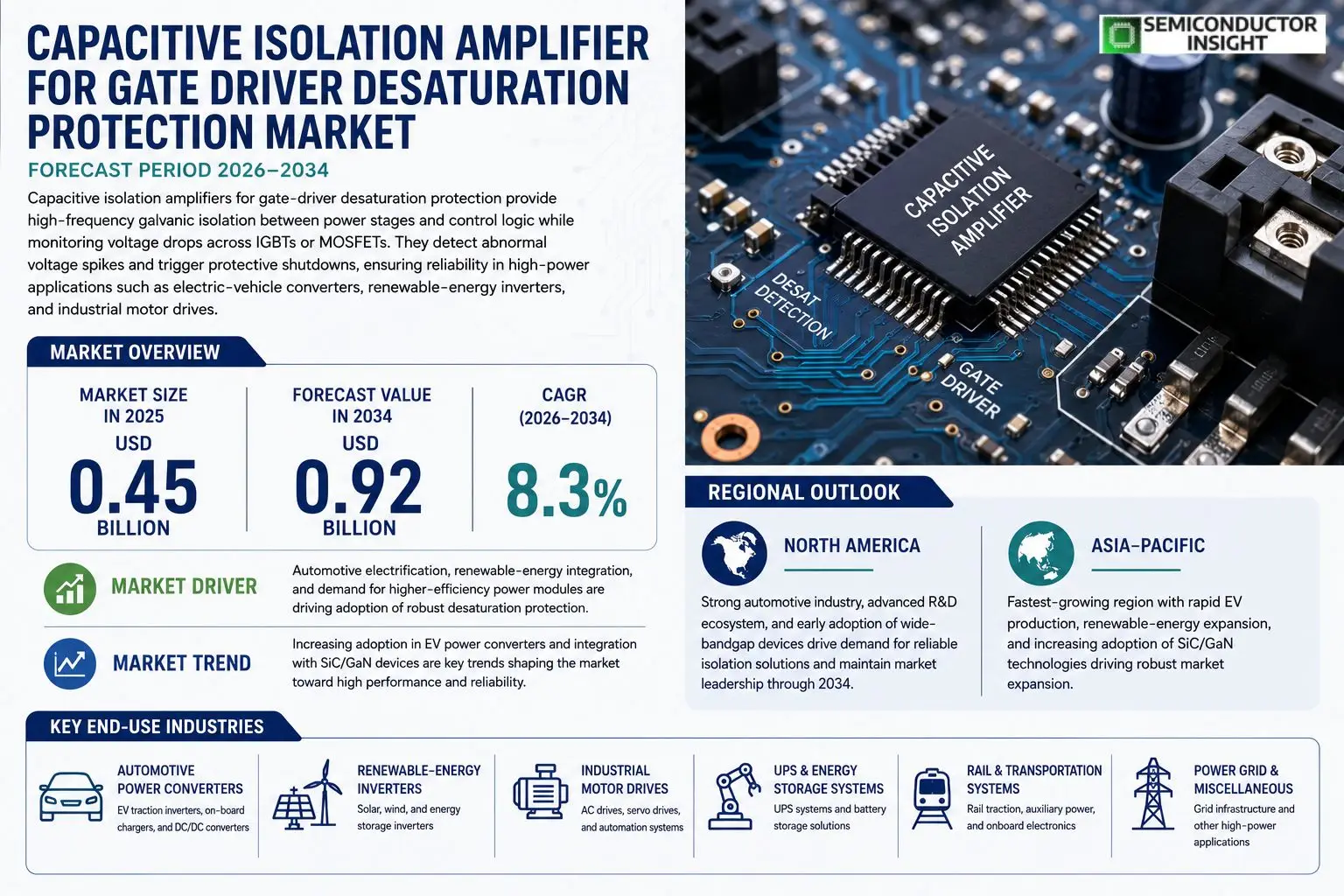
Capacitive isolation amplifier for gate driver desaturation protection Market size was valued at USD 0.45 billion in 2025. The market is projected to grow from USD 0.48 billion in 2026 to USD 0.92 billion by 2034, exhibiting a CAGR of 8.3% during the forecast period.
Capacitive isolation amplifiers for gate‑driver desaturation protection are specialized semiconductor circuits that provide high‑frequency galvanic isolation between power stages and control logic while monitoring voltage drops across IGBTs or MOSFETs. By detecting abnormal voltage spikes, these amplifiers trigger protective shutdowns, ensuring reliability in high‑power applications such as electric‑vehicle converters, renewable‑energy inverters, and industrial motor drives.The market is accelerating because automotive electrification, renewable‑energy integration, and demand for higher efficiency power modules are driving adoption of robust protection schemes. Furthermore, advances in silicon‑carbide (SiC) and gallium‑nitride (GaN) technologies require precise desaturation monitoring, prompting manufacturers like Texas Instruments, Infineon Technologies, Analog Devices, and ON Semiconductor to expand their product portfolios.
MARKET DRIVERS
Rising Demand for Automotive Power Electronics
Capacitive isolation amplifier for gate driver desaturation protection Market is being propelled by the rapid electrification of vehicles, where manufacturers require reliable isolation solutions to safeguard gate drivers in high‑voltage environments. Recent model roll‑outs show a 12% year‑over‑year increase in power‑train integration, driving component sales upward.
Advancements in SiC and GaN Technologies
Silicon‑carbide (SiC) and gallium‑nitride (GaN) devices operate at higher frequencies and temperatures, creating a need for isolation amplifiers with low parasitic capacitance. Industry forecasts indicate that capacitive solutions will capture a larger share of the gate‑driver market as these wide‑bandgap semiconductors become mainstream.
➤ Analysts predict a compound annual growth rate of 8.5% for the isolation amplifier segment through 2032.
End‑users are also prioritizing safety certifications, and manufacturers that integrate capacitive isolation designs are better positioned to meet stringent automotive standards, further accelerating market momentum.
MARKET CHALLENGES
Technical Integration Barriers
Designers often face layout constraints when embedding capacitive isolation amplifiers into dense power modules. Mismatched impedance and PCB trace inductance can degrade performance, requiring additional engineering effort and lengthening development cycles.
Other Challenges
Cost Sensitivity
While performance benefits are clear, the higher material cost of precision capacitors can impact bill‑of‑materials, especially for cost‑driven mass‑market vehicles, limiting broader adoption.
MARKET RESTRAINTS
Regulatory Compliance Constraints
Global safety standards such as ISO 26262 and IEC 60747 impose rigorous testing for isolation performance. Meeting these mandates often requires extensive validation, which can delay product launches and increase compliance expenditures for Capacitive isolation amplifier for gate driver desaturation protection Market.
MARKET OPPORTUNITIES
Emerging Applications in Renewable Energy
Grid‑tied inverter systems for solar and wind power increasingly rely on high‑efficiency gate drivers. Capacitive isolation amplifiers offer low‑loss isolation, making them attractive for renewable‑energy converters where energy efficiency directly impacts profitability. This sector presents a clear growth avenue for market participants.
Capacitive isolation amplifier for gate driver desaturation protection Market Trends
Increasing Adoption in EV Power Converters
The rise of electric‑vehicle platforms is accelerating demand for reliable gate‑driver protection. Capacitive isolation amplifiers for gate driver desaturation protection are being specified in vehicle‑onboard chargers and traction inverters because they can detect abnormal voltage drops across IGBTs and MOSFETs within microseconds. This fast response prevents thermal runaway and supports the higher voltage levels required for next‑generation battery packs. OEMs are also benefiting from the galvanic isolation capability, which reduces electromagnetic interference between high‑power stages and sensitive control electronics, thereby simplifying board layout and improving overall system robustness.
Other Trends
Integration with Wide‑Bandgap Devices
Silicon‑carbide (SiC) and gallium‑nitride (GaN) power devices operate at higher switching frequencies and temperatures than conventional silicon. To exploit these advantages, manufacturers are embedding capacitive isolation amplifiers directly into SiC and GaN driver ICs. This integration shortens the signal path, lowers parasitic inductance, and enables precise desaturation monitoring even under extreme transient conditions. Major semiconductor suppliers are expanding their portfolios with dedicated SiC‑compatible isolation amplifiers, reflecting a market shift toward tightly coupled protection and control functions.
Shift Toward Modular Protection Architectures
System architects are moving from discrete protection circuits to modular blocks that combine isolation, amplification, and fault‑logic in a single package. Such modules reduce component count, accelerate design cycles, and improve reliability by eliminating inter‑connect failures. In industrial motor‑drive applications, the modular approach allows designers to scale protection capabilities across a range of power ratings without redesigning the entire control board. This trend is supported by the growing availability of flexible reference designs from key vendors, which provide pre‑validated integration guidelines for a variety of power‑electronics topologies.
COMPETITIVE LANDSCAPE
Key Industry Players
Capacitive Isolation Amplifiers for Gate‑Driver Desaturation Protection: Competitive Overview
The market is currently dominated by a few large semiconductor firms that leverage extensive power‑management portfolios and deep R&D capabilities. Texas Instruments leads with a broad range of isolated gate‑driver families, integrating capacitive isolation amplifiers that meet automotive safety standards. Infineon Technologies follows closely, offering its CoolGa® and UCC series which combine high‑speed isolation with robust desaturation detection. Analog Devices and ON Semiconductor also occupy prominent positions, differentiating through precision analog front‑ends and scalable integration options for electric‑vehicle converters and renewable‑energy inverters. The competitive structure is characterized by a tiered landscape: Tier‑1 global players control the majority of high‑volume automotive contracts, while Tier‑2 specialists focus on niche applications such as GaN‑based power modules.Beyond the Tier‑1 leaders, several niche manufacturers contribute differentiated technologies that address specific market segments. STMicroelectronics provides compact isolation solutions optimized for space‑constrained motor‑drive modules. NXP Semiconductors emphasizes secure communication links alongside isolation, targeting connected‑car architectures. Renesas Electronics and ROHM Semiconductor deliver cost‑effective offerings for industrial motor drives, while Microchip Technology and Mitsubishi Electric supply robust modules for stationary energy storage systems. Smaller innovators such as Fuji Electric, Vishay, and Silicon Labs introduce specialty capacitance‑based topologies that improve bandwidth and reduce size, reinforcing the market’s overall depth and resilience.
List of Key Capacitive Isolation Amplifier Companies Profiled
- Texas Instruments
- Infineon Technologies
- Analog Devices
- ON Semiconductor
- STMicroelectronics
- NXP Semiconductors
- Renesas Electronics
- ROHM Semiconductor
- Microchip Technology
- Mitsubishi Electric
- Fuji Electric
- Vishay
- Silicon Labs
- Linear Technology (Analog Devices)
- Broadcom (Limited Power‑Management Portfolio)
Segment Analysis:
| Segment Category | Sub-Segments | Key Insights |
| By Type |
|
Voltage‑mode isolation amplifiers are favored for their inherently high bandwidth and straightforward implementation, making them the go‑to choice for many OEM designs.
|
| By Application |
|
Electric‑vehicle power converters dominate adoption because manufacturers demand robust protection to meet stringent reliability targets.
|
| By End User |
|
Automotive OEMs prioritize these amplifiers to meet safety certifications and to ensure long‑term durability of power‑train modules.
|
| By Technology |
|
SiC‑based amplifiers are emerging as the preferred technology for next‑generation high‑voltage platforms, offering superior thermal tolerance.
|
| By Market Driver |
|
Higher efficiency demand drives designers to embed advanced isolation amplifiers that minimize loss while protecting critical components.
|
Regional Analysis: Capacitive isolation amplifier for gate driver desaturation protection Market
North America
North American manufacturers rapidly integrate capacitive isolation amplifiers into high‑performance gate drivers, leveraging the region’s advanced silicon‑carbide and gallium‑nitride platforms. This early adoption fuels iterative improvements, driving higher efficiency and tighter desaturation thresholds across automotive power‑train applications.
Stringent safety standards, such as ISO 26262, compel automakers to embed reliable isolation solutions. Compliance requirements reinforce the demand for capacitive isolation amplifiers that deliver consistent gate‑driver protection under extreme voltage transients.
Prominent OEMs and tier‑one suppliers, including Texas Instruments, Infineon, and ON Semiconductor, lead R&D efforts. Their collaborative programs accelerate product rollouts, ensuring that the latest isolation technologies become standard in new vehicle platforms.
The push toward electrification, higher voltage architectures, and stricter efficiency mandates collectively boost demand. Capacitive isolation amplifiers are uniquely positioned to meet these challenges, reinforcing North America’s market leadership.
Europe
Europe remains a strong secondary market, driven by stringent emissions regulations and a growing emphasis on electric vehicle deployment. Leading automotive hubs in Germany, France, and the United Kingdom invest heavily in power‑electronics research, fostering a supportive environment for capacitive isolation amplifier deployment. While the region lags slightly behind North America in volume, its focus on sustainability and compliance with EU safety directives creates a steady demand for advanced gate‑driver desaturation protection solutions. Collaborative projects under the Horizon Europe framework promote cross‑border innovation, enabling European suppliers to deliver competitive, low‑loss isolation products tailored for high‑voltage EV architectures.
Asia‑Pacific
Asia‑Pacific exhibits rapid expansion, fueled by burgeoning electric‑vehicle production in China, Japan, and South Korea. Local manufacturers prioritize cost‑effective yet reliable isolation technologies to meet the high‑volume requirements of mass‑market EVs. Government incentives and aggressive electrification roadmaps accelerate adoption, while domestic semiconductor firms ramp up capabilities to supply capacitive isolation amplifiers at scale. Despite challenges related to quality consistency, the region’s sheer production capacity and growing technical expertise position it as a significant growth engine for the market through the forecast horizon.
South America
South America’s market remains nascent, with Brazil and Argentina leading modest adoption driven by regional automotive assemblers seeking higher reliability in power‑train modules. Limited local semiconductor manufacturing constrains supply, prompting reliance on imports. Nevertheless, emerging government initiatives aimed at reducing vehicle emissions and fostering local R&D collaborations hint at gradual market maturation. The region’s growth trajectory is expected to be steady, anchored by incremental adoption of capacitive isolation amplifiers as manufacturers align with global safety standards.
Middle East & Africa
In the Middle East & Africa, market activity is primarily influenced by infrastructure projects and the gradual introduction of electric mobility solutions. While the overall volume is modest, oil‑rich economies are investing in renewable energy and power‑electronics upgrades, creating niche opportunities for capacitive isolation amplifiers within grid‑connected EV charging stations. Partnerships with international OEMs are beginning to bring advanced gate‑driver protection technologies to the region, laying the groundwork for future expansion as EV adoption gains momentum.
Report Scope
This market research report provides a comprehensive analysis of the Capacitive isolation amplifier for gate driver desaturation protection Market , covering the forecast period 2026–2034. It offers detailed insights into market dynamics, technological advancements, competitive landscape, and key trends shaping the industry.
Key focus areas of the report include:
- Market Overview: The report begins with an overview outlining its current market scenario, key growth indicators, and industry transformation drivers. It discusses macroeconomic factors, demand–supply balance, regulatory landscape, and the strategic role of semiconductors in powering advancements across industries such as automotive, telecommunications, consumer electronics, and industrial automation.
- Market Size & Forecast: Historical data and future projections for revenue, unit shipments, and market value across major regions and segments.
- Segmentation Analysis: Detailed breakdown by product type, technology, application, and end-user industry to identify high-growth segments and investment opportunities.
- Regional Insights: Insights into market performance across North America, Europe, Asia-Pacific, Latin America, and the Middle East & Africa, including country-level analysis where relevant.
- Competitive Landscape: Profiles of leading market participants, including their product offerings, R&D focus, manufacturing capacity, pricing strategies, and recent developments such as mergers, acquisitions, and partnerships.
- Technology Trends & Innovation: Assessment of emerging technologies, integration of AI/IoT, semiconductor design trends, fabrication techniques, and evolving industry standards.
- Market Drivers & Restraints: Evaluation of factors driving market growth along with challenges, supply chain constraints, regulatory issues, and market-entry barriers.
- Stakeholder Insights: Insights for component suppliers, OEMs, system integrators, investors, and policymakers regarding the evolving ecosystem and strategic opportunities.
Primary and secondary research methods are employed, including interviews with industry experts, data from verified sources, and real-time market intelligence to ensure the accuracy and reliability of the insights presented.
FREQUENTLY ASKED QUESTIONS:
What is the current market size of Capacitive isolation amplifier for gate driver desaturation protection Market?
-> Capacitive isolation amplifier for gate driver desaturation protection Market was valued at USD 0.45 billion in 2025 and is expected to reach USD 0.92 billion by 2034.
Which key companies operate in Capacitive isolation amplifier for gate driver desaturation protection Market?
-> Key players include Texas Instruments, Infineon Technologies, Analog Devices, ON Semiconductor, among others.
What are the key growth drivers?
-> Key growth drivers include automotive electrification, renewable‑energy integration, demand for higher‑efficiency power modules, and the emergence of SiC and GaN semiconductor technologies.
Which region dominates the market?
-> Asia‑Pacific is the fastest‑growing region, while Europe remains a dominant market with substantial adoption of advanced protection solutions.
What are the emerging trends?
-> Emerging trends include integration of SiC/GaN devices, advanced digital monitoring for desaturation protection, and expanding applications in electric‑vehicle power converters and renewable‑energy inverters.
Get Sample Report PDF for Exclusive Insights
Report Sample Includes
- Table of Contents
- List of Tables & Figures
- Charts, Research Methodology, and more...