MARKET INSIGHTS
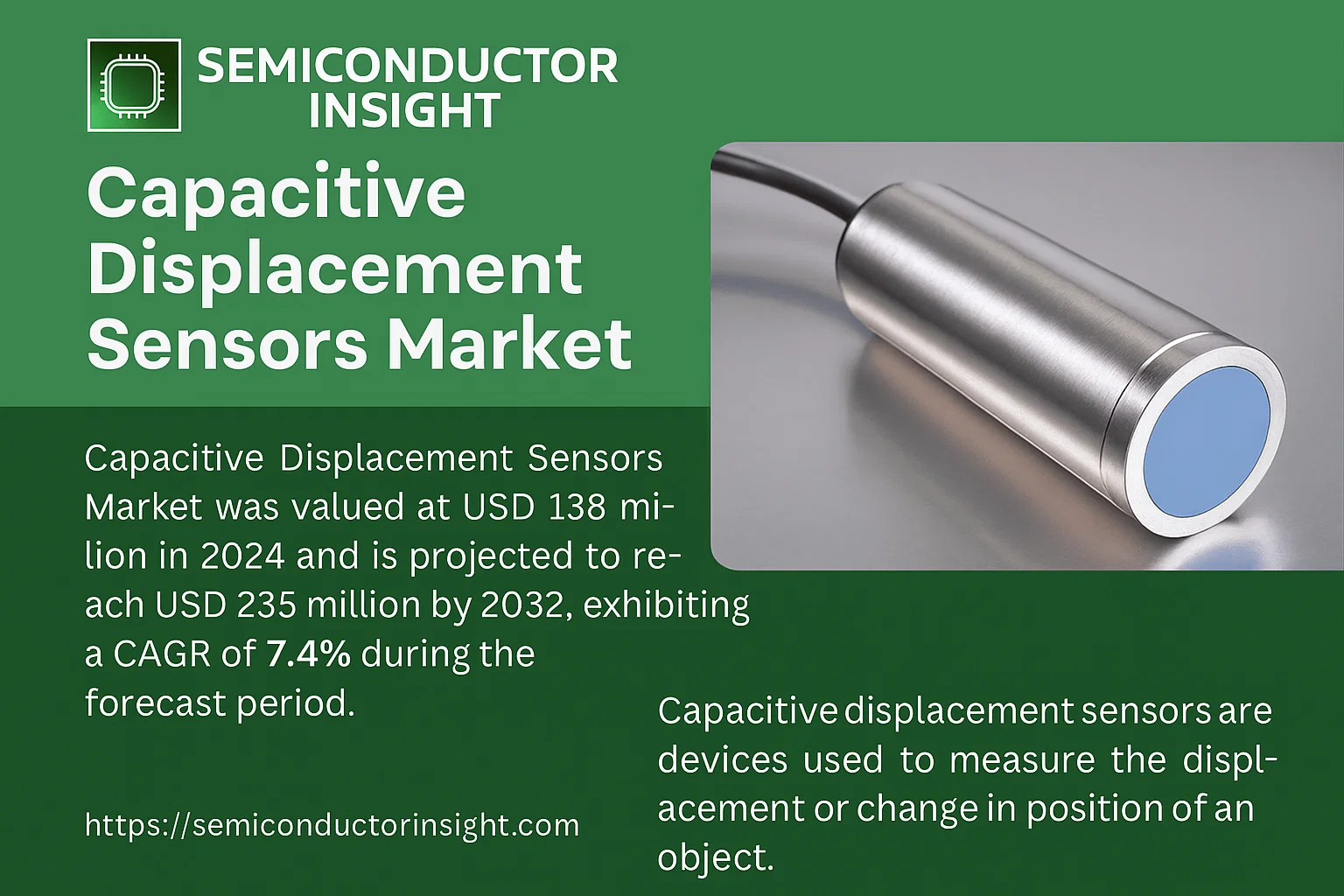
Global Capacitive Displacement Sensors Market was valued at USD 138 million in 2024 and is projected to reach USD 235 million by 2032, exhibiting a CAGR of 7.4% during the forecast period.
Capacitive displacement sensors are devices used to measure the displacement or change in position of an object. They operate based on changes in capacitance, which occur when the distance between the sensor and the target object changes. This makes them essential for applications requiring precise, non-contact measurement.
The market growth is primarily driven by the increasing demand for high-precision measurement in automation, robotics, and quality control processes across various industries. Additionally, the rising adoption of Industry 4.0 and smart manufacturing practices is fueling the demand for these sensors. Key players are focusing on developing sensors with higher accuracy, better resolution, and enhanced durability to cater to the evolving needs of end-users.
However, the market growth is restrained by factors such as the high cost of advanced capacitive sensors and the availability of alternative technologies like optical and inductive sensors. Furthermore, economic uncertainties and supply chain disruptions can impact market growth in the short term.
Regionally, North America and Europe are expected to hold significant market shares due to the presence of major manufacturing and technology companies, while the Asia-Pacific region is anticipated to witness the highest growth rate due to rapid industrialization and increasing investments in automation.
MARKET DRIVERS
Rising Demand from the Electronics and Semiconductor Sector
The global capacitive displacement sensors market is primarily driven by their extensive use in the electronics and semiconductor manufacturing industries. These sensors are critical for high-precision measurement and quality control in processes like wafer inspection, PCB assembly, and micro-component positioning. The relentless miniaturization of electronic components and the push for higher production yields necessitate sub-micron accuracy, which capacitive sensors reliably provide.
Superior Performance Over Alternative Technologies
Capacitive displacement sensors offer significant advantages, including non-contact measurement, high resolution, and high-frequency response. This makes them superior to traditional contact probes or laser-based systems in many applications, particularly for measuring conductive targets or in environments where non-contact is essential to prevent part damage or contamination. Their stability and ability to measure very small distances are key drivers for adoption in R&D and high-end manufacturing.
➤ Growth in automation and Industry 4.0 initiatives is a major catalyst, as these sensors are integral to smart manufacturing systems for real-time monitoring and feedback.
Furthermore, the expansion of industrial automation and the adoption of Industry 4.0 principles are fueling market growth. Capacitive sensors are essential components in automated assembly lines, robotics, and predictive maintenance systems, where they provide critical data for process control, ensuring efficiency and reducing downtime.
MARKET CHALLENGES
Susceptibility to Environmental Interference
A significant challenge for capacitive displacement sensors is their sensitivity to environmental factors. Changes in temperature, humidity, and the presence of contaminants (like oil or dust) between the sensor and the target can affect the dielectric constant of the air gap, leading to measurement inaccuracies. This necessitates careful installation, shielding, and sometimes complex calibration procedures, which can increase the total cost of ownership.
Other Challenges
Limitation to Conductive Targets
The fundamental operating principle of capacitive sensors requires the target material to be electrically conductive. This limits their application for measuring non-conductive materials like plastics, ceramics, or glass without applying a special conductive coating, adding an extra step and cost to the measurement process.
Intense Competition and Price Sensitivity
The market is highly competitive, with numerous global and regional players. While high-end sensors command premium prices, there is considerable price pressure in standard applications, challenging manufacturers to maintain profitability while investing in R&D for advanced features.
MARKET RESTRAINTS
High Initial Cost for High-Precision Systems
The advanced capacitive displacement sensor systems required for nanometer-level precision involve sophisticated electronics and calibration, resulting in a high initial investment. This cost can be a barrier to adoption for small and medium-sized enterprises (SMEs) or for applications where the ROI is not immediately clear, potentially restraining market growth in certain segments.
Technical Complexity and Need for Expertise
Effectively integrating capacitive sensors into a measurement system requires a certain level of technical expertise. Factors such as proper grounding, cable selection, and understanding measurement field effects are critical for optimal performance. The lack of in-house expertise can deter potential users from adopting this technology, favoring simpler, albeit less precise, alternatives.
MARKET OPPORTUNITIES
Expansion into New Application Areas
Significant opportunities exist in applying capacitive displacement sensors to new fields such as biomedical devices, electric vehicle (EV) battery manufacturing, and aerospace. In biomedical applications, they are used for precise positioning in surgical robots and diagnostic equipment. The burgeoning EV market requires high-precision sensors for battery cell stacking and quality control, creating a substantial new addressable market.
Development of Multi-Channel and Embedded Systems
The trend towards miniaturization and smart factories presents an opportunity for the development of compact, multi-channel sensor systems and sensors that can be embedded directly into machinery. These integrated solutions can provide simultaneous multi-point measurement, which is highly valuable for complex inspection tasks, opening up new revenue streams for sensor manufacturers.
Capacitive Displacement Sensors Market Trends
Sustained Market Growth and Regional Dynamics
The global Capacitive Displacement Sensors market was valued at 138 million in 2024 and is projected to reach US$ 235 million by 2032, at a Compound Annual Growth Rate (CAGR) of 7.4% during the forecast period. This robust growth is primarily driven by the increasing demand from downstream industries such as automotive and aerospace. The technology’s superior durability, excellent sensitivity, and higher measurement accuracy compared to other sensor types are key factors propelling market expansion.
Other Trends
Technological Advancement and Competitive Pressures
Capacitive displacement sensor technology is developing rapidly to meet the advanced requirements of modern applications. Companies are increasing investment in research and development to improve innovation capabilities and optimize product structures. However, the market faces challenges, including price fluctuations and supply restrictions of upstream raw materials. As more companies enter the market, competition is intensifying, which may lead to financial and technical difficulties for smaller companies without the backing of larger enterprises.
Shifting Regional Market Shares
From a regional perspective, developed markets in Europe, the United States, and Japan are mature with stable growth, driven by product upgrades. In contrast, emerging markets, particularly China, are exhibiting the fastest growth. The market in China was valued at 40 million US dollars in 2023, accounting for approximately 26.62% of the global market. It is projected to reach 74 million US dollars by 2030, increasing its global share to 29.66%. This growth is fueled by coexisting demands for product popularization and technological upgrading. The market is segmented by type, including Variable Polar Distance, Variable Area, and Variable Media types, and by application across sectors like Aerospace, Automotive, and Pharmaceuticals.
COMPETITIVE LANDSCAPE
Key Industry Players
Market Dominated by Established Global Leaders and Rapidly Evolving Regional Players
The global capacitive displacement sensors market is characterized by the presence of several established international players who have built strong reputations for precision, reliability, and technological innovation. Leading companies such as Micro-Epsilon and Physik Instrumente (PI) are at the forefront, holding significant market shares. These players dominate due to their extensive product portfolios, strong R&D capabilities, and global sales networks. The competitive environment is further shaped by the acquisition strategies of larger technology firms; for instance, MicroSense operates as a part of KLA, a major player in the semiconductor equipment sector. The market structure is moderately concentrated, with the top five companies accounting for a substantial portion of the global revenue, leveraging their expertise to serve high-demand sectors like aerospace, automotive, and semiconductors with highly accurate non-contact measurement solutions.
Beyond the top-tier vendors, a number of other significant companies compete by focusing on specific niches and regional markets. Players like Capacitec and Lion Precision have carved out strong positions in North America, offering specialized sensors for industrial automation and research applications. In the rapidly growing Asian market, companies such as Shance (Tianjin) Technology Co., Ltd., Sanying MotionControl Instruments, and CoreMorrow Ltd. are key domestic suppliers, often competing on cost and customization for local industries. Other notable participants, including MTI Instruments, WayCon, and IFM Electronic, address diverse application needs across manufacturing and process control. This secondary tier of competition is marked by continuous technological development and a focus on meeting the stringent requirements of emerging applications, ensuring a dynamic and evolving marketplace.
List of Key Capacitive Displacement Sensors Companies Profiled
- Micro-Epsilon
- Physik Instrumente
- MicroSense (KLA)
- Shance (Tianjin) Technology Co., Ltd.
- Capacitec
- ANHUI ACTUS TECHNOLOGY
- Sanying MotionControl Instruments
- CoreMorrow Ltd.
- Lion Precision
- MTI Instruments (VITREK)
- AMI Precision Control Technology
- Queensgate Instruments
- WayCon
- IFM Electronic
Segment Analysis:
| Segment Category | Sub-Segments | Key Insights |
| By Type |
|
Variable Polar Distance Type sensors are highly regarded for their exceptional precision in measuring minute changes in object proximity, making them indispensable for high-accuracy industrial applications. This segment’s dominance is driven by its superior linearity and robust performance in challenging environments. The ongoing technological advancements are enhancing their capabilities, ensuring sustained leadership due to their fundamental design that offers a direct relationship between displacement and capacitance change. |
| By Application |
|
Aerospace & Defense represents a critical application area demanding the highest standards of reliability and precision, which capacitive displacement sensors are uniquely positioned to provide. The stringent quality and safety requirements in this sector create a consistent, high-value demand. Innovations in sensor technology are increasingly tailored to meet the extreme conditions and precision measurements required for aerospace components, making this a leading and sophisticated market segment. |
| By End User |
|
Manufacturing & Industrial users are the primary drivers of demand, leveraging these sensors for automation, process control, and machinery monitoring to enhance efficiency and product quality. The push towards Industry 4.0 and smart manufacturing is intensifying the integration of these non-contact measurement solutions into production lines. This segment’s leadership is reinforced by the broad-based need for reliable displacement sensing across diverse industrial processes. |
| By Technology Sophistication |
|
High-Precision/Nanometer Resolution Sensors are at the forefront of market evolution, catering to the most demanding applications in semiconductors, scientific research, and advanced manufacturing. The trend towards miniaturization and the need for extreme accuracy are powerful drivers for this segment. Continuous innovation is focused on improving signal processing and noise immunity, solidifying the prominence of high-precision variants in cutting-edge technological applications. |
| By Operational Environment |
|
Harsh Industrial Environments constitute the most significant segment due to the widespread need for durable and reliable sensors in manufacturing plants, automotive assembly, and heavy machinery. Sensors designed for these conditions feature robust housings, enhanced sealing, and immunity to electromagnetic interference, making them essential for maintaining operational integrity. This segment’s leadership is underpinned by the critical requirement for measurement reliability in challenging settings where failure is not an option. |
Regional Analysis: Capacitive Displacement Sensors Market
The concentration of global electronics and automotive manufacturing in countries like China and Japan ensures sustained, high-volume demand for capacitive sensors used in precision assembly, positioning, and quality inspection on production lines.
There is aggressive adoption of industrial automation and robotics across the region, where capacitive displacement sensors are critical components for ensuring accuracy in robotic guidance, object detection, and micro-level positioning tasks.
Strong research and development activities, particularly in Japan and South Korea, lead to continuous advancements in sensor miniaturization, sensitivity, and integration capabilities, keeping regional offerings at the cutting edge.
Supportive initiatives, such as “Made in China 2025” and similar industrial digitization policies in other APAC nations, actively encourage the modernization of manufacturing, directly boosting the market for precision measurement sensors.
North America
North America represents a mature and technologically advanced market for capacitive displacement sensors, characterized by high demand from the aerospace, defense, and semiconductor sectors. The presence of leading technology companies and a strong focus on research and development drives the adoption of high-precision sensors for applications requiring extreme accuracy and reliability. The region’s stringent quality standards in manufacturing and a well-established industrial automation base further support market growth. Innovation is a key driver, with a focus on developing sensors for next-generation applications in areas like medical devices and advanced electronics.
Europe
Europe holds a significant share of the capacitive displacement sensors market, supported by its strong automotive industry and advanced manufacturing sector, particularly in Germany, France, and Italy. The region’s emphasis on precision engineering and high-quality production standards creates consistent demand for these sensors in metrology, machine tooling, and automated assembly lines. Strict regulatory frameworks regarding product quality and safety in various industries also promote the use of reliable measurement technologies. Additionally, ongoing initiatives towards Industry 4.0 and smart factory concepts are accelerating the integration of capacitive sensors into industrial IoT ecosystems.
South America
The capacitive displacement sensors market in South America is developing, with growth primarily driven by the gradual modernization of the industrial and automotive sectors in countries like Brazil and Argentina. While adoption is slower compared to other regions, there is increasing recognition of the benefits of automation for improving productivity and quality. Market growth is linked to investments in industrial infrastructure and the expansion of local manufacturing capabilities. The mining and agricultural equipment sectors also present niche opportunities for sensor applications in condition monitoring and precision control.
Middle East & Africa
The market in the Middle East & Africa is emerging, with potential growth linked to economic diversification efforts away from oil dependency. Countries in the Gulf Cooperation Council are investing in industrial and technological sectors, which could foster demand for automation and precision measurement tools like capacitive sensors. The region’s focus on developing manufacturing hubs and infrastructure projects presents future opportunities. However, the market currently remains niche, with adoption concentrated in specific applications such as in the energy sector and large-scale construction projects.
Report Scope
This market research report provides a comprehensive analysis of the Capacitive Displacement Sensors Market , covering the forecast period 2025–2032. It offers detailed insights into market dynamics, technological advancements, competitive landscape, and key trends shaping the industry.
Key focus areas of the report include:
- Market Overview: The report begins with an overview outlining its current market scenario, key growth indicators, and industry transformation drivers. It discusses macroeconomic factors, demand–supply balance, regulatory landscape, and the strategic role of semiconductors in powering advancements across industries such as automotive, telecommunications, consumer electronics, and industrial automation.
- Market Size & Forecast: Historical data and future projections for revenue, unit shipments, and market value across major regions and segments.
- Segmentation Analysis: Detailed breakdown by product type, technology, application, and end-user industry to identify high-growth segments and investment opportunities.
- Regional Insights: Insights into market performance across North America, Europe, Asia-Pacific, Latin America, and the Middle East & Africa, including country-level analysis where relevant.
- Competitive Landscape: Profiles of leading market participants, including their product offerings, R&D focus, manufacturing capacity, pricing strategies, and recent developments such as mergers, acquisitions, and partnerships.
- Technology Trends & Innovation: Assessment of emerging technologies, integration of AI/IoT, semiconductor design trends, fabrication techniques, and evolving industry standards.
- Market Drivers & Restraints: Evaluation of factors driving market growth along with challenges, supply chain constraints, regulatory issues, and market-entry barriers.
- Stakeholder Insights: Insights for component suppliers, OEMs, system integrators, investors, and policymakers regarding the evolving ecosystem and strategic opportunities.
Primary and secondary research methods are employed, including interviews with industry experts, data from verified sources, and real-time market intelligence to ensure the accuracy and reliability of the insights presented.
FREQUENTLY ASKED QUESTIONS:
What is the current market size of Capacitive Displacement Sensors Market?
-> Global Capacitive Displacement Sensors Market was valued at USD 138 million in 2024 and is projected to reach USD 235 million by 2032, growing at a CAGR of 7.4% during the forecast period.
Which key companies operate in Capacitive Displacement Sensors Market?
-> Key players include Micro-Epsilon, Physik Instrumente, MicroSense (KLA), Shance (Tianjin) Technology Co., Ltd., Capacitec, ANHUI ACTUS TECHNOLOGY, Sanying MotionControl Instruments, CoreMorrow Ltd., Lion Precision, MTI Instruments (VITREK), AMI Precision Control Technology, Queensgate Instruments, WayCon, and IFM Electronic, among others.
What are the key growth drivers?
-> Key growth drivers include superior durability, excellent sensitivity, and higher measurement accuracy of capacitive sensors compared to other types, along with wide application and development of downstream industries.
Which region dominates the market?
-> China is the fastest-growing market and a key emerging region, with its share of the global market expected to increase from 26.62% in 2023 to 29.66% by 2030. Europe, the United States, and Japan are mature markets with stable growth and high technological requirements.
What are the emerging trends?
-> Emerging trends include rapid technological development to meet advanced user requirements, increasing product popularity, and intensified market competition driving innovation and investment in science and technology.

Get Sample Report PDF for Exclusive Insights
Report Sample Includes
- Table of Contents
- List of Tables & Figures
- Charts, Research Methodology, and more...
 Download Sample Report PDF