MARKET INSIGHTS
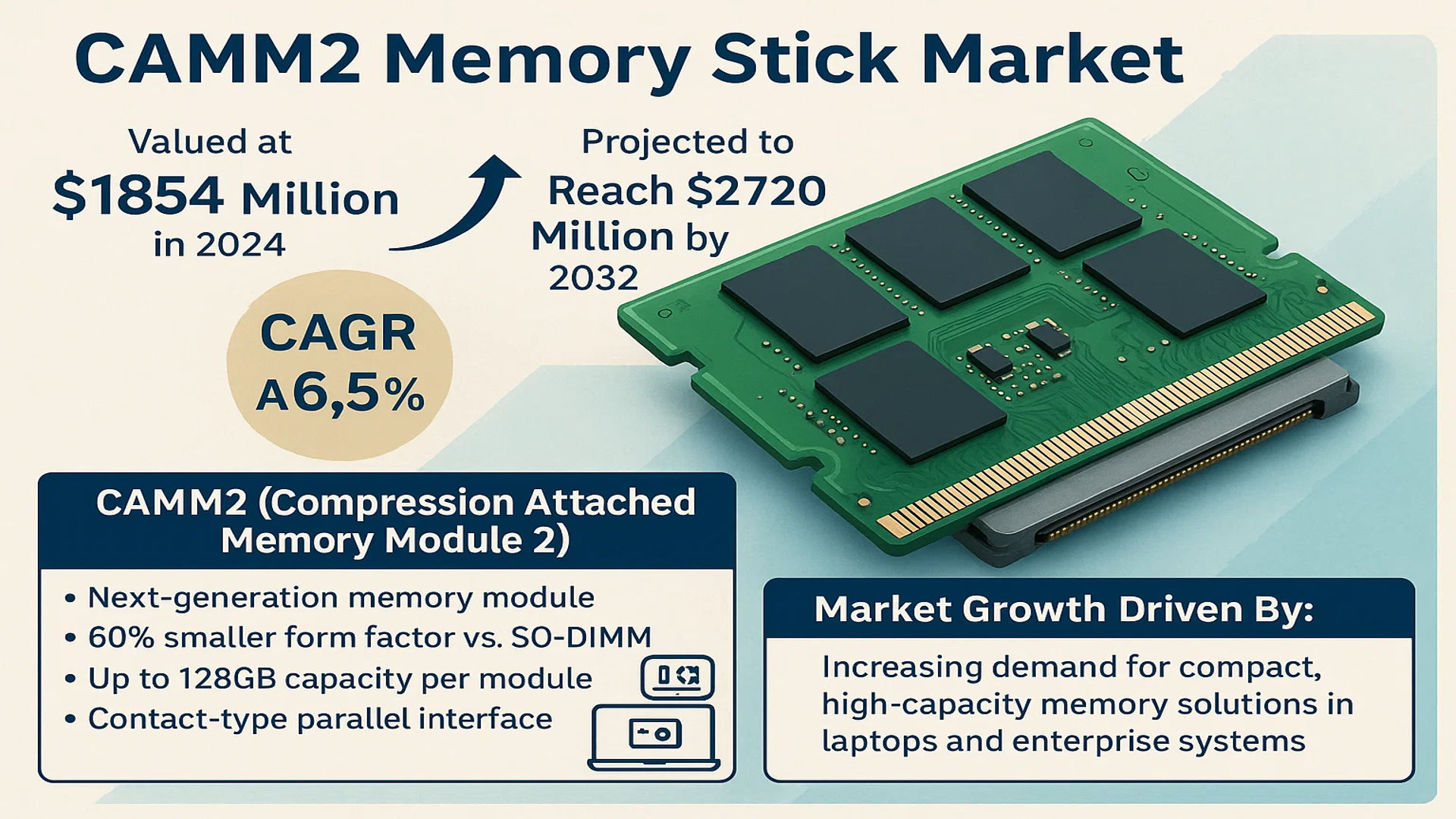
The global CAMM2 Memory Stick Market was valued at 1854 million in 2024 and is projected to reach US$ 2720 million by 2032, at a CAGR of 6.5% during the forecast period.
CAMM2 (Compression Attached Memory Module 2) is a next-generation memory module designed primarily for high-performance laptops. It offers a 60% smaller form factor compared to traditional SO-DIMMs while supporting up to 128GB capacity per module, which is four times higher than conventional alternatives. The technology utilizes a contact-type parallel interface that reduces circuit distance, improving both performance and power efficiency. These modules are particularly suited for applications requiring high-density storage and flexible expansion.
The market growth is driven by increasing demand for compact, high-capacity memory solutions in laptops and enterprise systems. Key players like Samsung, ADATA, and Colorful are actively investing in CAMM2 development, with DDR5 frequency variants expected to dominate the market segment. While North America leads in early adoption, Asia-Pacific shows strong growth potential due to expanding electronics manufacturing capabilities.
MARKET DYNAMICS
MARKET DRIVERS
Growing Demand for High-Performance Memory Solutions in Next-Gen Laptops to Accelerate CAMM2 Adoption
The increasing need for compact, high-capacity memory solutions in modern laptops is driving significant demand for CAMM2 technology. As notebook designs become thinner and lighter while requiring greater processing power for AI applications and content creation, traditional SO-DIMM modules face physical constraints. CAMM2’s revolutionary design addresses these limitations with its 60% smaller footprint compared to SO-DIMM while offering up to 128GB capacity – four times more than conventional modules. This combination of space efficiency and high-density memory support makes it particularly attractive for premium ultrabooks and mobile workstations where every millimeter counts.
Enterprise Digital Transformation Initiatives to Fuel Market Expansion
Corporate investments in digital infrastructure upgrades are creating robust demand for advanced memory solutions. As businesses increasingly adopt mobile workstations for design, engineering, and data analytics applications, the need for reliable, high-bandwidth memory becomes critical. CAMM2’s compression-attached interface significantly reduces circuit distances compared to traditional modules, improving signal integrity and enabling higher clock speeds. This technical advantage makes it particularly valuable for enterprise applications requiring stable performance under heavy workloads. The global shift toward hybrid work models is further amplifying this demand, with enterprises prioritizing mobile work solutions that don’t compromise on computing power.
The transition to DDR5 technology across computing platforms provides additional momentum for CAMM2 adoption. While current implementations focus on high-end professional systems, industry roadmaps suggest this technology will trickle down to mainstream laptops within the next three years as manufacturers optimize production processes and reduce costs.
MARKET RESTRAINTS
High Manufacturing Costs and Limited Production Capacity to Constrain Market Penetration
While CAMM2 offers compelling technical advantages, its premium pricing compared to conventional SO-DIMM modules presents a significant barrier to widespread adoption. The specialized manufacturing processes required for compression-attached modules increase production costs by approximately 30-40% compared to traditional memory solutions. This cost premium currently limits CAMM2 to high-end professional systems where the performance benefits justify the additional expense. For mainstream consumer laptops where price sensitivity remains a dominant factor, this creates a substantial adoption hurdle.
Other Restraints
Limited Ecosystem Compatibility
The CAMM2 standard requires specific motherboard designs and socket configurations that differ from traditional memory implementations. This creates interoperability challenges that deter some OEMs from early adoption, particularly in systems targeting price-conscious market segments where backward compatibility is valued.
Supply Chain Bottlenecks
Early-stage production limitations for CAMM2 modules have created uneven availability across regions, with many markets experiencing allocation constraints. While manufacturers are scaling capacity, these supply chain challenges temporarily restrict market growth potential.
MARKET CHALLENGES
Standardization and Industry Acceptance Hurdles to Slow Market Maturation
The emergence of CAMM2 as a potential successor to SO-DIMM faces several industry adoption challenges. While the technology offers clear engineering benefits, the established SO-DIMM ecosystem built over decades creates significant inertia. Many system integrators and manufacturers have invested heavily in SO-DIMM-compatible designs, creating resistance to shifting engineering resources toward the new standard. This hesitation is particularly evident among mid-range and entry-level laptop manufacturers where cost optimization remains paramount.
Additionally, the need for industry-wide standardization presents coordination challenges across the computing ecosystem. Without broad consensus among processor manufacturers, platform designers, and memory producers, CAMM2 risks becoming a niche solution rather than a mainstream standard. The technology’s success depends on synchronized adoption across these various industry segments, requiring complex alignment that typically slows emerging technology integration.
MARKET OPPORTUNITIES
Emerging AI and Edge Computing Applications to Create New Growth Avenues
The rapid expansion of AI capabilities in mobile devices presents a significant opportunity for CAMM2 technology. As laptop manufacturers integrate dedicated neural processors and expand on-device AI features, memory bandwidth becomes increasingly critical. CAMM2’s superior electrical characteristics enable higher-speed memory access compared to traditional modules – a crucial factor for AI workloads that require rapid data movement. This positions the technology as an enabling solution for next-generation AI-optimized laptops expected to dominate the premium segment within two years.
The growing edge computing market offers another strategic opportunity. As businesses deploy more powerful mobile workstations for field applications like geospatial analysis and industrial inspection, demand grows for rugged, high-performance memory solutions. CAMM2’s compression-attached design provides better mechanical stability than socketed modules, making it potentially more suitable for vibration-prone environments. Memory manufacturers exploring this opportunity could develop specialized CAMM2 variants with enhanced durability features for industrial and military applications.
Furthermore, the expected cost reductions from manufacturing scale effects will likely make CAMM2 competitive in broader market segments within the forecast period. As production volumes increase and process optimizations take effect, industry analysts project the price premium could decrease to 15-20% by 2026, potentially accelerating mainstream adoption.
CAMM2 MEMORY STICK MARKET TRENDS
Adoption of High-Performance Computing Fuels CAMM2 Memory Stick Market Growth
The global CAMM2 (Compression Attached Memory Module) memory stick market is experiencing rapid adoption due to its superior performance, compact design, and efficiency advantages over traditional SO-DIMM modules. With a projected CAGR of 6.5% during 2024-2032, the market is set to grow from $1,854 million in 2024 to $2,720 million by 2032. DDR5 frequency modules are leading this growth, driven by their higher bandwidth and lower power consumption. The module’s reduced size (60% smaller than SO-DIMM) makes it ideal for modern ultra-thin laptops and enterprise workstations where space optimization is critical.
Other Trends
Enterprise Demand for High-Density Memory Solutions
Enterprise applications, particularly data centers and cloud computing, are increasing demand for CAMM2 modules due to their support for ultra-high capacities (up to 128GB per module). With server workloads requiring faster memory throughput, CAMM2’s high-speed interface and superior thermal efficiency provide a competitive edge. Furthermore, enterprises are transitioning from older LPDDR variants to LPDDR5/5X modules due to their enhanced power efficiency, which is critical for large-scale deployments. The Asia-Pacific region, led by China and South Korea, is expected to dominate enterprise adoption due to investments in hyperscale data centers.
Consumer Electronics Driving Mass Market Penetration
The consumer segment is rapidly adopting CAMM2 memory in premium laptops, gaming notebooks, and AI-enabled devices, where faster data processing is crucial. Samsung, currently a market leader, has been aggressively expanding its CAMM2-based DDR5 modules, leveraging its semiconductor expertise to maintain a dominant position. Meanwhile, manufacturers like ADATA and Colorful are focusing on integrating CAMM2 into high-performance gaming laptops to support GPU-intensive workloads. The U.S. and Europe are key growth regions for consumer adoption, with demand increasing in professional and gaming applications. As CAMM2 becomes more cost-effective, mid-range consumer devices are also expected to adopt this technology.
Emergence of New Technology Standards and Competitive Landscape
The standardization of CAMM2 as a replacement for SO-DIMM is accelerating, with major OEMs incorporating the technology in next-gen laptops. Leading memory manufacturers such as Samsung, Jinbang, and Baiwei hold a significant market share (top five players accounting for ~XX% in 2024), but increasing competition is expected as more suppliers enter the space. Innovations in DDR5 speeds, LP variants, and ultra-low-voltage designs are likely to shape future market dynamics, ensuring sustained growth as computing demands evolve.
COMPETITIVE LANDSCAPE
Key Industry Players
Memory Manufacturers Accelerate Innovation in CAMM2 Technology
The global CAMM2 memory stick market features a mix of established semiconductor giants and specialized memory manufacturers striving to capitalize on the growing demand for high-performance laptop memory solutions. Samsung Electronics leads the market with its advanced DDR5-based CAMM2 modules, leveraging its vertical integration capabilities and strong OEM relationships across the PC industry.
ADATA Technology and Jinbang have emerged as significant competitors, particularly in the Asian markets, by offering cost-competitive solutions with capacities ranging from 32GB to 128GB. Their growth stems from aggressive pricing strategies and partnerships with regional laptop manufacturers looking to adopt the new memory standard.
The market has seen intensified R&D investments as companies race to develop LPDDR5/5X variants of CAMM2 modules, which promise even greater power efficiency for ultrathin laptops. This technological arms race is expected to reshape market shares as the industry transitions from DDR4-based SO-DIMM to the new standard.
Meanwhile, several Chinese manufacturers including Colorful and Baiwei are expanding their production capacities to meet both domestic and international demand. Their increasing presence adds competitive pressure that could lead to further price erosion in the medium term.
List of Key CAMM2 Memory Stick Manufacturers Profiled
- Samsung Electronics (South Korea)
- Jinbang Technology (China)
- Baiwei Semiconductor (China)
- ADATA Technology (Taiwan)
- Jin Baida Electronics (China)
- Colorful Technology (China)
Segment Analysis:
By Type
DDR5 Frequency Segment Leads Due to Superior Performance in High-End Computing Applications
The CAMM2 Memory Stick market is segmented based on type into:
- DDR5 Frequency
- Subtypes: Standard DDR5, High-Speed DDR5
- LPDDR5/5X Frequency
- Subtypes: Standard LPDDR5, Performance LPDDR5X
By Application
Enterprise Segment Dominates Due to High Demand in Business Computing Solutions
The market is segmented based on application into:
- Consumer
- Subtypes: Gaming Laptops, Ultrabooks, Workstations
- Enterprise
- Subtypes: Server Applications, Data Centers, Cloud Computing
By Capacity
128GB Modules Gain Traction for High-Performance Computing Needs
The market is segmented based on capacity into:
- 32GB
- 64GB
- 128GB
By End-Use Industry
IT & Telecommunications Sector Shows Strong Adoption Rate
The market is segmented based on end-use industry into:
- IT & Telecommunications
- Healthcare
- Banking & Financial Services
- Education
- Others
Regional Analysis: CAMM2 Memory Stick Market
Asia-Pacific
The Asia-Pacific region dominates the CAMM2 memory stick market, accounting for over 45% of global demand, driven primarily by China, Japan, and South Korea. China’s thriving consumer electronics manufacturing sector and Japan’s leadership in memory technology innovation position the region as the epicenter of CAMM2 adoption. The region benefits from established semiconductor fabrication plants and strong OEM relationships between memory manufacturers like Samsung and laptop producers. While DDR5-based CAMM2 modules are gaining traction in premium laptops, price sensitivity in emerging markets still fosters demand for LPDDR5 variants. Key players like Samsung and local manufacturers are strategically expanding production capacities to meet the region’s growing appetite for high-performance, space-efficient memory solutions.
North America
North America represents the second-largest CAMM2 market, with the U.S. leading in enterprise adoption due to early corporate laptop refresh cycles and strong IT infrastructure spending. The region shows particular preference for high-capacity (64GB+) DDR5 CAMM2 modules for workstation-class laptops. Regulatory pressures around energy efficiency and tech companies’ sustainability commitments are accelerating the shift from traditional SO-DIMMs. However, the transition faces moderate resistance from cost-conscious SMBs. Major PC OEMs headquartered in the region are working closely with memory suppliers to optimize CAMM2 integration, creating a robust ecosystem for future growth.
Europe
Europe’s CAMM2 market is growing steadily, with Germany and the UK spearheading adoption through their advanced engineering and professional workstation segments. EU energy efficiency directives are indirectly promoting CAMM2’s low-power advantages, particularly for LPDDR5X variants. The region shows balanced demand across consumer ultrabooks and enterprise applications, though adoption rates vary significantly between Western and Eastern Europe. Local presence of global memory distributors ensures steady supply chain operations, while the lack of regional memory manufacturers keeps dependence on Asian suppliers high. Environmental regulations may soon mandate standardized benchmarking for memory power consumption, potentially benefiting CAMM2 adoption.
South America
South America’s CAMM2 market remains nascent but exhibits strong long-term potential. Brazil leads regional adoption, driven by its growing IT services sector and increasing premium laptop imports. Economic volatility and currency fluctuations create pricing challenges for CAMM2 modules, slowing widespread adoption. The market shows unique characteristics: while consumer demand focuses on entry-level configurations, enterprise buyers demonstrate willingness to invest in high-performance modules for specialized applications like oil/gas and financial modeling. Local assembly of laptops incorporating CAMM2 could emerge as a key growth driver if regional trade policies incentivize localized production.
Middle East & Africa
The MEA region represents an emerging opportunity for CAMM2 memory sticks, with the UAE and Saudi Arabia leading adoption through their thriving business sectors and government IT modernization initiatives. High disposable incomes in GCC countries fuel demand for premium laptops utilizing advanced memory technologies. However, the broader region faces infrastructure limitations that constrain market growth, including inconsistent component supply chains and limited local technical support. Educational institutions and public sector digitization projects may serve as catalysts for future CAMM2 adoption, particularly as global laptop manufacturers increase their regional market focus.
Report Scope
This market research report provides a comprehensive analysis of the global CAMM2 Memory Stick market, covering the forecast period 2024–2032. It offers detailed insights into market dynamics, technological advancements, competitive landscape, and key trends shaping the industry.
Key focus areas of the report include:
- Market Size & Forecast: Historical data and future projections for revenue, unit shipments, and market value across major regions and segments. The global CAMM2 Memory Stick market was valued at USD 1,854 million in 2024 and is projected to reach USD 2,720 million by 2032, growing at a CAGR of 6.5%.
- Segmentation Analysis: Detailed breakdown by product type (DDR5 Frequency, LPDDR5/5X Frequency), application (Consumer, Enterprise), and end-user industry to identify high-growth segments.
- Regional Outlook: Insights into market performance across North America, Europe, Asia-Pacific, Latin America, and Middle East & Africa. The U.S. and China are key growth markets.
- Competitive Landscape: Profiles of leading market participants including Samsung, ADATA, Jinbang, Baiwei, Jin Baida, and Colorful, covering their product portfolios, market share, and strategic initiatives.
- Technology Trends & Innovation: Analysis of CAMM2’s advantages over SO-DIMM, including 60% smaller size, 128GB capacity support, and lower power consumption.
- Market Drivers & Restraints: Evaluation of factors driving adoption in laptops and challenges in market penetration.
- Stakeholder Analysis: Strategic insights for memory manufacturers, OEMs, and investors regarding the evolving market ecosystem.
The research employs both primary and secondary methodologies, including interviews with industry experts and analysis of verified market data to ensure accuracy.
FREQUENTLY ASKED QUESTIONS:
What is the current market size of Global CAMM2 Memory Stick Market?
-> CAMM2 Memory Stick Market was valued at 1854 million in 2024 and is projected to reach US$ 2720 million by 2032, at a CAGR of 6.5% during the forecast period.
Which key companies operate in Global CAMM2 Memory Stick Market?
-> Key players include Samsung, ADATA, Jinbang, Baiwei, Jin Baida, and Colorful.
What are the key growth drivers?
-> Key growth drivers include increasing laptop demand, advantages over SO-DIMM technology, and need for high-density memory solutions.
Which region dominates the market?
-> Asia-Pacific shows strongest growth potential, particularly in China, while North America leads in early adoption.
What are the emerging trends?
-> Emerging trends include higher capacity modules, energy-efficient designs, and integration with next-gen computing platforms.

Get Sample Report PDF for Exclusive Insights
Report Sample Includes
- Table of Contents
- List of Tables & Figures
- Charts, Research Methodology, and more...
 Download Sample Report PDF