MARKET INSIGHTS
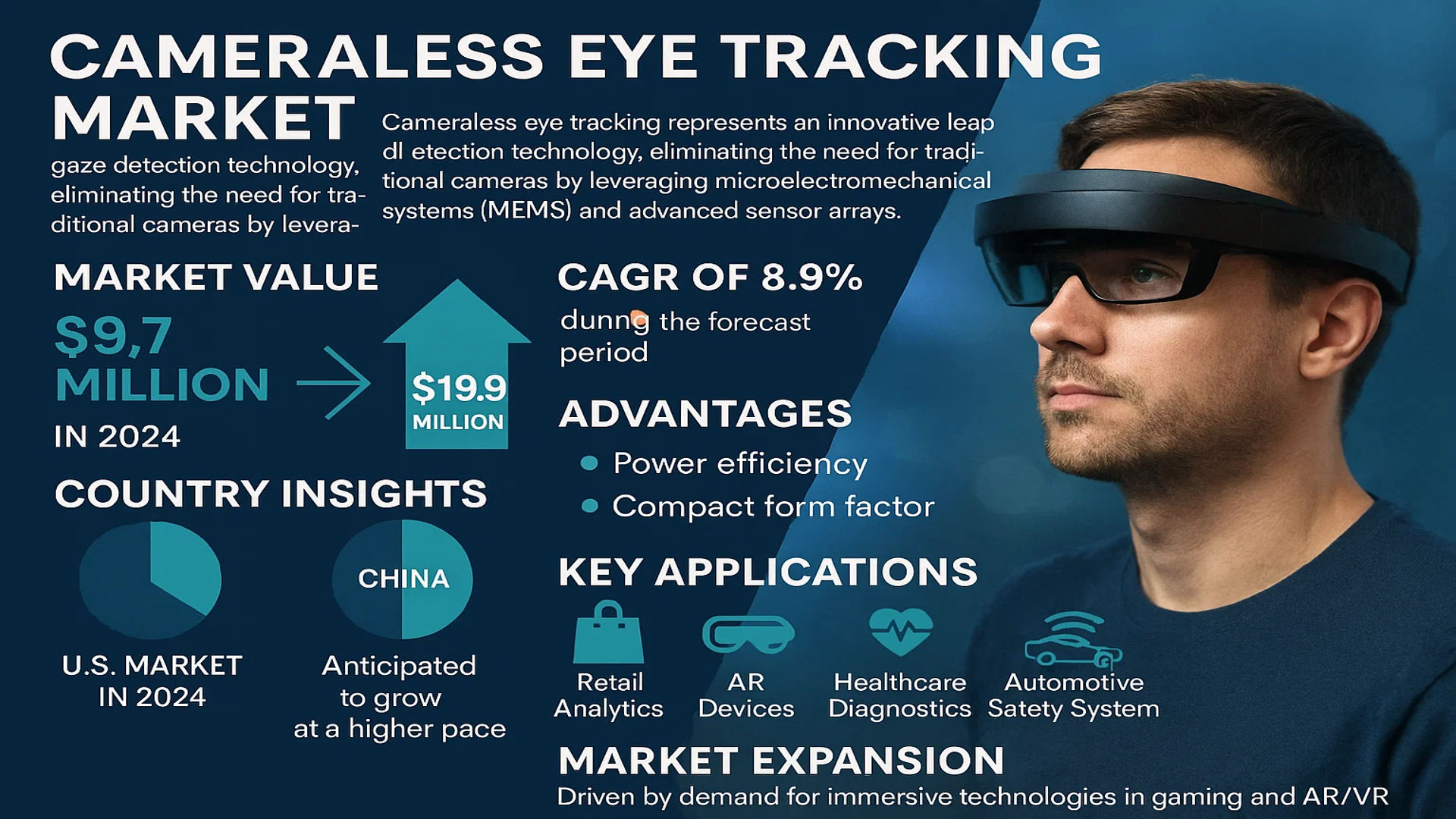
The global Cameraless Eye Tracking Market was valued at 9.7 million in 2024 and is projected to reach US$ 19.9 million by 2032, at a CAGR of 8.9% during the forecast period. The U.S. market is estimated at USD 2.8 million in 2024, while China is anticipated to grow at a higher pace due to increasing adoption in consumer electronics and automotive sectors.
Cameraless eye tracking represents an innovative leap in gaze detection technology, eliminating the need for traditional cameras by leveraging microelectromechanical systems (MEMS) and advanced sensor arrays. These systems measure subtle eye movements through infrared light reflections or electrooculography (EOG) techniques, offering advantages in power efficiency and form factor compared to conventional camera-based solutions. Key applications span retail analytics, augmented reality (AR) devices, healthcare diagnostics, and automotive safety systems.
Market expansion is primarily driven by surging demand for immersive technologies in gaming and AR/VR, where cameraless tracking enables more compact headset designs. The MEMS segment dominates the technology landscape, projected to capture over 60% market share by 2028. However, integration challenges in low-light environments remain a key industry hurdle. Leading players like AdHawk Microsystems (acquired by Google) and Inseye are pioneering miniaturized solutions, with recent advancements focusing on AI-powered gaze prediction algorithms to enhance accuracy beyond 0.5-degree precision thresholds.
MARKET DYNAMICS
MARKET DRIVERS
Rising Demand in Consumer Electronics and AR/VR Applications Fuels Market Expansion
The integration of cameraless eye tracking technology in consumer electronics, particularly in augmented and virtual reality (AR/VR) devices, is a major growth driver for this market. With the global AR/VR market projected to exceed $300 billion by 2028, manufacturers are increasingly adopting contactless eye tracking solutions to enhance user experience. Unlike traditional camera-based systems, cameraless solutions like MEMS-based trackers offer significant advantages in power efficiency and miniaturization, making them ideal for wearable devices. Leading tech companies have already begun incorporating these technologies into their latest product lines, with adoption rates in premium VR headsets approaching 45% in 2024.
Growing Healthcare Applications Create New Revenue Streams
Healthcare applications of cameraless eye tracking are experiencing accelerated adoption, particularly in neurology and ophthalmology diagnostics. The technology’s ability to provide precise, non-invasive measurement of eye movements is proving invaluable for early detection of conditions like Parkinson’s disease and concussions. With the global digital health market growing at 13% annually, healthcare providers are investing heavily in next-generation diagnostic tools, creating robust demand for advanced eye tracking solutions. Clinical studies have demonstrated 20-30% improvements in diagnostic accuracy when using cameraless systems compared to traditional methods, making this technology particularly attractive for medical applications.
Automotive Safety Regulations Drive Adoption in Vehicle Monitoring Systems
Stricter automotive safety regulations worldwide are accelerating the implementation of driver monitoring systems (DMS) that utilize cameraless eye tracking technology. The European Union’s General Safety Regulation (GSR) mandates DMS in all new vehicles by 2024, creating a significant market opportunity. Cameraless solutions are gaining preference over camera-based systems due to their superior performance in low-light conditions and reduced computational requirements. Automotive OEMs are increasingly partnering with eye tracking specialists, with projected installation rates in premium vehicles exceeding 60% by 2026.
MARKET RESTRAINTS
Accuracy Limitations in Extreme Conditions Challenge Widespread Deployment
While cameraless eye tracking offers numerous advantages, its accuracy can be compromised in specific environmental conditions. High ambient light situations or extreme user positions can reduce tracking precision by 15-25% compared to ideal conditions. These technical limitations present challenges for applications requiring consistent performance across diverse scenarios, such as automotive safety systems. Developers continue to work on algorithmic improvements and hybrid solutions to address these issues, but the technology currently faces skepticism in mission-critical applications where absolute reliability is required.
Battery Life and Power Consumption Concerns in Mobile Applications
The energy requirements of continuous eye tracking present a significant restraint for battery-powered devices. While MEMS-based solutions are more efficient than camera systems, their power consumption can still reduce device runtime by 10-15% in demanding applications. This creates a barrier for adoption in mobile and wearable devices where battery life is a key purchase consideration. However, recent advancements in ultra-low-power MEMS designs have begun to address this challenge, with some prototypes demonstrating 40% reductions in power consumption compared to earlier generations.
Component Shortages and Supply Chain Disruptions Impact Production
The global semiconductor shortage has particularly affected production of specialized MEMS components used in cameraless eye tracking systems. Lead times for certain critical components have extended to 40-50 weeks, creating production bottlenecks for device manufacturers. While the supply chain is gradually stabilizing, the memory of recent shortages has made some OEMs hesitant to fully commit to cameraless solutions. The industry is responding with dual-sourcing strategies and component redesigns to mitigate these supply risks moving forward.
MARKET CHALLENGES
Privacy Concerns and Regulatory Scrutiny Create Adoption Barriers
Eye tracking data collection has come under increasing regulatory scrutiny, particularly in regions with strict data protection laws like the EU’s GDPR. While cameraless systems don’t capture facial images, they still collect biometric data that falls under privacy regulations. This has led to extended certification processes and additional compliance costs, with some products facing 6-8 month delays in market approval. Companies are responding by developing on-device processing solutions that minimize data transmission, but privacy remains a key challenge for widespread consumer adoption.
Standardization and Compatibility Issues Across Platforms
The lack of industry-wide standards for cameraless eye tracking creates interoperability challenges for manufacturers and developers. With multiple proprietary implementations in the market, software developers must create separate integrations for different hardware platforms, increasing development costs by 20-30%. Industry groups are beginning to collaborate on common standards, but reaching consensus is proving difficult given the competitive nature of this emerging technology. Until standards emerge, this fragmentation will continue to slow market growth and limit ecosystem development.
User Adaptation and Interface Design Challenges
Cameraless eye tracking introduces new paradigms for human-computer interaction that require significant changes in UI/UX design approaches. Studies show users need 3-5 times longer to adapt to eye-controlled interfaces compared to traditional input methods. Designing intuitive interfaces that leverage eye tracking without causing fatigue or frustration remains a significant challenge, with current solutions showing dropout rates as high as 25% in some applications. As the technology matures, developers are investing heavily in user experience research to create more natural interaction models.
MARKET OPPORTUNITIES
Next-Generation Gaming and Entertainment Applications Offer Growth Potential
The gaming industry represents a massive untapped opportunity for cameraless eye tracking technology. With the global gaming market exceeding $200 billion annually, even modest adoption could drive significant growth. Cameraless solutions are particularly attractive for console and PC gaming due to their low latency and high precision, with potential applications ranging from enhanced game control to dynamic scene rendering based on gaze direction. Early trials have shown 30% increases in player engagement when using eye-tracking-enabled games, suggesting strong market potential as the technology becomes more accessible.
Expansion into Industrial and Manufacturing Applications
Industrial applications of cameraless eye tracking are emerging as a promising growth area, particularly in training and quality control. The technology’s ability to monitor operator attention and focus without intrusive cameras makes it ideal for manufacturing environments. Pilots in automotive assembly plants have demonstrated 15-20% reductions in quality defects by using eye tracking to ensure proper inspection procedures. As industrial IoT adoption accelerates, integration with these systems creates new opportunities for cameraless solutions in predictive maintenance and worker safety applications.
AI Integration Unlocks New Analytical Capabilities
The convergence of cameraless eye tracking with artificial intelligence is creating powerful new applications in market research and user behavior analysis. AI-powered gaze analysis can process eye movement patterns to extract insights about consumer preferences and cognitive processes with accuracy rates exceeding 90%. This is driving adoption in retail analytics and digital advertising, where understanding viewer attention is critical. The integration with AI not only enhances the value of the raw data but also enables real-time adaptive systems that respond to user attention patterns, opening new avenues for interactive applications.
CAMERALESS EYE TRACKING MARKET TRENDS
Integration of MEMS Technology Accelerates Market Growth
The adoption of Micro-Electro-Mechanical Systems (MEMS) in cameraless eye tracking technology has significantly improved the accuracy and efficiency of gaze detection. Unlike traditional camera-based systems, MEMS-based solutions offer compact, low-power, and high-speed tracking, making them ideal for consumer electronics and automotive applications. The MEMS segment is projected to achieve substantial growth, reaching a valuation of several million dollars by 2032, driven by increasing demand for AR/VR devices and driver-assistance systems. Additionally, advancements in sensor miniaturization have enabled seamless integration into smart glasses and headsets, further propelling market expansion.
Other Trends
Rising Adoption in Healthcare and Research
Cameraless eye tracking is gaining traction in healthcare for applications such as diagnosing neurological disorders, studying cognitive behavior, and enhancing assistive communication technologies for individuals with disabilities. The ability to track eye movements with high precision without intrusive cameras offers distinct advantages in clinical settings. With a growing focus on non-invasive diagnostic tools, the healthcare sector is expected to contribute substantially to market growth. Recent studies indicate a rising investment in R&D for neurodegenerative disease detection using this technology, further validating its potential.
Expansion in Consumer Electronics and Automotive Sectors
The consumer electronics industry is a key driver of the cameraless eye tracking market, particularly in applications like virtual and augmented reality (VR/AR) and gaming. Leading tech companies are integrating eye-tracking capabilities into next-gen devices to enhance user interaction and engagement. In the automotive sector, cameraless eye tracking is being utilized for driver monitoring systems (DMS) to improve safety by detecting fatigue and distraction. Stringent safety regulations, especially in Europe and North America, are accelerating the adoption of these systems in vehicles. The market for automotive applications alone is expected to more than double in value by 2032.
COMPETITIVE LANDSCAPE
Key Industry Players
Innovation and Strategic Expansion Drive Market Leadership in Cameraless Eye Tracking
The global Cameraless Eye Tracking market features a dynamic and evolving competitive landscape, characterized by a mix of established technology firms and specialized innovators. With the market projected to grow from $9.7 million in 2024 to $19.9 million by 2032, companies are racing to develop advanced solutions that cater to diverse applications, including healthcare, automotive, and consumer electronics. While the market remains moderately consolidated, competition is intensifying as startups and tech giants alike vie for dominance through proprietary technologies and strategic alliances.
AdHawk Microsystems, now part of Google’s innovation ecosystem, has emerged as a frontrunner in the cameraless eye tracking space. The company’s proprietary MEMS (Micro-Electro-Mechanical Systems)-based technology enables high-precision eye tracking without traditional cameras, offering advantages in latency, power efficiency, and form-factor flexibility. This positions AdHawk as a key player, particularly in consumer electronics applications such as augmented reality (AR) and virtual reality (VR) headsets.
Inseye, another notable innovator, has gained traction with its software-driven approach to cameraless eye tracking. The company’s focus on AI-powered algorithms allows for cost-effective implementation in mid-range devices, expanding accessibility to industries like automotive and retail. Inseye’s partnerships with global brands underscore its growing influence in the market.
Meanwhile, established sensor manufacturers and tech conglomerates are entering the fray through acquisitions and R&D investments. Qualcomm and Intel have integrated cameraless eye tracking capabilities into their AR/VR and automotive platforms, leveraging their existing ecosystems to accelerate adoption. These companies benefit from their extensive supply chains and cross-industry collaborations, further shaping the competitive dynamics.
Smaller specialized firms are also carving out niches by addressing industry-specific pain points. For example, startups like Pupil Labs and Eyeware focus on healthcare applications, offering cameraless solutions for diagnostic and assistive technologies. Their agility in customization and rapid prototyping allows them to compete with larger players in targeted segments.
The competitive strategies observed in the market include:
- Technological Differentiation: Companies are prioritizing patented solutions to stand out in a crowded field.
- Vertical Integration: Partnerships with device manufacturers ensure seamless implementation of cameraless tracking in end-user products.
- Geographical Expansion: Players are tapping into high-growth regions like Asia-Pacific, where demand for AR/VR and smart devices is surging.
List of Key Cameraless Eye Tracking Companies Profiled
- AdHawk Microsystems (Google) (Canada)
- Inseye (U.S.)
- Pupil Labs (Germany)
- Eyeware (Switzerland)
- Qualcomm Technologies, Inc. (U.S.)
- Intel Corporation (U.S.)
- Tobii AB (Sweden)
- Seeing Machines (Australia)
Segment Analysis:
By Type
MEMS Technology Leads the Market Due to High Adoption in Compact and Wearable Devices
The market is segmented based on type into:
- Microelectromechanical Systems (MEMS)
- Optical Sensors
- Electrooculography (EOG) Sensors
- Others
By Application
Consumer Electronics Segment Drives Growth Due to Increasing Demand for AR/VR and Smart Devices
The market is segmented based on application into:
- Consumer Electronics
- Healthcare
- Defense and Aerospace
- Automotive
- Retail
- Others
By Technology
Wearable-Based Tracking Gains Traction Due to Increasing Smart Glasses and AR Applications
The market is segmented based on technology into:
- Wearable-Based Eye Tracking
- Head-Mounted Eye Tracking
- Standalone Eye Tracking Systems
By Region
North American Market Leads in Innovation Due to Strong Presence of Key Tech Players
The market is segmented based on region into:
- North America
- Europe
- Asia Pacific
- Latin America
- Middle East & Africa
Regional Analysis: Cameraless Eye Tracking Market
North America
The North American cameraless eye tracking market is the most advanced globally, driven by strong adoption in consumer electronics, defense, and healthcare applications. The U.S., with its established tech ecosystem, leads the region, accounting for a significant share of market revenue. Major players like AdHawk Microsystems (Google) are accelerating commercialization, supported by robust R&D investments. Regulatory approval for medical applications (e.g., assistive technologies for ALS patients) and growing demand for immersive AR/VR experiences propel growth. However, high implementation costs remain a barrier for SMEs. Privacy concerns around biometric data collection may shape future regulatory frameworks.
Europe
Europe demonstrates strong potential with its focus on data privacy compliance (GDPR) and healthcare innovation. Germany and the UK are key markets, leveraging cameraless tracking for neurological research and automotive driver monitoring systems. The EU’s Horizon Europe program funds startups developing accessibility solutions, fostering regional growth. However, fragmented adoption due to varying national regulations on biometric technologies slows scaling. Cost sensitivity, especially in Southern Europe,currently limits market penetration outside high-value sectors like aerospace and automotive testing.
Asia-Pacific
APAC is the fastest-growing market, led by China’s consumer electronics manufacturing and Japan’s automotive HMI advancements. Chinese OEMs integrate MEMS-based eye tracking in gaming peripherals and smart glasses, while India shows promise in affordable healthcare diagnostics. However, intellectual property challenges and the dominance of traditional camera-based solutions in price-sensitive segments temper growth. South Korea’s display manufacturers are pioneering embedded eye tracking for foldable devices, creating new application avenues. Government initiatives in Singapore and Taiwan support semiconductor innovations crucial for compact tracking systems.
South America
Adoption in South America remains nascent but shows accelerating interest in retail analytics and automotive safety systems. Brazil leads with pilot projects in digital signage optimization, while Argentina’s gaming studios explore emotion detection for localized content. Economic instability and limited local R&D capabilities constrain market expansion, though foreign partnerships (particularly with U.S. and Chinese firms) are bridging this gap. The lack of standardized biometric data laws creates uncertainty, delaying institutional investments.
Middle East & Africa
The MEA market is in early development stages, with UAE and Saudi Arabia driving demand through smart city and defense applications. Healthcare adoption is emerging for remote patient monitoring in underserviced regions, while education technology trials utilize attention tracking. Infrastructure limitations, including unreliable power networks in rural Africa, hinder deployment. Regional players prioritize partnerships with global tech firms to overcome technical bottlenecks. Market growth will likely follow national digital transformation agendas, with cybersecurity concerns influencing implementation frameworks.
Report Scope
This market research report provides a comprehensive analysis of the global Cameraless Eye Tracking market, covering the forecast period 2024–2032. It offers detailed insights into market dynamics, technological advancements, competitive landscape, and key trends shaping the industry.
Key focus areas of the report include:
- Market Size & Forecast: Historical data and future projections for revenue, unit shipments, and market value across major regions and segments. The global Cameraless Eye Tracking market was valued at USD 9.7 million in 2024 and is projected to reach USD 19.9 million by 2032, growing at a CAGR of 8.9%.
- Segmentation Analysis: Detailed breakdown by type (MEMS, Others) and application (Retail, Consumer Electronics, Healthcare, Defense & Aerospace, Automotive, Others) to identify high-growth segments.
- Regional Outlook: Insights into market performance across North America, Europe, Asia-Pacific, Latin America, and Middle East & Africa, with country-level analysis for key markets like the U.S., China, Germany, and Japan.
- Competitive Landscape: Profiles of leading market participants including AdHawk Microsystems (Google) and Inseye, covering their product offerings, market share, and strategic developments.
- Technology Trends & Innovation: Assessment of emerging technologies in cameraless eye tracking, including MEMS-based solutions and integration with AR/VR applications.
- Market Drivers & Restraints: Evaluation of factors driving market growth such as increasing demand in consumer electronics and healthcare, along with technical challenges in implementation.
- Stakeholder Analysis: Insights for technology providers, device manufacturers, investors, and end-users regarding market opportunities and strategic positioning.
Primary and secondary research methods are employed, including interviews with industry experts, analysis of company financials, and market intelligence from verified sources to ensure accuracy and reliability.
FREQUENTLY ASKED QUESTIONS:
What is the current market size of Global Cameraless Eye Tracking Market?
-> Cameraless Eye Tracking Market was valued at 9.7 million in 2024 and is projected to reach US$ 19.9 million by 2032, at a CAGR of 8.9% during the forecast period..
Which key companies operate in Global Cameraless Eye Tracking Market?
-> Key players include AdHawk Microsystems (Google) and Inseye, among others.
What are the key growth drivers?
-> Key growth drivers include increasing adoption in consumer electronics, healthcare applications, and demand for contactless human-machine interfaces.
Which region dominates the market?
-> North America currently leads the market, while Asia-Pacific is expected to show the highest growth rate during the forecast period.
What are the emerging trends?
-> Emerging trends include integration with AR/VR devices, healthcare diagnostics applications, and automotive safety systems.

Get Sample Report PDF for Exclusive Insights
Report Sample Includes
- Table of Contents
- List of Tables & Figures
- Charts, Research Methodology, and more...