Camera Link Interface Board Market Insights
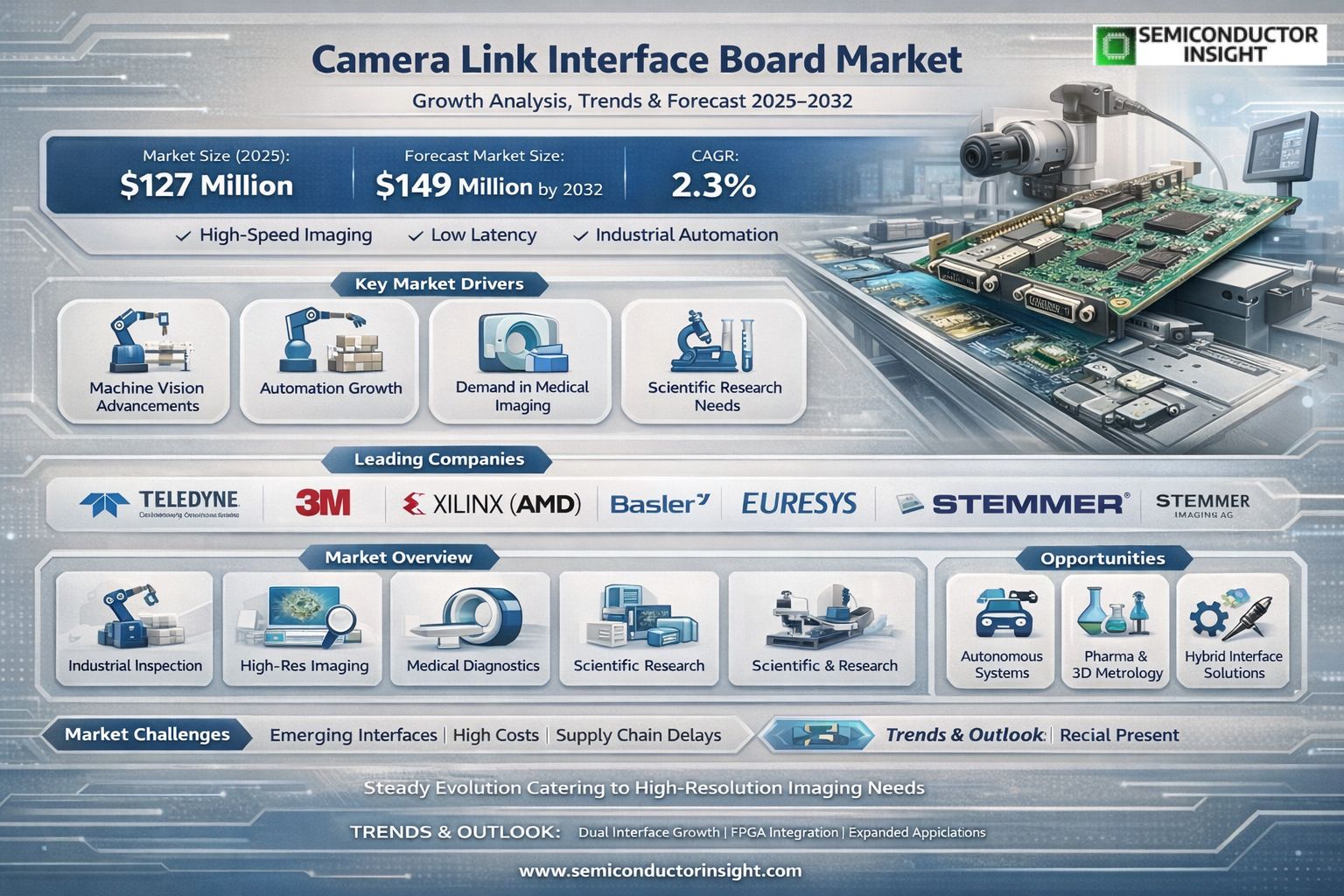
Global Camera Link Interface Board market size was valued at USD 127 million in 2025. The market is projected to reach USD 149 million by 2032, exhibiting a CAGR of 2.3% during the forecast period.
Camera Link Interface Boards are specialized hardware components that enable high-speed, efficient transfer of large volumes of image data from cameras to computers or processing systems. These boards are essential in applications demanding high-resolution imaging and low-latency performance, such as machine vision setups. They support standards like Base, Medium, Full, and Extended configurations, ensuring reliable data transmission over serial links.
The market sees steady expansion driven by increasing automation in manufacturing, advancements in industrial imaging, and demand from medical and scientific sectors. While newer interfaces challenge its dominance, Camera Link remains vital for legacy and high-bandwidth needs. Key players including Teledyne, Basler AG, Xilinx (AMD), EURESYS, STEMMER IMAGING AG, JAI, and Critical Link LLC offer robust portfolios, focusing on FPGA-based solutions and integration with modern PCs. Their innovations in frame grabbers continue to support growth amid evolving vision systems.
MARKET DRIVERS
Advancements in Machine Vision Applications
Camera Link Interface Board Market is propelled by the surging demand for high-speed image acquisition in industrial automation. Machine vision systems increasingly rely on Camera Link for its reliable data transfer rates up to 6.8 Gbps, supporting real-time processing in sectors like electronics manufacturing and quality control. Global adoption has grown with factory automation expanding at a 12% CAGR through 2028.
Rising Integration with AI and Robotics
Integration of AI-driven inspection tools boosts the market, as Camera Link boards provide the bandwidth essential for high-resolution sensors in robotic arms and pick-and-place operations. The synergy with edge computing enhances defect detection accuracy, driving deployments in automotive assembly lines where precision imaging reduces downtime by 25%.
➤ Expansion in non-industrial sectors, including medical diagnostics, further accelerates growth with Camera Link’s low-latency performance.
Overall, these drivers position Camera Link Interface Board Market for sustained expansion amid digital transformation initiatives worldwide.
MARKET CHALLENGES
Competition from Emerging Interfaces
Camera Link Interface Board Market faces hurdles from newer standards like USB3 Vision and GigE Vision, which offer plug-and-play simplicity and cost advantages. Transitioning industries struggle with legacy system compatibility, slowing adoption rates despite Camera Link’s superior frame rates.
Other Challenges
Supply Chain Disruptions
Semiconductor shortages have increased lead times for interface boards by 40%, impacting production scalability in vision-dependent markets.
Technical Complexity
Customization demands for frame grabbers raise engineering costs, challenging smaller firms entering Camera Link Interface Board Market.
MARKET RESTRAINTS
High Development and Deployment Costs
Premium pricing of Camera Link Interface Board Market products, often exceeding $1,000 per unit, restrains widespread adoption among budget-constrained SMEs. Specialized cabling and shielding add to total ownership costs, limiting penetration in emerging economies.
Evolving standards like Camera Link 2.0 introduce upgrade pressures, but backward compatibility issues deter investments. Market growth is capped at 8% annually due to these economic barriers in price-sensitive applications.
Regulatory compliance for industrial safety further escalates validation expenses, particularly in Europe under stringent machinery directives.
MARKET OPPORTUNITIES
Emerging Applications in Autonomous Systems
Camera Link Interface Board Market holds potential in autonomous vehicles and drones, where multi-camera synchronization demands exceed 10 Gbps throughput. Partnerships with ADAS developers could unlock a $500 million segment by 2030.
Growth in pharmaceutical inspection and 3D metrology creates niches for high-fidelity imaging boards, with precision requirements favoring Camera Link over wireless alternatives.
Hybrid solutions combining Camera Link with CoaXPress open retrofit opportunities in legacy factories, projecting a 15% uplift in market share for upgraded systems.
Camera Link Interface Board Market Trends
Rising Demand in Industrial Machine Vision
Camera Link Interface Board Market continues to see robust demand driven by industrial machine vision applications, where high-speed transfer of large image data volumes is essential for high-resolution, low-latency imaging. These boards facilitate seamless connectivity between cameras and processing systems, enabling real-time inspection and automation in manufacturing environments. Key players such as Teledyne, Basler AG, and Xilinx (AMD) are innovating to support this segment, which holds significant market share due to advancements in automation technologies.
Other Trends
Advancements in Dual Interface Boards
Dual Interface Board variants are gaining traction within Camera Link Interface Board Market for their enhanced performance in handling complex imaging setups. Compared to single interface options, dual boards offer greater flexibility for multi-camera systems, appealing to sectors requiring synchronized data capture. Manufacturers like EURESYS and STEMMER IMAGING AG are focusing on these developments to meet evolving needs in precision applications.
Expansion in Medical Imaging and Scientific Research
In medical imaging and scientific research, Camera Link Interface Board Market is witnessing steady growth as these boards support high-fidelity image processing for diagnostics and instrumentation. Applications in medical imaging demand reliable data transfer for detailed scans, while scientific research benefits from low-latency capabilities in experimental setups. Regional dynamics show North America and Europe leading adoption, with Asia, particularly China and Japan, emerging as key growth areas due to investments in research infrastructure. Competitors including JAI, Critical Link LLC, and NI are profiling strategies to capture shares in these diverse applications, navigating challenges like integration with evolving standards.
COMPETITIVE LANDSCAPE
Key Industry Players
Leading Manufacturers Shaping Camera Link Interface Board Market
Camera Link Interface Board Market is characterized by a concentrated structure dominated by a few established technology leaders, with the global top five players holding a substantial revenue share in 2025. Teledyne, formerly FLIR Systems, emerges as a frontrunner, leveraging its expertise in imaging solutions to deliver high-performance boards essential for high-speed data transfer in machine vision applications. Supported by 3M’s robust electronics manufacturing capabilities and Xilinx (now AMD)’s FPGA-based innovations, these companies drive market growth amid rising demand for low-latency imaging in industrial and scientific sectors. The market, valued at $127 million in 2025 and projected to reach $149 million by 2032 at a 2.3% CAGR, reflects an oligopolistic landscape where innovation in dual and single interface boards solidifies their positions.
Beyond the top tier, niche players contribute significantly through specialized offerings tailored to medical imaging, scientific research, and instrumentation. Basler AG excels in camera integration, while EURESYS and STEMMER IMAGING AG focus on frame grabbers compatible with Camera Link standards. Emerging challengers like JAI, Critical Link LLC, and Terasic Inc. target FPGA-accelerated solutions for high-resolution needs, fostering competition in regional markets such as North America and Europe. Additional firms including Active Silicon, OMRON SENTECH, NI, and Sky Blue Microsystems GmbH enhance diversity, addressing specific pain points like integration with PCIe systems and real-time processing, though they hold smaller shares amid ongoing mergers and R&D investments.
List of Key Camera Link Interface Board Companies Profiled
- Teledyne
- 3M
- Xilinx (AMD)
- Basler AG
- EURESYS
- STEMMER IMAGING AG
- 1Vision
- JAI
- Critical Link LLC
- Terasic Inc.
- Active Silicon
- OMRON SENTECH CO.,LTD.
- NI
- Sky Blue Microsystems GmbH
Segment Analysis:
| Segment Category | Sub-Segments | Key Insights |
| By Type |
|
Dual Interface Board leads the market by offering superior connectivity for simultaneous data streams from multiple cameras, making it ideal for demanding imaging applications that require synchronized inputs and enhanced throughput.
|
| By Application |
|
Industrial Machine Vision dominates applications due to its critical role in enabling real-time inspection and automation processes where high-speed image acquisition is paramount.
|
| By End User |
|
Industrial Manufacturers represent the forefront end-user segment, leveraging these boards for robust imaging solutions in production-heavy operations.
|
| By Configuration |
|
Full Configuration leads by supporting maximum data throughput, catering to applications demanding ultra-high-resolution imaging without bottlenecks.
|
| By Form Factor | PCIe Boards hold the leading position with their high-speed bus compatibility, ensuring optimal performance in modern computing environments.
|
Regional Analysis: Camera Link Interface Board Market
North America
Strong demand from industrial automation propels Camera Link Interface Board Market, with manufacturers prioritizing high-bandwidth solutions for factory floors. Aerospace applications demand ruggedized boards for harsh conditions, boosting regional growth through defense contracts and R&D funding.
Innovations in frame grabber integration enhance Camera Link Interface Board capabilities, enabling multi-camera setups for complex machine vision tasks. North American firms lead in software-defined interfaces, improving flexibility for AI-enhanced imaging systems.
Medical imaging and semiconductor inspection drive adoption, where high-resolution data transfer via Camera Link Interface Boards ensures diagnostic accuracy and yield optimization. Robotics sectors benefit from synchronized image capture in dynamic environments.
Prominent players focus on ecosystem partnerships, developing plug-and-play Camera Link Interface Board solutions. Customization for PCIe and USB interfaces strengthens market position amid rising needs for scalable vision architectures.
Europe
Europe exhibits steady expansion in Camera Link Interface Board Market, fueled by precision engineering in automotive and pharmaceuticals. Stringent safety regulations drive demand for certified high-reliability boards in automated assembly lines and quality assurance systems. German and French manufacturers excel in integrating these interfaces with EtherCAT protocols, enhancing real-time control in smart factories. The region’s emphasis on sustainable manufacturing promotes energy-efficient designs, aligning with green initiatives. Collaborative R&D across borders accelerates advancements in hyperspectral imaging applications, vital for food processing and environmental monitoring. Despite supply chain challenges, Europe’s diversified vendor base ensures resilience, supporting growth in emerging fields like non-destructive testing. Investments in Industry 4.0 frameworks position the market for sustained momentum, with focus on interoperability standards to future-proof deployments.
Asia-Pacific
Asia-Pacific emerges as a dynamic hub in Camera Link Interface Board Market, propelled by explosive manufacturing growth in electronics and consumer goods. China’s vast production facilities demand scalable high-speed interfaces for surface-mount technology inspections, while Japan’s expertise in robotics integrates advanced boards for collaborative systems. Cost-effective production scales adoption across mid-tier applications, blending imported tech with local innovations. Rapid urbanization spurs surveillance and traffic management uses, requiring robust Camera Link Interface Board performance in networked environments. Government incentives for semiconductor localization bolster domestic capabilities, fostering a competitive pricing landscape. Challenges like IP protection are offset by burgeoning startups, driving hybrid solutions for edge computing in vision tasks. The region’s sheer volume positions it for accelerated market penetration through volume-driven efficiencies.
South America
South America shows promising potential in Camera Link Interface Board Market, centered on agriculture and mining automation. Brazilian agrotech firms leverage these boards for crop monitoring drones, enabling precise yield analysis via high-frame-rate capture. Resource extraction industries in Chile and Peru adopt rugged solutions for equipment inspection in remote sites, prioritizing vibration resistance and extended temperature ranges. Import dependencies are easing with regional assembly initiatives, tailoring products to local power standards. Educational institutions partner with global suppliers to build expertise, spurring custom developments for biodiversity research imaging. Infrastructure investments enhance connectivity, facilitating cloud-integrated vision systems. Growth hinges on overcoming economic volatility, with focus shifting toward affordable, maintenance-free interfaces to broaden accessibility across SMEs.
Middle East & Africa
The Middle East & Africa region witnesses gradual uptake in Camera Link Interface Board Market, driven by oil & gas and security applications. UAE’s smart city projects integrate high-resolution boards for perimeter surveillance, demanding dust-resistant designs for harsh climates. South African mining operations utilize them for conveyor belt monitoring, emphasizing real-time anomaly detection. Defense modernizations across the Gulf states prioritize secure, low-latency interfaces for UAV reconnaissance. Skill development programs bridge adoption gaps, while free trade zones attract assembly plants for customized solutions. Water management and renewable energy inspections open new avenues, requiring portable Camera Link Interface Board variants. Strategic alliances with international vendors mitigate infrastructure hurdles, laying foundations for broader industrial vision integration.
Report Scope
This market research report provides a comprehensive analysis of the Camera Link Interface Board Market , covering the forecast period 2025–2032. It offers detailed insights into market dynamics, technological advancements, competitive landscape, and key trends shaping the industry.
Key focus areas of the report include:
- Market Overview: The report begins with an overview outlining its current market scenario, key growth indicators, and industry transformation drivers. It discusses macroeconomic factors, demand–supply balance, regulatory landscape, and the strategic role of Camera Link Interface Boards in powering advancements across industries such as industrial machine vision, medical imaging, scientific research and instrumentation.
- Market Size & Forecast: Historical data and future projections for revenue, unit shipments, and market value across major regions and segments.
- Segmentation Analysis: Detailed breakdown by product type, technology, application, and end-user industry to identify high-growth segments and investment opportunities.
- Regional Insights: Insights into market performance across North America, Europe, Asia, South America, and the Middle East & Africa, including country-level analysis where relevant.
- Competitive Landscape: Profiles of leading market participants, including their product offerings, R&D focus, manufacturing capacity, pricing strategies, and recent developments such as mergers, acquisitions, and partnerships.
- Technology Trends & Innovation: Assessment of emerging technologies, integration of AI/IoT, semiconductor design trends, fabrication techniques, and evolving industry standards.
- Market Drivers & Restraints: Evaluation of factors driving market growth along with challenges, supply chain constraints, regulatory issues, and market-entry barriers.
- Stakeholder Insights: Insights for component suppliers, OEMs, system integrators, investors, and policymakers regarding the evolving ecosystem and strategic opportunities.
Primary and secondary research methods are employed, including interviews with industry experts, data from verified sources, and real-time market intelligence to ensure the accuracy and reliability of the insights presented.
FREQUENTLY ASKED QUESTIONS:
What is the current market size of Camera Link Interface Board Market?
-> Global Camera Link Interface Board Market was valued at USD 127 million in 2025 and is expected to reach USD 149 million by 2032, at a CAGR of 2.3%.
Which key companies operate in Camera Link Interface Board Market?
-> Key players include Teledyne, 3M, Xilinx(AMD), Basler AG, EURESYS, STEMMER IMAGING AG, among others.
What are the key growth drivers?
-> Key growth drivers include demand for high-speed, low-latency image data transfer in industrial machine vision, medical imaging, and scientific research.
Which region dominates the market?
-> North America holds a significant share, while Asia (including China and Japan) is poised for rapid growth.
What are the emerging trends?
-> Emerging trends include growth in Dual Interface Board segment, advancements in FPGA integration, and expansion in high-resolution imaging applications.

Get Sample Report PDF for Exclusive Insights
Report Sample Includes
- Table of Contents
- List of Tables & Figures
- Charts, Research Methodology, and more...
 Download Sample Report PDF