Camera Link High Speed (CLHS) Frame Grabbers Market Insights
Global Camera Link High Speed (CLHS) Frame Grabbers market size was valued at USD 156.4 million in 2025. The market is projected to grow from USD 167.2 million in 2026 to USD 298.7 million by 2034, exhibiting a CAGR of 6.6% during the forecast period.
Camera Link HS (CLHS) is the next-generation interface standard purpose-built to meet the evolving demands of modern machine vision applications. It is capable of transmitting high-bandwidth, low-latency, and low-jitter real-time signals between cameras and frame grabbers, making it particularly well-suited for high-speed industrial imaging environments. Designed from a system-level perspective, the standard ensures that both cameras and image grabbers can be developed at competitive cost points, while still delivering the ease of use, operational flexibility, and data reliability that end users require across diverse imaging workflows.
The market is experiencing steady growth driven by rising adoption of automated inspection systems in manufacturing, increasing deployment of machine vision in semiconductor and electronics industries, and expanding use of high-speed imaging in life sciences and defense sectors. Key players operating in global Camera Link High Speed (CLHS) Frame Grabbers market include Teledyne, Dalsa, Basler, AES, and KAYA Instruments, among others, each offering a broad portfolio of PCIe-based frame grabber solutions compatible with the CLHS standard.
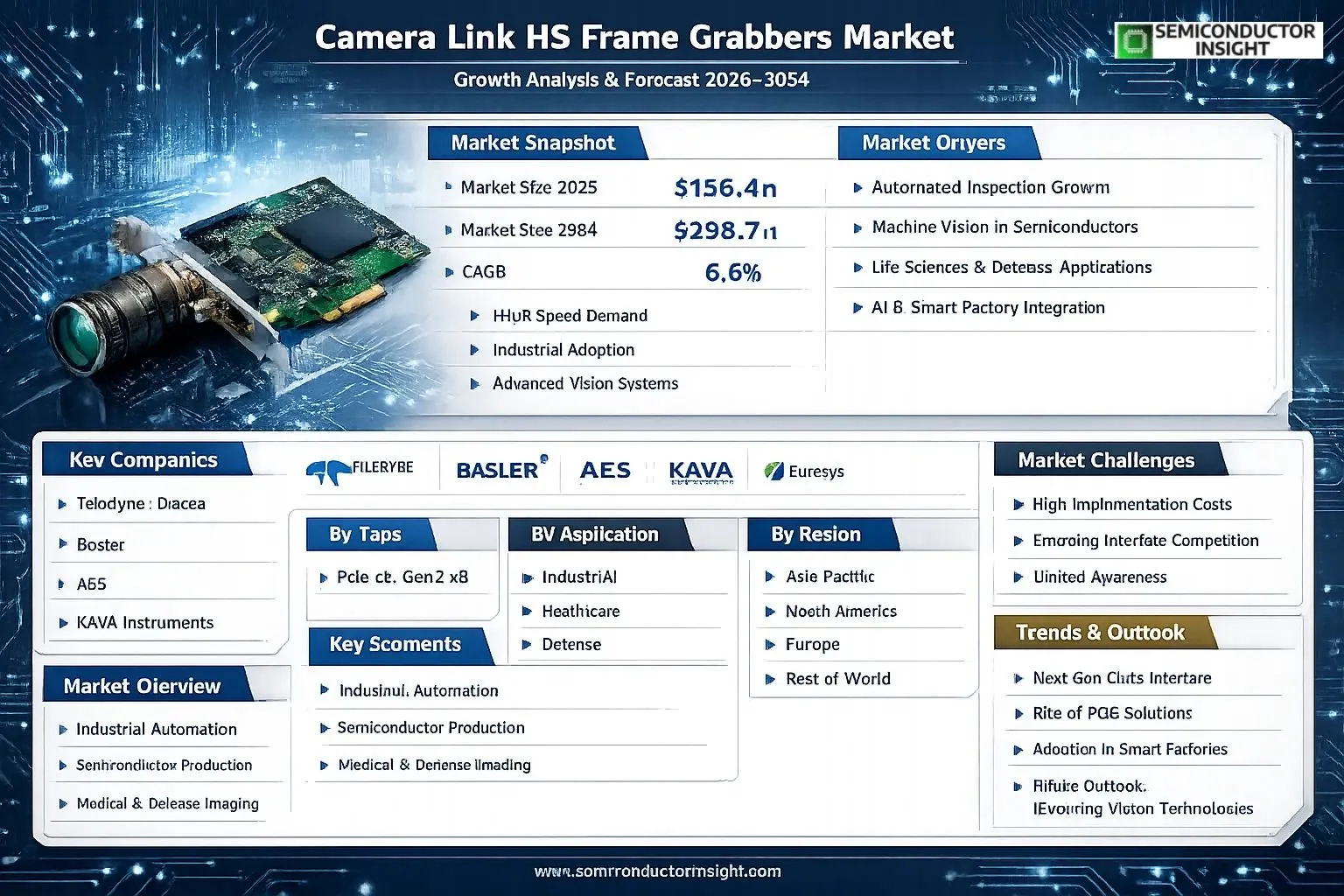
MARKET DRIVERS
Rising Demand for High-Speed Machine Vision in Industrial Automation
The Camera Link High Speed (CLHS) Frame Grabbers Market is experiencing significant momentum driven by the rapid expansion of industrial automation and smart manufacturing initiatives worldwide. As production environments increasingly adopt high-throughput inspection systems, the need for frame grabbers capable of handling multi-gigabit data streams has grown considerably. CLHS technology, built on the PCI Express interface standard, offers bandwidths exceeding 850 MB/s per lane, making it well-suited for line-scan and area-scan cameras operating at extremely high frame rates. Industries such as semiconductor fabrication, electronics assembly, and flat panel display manufacturing are among the primary adopters, where even microscopic defect detection demands ultra-fast, lossless image acquisition.
Integration with AI-Driven Quality Control and Inspection Systems
Another critical driver in the Camera Link High Speed (CLHS) Frame Grabbers Market is the accelerating integration of artificial intelligence and deep learning algorithms into automated optical inspection (AOI) platforms. Modern AI-based vision systems require real-time, high-fidelity image data to train and execute complex neural network models for defect classification, dimensional measurement, and surface analysis. CLHS frame grabbers serve as a vital interface layer between high-resolution cameras and the host processing system, ensuring data integrity at multi-lane configurations. The adoption of Industry 4.0 frameworks across manufacturing sectors in North America, Europe, and Asia-Pacific is further fueling investment in high-performance vision infrastructure, directly benefiting the CLHS frame grabber segment.
➤ The global push toward zero-defect manufacturing and smart factory transformation is positioning Camera Link High Speed (CLHS) Frame Grabbers as mission-critical components in next-generation industrial vision architectures.
Government-backed manufacturing modernization programs, particularly across Japan, South Korea, Germany, and China, are allocating substantial resources toward vision-guided robotics and precision inspection lines. These macro-level investments are translating into sustained procurement cycles for CLHS-compatible imaging hardware, including frame grabbers, reinforcing a structurally positive demand outlook for the Camera Link High Speed (CLHS) Frame Grabbers Market through the coming years.
MARKET CHALLENGES
High Implementation Costs and Complexity of System Integration
One of the most pressing challenges facing the Camera Link High Speed (CLHS) Frame Grabbers Market is the relatively high total cost of ownership associated with deploying CLHS-based imaging systems. Beyond the hardware acquisition cost, end users must account for specialized PCIe slot availability, driver compatibility, cable management for CX4 or SFP+ connectors, and the need for technically skilled engineers to configure multi-camera synchronization setups. For small and mid-sized enterprises operating on constrained capital budgets, these barriers can delay adoption or push them toward lower-cost alternatives such as USB3 Vision or GigE Vision platforms, even when throughput requirements would otherwise justify CLHS deployment.
Other Challenges
Competition from Emerging Interface Standards
The Camera Link High Speed (CLHS) Frame Grabbers Market faces mounting competitive pressure from newer interface technologies such as CoaXPress (CXP-12), 25GigE Vision, and USB4-based imaging solutions. These alternatives are gaining traction due to their longer cable reach, simplified cabling architectures, and in some cases, comparable bandwidth profiles. As camera manufacturers increasingly design sensors with native support for these competing interfaces, frame grabber vendors must continuously demonstrate the technical differentiation and ecosystem maturity of the CLHS standard to retain design wins in new system integrations.
Limited Awareness Among Emerging Market End Users
In high-growth regions including Southeast Asia, Latin America, and parts of Eastern Europe, awareness and technical familiarity with Camera Link High Speed (CLHS) Frame Grabbers remain comparatively limited. Local systems integrators in these markets often default to more widely recognized imaging standards, limiting the geographic expansion velocity of CLHS technology. Vendors operating in the Camera Link High Speed (CLHS) Frame Grabbers Market must invest in regional technical education, application engineering support, and partner certification programs to accelerate penetration beyond established markets.
MARKET RESTRAINTS
Supply Chain Vulnerabilities and Semiconductor Component Constraints
The Camera Link High Speed (CLHS) Frame Grabbers Market is exposed to supply chain risks stemming from the broader semiconductor industry’s cyclical nature. CLHS frame grabbers rely on specialized FPGA devices, high-speed serializer/deserializer (SerDes) chips, and PCIe bridge controllers,components that have historically been subject to extended lead times and constrained availability during periods of global chip shortages. Disruptions in the supply of these critical components can delay product launches, inflate manufacturing costs, and limit the ability of vendors to fulfill large-volume orders from OEM customers and systems integrators, thereby acting as a restraint on market growth.
Fragmented Standardization and Ecosystem Interoperability Concerns
While the CLHS standard is maintained under the Camera Link HS specification by the Automated Imaging Association (AIA), practical interoperability between frame grabbers and cameras from different vendors can still present integration challenges. Differences in firmware implementations, GenICam compliance levels, and software development kit (SDK) architectures across hardware vendors introduce friction for end users requiring multi-vendor system configurations. This fragmentation acts as a restraint within the Camera Link High Speed (CLHS) Frame Grabbers Market, as it increases integration timelines and can erode confidence among system architects evaluating CLHS against more plug-and-play-oriented interface standards. Ongoing standardization efforts and cross-vendor certification initiatives will be essential in mitigating this structural restraint.
MARKET OPPORTUNITIES
Expanding Applications in Life Sciences, Medical Imaging, and Defense Sectors
Beyond traditional industrial machine vision, the Camera Link High Speed (CLHS) Frame Grabbers Market holds considerable growth opportunities in life sciences and medical imaging applications. High-throughput genomic screening, digital pathology slide scanning, and fluorescence microscopy all demand extremely high data rates and deterministic image capture performance that align well with CLHS capabilities. Medical device OEMs and research institutions developing next-generation diagnostic imaging platforms represent a nascent but high-value customer segment. The stringent image fidelity requirements in these verticals make CLHS an attractive technical choice, and vendors who develop life-science-optimized frame grabber configurations with relevant regulatory compliance support stand to capture significant market share.
Growth in Hyperspectral and 3D Imaging System Deployments
The proliferation of hyperspectral imaging and structured-light 3D vision systems in food safety inspection, precision agriculture, and advanced robotics presents a compelling opportunity landscape for the Camera Link High Speed (CLHS) Frame Grabbers Market. These imaging modalities generate substantially higher data volumes per unit time compared to conventional monochrome or color cameras, making the high-bandwidth, low-latency data transfer architecture of CLHS especially advantageous. As hyperspectral camera manufacturers seek robust frame grabber partners capable of reliably handling multi-spectral data streams, CLHS-based solutions are increasingly being evaluated for integration into turnkey inspection and sensing systems. Vendors that proactively develop application-specific reference designs for these emerging imaging use cases are well-positioned to capitalize on this expanding opportunity within the Camera Link High Speed (CLHS) Frame Grabbers Market.
Camera Link High Speed (CLHS) Frame Grabbers Market Trends
Rising Adoption of High-Speed Machine Vision Systems Driving Market Momentum
The Camera Link High Speed (CLHS) Frame Grabbers Market is witnessing significant momentum driven by the accelerating integration of high-speed imaging systems in industrial automation environments. As manufacturing facilities globally transition toward smart factory architectures, the demand for frame grabbers capable of transmitting high-bandwidth, low-latency, and low-jitter real-time signals between cameras and processing units has intensified. CLHS technology, as a next-generation interface standard, addresses the evolving requirements of machine vision applications by enabling reliable data transfers across complex inspection and quality control setups. Industries such as semiconductor fabrication, electronics assembly, and automotive manufacturing have increasingly adopted CLHS-compatible frame grabbers to support precision imaging at elevated throughput levels, reinforcing the market’s upward trajectory.
Other Trends
Expansion of PCIe-Based Interface Configurations
A notable trend shaping the Camera Link High Speed (CLHS) Frame Grabbers Market is the growing preference for PCIe-based interface variants, particularly PCIe x8, PCIe Gen2 x4, PCIe Gen2 x8, and PCIe Gen3.0 x8 configurations. Among these, PCIe Gen3.0 x8 is gaining traction due to its superior bandwidth capabilities, which are essential for handling ultra-high-resolution image data in real-time processing environments. System integrators and OEMs are increasingly specifying PCIe Gen3.0-compatible frame grabbers to future-proof their imaging infrastructure, as multi-camera setups and line-scan applications demand consistent data throughput without bottlenecks at the host interface level.
Growing Deployment Across Industrial Camera Applications
Within the application landscape, industrial cameras continue to represent the dominant end-use segment for CLHS frame grabbers. The proliferation of automated optical inspection (AOI) systems, robotic guidance platforms, and 3D measurement solutions in sectors including food and beverage processing, pharmaceuticals, and flat panel display manufacturing has sustained robust demand. Compared to ordinary cameras, industrial-grade imaging systems require stricter synchronization, higher frame rates, and deterministic data delivery , characteristics that CLHS frame grabbers are specifically engineered to support. This application-driven differentiation is expected to reinforce the industrial camera segment’s leading position within the broader market.
Asia-Pacific Emerging as a Key Regional Growth Engine
From a regional perspective, Asia-Pacific , with China and Japan at the forefront , is emerging as a critical growth engine for the Camera Link High Speed (CLHS) Frame Grabbers Market. The region’s expanding electronics manufacturing base, combined with aggressive investments in factory automation and machine vision infrastructure, has created favorable conditions for CLHS adoption. North America remains a mature and technologically advanced market, with established players such as Teledyne, Dalsa, Basler, AES, and KAYA Instruments maintaining strong competitive positions. As these key manufacturers continue to develop cost-optimized yet high-performance frame grabber solutions, the market is poised for sustained expansion across both developed and emerging economies through the forecast period.
COMPETITIVE LANDSCAPE
Key Industry Players
Camera Link High Speed (CLHS) Frame Grabbers Market , Competitive Intelligence & Strategic Profiling of Leading Manufacturers
global Camera Link High Speed (CLHS) Frame Grabbers market is characterized by the presence of a concentrated group of technologically advanced players competing on the basis of interface innovation, PCIe compatibility, and integration with industrial machine vision ecosystems. Teledyne DALSA stands out as the dominant force in this space, leveraging its deep-rooted expertise in imaging hardware and frame grabber architectures to maintain a leading revenue share. The company’s Xtium and Xcelera series of CLHS-compatible frame grabbers are widely adopted across semiconductor inspection, electronics manufacturing, and automated optical inspection (AOI) environments. The top five global manufacturers collectively accounted for a substantial share of total market revenue in 2025, reflecting the high barriers to entry posed by R&D requirements, proprietary firmware development, and compliance with the Camera Link HS interface standard , a next-generation protocol designed to deliver high-bandwidth, low-latency, and low-jitter real-time signal transmission between cameras and frame grabbers.
Beyond the market leader, several other specialized and niche players contribute meaningfully to the competitive dynamics of the CLHS frame grabber landscape. KAYA Instruments has emerged as a notable innovator, offering high-performance frame grabbers with multi-protocol support including CLHS, CoaXPress, and Camera Link, targeting high-speed industrial imaging and scientific applications. Basler AG, primarily recognized for its industrial cameras, has expanded its ecosystem to support CLHS-compatible acquisition hardware. AES (Active Silicon / Advanced Electronic Systems) provides ruggedized frame grabbers with strong PCIe Gen2 and Gen3 support catering to defense and industrial segments. Meanwhile, companies such as Euresys, Matrox Imaging, BitFlow, and Imperx continue to compete through differentiated software frameworks, FPGA-based processing capabilities, and multi-camera synchronization features. The competitive landscape is also shaped by regional players in Asia-Pacific, particularly in China, Japan, and South Korea, where rising adoption of industrial automation and machine vision systems is accelerating local demand for CLHS-based acquisition solutions across PCIe x8, PCIe Gen2 x4, PCIe Gen2 x8, and PCIe Gen3.0 x8 form factors.
List of Key Camera Link High Speed (CLHS) Frame Grabbers Companies Profiled
- Teledyne DALSA
- KAYA Instruments
- Basler AG
- Euresys
- AES (Advanced Electronic Systems)
- Matrox Imaging
- BitFlow
- Imperx
- Active Silicon
- Silicon Software (a Basler Company)
- Pleora Technologies
- Adimec Advanced Image Systems
- STEMMER IMAGING
- Siso (Silicon Software)
- Photon Focus
Segment Analysis:
| Segment Category | Sub-Segments | Key Insights |
| By Type |
|
Leading Segment: PCIe x8
|
| By Application |
|
Leading Segment: Industrial Cameras
|
| By End User |
|
Leading Segment: Industrial Automation
|
| By Form Factor |
|
Leading Segment: Board-Level
|
| By Number of Channels |
|
Leading Segment: Multi-Channel
|
Regional Analysis: Camera Link High Speed (CLHS) Frame Grabbers Market
North America
North America’s leading tech clusters drive CLHS frame grabber advancements, focusing on embedded processing and FPGA integration for superior image acquisition speeds.
Strong push in factory automation utilizes CLHS for high-resolution inspections, enabling precise synchronization in conveyor systems and assembly lines.
Prominent developers collaborate with integrators, offering robust software SDKs that streamline deployment in vision-guided robotics applications.
Rising use in non-destructive testing for electronics and pharmaceuticals underscores CLHS frame grabbers’ role in quality assurance processes.
Europe
Europe exhibits steady growth in the Camera Link High Speed (CLHS) Frame Grabbers Market, propelled by sophisticated manufacturing and automation sectors. Countries like Germany and France lead with stringent quality standards in automotive and pharmaceutical industries, where CLHS enables ultra-fast data transfer for 3D imaging and surface analysis. Emphasis on Industry 4.0 initiatives integrates these frame grabbers into smart factories, enhancing predictive maintenance through high-fidelity video streams. Collaborative EU-funded projects accelerate innovation in multi-camera setups for logistics and food processing. The market benefits from a skilled workforce proficient in customizing solutions for vibration-resistant environments, ensuring reliability in high-throughput production lines. Sustainability drives adoption of energy-efficient CLHS protocols, aligning with green manufacturing goals while maintaining superior bandwidth for complex vision tasks.
Asia-Pacific
Asia-Pacific emerges as a dynamic force in the Camera Link High Speed (CLHS) Frame Grabbers Market, fueled by rapid industrialization and electronics boom. Japan and South Korea pioneer high-speed applications in semiconductor fabrication and consumer electronics testing, leveraging CLHS for gigabit-level throughput in precision alignment tasks. China’s expansive manufacturing base adopts these frame grabbers for scalable machine vision in textiles and packaging, optimizing defect classification. Government incentives for smart manufacturing spur infrastructure upgrades, integrating CLHS with AI-driven analytics for real-time decision-making. The region’s cost-effective supply chains enable widespread deployment in consumer goods assembly, where low-latency capture supports intricate pattern recognition. Increasing focus on export-oriented quality control further amplifies demand for robust, cable-extensible CLHS solutions.
South America
South America shows promising potential in the Camera Link High Speed (CLHS) Frame Grabbers Market, particularly in Brazil and Argentina’s growing industrial sectors. Adoption accelerates in agribusiness for crop monitoring and food sorting, where CLHS frame grabbers handle high-frame-rate imaging under variable lighting. Automotive assembly lines benefit from enhanced synchronization for part verification, bridging gaps in legacy systems. Local integrators adapt solutions for tropical climates, emphasizing durability and thermal management. Investments in digital transformation initiatives promote CLHS integration into automated warehouses, improving inventory accuracy through overhead vision systems. Collaborative ventures with global suppliers foster knowledge transfer, positioning the region for expanded use in mining inspection and renewable energy panel quality checks.
Middle East & Africa
The Middle East & Africa region is nascent yet expanding in the Camera Link High Speed (CLHS) Frame Grabbers Market, driven by oil & gas and infrastructure projects. UAE and South Africa lead in pipeline inspection and security surveillance, utilizing CLHS for long-distance, high-resolution feeds in remote operations. Emerging smart city developments incorporate these frame grabbers in traffic management and perimeter monitoring systems. Customization for dust-prone environments ensures consistent performance in harsh settings. Regional partnerships with international firms introduce training programs, building capacity for deployment in mining and port automation. Focus on diversification from hydrocarbons boosts applications in healthcare imaging and agricultural drones, laying groundwork for broader market penetration through reliable, high-speed data acquisition.
Report Scope
This market research report provides a comprehensive analysis of the Camera Link High Speed (CLHS) Frame Grabbers Market, covering the forecast period 2026–2034. It offers detailed insights into market dynamics, technological advancements, competitive landscape, and key trends shaping the industry.
Key focus areas of the report include:
- Market Overview: The report begins with an overview outlining its current market scenario, key growth indicators, and industry transformation drivers. It discusses macroeconomic factors, demand–supply balance, regulatory landscape, and the strategic role of Camera Link High Speed (CLHS) Frame Grabbers in powering advancements across industries such as machine vision, industrial automation, robotics, and quality inspection.
- Market Size & Forecast: Historical data and future projections for revenue, unit shipments, and market value across major regions and segments.
- Segmentation Analysis: Detailed breakdown by product type, technology, application, and end-user industry to identify high-growth segments and investment opportunities.
- Regional Insights: Insights into market performance across North America, Europe, Asia-Pacific, Latin America, and the Middle East & Africa, including country-level analysis where relevant.
- Competitive Landscape: Profiles of leading market participants, including their product offerings, R&D focus, manufacturing capacity, pricing strategies, and recent developments such as mergers, acquisitions, and partnerships.
- Technology Trends & Innovation: Assessment of emerging technologies, integration of AI/IoT, frame grabber design trends, transmission techniques, and evolving industry standards.
- Market Drivers & Restraints: Evaluation of factors driving market growth along with challenges, supply chain constraints, regulatory issues, and market-entry barriers.
- Stakeholder Insights: Insights for component suppliers, OEMs, system integrators, investors, and policymakers regarding the evolving ecosystem and strategic opportunities.
Primary and secondary research methods are employed, including interviews with industry experts, data from verified sources, and real-time market intelligence to ensure the accuracy and reliability of the insights presented.
FREQUENTLY ASKED QUESTIONS:
What is the current market size of Camera Link High Speed (CLHS) Frame Grabbers Market?
-> Global Camera Link High Speed (CLHS) Frame Grabbers market was valued at USD 156.4 million in 2025 and is projected to reach USD 298.7 million by 2034, at a CAGR of 6.6% during the forecast period.
Which key companies operate in Camera Link High Speed (CLHS) Frame Grabbers Market?
-> Key players include Teledyne, Dalsa, Balser, AES, KAYA Instruments, among others.
What are the key growth drivers?
-> Key growth drivers include demand for high-bandwidth low-latency low-jitter real-time signals in machine vision applications, industrial automation expansion, and need for flexible reliable imaging solutions.
Which region dominates the market?
-> The U.S. market size is estimated at USD million in 2025 while China is to reach USD million.
What are the emerging trends?
-> Emerging trends include next-generation CLHS interface for machine vision, PCIe x8 segment reaching USD million by 2034 at a % CAGR, and designs enabling low-cost cameras with ease of use flexibility data reliability.

Get Sample Report PDF for Exclusive Insights
Report Sample Includes
- Table of Contents
- List of Tables & Figures
- Charts, Research Methodology, and more...