Building Automation (BACnet, KNX) Transceiver IC Market Insights
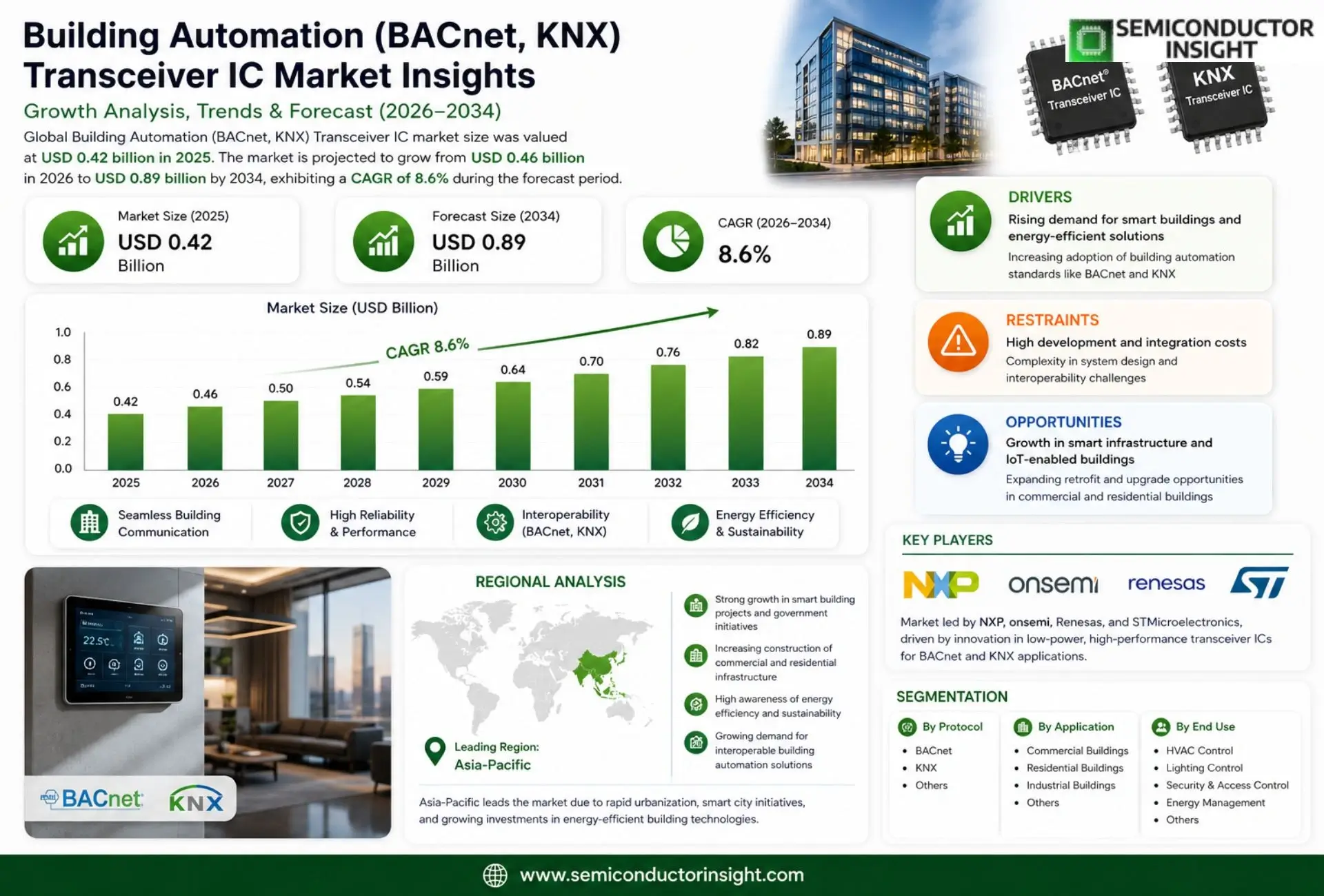
Global Building Automation (BACnet, KNX) Transceiver IC Market size was valued at USD 0.42 billion in 2025. The market is projected to grow from USD 0.46 billion in 2026 to USD 0.89 billion by 2034, exhibiting a CAGR of 8.6% during the forecast period.
Building Automation (BACnet, KNX) Transceiver ICs are specialized integrated circuits vital for enabling communication in smart building networks. These ICs handle protocol-specific signal transmission and reception, supporting BACnet’s MS/TP over RS-485 and KNX’s diverse media like twisted-pair, powerline, and RF. They ensure interoperability across devices for HVAC, lighting, shading, and security systems, while offering features like low power consumption and noise immunity.
The market is experiencing strong growth driven by expanding smart building deployments, regulatory mandates for energy efficiency, and IoT convergence. While retrofit projects in existing structures boost demand, new constructions in urban areas further accelerate adoption. Advancements in semiconductor fabrication enhance performance and cost-effectiveness. Key players’ innovations also spur progress. For instance, in February 2024, Silicon Labs unveiled its next-generation KNX transceiver ICs with integrated security for IoT-enabled building automation. Texas Instruments, Renesas Electronics, STMicroelectronics, and NXP Semiconductors are prominent players with comprehensive portfolios.
MARKET DRIVERS
Rising Demand for Energy Efficiency in Smart Buildings
Building Automation (BACnet, KNX) Transceiver IC Market is propelled by the global push toward sustainable infrastructure, as buildings account for a significant portion of worldwide energy consumption. Transceiver ICs enabling reliable BACnet and KNX protocol communication play a critical role in integrating HVAC, lighting, and access control systems for optimized energy management and reduced operational costs.
Expansion of IoT and Smart City Initiatives
Integration of IoT technologies in commercial and residential structures drives adoption of standardized protocols like BACnet and KNX. These transceiver ICs facilitate seamless data exchange across diverse devices, supporting advanced analytics and real-time control essential for modern building automation ecosystems.
➤ Growing deployment of building automation systems in office buildings, shopping centers, and public infrastructure accelerates demand for robust transceiver solutions.
Support for multiple media types including twisted pair, power line, and radio in KNX systems, alongside BACnet’s manufacturer-independent interoperability, further strengthens market momentum as facility managers seek flexible and future-proof communication hardware.
MARKET CHALLENGES
Interoperability and Integration Complexity
Building Automation (BACnet, KNX) Transceiver IC Market, achieving seamless communication between devices from different manufacturers remains a persistent hurdle despite standardized protocols. Custom integration efforts often extend project timelines and increase costs for system integrators.
Other Challenges
Cybersecurity Vulnerabilities
As building automation networks connect to cloud platforms and IP-based systems, transceiver ICs must address rising threats to data integrity and system security, requiring continuous firmware updates and robust encryption capabilities.
High Initial Implementation Costs
Small and medium-sized building projects face barriers due to the upfront investment needed for compliant BACnet and KNX transceiver solutions and supporting infrastructure.
MARKET RESTRAINTS
High Upfront Costs and Complexity
Building Automation (BACnet, KNX) Transceiver IC Market faces restraint from elevated initial costs associated with deploying certified transceiver hardware and full protocol stacks, particularly impacting adoption among budget-conscious smaller facilities and retrofit projects.
Limited Awareness and Skilled Workforce Shortage
Insufficient technical expertise in designing and maintaining BACnet and KNX-based systems slows market penetration. The specialized knowledge required for transceiver IC integration and protocol configuration creates a barrier for widespread implementation beyond large-scale commercial developments.
MARKET OPPORTUNITIES
Smart City Development and Retrofit Markets
Emerging smart city projects in developing regions present substantial growth potential for Building Automation (BACnet, KNX) Transceiver IC Market. Opportunities arise in integrating transceiver solutions with renewable energy systems and advanced HVAC controls to enhance building intelligence and sustainability.
Advancements in Wireless and Secure Communication
Development of low-power radio transceivers for KNX-RF and secure BACnet/SC variants opens new avenues for wireless building automation deployments. These innovations address retrofit needs and cybersecurity demands, enabling broader adoption across diverse building types.
Building Automation (BACnet, KNX) Transceiver IC Market Trends
Integration of Enhanced Security Features in Transceiver Designs
Building Automation (BACnet, KNX) Transceiver IC Market is witnessing significant momentum as smart building deployments accelerate globally. These specialized integrated circuits serve as critical components for reliable communication in building automation networks, supporting BACnet MS/TP over RS-485 and KNX across twisted-pair, powerline, and RF media. Their role in ensuring seamless interoperability for HVAC, lighting, shading, and security systems remains central to modern building management.
One of the primary trends shaping Building Automation (BACnet, KNX) Transceiver IC Market involves the incorporation of advanced security capabilities directly into transceiver hardware. As buildings become more connected through IoT convergence, manufacturers are prioritizing integrated security features to protect against cyber threats while maintaining low power consumption and robust noise immunity. This evolution allows for safer data transmission across diverse automation devices without compromising performance or increasing system complexity.
Other Trends
Shift Toward Hybrid Wired and Wireless Solutions
Building Automation (BACnet, KNX) Transceiver IC Market, a notable development is the growing emphasis on hybrid communication architectures. While traditional wired protocols like BACnet and KNX continue to provide reliable backbone connectivity in commercial and industrial settings, transceiver ICs are increasingly designed to facilitate smoother integration with wireless and IP-based extensions. This trend supports retrofit projects in existing structures as well as new urban constructions, enabling greater flexibility in system design and easier scalability for facility managers.
Advancements in Semiconductor Processes and Industry Consolidation
Semiconductor fabrication improvements are enhancing the efficiency, cost-effectiveness, and functionality of Building Automation (BACnet, KNX) Transceiver ICs. Leading suppliers are focusing on optimizing power management and signal integrity to meet stringent energy efficiency regulations driving smart building adoption. Recent industry moves, such as major acquisitions in the connectivity space, signal potential for accelerated innovation and broader portfolio integration among key players including Texas Instruments, Renesas Electronics, STMicroelectronics, and NXP Semiconductors.
Overall, Building Automation (BACnet, KNX) Transceiver IC Market trends reflect a maturing ecosystem where protocol-specific transceivers evolve to address demands for interoperability, security, and energy optimization. These developments position transceiver ICs as foundational elements enabling the next wave of intelligent, sustainable building infrastructure across global markets.
COMPETITIVE LANDSCAPEKey Industry Players
Building Automation (BACnet, KNX) Transceiver IC Market
Building Automation (BACnet, KNX) Transceiver IC Market features a mix of established semiconductor leaders and specialized providers focused on protocol-specific communication solutions. Prominent players such as STMicroelectronics, Texas Instruments (including its recent acquisition of Silicon Labs), onsemi, and Renesas Electronics dominate with comprehensive portfolios supporting KNX twisted-pair transceivers and BACnet MS/TP implementations over RS-485. These companies leverage advanced semiconductor processes to deliver low-power, noise-immune ICs that enable reliable interoperability for HVAC, lighting, shading, and security systems in smart buildings.
Additional significant players include Elmos Semiconductor with its specialized KNX/EIB transceiver family, alongside broader semiconductor firms like NXP Semiconductors and Infineon Technologies that contribute through related interface and connectivity solutions. The competitive landscape is driven by ongoing innovation in integrated security features, power efficiency, and multi-protocol support amid rising demand for IoT-enabled building automation and energy efficiency mandates.
List of Key Building Automation (BACnet, KNX) Transceiver IC Companies Profiled
- STMicroelectronics
- Texas Instruments
- Silicon Labs
- onsemi
- Renesas Electronics
- Elmos Semiconductor
- NXP Semiconductors
- Infineon Technologies
- Siemens
- Schneider Electric
- ABB
- Hager Group
- Gira
- STEINEL
- HDL Automation
Segment Analysis:
| Segment Category | Sub-Segments | Key Insights |
| By Type |
|
KNX Transceiver ICs represent the leading segment due to their versatility in supporting multiple physical media including twisted-pair, powerline, and radio frequency communication. These ICs enable seamless device interoperability across diverse building automation ecosystems. Their robust noise immunity and support for decentralized intelligence make them particularly suitable for complex installations requiring flexible topology. Manufacturers continue to integrate advanced security features and low-power design elements that align with modern IoT-enabled smart buildings. Enhanced compatibility with emerging wireless protocols further strengthens their position in both new construction and retrofit projects. |
| By Application |
|
HVAC Control Systems emerge as the leading application segment. Transceiver ICs in this domain facilitate precise communication between sensors, actuators, and central controllers for optimized temperature regulation and air quality management. They support real-time data exchange essential for implementing energy-efficient strategies and demand-response capabilities. Integration with BACnet and KNX protocols ensures reliable operation across large-scale building networks. These ICs deliver the robustness needed to maintain uninterrupted connectivity in environments with electrical noise and varying load conditions, making them indispensable for sustainable building operations. |
| By End User |
|
Commercial Buildings constitute the leading end-user segment. These environments demand sophisticated building automation networks that integrate multiple subsystems for enhanced occupant comfort and operational efficiency. Transceiver ICs enable reliable protocol communication across extensive floor spaces and varied zones within office towers, hotels, and retail spaces. Their ability to support both BACnet MS/TP and KNX topologies addresses the complex interoperability requirements of modern commercial properties. Continuous innovation in transceiver design focuses on improved electromagnetic compatibility and power efficiency, which are critical for large-scale deployments where uptime and energy optimization directly impact business performance. |
| By Protocol Support |
|
KNX TP (Twisted Pair) leads this segment owing to its widespread adoption in structured cabling environments. It provides stable, high-reliability communication channels ideal for mission-critical building automation functions. The transceiver ICs optimized for KNX TP excel in delivering deterministic performance with minimal latency across interconnected devices. Their design emphasizes fault tolerance and ease of integration during both initial installation and system expansion phases. This protocol support continues to evolve with features that enhance cybersecurity and facilitate convergence with IP-based building management platforms. |
| By Feature Integration |
|
Secure Transceivers with Encryption represent the leading category in feature integration. As buildings increasingly connect to broader IoT ecosystems, the need for robust protection against cyber threats has become paramount. These advanced ICs incorporate hardware-based security mechanisms directly into the communication layer, ensuring data integrity and confidentiality across BACnet and KNX networks. They address growing concerns regarding unauthorized access while maintaining full protocol compliance. Developers prioritize these solutions for projects requiring compliance with evolving security standards, offering peace of mind through embedded encryption without compromising communication speed or reliability. |
Regional Analysis: Building Automation (BACnet, KNX) Transceiver IC Market
Europe
Europe stands as the leading region Building Automation (BACnet, KNX) Transceiver IC Market, driven by stringent energy efficiency regulations and a mature ecosystem for smart building technologies. Countries across the continent have prioritized sustainable construction practices, creating sustained demand for advanced transceiver solutions that support seamless BACnet and KNX protocol integration. The region’s strong focus on retrofitting existing building infrastructure with intelligent automation systems has accelerated adoption of these specialized ICs, enabling reliable communication between sensors, actuators, and central control units.Leading manufacturers benefit from close collaboration with European standards organizations, ensuring transceiver ICs meet rigorous performance and interoperability requirements. The emphasis on green building certifications and carbon reduction targets continues to push innovation in low-power transceiver designs optimized for KNX and BACnet networks. Additionally, the growing integration of IoT platforms within commercial and residential buildings further amplifies the need for robust, secure transceiver solutions capable of handling complex building automation protocols. Europe’s established supply chain for semiconductor components and supportive policy framework position it at the forefront of technological advancement in this specialized market.
European countries maintain a competitive edge through active participation in shaping BACnet and KNX communication standards. This environment fosters development of next-generation transceiver ICs with enhanced security features and energy optimization capabilities. Industry players invest heavily in R&D to deliver solutions that exceed current protocol requirements while ensuring backward compatibility with legacy building automation systems.
Comprehensive directives aimed at improving building energy performance create favorable conditions for widespread deployment of BACnet and KNX-based automation. Transceiver IC manufacturers align their product roadmaps with these regulatory requirements, developing components that facilitate precise monitoring and control essential for achieving ambitious environmental targets across commercial and public buildings.
The large stock of aging commercial and residential buildings presents significant opportunities for modernization through building automation technologies. Transceiver ICs play a critical role in enabling cost-effective integration of smart systems into existing structures, supporting smooth data exchange between diverse automation devices while maintaining system reliability and protocol integrity.
Strong partnerships between semiconductor suppliers, building automation integrators, and research institutions accelerate innovation cycles for BACnet and KNX transceiver solutions. This collaborative approach ensures that transceiver ICs address real-world deployment challenges while supporting the evolving requirements of intelligent building management systems.
North America
North America exhibits robust growth Building Automation (BACnet, KNX) Transceiver IC Market, fueled by increasing commercial construction activity and rising awareness of intelligent building benefits. The region’s technology-driven culture encourages early adoption of advanced automation protocols, with BACnet maintaining particularly strong presence in commercial facilities. Transceiver IC developers focus on delivering high-performance solutions that support reliable network communication across large-scale building projects. Growing emphasis on occupant comfort, operational efficiency, and security drives demand for sophisticated transceiver components capable of handling complex automation architectures while ensuring seamless interoperability between different vendors’ systems.
Asia-Pacific
Asia-Pacific demonstrates dynamic expansion Building Automation (BACnet, KNX) Transceiver IC Market, supported by rapid urbanization and massive infrastructure development initiatives. Emerging economies in the region are increasingly incorporating smart building concepts into new construction projects, creating substantial opportunities for BACnet and KNX transceiver solutions. Local manufacturers are strengthening their capabilities in protocol-specific IC design to meet both domestic and international requirements. The push toward sustainable urban development encourages integration of energy management systems that rely on robust transceiver technology for effective device communication and centralized control.
South America
South America shows steady progress Building Automation (BACnet, KNX) Transceiver IC Market as governments and private developers recognize the long-term advantages of intelligent infrastructure. While adoption rates remain moderate compared to more mature markets, growing interest in modernizing commercial real estate creates demand for reliable transceiver solutions. Regional players are gradually building expertise in BACnet and KNX technologies, focusing on cost-effective implementations suitable for local climate conditions and building requirements. Increasing awareness of energy conservation benefits supports gradual penetration of automation systems utilizing advanced transceiver ICs.
Middle East & Africa
The Middle East and Africa region presents emerging opportunities Building Automation (BACnet, KNX) Transceiver IC Market, particularly in high-profile commercial and hospitality projects. Ambitious smart city initiatives in several Gulf countries drive interest in sophisticated building automation platforms that depend on high-quality transceiver components. While challenges related to extreme environmental conditions require specialized solutions, the region’s focus on luxury developments and sustainable architecture creates niche demand for BACnet and KNX compatible transceiver ICs. Market participants are adapting their offerings to address unique regional requirements while supporting long-term infrastructure modernization goals.
Report Scope
This market research report provides a comprehensive analysis of the Building Automation (BACnet, KNX) Transceiver IC Market , covering the forecast period 2026–2034. It offers detailed insights into market dynamics, technological advancements, competitive landscape, and key trends shaping the industry.
Key focus areas of the report include:
- Market Overview: The report begins with an overview outlining its current market scenario, key growth indicators, and industry transformation drivers. It discusses macroeconomic factors, demand–supply balance, regulatory landscape, and the strategic role of semiconductors in powering advancements across industries such as automotive, telecommunications, consumer electronics, and industrial automation.
- Market Size & Forecast: Historical data and future projections for revenue, unit shipments, and market value across major regions and segments.
- Segmentation Analysis: Detailed breakdown by product type, technology, application, and end-user industry to identify high-growth segments and investment opportunities.
- Regional Insights: Insights into market performance across North America, Europe, Asia-Pacific, Latin America, and the Middle East & Africa, including country-level analysis where relevant.
- Competitive Landscape: Profiles of leading market participants, including their product offerings, R&D focus, manufacturing capacity, pricing strategies, and recent developments such as mergers, acquisitions, and partnerships.
- Technology Trends & Innovation: Assessment of emerging technologies, integration of AI/IoT, semiconductor design trends, fabrication techniques, and evolving industry standards.
- Market Drivers & Restraints: Evaluation of factors driving market growth along with challenges, supply chain constraints, regulatory issues, and market-entry barriers.
- Stakeholder Insights: Insights for component suppliers, OEMs, system integrators, investors, and policymakers regarding the evolving ecosystem and strategic opportunities.
Primary and secondary research methods are employed, including interviews with industry experts, data from verified sources, and real-time market intelligence to ensure the accuracy and reliability of the insights presented.
FREQUENTLY ASKED QUESTIONS:
What is the current market size of Building Automation (BACnet, KNX) Transceiver IC Market?
-> Building Automation (BACnet, KNX) Transceiver IC Market was valued at USD 0.42 billion in 2025 and is expected to reach USD 0.89 billion by 2034, growing at a CAGR of 8.6%.
Which key companies operate Building Automation (BACnet, KNX) Transceiver IC Market?
-> Key players include Silicon Labs, Texas Instruments, Renesas Electronics, STMicroelectronics, and NXP Semiconductors, among others.
What are the key growth drivers?
-> Key growth drivers include expanding smart building deployments, regulatory mandates for energy efficiency, IoT convergence, retrofit demand in existing buildings, and new urban construction projects.
Which region dominates the market?
-> The reference content does not specify a dominant region for Building Automation (BACnet, KNX) Transceiver IC Market.
What are the emerging trends?
-> Emerging trends include integration of security features in KNX transceivers, IoT-enabled building automation, semiconductor advancements enhancing performance and efficiency, and next-generation protocol-supporting IC designs.

Get Sample Report PDF for Exclusive Insights
Report Sample Includes
- Table of Contents
- List of Tables & Figures
- Charts, Research Methodology, and more...