Broadband Data Card Market Insights
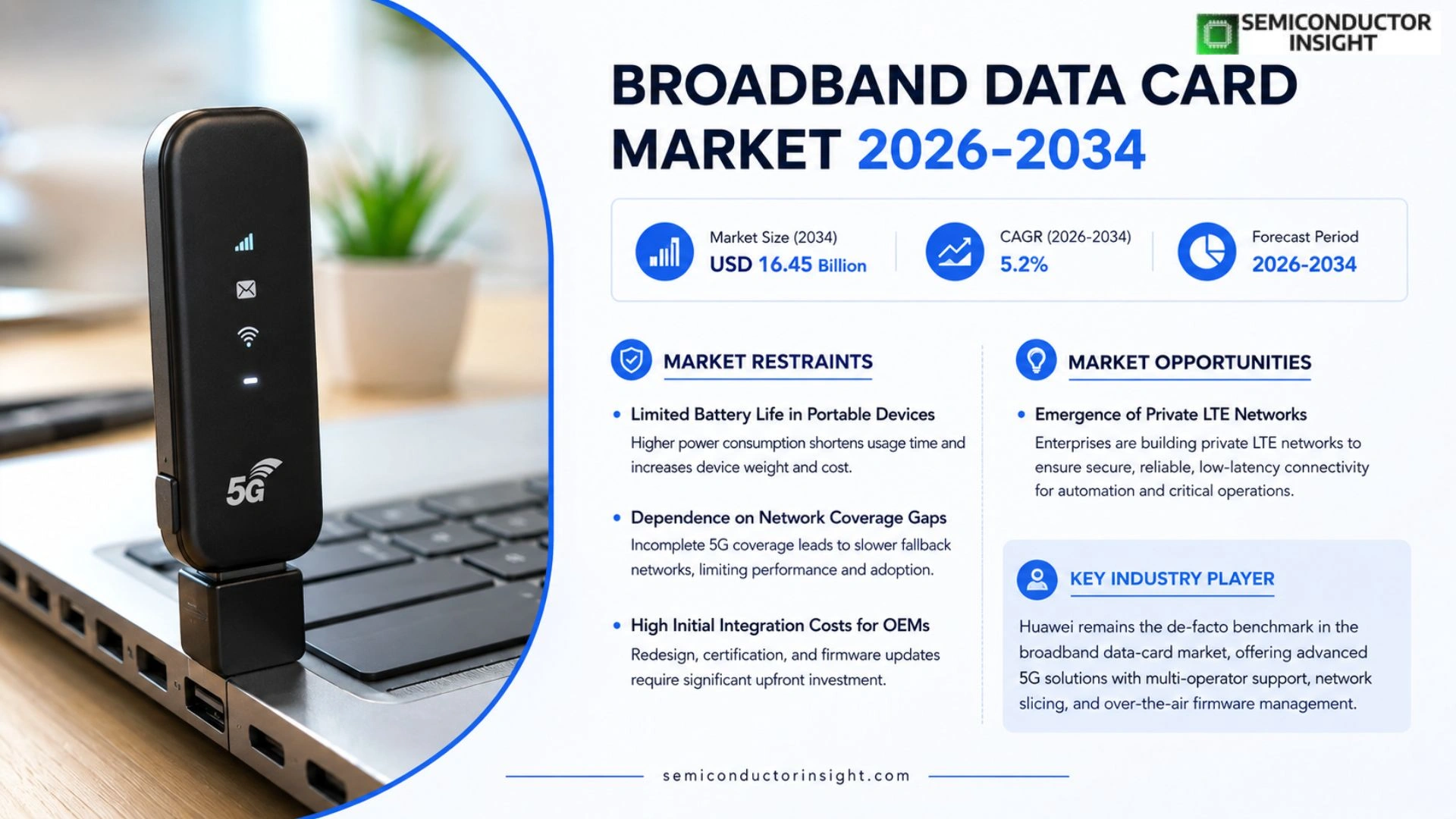
Global Broadband Data Card market size was valued at USD 10.474 billion in 2025. The market is projected to grow from USD 10.474 billion in 2025 to USD 16.45 billion by 2034, exhibiting a CAGR of approximately 5.2% during the forecast period.
A Broadband Data Card is a terminal device that provides high‑speed wireless connectivity through mobile networks, enabling wide‑area internet access for laptops, tablets or industrial handhelds that lack built‑in cellular modules; it is offered as USB dongles, MiFi hotspots, PCIe cards or embedded modules and serves as an external plug‑and‑play solution across consumer electronics and vertical industry applications.
MARKET DRIVERS
Rising Demand for Mobile Broadband Connectivity
The proliferation of remote‑work models and the acceleration of machine‑to‑machine communications have created a persistent need for reliable, on‑the‑go Internet access. Enterprises are increasingly outfitting field technicians, logistics fleets, and retail kiosks with plug‑in data solutions, a shift that directly fuels Broadband Data Card Market. Device manufacturers are responding by embedding cards that support seamless hand‑offs between cellular towers, which reduces downtime and enhances user productivity.
Advancements in LTE and 5G Chipsets
Recent silicon revisions have cut power draw by up to 30 % while delivering peak download rates exceeding 1 Gbps on 5G‑NR bands. These technical gains lower the total cost of ownership for customers and expand the functional envelope of data cards in IoT gateways and industrial PCs. Cost‑effective integration is now a realistic target for midsize vendors aiming to differentiate their product lines.
➤ “The convergence of affordable 5G modules and the push for ubiquitous connectivity positions data cards as the essential bridge between legacy equipment and next‑gen networks.”
As a consequence, original equipment manufacturers (OEMs) are realigning their roadmaps to prioritize data‑card‑enabled platforms, a move that reshapes procurement cycles and accelerates the overall market tempo.
MARKET CHALLENGES
Regulatory and Spectrum Constraints
National telecom regulators continue to revise band allocations for mobile broadband, and compliance testing timelines have lengthened in key regions such as Europe and South America. Broadband Data Card Market must absorb these policy shifts, which often translate into redesigns and delayed product launches for manufacturers seeking certification across multiple jurisdictions.
Other Challenges
Pricing Pressure
End‑users, especially in price‑sensitive segments like consumer electronics, demand sub‑$10 unit costs for fully configured cards. This pressure squeezes margins for component suppliers and forces a trade‑off between feature richness and affordability.
MARKET RESTRAINTS
Limited Battery Life in Portable Devices
High‑throughput 5G modules consume more energy than earlier LTE counterparts, shortening the operational window for battery‑powered equipment. For handheld scanners or rugged tablets, manufacturers must allocate larger battery packs, which adds weight and cost,a deterrent for adoption in field‑service scenarios.
Dependence on Network Coverage Gaps
Despite the rollout of 5G, many rural and suburban corridors remain underserved. Data cards deployed in those zones frequently fallback to slower LTE or even 3G networks, undermining the performance promises that drive purchase decisions. This coverage disparity curtails market penetration in regions where connectivity would otherwise be a strong value proposition.
High Initial Integration Costs for OEMs
Integrating a broadband data card requires redesigning antenna layouts, securing FCC/CE certifications, and updating firmware management pipelines. Small‑to‑mid‑size manufacturers often lack the capital reserves to absorb these upfront expenditures, leading them to postpone or abandon data‑card projects.
MARKET OPPORTUNITIES
Emergence of Private LTE Networks
Enterprises are establishing dedicated LTE cells within factories, campuses, and logistics hubs to guarantee deterministic performance and isolate traffic from public networks. Broadband Data Card Market participants that offer cards certified for private spectrum can tap into this niche, delivering secure, low‑latency links for automation systems and autonomous vehicles.
Integration with Edge Computing Platforms
The convergence of edge servers and cellular data cards enables processing of sensor streams at the network edge, reducing backhaul requirements. Vendors that bundle edge‑ready SDKs with their cards are positioned to capture value from verticals such as smart manufacturing and real‑time video analytics.
Geographic Expansion in Emerging Economies
Investment in 4G/5G infrastructure across Southeast Asia and Africa is accelerating, yet device penetration remains modest. Targeted marketing of low‑cost, rugged data cards can unlock sizeable demand from mobile banking, e‑learning, and tele‑health initiatives that depend on consistent broadband access.
Broadband Data Card Market Trends
Enterprise Adoption Accelerates
The shift toward remote field operations has turned Broadband Data Card Market into a strategic asset for multinational firms. Enterprises are replacing ad‑hoc Wi‑Fi connections with dedicated, plug‑and‑play cards to guarantee bandwidth continuity for diagnostics, video streaming, and telemetry. This migration is fueled by the rising cost of network downtime and by tighter data‑privacy regulations that discourage reliance on public hotspots. As a result, procurement teams are specifying multi‑operator, network‑slicing capable cards that can switch carriers without service interruption. The business implication is clear: vendors that embed robust remote‑management interfaces and support rapid firmware upgrades will capture a larger share of the enterprise spend.
Other Trends
Supply Chain Constraints
Chip shortages and the concentration of 5G reference designs in a handful of silicon providers have raised lead times for new card models. Companies that diversify their component base or maintain buffer inventories are better positioned to meet sudden spikes in demand from the industrial IoT segment. Moreover, manufacturers that offer modular firmware that can be updated to newer radio stacks extend the usable life of existing hardware, mitigating the risk of obsolescence during prolonged supply bottlenecks.
Regional Demand Divergence
North America continues to prioritize redundancy, integrating Broadband Data Cards into disaster‑recovery kits for utilities and logistics firms. In Europe, data‑sovereignty rules push firms toward cards that allow on‑premise policy control and localized SIM profiles. Asian markets, especially China, benefit from joint operator‑equipment initiatives that accelerate large‑scale deployments in transportation hubs and emergency response networks. These regional nuances shape product roadmaps: carriers demand tighter security modules for European deployments, while North American buyers focus on dual‑band coverage for underground and rural sites.
COMPETITIVE LANDSCAPE
Key Industry Players
Broadband Data Card Market Competitive Overview
Huawei remains the de‑facto benchmark in the broadband data‑card arena. Its early adoption of 5G reference designs, backed by an extensive silicon portfolio, allows it to supply turnkey solutions to OEMs that require multi‑operator support, network slicing and over‑the‑air firmware management. The company’s deep ties with Asian carriers and a growing enterprise client base give it leverage to negotiate volume pricing and secure long‑term contracts for field‑service devices, smart‑city sensors and mobile medical units. Across the globe, the market still reflects a two‑tier structure: a handful of multinational conglomerates capture roughly 60 % of revenue, while regional specialists and niche innovators compete for the remaining share by offering ruggedized form factors, customized security modules, or cost‑effective USB dongles for low‑margin deployments.
Beyond the dominant tier, a diverse set of players adds depth to the competitive landscape. ZTE and Nokia exploit their carrier‑grade networking heritage to push high‑throughput modules into transportation hubs and industrial gateways. Samsung leverages its semiconductor strength to embed advanced RF front‑ends in compact MiFi devices aimed at consumer‑enterprise convergence. Sierra Wireless, Teltonika Networks and Digi International differentiate through robust device‑management platforms that appeal to logistics operators needing remote diagnostics. Cradlepoint and Netgear focus on integrated edge‑router solutions where the data card acts as a fail‑over link. Inseego, Motorola Solutions and Thales target sectors where hardened security and regulatory compliance are paramount, such as defense communications and financial‑service point‑of‑sale terminals. Smaller firms like Semtech, D‑Link and TCL concentrate on niche form factors,PCIe cards or embedded modules,allowing system integrators to embed connectivity directly into bespoke equipment.
List of Key Broadband Data Card Companies Profiled
- Huawei Technologies
- ZTE Corporation
- Nokia
- Samsung Electronics
- Sierra Wireless
- Teltonika Networks
- Digi International
- Cradlepoint
- Netgear
- Inseego
- Motorola Solutions
- Thales
- Semtech
- D‑Link
- TCL Communication Technology
Segment Analysis:
| Segment Category | Sub-Segments | Key Insights |
| By Type |
|
USB Dongle is widely favored for its plug‑and‑play simplicity, enabling rapid deployment in field operations.
|
| By Application |
|
Energy Sector drives adoption where ruggedness and continuous uptime are critical.
|
| By End User |
|
Enterprises prioritize redundancy and centralized management.
|
| By Security Level |
|
Hardware Encryption Data Card is increasingly chosen for regulated environments.
|
| By Cellular Generation |
|
5G Data Card represents the enterprise‑grade evolution.
|
Regional Analysis: Broadband Data Card Market
North America
Large manufacturers are embedding broadband data cards into production‑line robots to guarantee uninterrupted data flow. The move reduces reliance on legacy wired links, thereby accelerating line reconfiguration and lowering downtime during maintenance windows.
The Federal Communications Commission’s recent spectrum reallocation has opened new bands for IoT devices, prompting OEMs to redesign card form factors. Compliance testing now includes stricter emissions thresholds, influencing supplier selection.
Integration of eSIM capabilities is reshaping the deployment model. Operators can provision connectivity remotely, eliminating physical SIM swaps and enabling rapid scaling across distributed assets.
Players that bundle advanced telemetry analytics with their hardware are distinguishing themselves. This value‑added approach appeals to corporations seeking actionable insights rather than raw data streams.
Europe
European markets display a nuanced balance between regulatory caution and progressive adoption. The European Union’s emphasis on data sovereignty drives manufacturers to favor locally hosted connectivity platforms. At the same time, sectors such as renewable energy and smart transportation are piloting broadband data cards to meet real‑time monitoring requirements. Suppliers that can certify compliance with the Radio Equipment Directive while offering multi‑band flexibility find a receptive audience. Moreover, collaborative standards initiatives among telecom operators are fostering interoperable solutions, reducing integration friction for cross‑border deployments.
Asia‑Pacific
In Asia‑Pacific, Broadband Data Card narrative is shaped by a juxtaposition of rapid urbanization and expansive rural outreach programs. Nations like India and Indonesia leverage these cards to extend broadband to remote villages, integrating them into solar‑powered kiosks and agricultural sensors. The region’s manufacturers benefit from a cost‑sensitive supply chain, enabling competitive pricing without sacrificing performance. Nonetheless, fragmented regulatory environments require vendors to navigate country‑specific approval processes, prompting a rise in modular designs that can be adapted to distinct spectrum allocations.
South America
South American economies are channeling broadband data cards into logistics and public safety applications. The continent’s challenging geography,dense jungles, mountainous terrain,makes wired connectivity impractical in many locales. Consequently, emergency services adopt cellular‑backed data cards for real‑time situational awareness during disaster response. Market participants that provide ruggedized enclosures and extended temperature tolerances gain trust among governmental procurement bodies, which prioritize durability over marginal performance gains.
Middle East & Africa
The Middle East & Africa region reflects a growing appetite for mobile connectivity in sectors ranging from oil‑and‑gas to mobile health. In oil fields, broadband data cards enable continuous feed of downhole sensor data, supporting predictive maintenance and safety compliance. African telecom operators are expanding 5G footprints, and early adopters are testing data cards to power remote education hubs and telemedicine stations. Companies that can align product lifecycles with the swift rollout of new carrier bands while offering localized support structures are securing footholds in this emerging market segment.
Report Scope
This market research report provides a comprehensive analysis of the Broadband Data Card Market , covering the forecast period 2026–2034. It offers detailed insights into market dynamics, technological advancements, competitive landscape, and key trends shaping the industry.
Key focus areas of the report include:
- Market Overview: The report begins with an overview outlining its current market scenario, key growth indicators, and industry transformation drivers. It discusses macroeconomic factors, demand–supply balance, regulatory landscape, and the strategic role of semiconductors in powering advancements across industries such as automotive, telecommunications, consumer electronics, and industrial automation.
- Market Size & Forecast: Historical data and future projections for revenue, unit shipments, and market value across major regions and segments.
- Segmentation Analysis: Detailed breakdown by product type, technology, application, and end-user industry to identify high-growth segments and investment opportunities.
- Regional Insights: Insights into market performance across North America, Europe, Asia-Pacific, Latin America, and the Middle East & Africa, including country-level analysis where relevant.
- Competitive Landscape: Profiles of leading market participants, including their product offerings, R&D focus, manufacturing capacity, pricing strategies, and recent developments such as mergers, acquisitions, and partnerships.
- Technology Trends & Innovation: Assessment of emerging technologies, integration of AI/IoT, semiconductor design trends, fabrication techniques, and evolving industry standards.
- Market Drivers & Restraints: Evaluation of factors driving market growth along with challenges, supply chain constraints, regulatory issues, and market-entry barriers.
- Stakeholder Insights: Insights for component suppliers, OEMs, system integrators, investors, and policymakers regarding the evolving ecosystem and strategic opportunities.
Primary and secondary research methods are employed, including interviews with industry experts, data from verified sources, and real-time market intelligence to ensure the accuracy and reliability of the insights presented.
FREQUENTLY ASKED QUESTIONS:
What is the current market size of Broadband Data Card Market?
-> Broadband Data Card Market was valued at USD 10,474 million in 2025 and is expected to reach USD 14,843 million by 2032, growing at a CAGR of 5.3% during the forecast period.
Which key companies operate in Broadband Data Card Market?
-> Key players include Teltonika Networks, Nokia, Samsung Electronics, Netgear, Cradlepoint, Digi International, Peplink, Semtech, Thales, Sierra Wireless, Inseego, Motorola Mobility, TCL Communication Technology, Huawei Technologies, ZTE, D-Link, among others.
What are the key growth drivers?
-> Key growth drivers include increased remote‑work adoption, accelerated industrial IoT deployments, spectrum refarming that improves indoor coverage, and widespread availability of 5G data‑card reference designs.
Which region dominates the market?
-> North America leads the market thanks to strong demand for redundancy solutions and enterprise‑grade broadband connectivity, while Europe and Asia also show significant growth.
What are the emerging trends?
-> Emerging trends include integration of Broadband Data Cards with IoT platforms, hardware‑encryption security features, and multi‑operator / network‑slicing capabilities for enterprise applications.

Get Sample Report PDF for Exclusive Insights
Report Sample Includes
- Table of Contents
- List of Tables & Figures
- Charts, Research Methodology, and more...
 Download Sample Report PDF