Market Insights
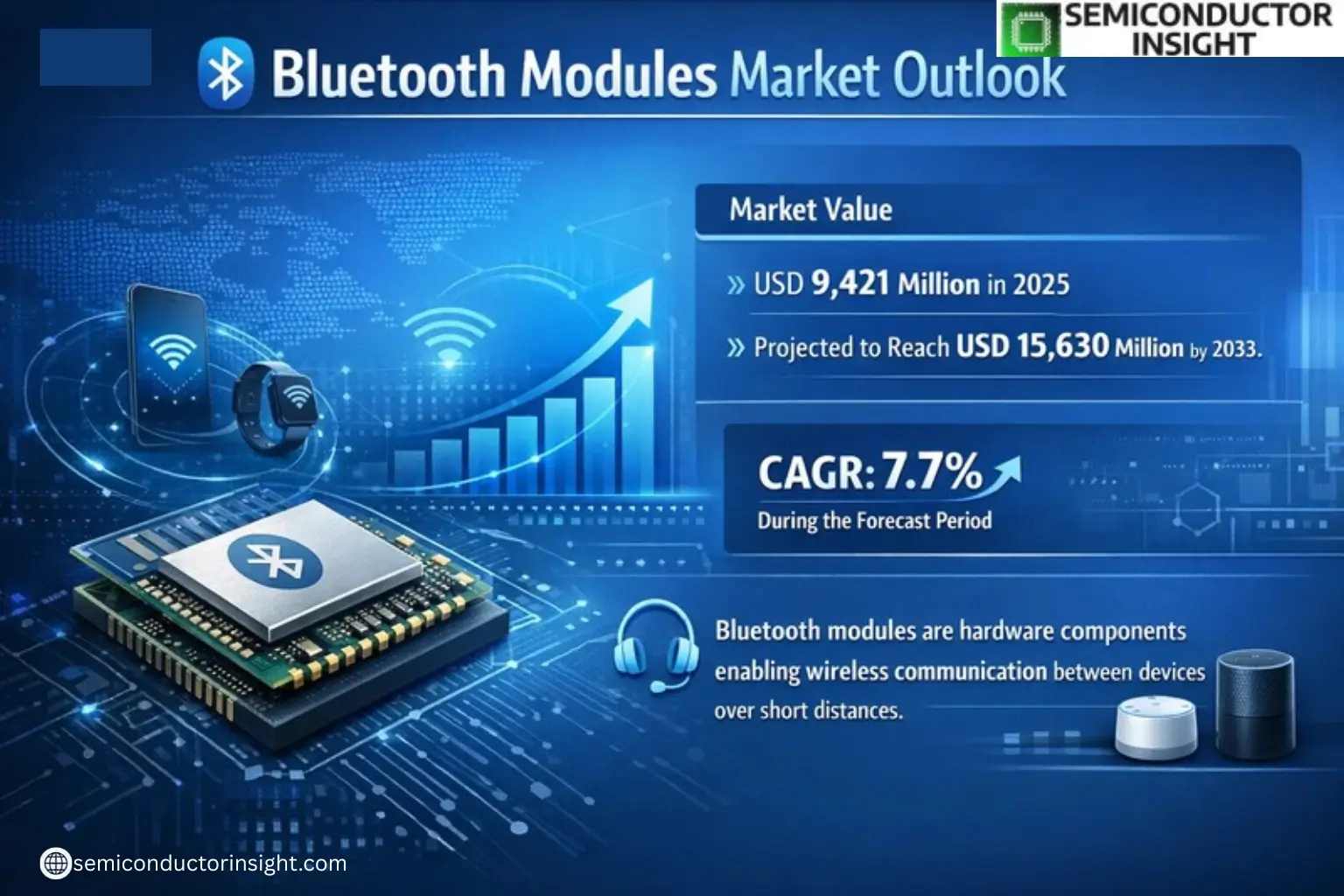
Global Bluetooth Modules Market was valued at USD 9,421 million in 2025 and is projected to reach USD 15,630 million by 2033, exhibiting a CAGR of 7.7% during the forecast period.
Bluetooth modules are hardware components that enable wireless communication between devices over short distances. These compact, low-power solutions integrate Bluetooth technology into products such as smartphones, wearables, IoT devices, and industrial equipment. The modules support various Bluetooth versions (Classic, Low Energy, and Dual-mode) to cater to diverse connectivity needs.
The market growth is driven by increasing adoption of IoT devices, rising demand for wireless audio solutions like TWS earbuds, and advancements in smart home automation. Asia (excluding China) dominates the market with a 45% share due to strong electronics manufacturing ecosystems. Classic Bluetooth modules hold over 55% market share owing to their widespread use in audio applications. Key players such as Murata, Qualcomm, Intel, and Broadcom collectively account for more than 65% of global revenues through innovative product development and strategic partnerships.
MARKET DRIVERS
Rising Demand for IoT-Enabled Devices
Bluetooth Modules Market is experiencing significant growth due to the rapid adoption of IoT devices across industries. Smart home automation, wearable technology, and industrial IoT applications are driving demand for reliable wireless connectivity solutions. Bluetooth modules offer low-power consumption and seamless integration, making them ideal for connected ecosystems.
Advancements in Bluetooth Technology
Recent developments in Bluetooth 5.2 and 5.3 standards have enhanced data transfer speeds, range, and mesh networking capabilities. These improvements are critical for applications requiring stable connectivity in smart cities and enterprise solutions. The market is projected to grow at a CAGR of 9.2% through 2027, supported by these technological upgrades.
The automotive sector is also contributing to growth, with Bluetooth modules becoming standard in infotainment systems and vehicle telematics.
MARKET CHALLENGES
Interoperability and Standardization Issues
Despite advancements, compatibility challenges persist between different Bluetooth versions and vendor-specific implementations. This creates integration hurdles for developers working with mixed-device environments, particularly in industrial settings.
Other Challenges
Security Vulnerabilities
Bluetooth modules face ongoing cybersecurity risks, including eavesdropping and man-in-the-middle attacks. Manufacturers must invest in enhanced encryption and authentication protocols to maintain consumer trust.
MARKET RESTRAINTS
Competition from Alternative Technologies
Bluetooth Modules Market faces pressure from emerging wireless protocols like UWB and Thread, which offer specialized advantages in certain applications. While Bluetooth dominates consumer electronics, these alternatives are gaining traction in precision location and ultra-low-power use cases.
MARKET OPPORTUNITIES
Expansion in Healthcare Applications
Medical device manufacturers are increasingly incorporating Bluetooth modules into remote patient monitoring systems. Global healthcare Bluetooth module segment is expected to reach USD 1.8 billion by 2026, driven by telehealth adoption and chronic disease management needs.
Smart City Infrastructure Development
Municipalities worldwide are deploying Bluetooth-enabled sensors for traffic management, environmental monitoring, and public safety systems. This presents significant growth potential for industrial-grade Bluetooth modules with extended range capabilities.
Bluetooth Modules Market Trends
Strong Growth Projected for Bluetooth Modules Market
Global Bluetooth Modules Market was valued at USD 9.42 billion in 2025 and is projected to reach USD 15.63 billion by 2033, growing at a CAGR of 7.7%. This growth is driven by increasing adoption across mobile phones, connected home devices, and industrial IoT applications. Classic Bluetooth Modules currently dominate with over 55% market share, while Bluetooth Low Energy (BLE) solutions are gaining traction in power-sensitive applications.
Other Trends
Regional Market Dynamics
Asia (excluding China) holds the largest market share at 45%, followed by China and North America at 40% combined. The region benefits from strong electronics manufacturing ecosystems and growing IoT adoption. Europe shows steady growth with Germany, France, and the UK leading in industrial automation applications of Bluetooth modules.
Key Technology Shift Towards Dual-Mode Modules
Industry leaders including Murata, Qualcomm, and Intel are focusing on dual-mode Bluetooth solutions that combine Classic and BLE functionality. These modules now represent 30% of new product developments as they offer backward compatibility while supporting modern low-power requirements. The mobile phone segment remains the largest application area, accounting for 38% of global module sales.
Competitive Landscape Consolidation
The top four Bluetooth module manufacturers hold 65% market share, with Murata leading in both Classic and BLE segments. Recent industry movements include acquisitions focused on improving wireless range and power efficiency, with particular emphasis on automotive and industrial IoT applications where reliability is critical.
Emerging Applications Driving Future Demand
Connected home devices and smart building applications are projected to be the fastest-growing segments, with annual growth rates exceeding 12%. The market is also seeing increased demand for modules supporting Bluetooth 5.2 and 5.3 specifications, particularly for audio applications and location services where enhanced data throughput and ranging capabilities are required.
COMPETITIVE LANDSCAPE
Key Industry Players
Murata and Qualcomm Lead in Bluetooth Modules Market Dominance
Bluetooth Modules Market is highly concentrated, with the top four manufacturers holding over 65% market share. Murata and Qualcomm emerge as clear leaders, leveraging their advanced semiconductor technologies and extensive patent portfolios. Intel and Broadcom follow closely, benefiting from their established presence in wireless communication chipsets. These industry giants dominate through vertical integration, offering end-to-end solutions from silicon to protocol stacks.
Several niche players specialize in application-specific Bluetooth modules. STMicroelectronics and Cypress Semiconductor focus on IoT applications with their low-power solutions, while Taiyo Yuden and Laird cater to automotive and industrial segments respectively. Regional players like Hosiden in Japan and Panasonic in Asia maintain strong footholds in local markets through customized offerings and supply chain advantages.
List of Key Bluetooth Modules Companies Profiled
- Murata
- Qualcomm
- Intel
- Broadcom
- Panasonic
- Texas Instruments
- Fujitsu
- Hosiden
- STMicroelectronics
- Laird
- Taiyo Yuden
- Cypress Semiconductor
- Microchip Technology
- Silicon Labs
Segment Analysis:
| Segment Category | Sub-Segments | Key Insights |
| By Type |
|
Classic Bluetooth Modules dominate due to:
|
| By Application |
|
Mobile Phones lead application segment because:
|
| By End User |
|
Consumer Electronics remains dominant due to:
|
| By Power Range |
|
Short Range modules lead the market because:
|
| By Connectivity Protocol |
|
Bluetooth 5.0 shows strongest adoption due to:
|
Regional Analysis: Bluetooth Modules Market
Asia-Pacific
The region hosts concentrated electronics manufacturing clusters that enable efficient Bluetooth module production at scale. Local component suppliers and testing facilities reduce lead times for OEMs requiring customized module solutions.
Rapid adoption of Bluetooth 5.x standards in consumer electronics drives refresh cycles. Smart city initiatives across major APAC metros are integrating Bluetooth mesh networks for asset tracking and building automation solutions.
Special economic zones in Shenzhen and Hyderabad focus on IoT product development using advanced Bluetooth modules. Research centers collaborate with module manufacturers to optimize power efficiency for battery-operated devices.
Localization of semiconductor packaging and testing reduces Bluetooth module costs. Government incentives for indigenous manufacturing help maintain price competitiveness in global markets.
North America
North America shows strong demand for high-performance Bluetooth modules in automotive and healthcare applications. The presence of leading technology firms drives adoption of dual-mode modules combining BLE and classic Bluetooth. Stringent certification requirements ensure module reliability for medical and industrial use cases. The region leads in developing Bluetooth mesh networking solutions for commercial lighting systems. Major tech companies collaborate with module manufacturers to integrate AI capabilities for context-aware connectivity solutions.
Europe
European demand focuses on energy-efficient Bluetooth modules meeting strict environmental regulations. Automotive OEMs drive requirements for certified modules supporting CarPlay and Android Auto integrations. Industrial IoT deployments utilize long-range Bluetooth variants for asset monitoring. The region shows growing adoption of module-plus-services models where suppliers bundle connectivity management software. Nordic countries lead in developing ultra-low-power modules for wearable health monitors.
South America
Market growth concentrates in Brazil and Argentina where local manufacturing supports automotive and consumer electronics sectors. Bluetooth modules find increasing use in retail beacons and payment terminals. Economic challenges encourage adoption of cost-optimized module designs with essential features. Government initiatives promoting smart city projects create opportunities for Bluetooth-based infrastructure monitoring solutions.
Middle East & Africa
The region shows emerging demand for Bluetooth modules in smart building and hospitality applications. Tourism hubs deploy Bluetooth wayfinding solutions in airports and megamalls. Limited local manufacturing results in reliance on imported modules with local value-added services. Infrastructure development projects incorporate Bluetooth mesh networks for facility management in commercial complexes.
Report Scope
This market research report provides a comprehensive analysis of the Bluetooth Modules Market, covering the forecast period 2025–2033. It offers detailed insights into market dynamics, technological advancements, competitive landscape, and key trends shaping the industry.
Key focus areas of the report include:
- Market Overview: The report begins with an overview outlining its current market scenario, key growth indicators, and industry transformation drivers. It discusses macroeconomic factors, demand–supply balance, regulatory landscape, and the strategic role of wireless communications in powering advancements across industries such as consumer electronics, automotive, telecommunications, and industrial automation.
- Market Size & Forecast: Historical data and future projections for revenue, unit shipments, and market value across major regions and segments.
- Segmentation Analysis: Detailed breakdown by product type, technology, application, and end-user industry to identify high-growth segments and investment opportunities.
- Regional Insights: Insights into market performance across North America, Europe, Asia-Pacific, Latin America, and the Middle East & Africa, including country-level analysis where relevant.
- Competitive Landscape: Profiles of leading market participants, including their product offerings, R&D focus, manufacturing capacity, pricing strategies, and recent developments such as mergers, acquisitions, and partnerships.
- Technology Trends & Innovation: Assessment of emerging technologies, integration of AI/IoT, wireless communication trends, fabrication techniques, and evolving industry standards.
- Market Drivers & Restraints: Evaluation of factors driving market growth along with challenges, supply chain constraints, regulatory issues, and market-entry barriers.
- Stakeholder Insights: Insights for component suppliers, OEMs, system integrators, investors, and policymakers regarding the evolving ecosystem and strategic opportunities.
Primary and secondary research methods are employed, including interviews with industry experts, data from verified sources, and real-time market intelligence to ensure the accuracy and reliability of the insights presented.
FREQUENTLY ASKED QUESTIONS:
What is the current market size of Bluetooth Modules Market?
-> Bluetooth Modules Market was valued at USD 9,421 million in 2025 and is projected to reach USD 15,630 million by 2033, exhibiting a CAGR of 7.7% during the forecast period.
What is the growth rate of the Bluetooth Modules Market?
-> The market is expected to grow at a CAGR of 7.7% during the forecast period (2025-2033).
Which key companies operate in Bluetooth Modules Market?
-> Key players include Murata, Qualcomm, Intel, Broadcom, Panasonic, Texas Instruments, Fujitsu, and STMicroelectronics, among others.
What are the major product segments in Bluetooth Modules Market?
-> The market is segmented into Classic Bluetooth Modules (55% share), Bluetooth Low Energy (BLE) Modules, and Dual-mode Bluetooth Modules.
Which region dominates the Bluetooth Modules Market?
-> Asia (excluding China) is the largest market with about 45% share, followed by China and North America.
What are the key applications of Bluetooth Modules?
-> Major applications include Mobile Phones, Connected Home, Computers, and others, with Mobile Phones being the largest segment.
Get Sample Report PDF for Exclusive Insights
Report Sample Includes
- Table of Contents
- List of Tables & Figures
- Charts, Research Methodology, and more...
 Download Sample Report PDF