MARKET INSIGHTS
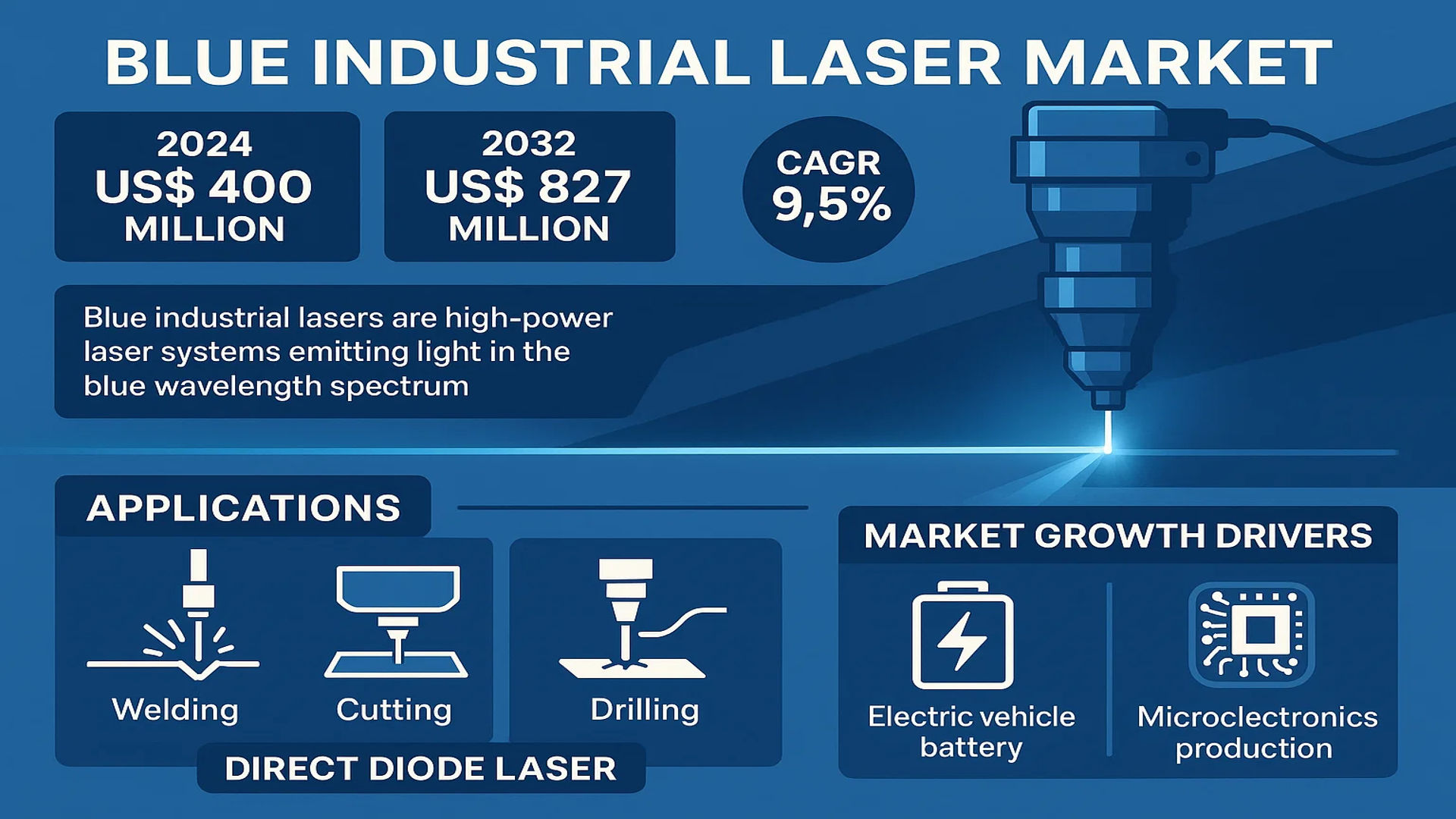
The global Blue Industrial Laser Market size was valued at US$ 400 million in 2024 and is projected to reach US$ 827 million by 2032, at a CAGR of 9.5% during the forecast period 2025-2032.
Blue industrial lasers are high-power laser systems emitting light in the blue wavelength spectrum (typically around 450 nm), which are increasingly used for precision material processing applications. These lasers offer superior absorption in metals like copper and gold compared to traditional infrared lasers, making them ideal for welding, cutting, and drilling in industries such as automotive, aerospace, and electronics manufacturing. Key product types include direct diode lasers and fiber-coupled lasers with power outputs ranging from below 1000W to above 1000W.
The market growth is primarily driven by rising demand from electric vehicle battery manufacturing and microelectronics production, where blue lasers enable higher precision processing of heat-sensitive materials. However, challenges remain in scaling production capacities and reducing system costs. Recent developments include Nuburu’s launch of a 1kW blue laser system for battery welding in 2023 and Shimadzu’s partnership with automotive suppliers to integrate blue laser technology into production lines. Other key players like Laserline and DILAS are expanding their product portfolios to capitalize on emerging applications in consumer electronics manufacturing.
MARKET DYNAMICS
MARKET DRIVERS
Expanding Applications in Electric Vehicle Battery Manufacturing to Propel Demand
The rapid growth of the electric vehicle (EV) industry is significantly driving demand for blue industrial lasers. These lasers play a critical role in battery manufacturing processes such as welding dissimilar metals in battery packs, cutting electrodes, and structuring battery foils. As global EV production is projected to grow at a CAGR exceeding 15% over the next decade, manufacturers are increasingly adopting blue lasers due to their superior absorption in copper and aluminum compared to traditional infrared lasers. This technological advantage enables faster processing speeds and higher precision in battery production lines.
Technological Advancements in Precision Materials Processing
Recent technological breakthroughs in blue laser diode technology have expanded their industrial applications. With wavelengths around 450nm, blue lasers offer significantly better absorption in reflective materials like gold, copper, and aluminum compared to infrared alternatives. This has driven adoption in microelectronics manufacturing where component miniaturization requires extremely precise processing. The ability to achieve feature sizes below 10 microns while maintaining high power density makes blue lasers indispensable for cutting-edge semiconductor packaging and microelectronics assembly applications.
Furthermore, the integration of intelligent control systems and automated beam shaping capabilities enhances process reproducibility. Major manufacturers have introduced blue laser systems with real-time monitoring and adaptive power control, reducing defect rates in precision welding applications by up to 40% compared to conventional systems.
MARKET RESTRAINTS
High Initial Investment Costs Limit SME Adoption
The capital expenditure required for industrial blue laser systems presents a significant barrier to market expansion. While prices have decreased approximately 12% annually since 2020, complete industrial laser systems still require investments ranging from $200,000 to over $1 million depending on power and configuration. This high entry cost discourages small and medium enterprises from adopting the technology, particularly in price-sensitive emerging markets where financial constraints are more pronounced.
Additionally, the total cost of ownership extends beyond the initial purchase, including maintenance contracts, specialized operator training, and periodic component replacements. The complex optoelectronic components in blue laser systems require climate-controlled environments and regular calibration by certified technicians, further increasing operational expenditures.
Limited Power Output Compared to Alternative Laser Technologies
While blue lasers excel in precision applications, their current power limitations restrict adoption in heavy industrial processes requiring high throughput. Maximum commercially available blue laser power currently reaches approximately 6kW, significantly lower than the 20-30kW fiber lasers commonly used in thick metal cutting applications. This power gap forces manufacturers to maintain parallel laser systems for different applications, increasing complexity and overhead costs.
MARKET CHALLENGES
Thermal Management and Reliability Concerns
Blue laser diodes face inherent challenges in thermal management due to their lower wall-plug efficiency compared to infrared lasers. The quantum wells in blue laser diodes generate significant heat at high power levels, leading to spectral shifting and decreased beam quality. Industry data indicates that thermal-related issues account for approximately 35% of field failures in high-power blue laser systems, necessitating complex cooling solutions that increase system complexity and maintenance requirements.
Other Challenges
Material Compatibility Issues
While blue lasers perform exceptionally well with copper and gold, their interaction with certain polymers and composite materials can cause unwanted chemical changes at the processing site. Manufacturers must carefully evaluate material responses before implementing blue laser systems, potentially limiting application scope.
Supply Chain Vulnerabilities
The specialized gallium nitride (GaN) substrates required for blue laser production face periodic shortages due to concentrated supplier bases and complex manufacturing processes. These supply chain constraints can lead to extended lead times and price volatility in the blue laser market.
MARKET OPPORTUNITIES
Emerging Applications in 3D Printing and Additive Manufacturing
The expanding adoption of metal additive manufacturing presents significant growth opportunities for blue laser technology. Recent developments in blue laser powder bed fusion systems demonstrate improved surface finish and reduced porosity in printed copper components compared to infrared systems. With the global metal 3D printing market projected to exceed $8 billion by 2028, specialized blue laser systems optimized for additive manufacturing could capture a substantial share of this growing segment.
Integration With Industry 4.0 and Smart Manufacturing
The ongoing digital transformation in manufacturing creates opportunities for intelligent blue laser systems with enhanced connectivity and analytics capabilities. By incorporating IoT sensors and machine learning algorithms, next-generation blue lasers can achieve predictive maintenance, adaptive process control, and seamless integration with robotic work cells. These smart manufacturing capabilities are particularly valuable in automotive and aerospace applications where traceability and process consistency are critical.
Furthermore, the development of compact blue laser modules compatible with collaborative robots opens new possibilities for flexible manufacturing cells. These solutions enable automated material processing in space-constrained environments while maintaining the precision advantages of blue laser technology.
BLUE INDUSTRIAL LASER MARKET TRENDS
High-Precision Manufacturing to Drive Adoption of Blue Industrial Lasers
The increasing demand for high-precision manufacturing across industries such as automotive, aerospace, and electronics is significantly accelerating the adoption of blue industrial lasers. With wavelengths around 450nm, these lasers offer superior absorption in copper and gold compared to traditional infrared lasers, making them ideal for welding, cutting, and drilling applications where precision is critical. Recent advancements in diode-pumped solid-state (DPSS) laser technology have further improved beam quality and power stability, enabling manufacturers to achieve micron-level accuracy in material processing. The market for blue industrial lasers is projected to grow at a compound annual growth rate (CAGR) of over 12% between 2024 and 2032, driven by their expanding use in EV battery production and microelectronics fabrication.
Other Trends
Battery Manufacturing and Electric Vehicle Expansion
The rapid growth of the electric vehicle (EV) industry has created substantial demand for blue industrial lasers, particularly in battery cell welding and tab cutting applications. Copper welding, a critical process in lithium-ion battery production, benefits tremendously from blue lasers’ superior energy absorption characteristics. Major automotive manufacturers are investing heavily in laser-based production lines to meet the increasing volume requirements for EV batteries. Asia-Pacific currently dominates this application segment, accounting for over 60% of global blue laser deployments in battery manufacturing.
Technological Advancements in Laser Sources
Recent breakthroughs in gallium nitride (GaN) semiconductor technology are enabling the development of more powerful and energy-efficient blue laser sources. Manufacturers are now producing industrial-grade blue lasers with outputs exceeding 2kW, significantly expanding their applicability in heavy industrial processes. Furthermore, the integration of smart monitoring systems and AI-driven process control is enhancing the reliability and repeatability of blue laser operations. These technological innovations are making blue lasers increasingly competitive against traditional fiber and CO2 lasers, particularly in applications involving highly reflective materials.
COMPETITIVE LANDSCAPE
Key Industry Players
Laser Manufacturers Expand Technological Capabilities to Secure Market Position
The global Blue Industrial Laser market is characterized by a mix of established corporations and emerging players, creating a dynamic competitive environment. Nuburu has emerged as a frontrunner, leveraging its patented blue laser technology to capture nearly 18% of the market share in 2024. The company’s dominance stems from its optimized laser systems for welding copper and other reflective metals, which are increasingly used in electric vehicle battery production.
Laserline GmbH and Shimadzu Corporation ranked among the top five manufacturers last year, collectively accounting for 22% of global revenues. These players are gaining traction through continuous R&D investments, particularly in high-power (>1000W) laser systems that offer superior precision for aerospace and automotive applications. Their growth is further propelled by strategic collaborations with material science firms to develop customized solutions.
While traditional players maintain strong positions, Chinese manufacturers like Wuhan Raycus Fiber Laser Technologies are rapidly expanding their footprint. With government support for domestic production, these firms now control approximately 15% of the Asia-Pacific market. Their competitive pricing strategies and rapid prototyping capabilities make them formidable challengers in price-sensitive segments.
Meanwhile, BWT Group and Changchun New Industries Optoelectronics are adopting hybrid growth approaches. Beyond product innovation, these companies are acquiring regional distributors to strengthen after-sales service networks, recognizing that technical support often drives customer loyalty in industrial laser applications.
List of Key Blue Industrial Laser Companies Profiled
- Nuburu Inc. (U.S.)
- DILAS Diodenlaser GmbH (Germany)
- Shimadzu Corporation (Japan)
- Laserline GmbH (Germany)
- Shenzhen United Winners Laser Co., Ltd. (China)
- Wuhan Raycus Fiber Laser Technologies Co., Ltd. (China)
- BWT Group (Germany)
- Changchun New Industries Optoelectronics Tech. Co., Ltd. (China)
Segment Analysis:
By Type
High-Power Segment (>1000W) Gains Traction Due to Industrial Precision Cutting and Welding Applications
The market is segmented based on power capacity into:
- ≤1000W
- Subtypes: 500W, 800W, and others
- >1000W
- Subtypes: 1500W, 2000W, and others
By Application
Automotive Segment Dominates Owing to High Adoption in Vehicle Manufacturing Processes
The market is segmented based on application into:
- Automotive
- Sub-applications: Welding, Cutting, and marking
- Battery
- Aerospace
- Electronics
- Others
By Technology
Fiber Laser Technology Leads the Market Due to Superior Efficiency and Lower Maintenance
The market is segmented based on technology into:
- Fiber lasers
- Diode lasers
- Solid-state lasers
By End-User
Manufacturing Sector Holds Largest Share Due to Widespread Industrial Applications
The market is segmented based on end-user into:
- Manufacturing
- Electronics
- Automotive
- Aerospace & Defense
- Energy
Regional Analysis: Blue Industrial Laser Market
Asia-Pacific
The Asia-Pacific region dominates the global blue industrial laser market, driven by rapid industrialization and technological advancements in China, Japan, and South Korea. China alone accounts for over 40% of global demand, with key manufacturers like Wuhan Raycus Fiber Laser Technologies and Shenzhen United Winners Laser leading production. The region benefits from strong government support for advanced manufacturing and the presence of major automotive and electronics industries requiring high-precision laser applications. South Korea’s semiconductor sector and Japan’s robotics industry further contribute to blue laser adoption, particularly in microfabrication and battery welding applications. However, price competition among domestic manufacturers presents challenges for premium technology adoption.
North America
North America represents the second-largest market for blue industrial lasers, with the U.S. accounting for approximately 75% of regional revenue. The market thrives on aerospace and defense applications, where blue lasers’ superior copper welding capabilities are critical. Companies like Nuburu have pioneered high-power blue laser systems for electric vehicle battery manufacturing. Strict workplace safety regulations and the presence of advanced R&D facilities accelerate technology penetration, though higher costs compared to infrared lasers limit adoption among small manufacturers. Recent Department of Energy initiatives supporting clean energy manufacturing are expected to drive further demand in battery production sectors.
Europe
European demand focuses on high-precision industrial applications with German automotive manufacturers and Swiss watchmakers adopting blue lasers for intricate metal processing. The region shows particular strength in the >1000W segment for heavy industrial welding, with Laserline GmbH emerging as a key technology provider. EU regulations on energy-efficient manufacturing processes favor blue laser adoption over traditional methods. However, market growth faces constraints from high conversion costs for existing production lines and competition from established fiber laser technologies in material processing applications.
Middle East & Africa
This emerging market shows promising growth potential, particularly in GCC countries investing in industrial diversification beyond oil. The UAE and Saudi Arabia are establishing technology hubs that incorporate advanced laser systems for metal fabrication and additive manufacturing. While current market penetration remains low compared to global standards, strategic partnerships with European and Asian laser manufacturers are helping bridge the technology gap. Infrastructure limitations and skilled labor shortages currently prevent wider adoption across the region.
South America
Brazil and Argentina lead South America’s niche market, primarily serving automotive and medical device manufacturing sectors. Economic volatility and foreign exchange challenges make capital-intensive laser investments difficult, though localized production efforts are gaining traction. The market shows preference for lower-power (<1000W) blue laser systems suited for small-scale precision applications. Growing interest in renewable energy technologies may create future opportunities in solar panel and battery manufacturing applications.
Report Scope
This market research report provides a comprehensive analysis of the Global Blue Industrial Laser Market, covering the forecast period 2024–2032. It offers detailed insights into market dynamics, technological advancements, competitive landscape, and key trends shaping the industry.
Key focus areas of the report include:
- Market Size & Forecast: Historical data and future projections for revenue, unit shipments, and market value across major regions and segments.
- Segmentation Analysis: Detailed breakdown by power output (≤1000W and >1000W), application (Automobile, Battery, Aerospace, and Others), and end-user industry to identify high-growth segments.
- Regional Outlook: Insights into market performance across North America, Europe, Asia-Pacific, Latin America, and the Middle East & Africa, including country-level analysis.
- Competitive Landscape: Profiles of leading market participants, including their product portfolios, R&D investments, and strategic initiatives such as mergers, acquisitions, and partnerships.
- Technology Trends & Innovation: Assessment of advancements in blue laser technology, integration with automation, and emerging applications in precision manufacturing.
- Market Drivers & Restraints: Evaluation of factors such as demand for high-precision laser processing, adoption in EV battery manufacturing, and challenges like high initial costs and regulatory constraints.
- Stakeholder Analysis: Strategic insights for laser manufacturers, industrial end-users, investors, and policymakers regarding market opportunities and risks.
Primary and secondary research methods are employed, including interviews with industry experts, validated market data, and real-time intelligence to ensure accuracy and reliability.
FREQUENTLY ASKED QUESTIONS:
What is the current market size of the Global Blue Industrial Laser Market?
-> Blue Industrial Laser Market size was valued at US$ 400 million in 2024 and is projected to reach US$ 827 million by 2032, at a CAGR of 9.5% during the forecast period 2025-2032.
Which key companies operate in the Global Blue Industrial Laser Market?
-> Key players include Nuburu, DILAS, Shimadzu Corporation, Laserline, Shenzhen United Winners Laser, Wuhan Raycus Fiber Laser Technologies, BWT, and Changchun New Industries Optoelectronics Tech.
What are the key growth drivers?
-> Growth is driven by increasing demand for precision welding in EV batteries, adoption in micro-processing applications, and advancements in high-power blue laser diodes.
Which region dominates the market?
-> Asia-Pacific leads in market share due to manufacturing expansion, while North America shows strong growth in aerospace and defense applications.
What are the emerging trends?
-> Emerging trends include hybrid laser systems, AI-driven process optimization, and sustainable manufacturing solutions.

Get Sample Report PDF for Exclusive Insights
Report Sample Includes
- Table of Contents
- List of Tables & Figures
- Charts, Research Methodology, and more...
 Download Sample Report PDF