MARKET INSIGHTS
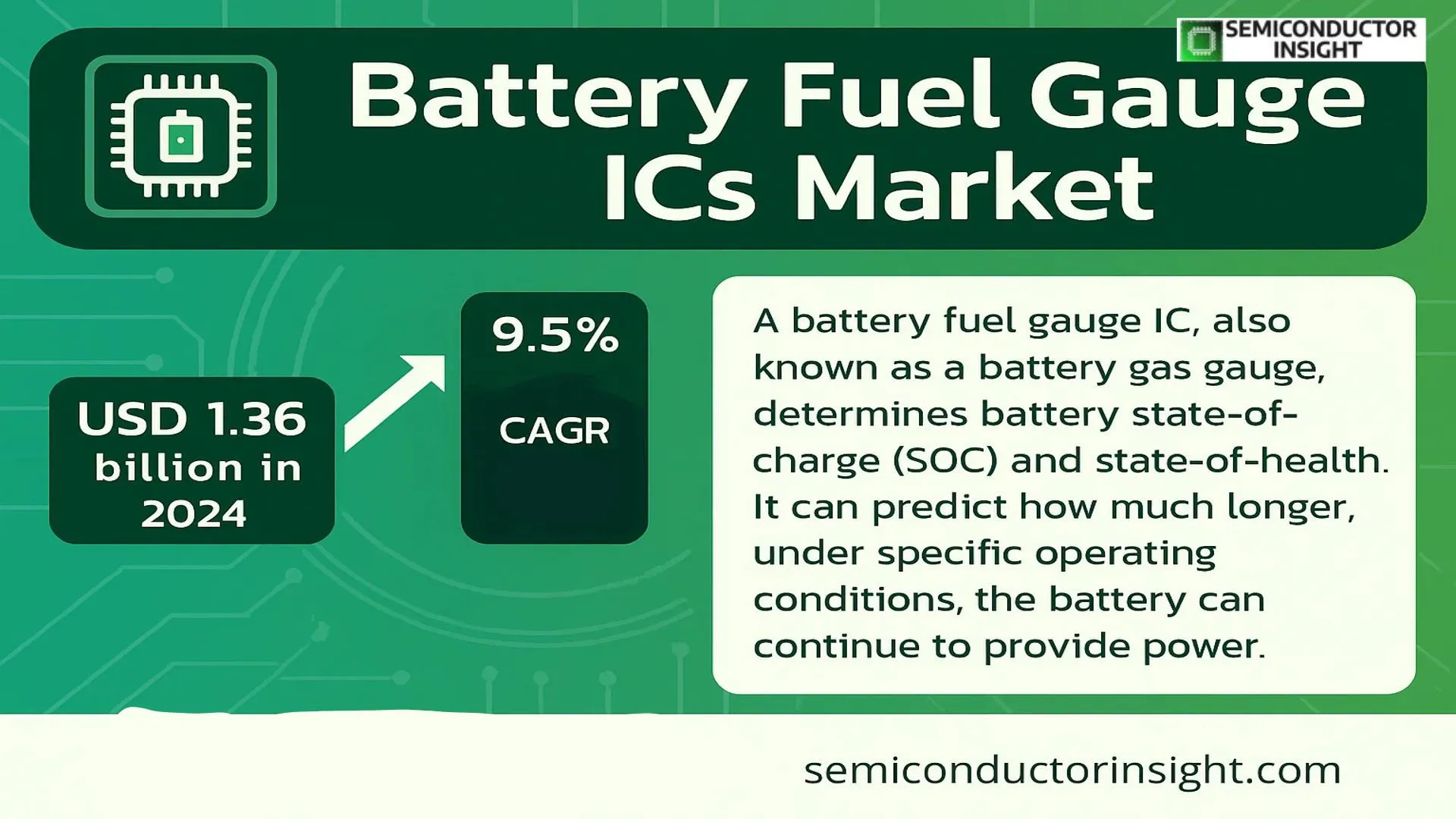
Global Battery Fuel Gauge ICs Market size was valued at USD 1.36 billion in 2024 and is projected to reach USD 2.54 billion by 2032, exhibiting a CAGR of 9.5% during the forecast period.
A battery fuel gauge IC, also known as a battery gas gauge, determines battery state-of-charge (SOC) and state-of-health. It can predict how much longer, under specific operating conditions, the battery can continue to provide power.
The market is experiencing steady growth due to several factors, including the proliferation of portable electronics, the growth of electric vehicles, and the increasing demand for energy storage solutions. The rising demand for battery safety and management in consumer electronics, electric vehicles, and industrial applications is a primary driver. Additionally, advancements in battery technology and the increasing integration of Internet of Things (IoT) devices are contributing to market expansion. The increasing adoption of electric vehicles and renewable energy storage systems is also expected to fuel the market growth. For instance, in February 2024, the Biden-Harris administration announced new standards and funding to modernize the national electric grid and accelerate the adoption of electric vehicles, which will increase the demand for battery management solutions.
MARKET DRIVERS
Proliferation of Battery-Powered Electronics
The global surge in demand for smartphones, laptops, tablets, and wearable devices is a primary driver for the Battery Fuel Gauge IC market. These chips are essential for providing accurate state-of-charge information, enhancing user experience and device reliability. The expansion of the Internet of Things (IoT), which relies heavily on battery-powered sensors and edge devices, further fuels the need for sophisticated battery monitoring solutions.
Advancements in Battery Technologies
The evolution of battery chemistries, particularly the widespread adoption of lithium-ion and lithium-polymer batteries, demands more accurate and intelligent fuel gauging. These advanced batteries have complex charge/discharge characteristics that require precise monitoring to prevent overcharging, deep discharging, and thermal runaway, thereby ensuring safety and maximizing battery lifespan.
➤ The adoption of electric vehicles (EVs) and the expansion of energy storage systems (ESS) represent significant growth vectors, demanding high-accuracy fuel gauges for battery management systems (BMS) to ensure operational safety and efficiency.
Furthermore, increasing consumer expectations for longer battery life and real-time battery status information are pushing manufacturers to integrate more advanced fuel gauge ICs into their products, making it a critical differentiator in competitive markets.
MARKET CHALLENGES
Accuracy and Calibration Complexities
Achieving high accuracy across diverse operating conditions, including varying temperatures and load currents, remains a significant technical hurdle. Fuel gauge ICs require sophisticated algorithms and initial calibration, which can increase development time and cost for original equipment manufacturers (OEMs).
Other Challenges
Integration with Diverse Battery Chemistries
The market must contend with supporting a wide range of battery types and chemistries beyond standard Li-ion, each with unique voltage profiles and aging characteristics, complicating the design of universal or highly accurate ICs.
Cost and Size Constraints
In highly price-sensitive consumer electronics segments, there is constant pressure to reduce the bill of materials (BOM). Integrating advanced fuel gauging functionality while maintaining a small footprint and low cost is a persistent challenge for IC suppliers.
MARKET RESTRAINTS
High Development and Certification Costs
The research and development required for creating highly accurate fuel gauge ICs, along with the costs associated with certification for safety standards (like UL, IEC), can be prohibitive for smaller players. This high barrier to entry limits the number of new competitors and can slow overall market innovation.
Reliance on Mature Consumer Electronics Markets
The market’s growth is somewhat tethered to the saturation and cyclical nature of key consumer electronics segments like smartphones. A slowdown in these core markets can directly impact the demand for Battery Fuel Gauge ICs, acting as a restraint on growth.
MARKET OPPORTUNITIES
Expansion into Electric Vehicles and Industrial Applications
The rapid global transition to electric mobility presents a massive opportunity. EVs require highly reliable and accurate battery management systems, where fuel gauge ICs are a critical component for monitoring battery health, range estimation, and safety, opening up a high-growth avenue.
Integration of AI and Machine Learning
The incorporation of artificial intelligence and machine learning algorithms into fuel gauge ICs allows for predictive analytics regarding battery life and performance degradation. This enables proactive maintenance and enhances battery utilization, creating value-added opportunities in premium consumer electronics and industrial IoT.
Growth in Renewable Energy Storage
The increasing deployment of residential and grid-scale energy storage systems for solar and wind power relies on large battery packs. This creates a strong demand for robust fuel gauge ICs that can accurately monitor the state of health and charge of these systems over long lifetimes, ensuring efficiency and reliability.
Battery Fuel Gauge ICs Market Trends
Robust Global Growth and Market Expansion
The global Battery Fuel Gauge ICs market is demonstrating significant and sustained growth, driven by the proliferation of portable electronic devices. The market, valued at $1,362 million in 2024, is projected to surge to $2,537 million by 2032, reflecting a healthy compound annual growth rate (CAGR) of 9.5%. These specialized integrated circuits, which precisely determine a battery’s state-of-charge (SOC) and state-of-health (SOH), are critical components for accurately predicting remaining battery life and enhancing user experience across numerous applications. This expansion is underpinned by increasing demand for power management efficiency in an increasingly connected and mobile world.
Other Trends
Dominance of Asia-Pacific Consumption Region
A key geographical trend is the overwhelming dominance of the Asia-Pacific region, which accounts for approximately 60% of the global market share. This concentration is a direct result of the region being a major hub for the manufacturing and consumption of consumer electronics. The market in Asia-Pacific is expected to witness stable growth in the coming years, fueled by continued production and rising disposable incomes. North America holds the position as the second-largest market with a 20% share, while Europe accounts for 10%.
Application Diversity Driving Volume
The application landscape for Battery Fuel Gauge ICs is diverse and expanding. The largest segment by application is Mobile Devices & Laptop PCs, but significant growth is also being observed in Wearables, Medical Devices, Power Tools, and the rapidly evolving Robots & Drone sector. This diversification underscores the technology’s critical role beyond traditional consumer electronics, moving into high-performance and safety-critical applications where accurate battery monitoring is paramount.
Consolidated Competitive Landscape
The market features a consolidated competitive landscape dominated by established semiconductor players. Key manufacturers such as Texas Instruments, STMicroelectronics, Maxim Integrated, Microchip Technology, and Analog Devices lead the industry. The top five companies collectively command over 17% of the global market, indicating a high level of competition centered on technological innovation, accuracy, and integration capabilities. This concentration necessitates continuous research and development from participants to maintain and grow their market positions amidst the expanding demand.
COMPETITIVE LANDSCAPE
Key Industry Players
A Dynamic Market Led by Established Semiconductor Giants and Specialized Innovators
The global Battery Fuel Gauge ICs market is characterized by a concentrated competitive environment dominated by a handful of major semiconductor corporations. Texas Instruments is widely recognized as a market leader, leveraging its extensive portfolio and strong R&D capabilities to maintain a significant market share. The top five companies, including STMicroelectronics, Maxim Integrated (now part of Analog Devices), Microchip Technology, and Analog Devices itself, collectively accounted for over 17% of the global market in 2024. These players compete intensely on the basis of accuracy, integration, power efficiency, and software algorithms for state-of-charge (SOC) and state-of-health (SOH) prediction across diverse applications from consumer electronics to industrial devices.
Beyond the dominant leaders, the market includes several other significant players that carve out substantial niches. Companies like Renesas Electronics and ON Semiconductor offer robust solutions for automotive and industrial segments. The competitive landscape is further populated by specialized firms such as Richtek Technology, which focuses on power management ICs, and CellWise, known for its battery management solutions, particularly in the Asian market. Chinese suppliers like SinoWealth are also gaining prominence, contributing to the competitive dynamics, especially within the Asia-Pacific region which consumes 60% of the global market.
List of Key Battery Fuel Gauge ICs Companies Profiled
- Texas Instruments
- STMicroelectronics
- ON Semiconductor
- Analog Devices
- Maxim Integrated
- Microchip Technology
- Renesas Electronics
- CellWise
- SinoWealth
- Richtek Technology
- NXP Semiconductors
- Infineon Technologies
- Qualcomm
- Dialog Semiconductor
- ROHM Semiconductor
Segment Analysis:
| Segment Category | Sub-Segments | Key Insights |
| By Type |
|
Single Battery fuel gauge ICs are the dominant technology, finding extensive application in a vast array of consumer electronics such as smartphones, laptops, and wearables where single-cell lithium-ion battery packs are the standard. Their widespread adoption is driven by relatively simpler system integration requirements and cost-effectiveness for high-volume production. In contrast, Multiple Battery ICs are critical for more power-intensive applications like power tools, electric vehicles, and energy storage systems, where they provide essential monitoring for series and parallel battery configurations to ensure safety and optimize performance across multiple cells. |
| By Application |
|
Mobile Devices & Laptop PCs constitute the largest application segment, fueled by the immense, continuous global demand for smartphones and portable computers that require highly accurate battery monitoring for user convenience and device longevity. The Wearables segment is experiencing particularly dynamic growth, driven by innovations in health and fitness trackers and smartwatches that demand compact, low-power gauge ICs. High-reliability requirements characterize the Medical Devices segment for portable equipment, while the Robots & Drone segment demands robust gauges capable of handling high discharge rates and harsh operating conditions, representing a key area for technological advancement. |
| By End User |
|
Consumer Electronics remains the largest end-user segment, driven by the pervasive use of portable electronic devices across global populations and continuous product innovation cycles. The Industrial & Automotive segment is a critical growth area, with increasing adoption in industrial automation, electric vehicle power management systems, and grid storage solutions, where accurate fuel gauging is essential for operational safety and efficiency. The Healthcare segment demands the highest levels of accuracy and reliability for portable medical devices, with stringent regulatory requirements influencing product development and creating a specialized, high-value niche within the market. |
| By Technology |
|
Model Gauge technology is increasingly becoming the preferred choice for new designs, as it combines the strengths of coulomb counting and voltage-based methods with advanced algorithms to provide high accuracy across a wide range of operating conditions and over the battery’s entire lifespan. Coulomb Counting remains a widely implemented, cost-effective method prized for its straightforward implementation, though it can be susceptible to accumulating errors over time. Voltage-Based or Impedance Track technologies are valued in applications where simplicity and low cost are paramount, but they generally offer lower accuracy compared to more advanced algorithmic solutions, making them suitable for less demanding use cases. |
| By Accuracy Level |
|
High-Accuracy fuel gauge ICs are the leading segment in terms of technological value and growth potential, driven by demand from premium consumer electronics, medical devices, and electric vehicles where precise state-of-charge information is critical for performance and safety. Standard-Accuracy ICs represent the volume mainstream of the market, balancing performance with cost for a broad range of applications such as mid-tier smartphones and power tools. Basic Monitoring ICs serve cost-sensitive markets and simpler applications where an approximate battery level indication is sufficient, but this segment faces pressure as higher accuracy technologies become more cost-effective over time. |
Regional Analysis: Battery Fuel Gauge ICs Market
Asia-Pacific
The concentration of the world’s leading consumer electronics brands and their vast supply chains in the Asia-Pacific region creates a foundational demand for battery fuel gauge ICs. This market is characterized by intense competition and a relentless drive for longer battery life and faster charging, pushing continuous innovation in IC accuracy and features, directly benefiting from proximity to manufacturers.
The explosive growth of the electric vehicle and light electric vehicle markets, particularly in China and India, is a major growth vector. Battery fuel gauge ICs are essential for Battery Management Systems (BMS) to ensure safety, performance, and longevity. This sector demands high-precision, high-reliability ICs capable of managing large battery packs under diverse conditions.
The region is home to some of the world’s most advanced semiconductor fabrication plants and R&D centers. This fosters a collaborative environment where fuel gauge IC developers can work closely with battery cell manufacturers and system integrators to create optimized, application-specific solutions, accelerating the adoption of new technologies like impedance tracking.
Supportive government policies across many Asia-Pacific nations promoting electronics manufacturing, renewable energy adoption, and electric mobility are significant tailwinds. Initiatives aimed at building domestic semiconductor self-sufficiency further incentivize local development and production of critical components like fuel gauge ICs, securing the region’s long-term leadership.
North America
North America remains a critical and technologically advanced market for Battery Fuel Gauge ICs, characterized by high-value applications and stringent performance requirements. The region is a leader in premium consumer electronics, particularly high-end laptops, smartphones, and a burgeoning wearables sector, where accurate battery life indication is a key differentiator. The automotive sector is a major driver, with North American automakers rapidly accelerating their electric vehicle portfolios, demanding sophisticated BMS solutions where fuel gauge ICs play a central role. Furthermore, the region’s strong industrial and medical equipment sectors require robust and highly reliable battery monitoring for portable and backup power systems. The presence of leading semiconductor companies and a culture of innovation fosters the development of next-generation ICs with advanced features like cloud connectivity and predictive analytics.
Europe
The European market for Battery Fuel Gauge ICs is defined by its strong automotive industry and high standards for quality and environmental regulations. The aggressive transition to electric vehicles mandated by EU policies is creating substantial demand for advanced battery management technologies. European automotive OEMs prioritize safety and accuracy, pushing for the highest-grade fuel gauge ICs. Beyond automotive, the region has a robust market for industrial tools, portable medical devices, and smart home appliances, all requiring dependable battery state-of-charge monitoring. The regulatory environment, including strict energy efficiency standards (like Ecodesign directives), compels manufacturers to integrate precise power management components to minimize energy waste and extend product lifecycles.
South America
The South American market for Battery Fuel Gauge ICs is an emerging one, with growth primarily fueled by the increasing adoption of consumer electronics and the beginnings of electric mobility. The market is price-sensitive, creating demand for cost-optimized fuel gauge solutions, though there is a growing appreciation for quality and reliability. The region’s nascent renewable energy storage market also presents a future growth opportunity for battery monitoring ICs used in residential and small commercial battery systems. While the industrial base is less developed than in other regions, local manufacturing incentives in countries like Brazil are encouraging the assembly of electronics, which could gradually increase the integration of components like fuel gauge ICs into the regional supply chain.
Middle East & Africa
The Middle East & Africa region represents a diverse market with varying levels of adoption. The Middle East, particularly the Gulf Cooperation Council (GCC) countries, shows demand driven by high disposable income and a strong appetite for the latest consumer electronics and luxury vehicles, including EVs. There is also significant potential in the region’s growing investments in renewable energy and grid storage projects, which require battery monitoring. In Africa, the market is more nascent, with growth tied to the expanding mobile phone penetration and the development of off-grid solar power solutions, where simple yet reliable battery fuel gauge functionality is crucial for user experience and system management.
Report Scope
This market research report provides a comprehensive analysis of the Battery Fuel Gauge ICs Market , covering the forecast period 2025–2032. It offers detailed insights into market dynamics, technological advancements, competitive landscape, and key trends shaping the industry.
Key focus areas of the report include:
- Market Overview: The report begins with an overview outlining its current market scenario, key growth indicators, and industry transformation drivers. It discusses macroeconomic factors, demand–supply balance, regulatory landscape, and the strategic role of semiconductors in powering advancements across industries such as automotive, telecommunications, consumer electronics, and industrial automation.
- Market Size & Forecast: Historical data and future projections for revenue, unit shipments, and market value across major regions and segments.
- Segmentation Analysis: Detailed breakdown by product type, technology, application, and end-user industry to identify high-growth segments and investment opportunities.
- Regional Insights: Insights into market performance across North America, Europe, Asia-Pacific, Latin America, and the Middle East & Africa, including country-level analysis where relevant.
- Competitive Landscape: Profiles of leading market participants, including their product offerings, R&D focus, manufacturing capacity, pricing strategies, and recent developments such as mergers, acquisitions, and partnerships.
- Technology Trends & Innovation: Assessment of emerging technologies, integration of AI/IoT, semiconductor design trends, fabrication techniques, and evolving industry standards.
- Market Drivers & Restraints: Evaluation of factors driving market growth along with challenges, supply chain constraints, regulatory issues, and market-entry barriers.
- Stakeholder Insights: Insights for component suppliers, OEMs, system integrators, investors, and policymakers regarding the evolving ecosystem and strategic opportunities.
Primary and secondary research methods are employed, including interviews with industry experts, data from verified sources, and real-time market intelligence to ensure the accuracy and reliability of the insights presented.
FREQUENTLY ASKED QUESTIONS:
What is the current market size of Battery Fuel Gauge ICs Market?
-> Global Battery Fuel Gauge ICs Market was valued at USD 1362 million in 2024 and is projected to reach USD 2537 million by 2032, exhibiting a CAGR of 9.5% during the forecast period.
Which key companies operate in Battery Fuel Gauge ICs Market?
-> Key players include Texas Instruments, STMicroelectronics, Maxim Integrated, Microchip Technology, Analog Devices, ON Semiconductor, Renesas Electronics, CellWise, SinoWealth, and Richtek Technology, among others. The top five companies accounted for more than 17% of the global market share in 2024.
What are the key growth drivers?
-> Key growth drivers include increasing demand for accurate battery state-of-charge and state-of-health monitoring in portable electronics, the proliferation of battery-powered devices, and advancements in power management technologies.
Which region dominates the market?
-> Asia-Pacific is the largest market, accounting for 60% of the global share, followed by North America (20%) and Europe (10%).
What are the emerging trends?
-> Emerging trends include the integration of fuel gauge ICs in wearables, medical devices, power tools, and drones, alongside technological innovations for higher accuracy and multi-cell battery monitoring.

Get Sample Report PDF for Exclusive Insights
Report Sample Includes
- Table of Contents
- List of Tables & Figures
- Charts, Research Methodology, and more...
 Download Sample Report PDF